
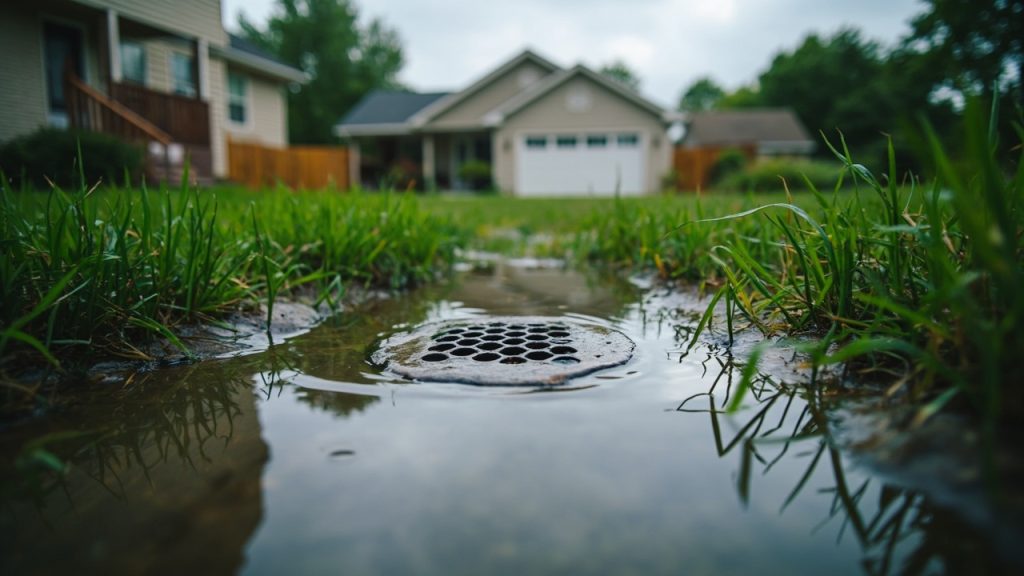
Your French drain was installed to protect your foundation, redirect groundwater, and keep your yard dry. When it starts failing, the system does not announce itself with a loud alarm. Instead, it sends quiet signals that most homeowners miss until the basement carpet is soaking wet or a wall crack runs floor to ceiling.
West Bloomfield sits on some of the heaviest clay soil in Oakland County. That soil, combined with Michigan’s freeze-thaw cycles and above-average spring rainfall, puts serious stress on exterior drainage systems. French drains here work harder than in most parts of the country, and they fail faster when they are not maintained.
This guide walks you through the seven signs that your system is compromised, explains the science behind each failure mode, and tells you when a diagnostic call is the right next step.
What a French Drain Actually Does (and Why Failure Is Gradual)
A French drain is a trench filled with gravel and a perforated PVC pipe wrapped in geotextile filter fabric. Its job is to intercept groundwater before it reaches your foundation wall, then channel it to a discharge point, a catch basin, or a sump pump system.
The geotextile fabric is the most critical component. It keeps fine soil particles out of the gravel bed and away from the perforated pipe slots. When that fabric clogs, or when the pipe crushes, or when the discharge point gets blocked, hydrostatic pressure builds against your foundation wall. That pressure does not stay outside. It pushes in through the cove joint, through hairline cracks, and through block mortar seams.
In Michigan, most French drains have a functional lifespan of 20 to 30 years. Systems installed near heavy clay concentrations, like those common in West Bloomfield, Commerce Township, and the Orchard Lake area, often start showing signs of degradation earlier than that, especially if the original installation used a non-woven fabric instead of a woven geotextile.
Sign 1: Standing Water and Soggy Spots in Your Yard After Rain
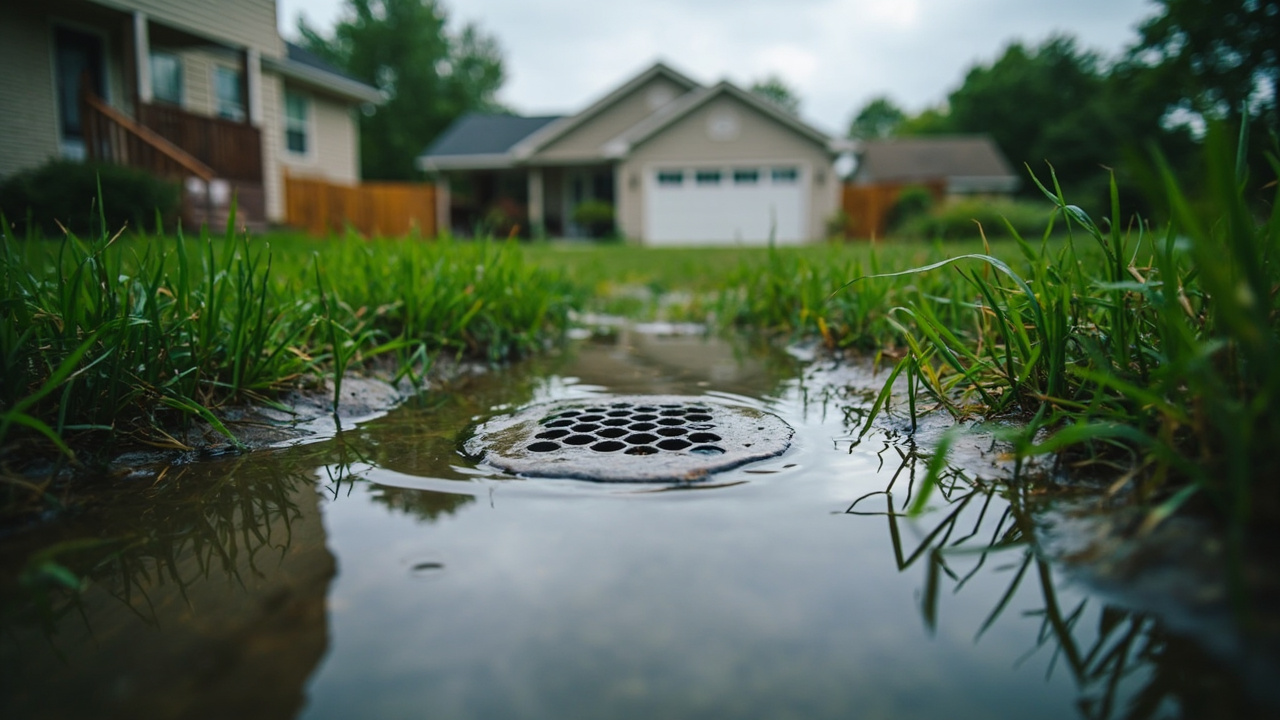
This is the most visible sign, and the one that brings most West Bloomfield homeowners to pick up the phone. After a standard rain event, you should not have standing water in your yard 24 to 48 hours later. If you do, your French drain is not moving water fast enough.
The typical cause is a saturated or silted gravel bed. Over time, fine clay particles migrate through or around the geotextile fabric and fill the void spaces in the gravel. The pipe can still be intact, but water cannot reach it through the packed clay-gravel mixture. The trench becomes a bathtub instead of a channel.
A crushed pipe is the other common culprit. Heavy vehicle traffic over the trench area, frost heave from freeze-thaw cycles, or tree root intrusion can collapse perforated PVC piping. When the pipe cross-section narrows, water backs up into the gravel bed and eventually surfaces as pooling in your lawn.
Pay close attention to where the water pools. Pooling directly above the trench line is a strong indicator of gravel saturation. Pooling at the far end of the yard, near the discharge point, often means a blocked outlet pipe or a clogged catch basin.
Sign 2: White Powdery Residue on Your Basement Walls
Efflorescence is the white, chalky deposit that forms when water moves through concrete or block foundation walls and evaporates on the surface, leaving mineral salts behind. It is not structurally dangerous on its own, but it is a reliable indicator that water is consistently passing through your foundation.
If your French drain were working correctly, groundwater would not reach the wall in the first place. Efflorescence means the exterior drainage system is no longer intercepting that water before it contacts your foundation. The longer this continues, the more those mineral salts erode the concrete surface, weaken mortar joints, and open pathways for larger water intrusion events.
Look for efflorescence along the base of your basement walls, especially near the cove joint where the wall meets the floor. That joint is the most common entry point for water under hydrostatic pressure. Staining here, combined with damp concrete or visible moisture, tells you the drain has been compromised for a while.
Sign 3: Elevated Basement Humidity and Musty Odors
Your nose is a diagnostic tool. A musty basement odor almost always traces back to elevated relative humidity and, in many cases, early-stage mold colonization on organic materials like wood framing, drywall paper, or stored cardboard.
When a French drain fails, water does not always pour in visibly. Often it seeps in slowly through porous concrete, raising the ambient moisture level in the basement air. That moisture creates ideal conditions for mold growth, which begins within 24 to 48 hours on wet organic materials, according to EPA mold guidelines.
If you are running a dehumidifier constantly just to keep basement humidity below 60 percent, and it was not always like that, your drainage system deserves a hard look. The dehumidifier is treating a symptom. The failing drain is the cause.
Mold remediation costs significantly more than French drain repair. If you are already dealing with basement mold, read about why bleach will not fix your basement mold problem before you try to address it yourself.
Sign 4: Foundation Cracks That Were Not There Before
This is the danger-zone sign. New or widening cracks in your foundation wall are a direct symptom of unmanaged hydrostatic pressure. When water saturates the soil around your foundation and has no drainage path, it pushes against the wall with increasing force.
Hydrostatic pressure is measured in pounds per square foot, and fully saturated clay soil exerts enormous lateral force. Poured concrete walls typically develop horizontal cracks when the middle of the wall bows inward under that pressure. Block foundation walls crack along mortar joints in a stair-step pattern.
Vertical cracks in poured concrete can also indicate differential settlement caused by erosion under the footing, which is another downstream effect of chronic drainage failure. Any crack wider than one-eighth of an inch, or any crack that is actively growing, warrants an immediate professional evaluation.
Once a foundation crack is present, you are no longer just dealing with a drainage problem. You are dealing with a structural problem and a water intrusion problem simultaneously. The repair cost at this stage is substantially higher than addressing the French drain failure early.

Sign 5: Your Sump Pump Is Running Constantly
A sump pump that runs every few minutes during or after rain is not performing well. It is struggling. In a properly functioning drainage system, the French drain intercepts groundwater before it reaches the sump pit. The pump serves as a secondary safeguard for high-volume events.
When the exterior French drain fails, all that groundwater bypasses the exterior system and finds its way to the sump pit through cove joint seepage and wall infiltration. The pump cycles constantly trying to keep up with what the drain should have handled before the water ever entered the house.
Constant cycling shortens pump motor life dramatically. It also signals that your system is one heavy rainstorm away from being overwhelmed. If your pump fails during a peak-load event and you have no functional exterior drain, basement flooding follows within hours.
Sign 6: Visible Erosion or Settled Soil Along the Drain Line
Walk the perimeter of your yard and look for depressions or channels running along the path of your French drain trench. Settled or sunken soil above the trench line means the gravel bed has compacted or the pipe has collapsed, causing the ground above to drop.
Erosion channels that run perpendicular to the drain, moving water away from the trench, indicate the drain is so overwhelmed that water is surfacing and finding its own path. You might see bare soil, exposed aggregate, or small gullies after rain events.
Check the discharge point, wherever your drain outlets to daylight, a catch basin, or a dry well. Blocked discharge pipes are one of the most common and easily overlooked failure modes. Leaves, sediment, rodent nesting, and even frost expansion can plug the outlet and cause the entire system to back up.
Sign 7: Water Stains at the Base of Finished Basement Walls
If you have a finished basement, water intrusion often hides behind drywall until the damage is significant. Look for brown staining at the base of walls, paint bubbling, warped baseboards, or a soft feel to the lower sections of drywall. These are signs that water has been wicking up through the slab or entering through the cove joint and soaking into finished materials.
By the time finished materials show visible damage, the moisture has usually been present long enough to initiate mold growth behind the wall. The finished surface creates a moisture trap that keeps conditions humid and dark, exactly what mold needs to establish colonies.
Water-damaged flooring often follows the same pattern. If your basement has hardwood or engineered wood flooring that is cupping, buckling, or discoloring near the perimeter walls, learn about how to evaluate hardwood floor damage after water exposure before deciding whether to repair or replace.
Why Detroit-Area Clay Soil Destroys French Drains Faster Than You Expect
Southeast Michigan sits on glacial lake bed deposits. The result is a dense, fine-grained clay soil that holds water like a sponge and drains slowly. In West Bloomfield, Bloomfield Hills, and much of the northern Oakland County corridor, you are dealing with soil that has almost zero percolation rate in saturated conditions.
This matters for French drains because the geotextile filter fabric, which is designed to let water pass while blocking soil particles, gets challenged relentlessly in clay environments. Clay particles are extremely fine, often smaller than the fabric pores in non-woven geotextile. Over time, those particles accumulate on the fabric surface and inside the fabric matrix, reducing permeability to near zero. This process is called silting, or biofouling when organic matter is involved.
Freeze-thaw cycles compound the problem. Michigan averages dozens of freeze-thaw cycles each winter. Every time saturated soil freezes, it expands. Every time it thaws, it contracts. That movement shifts gravel, pinches pipes, and disrupts the geotextile fabric’s position relative to the pipe. Over several years, even a well-installed system experiences cumulative mechanical damage from this cycle alone.
According to Michigan’s Department of Environment, Great Lakes, and Energy (EGLE), southeast Michigan’s average annual precipitation creates drainage demands that consistently test residential systems. High-intensity storms have become more common, and systems installed under older design assumptions often cannot handle current peak flow rates.

French Drain Failure vs. Other Drainage Problems
| Symptom | Likely Cause | Urgency Level | Typical Next Step |
|---|---|---|---|
| Standing water 48+ hours after rain | Silted gravel bed or crushed pipe | Moderate | Camera inspection of drain line |
| Efflorescence on basement walls | Chronic groundwater infiltration | Moderate | Exterior drain and wall assessment |
| Horizontal foundation wall crack | Hydrostatic pressure from failed drainage | High | Structural and drainage evaluation |
| Sump pump running every 5 minutes | Exterior drain not intercepting groundwater | High | Drain inspection and pump audit |
| Musty basement odor | Elevated humidity from seepage | Moderate to High | Moisture mapping and mold inspection |
| Settled soil above drain trench | Pipe collapse or gravel compaction | Moderate | Excavation and system inspection |
| Blocked discharge outlet | Debris, frost, or root intrusion | Moderate | Outlet clearing and flow test |
Repair vs. Replace: What Your French Drain Actually Needs
Not every failing French drain needs a full replacement. The right answer depends on where the failure is and how long it has been occurring.
| Failure Type | Repair Option | Replacement Likely Needed? | Estimated Scope |
|---|---|---|---|
| Blocked discharge pipe | Hydro-jetting or manual clearing | No | Hours, minimal excavation |
| Silted geotextile fabric (partial) | Partial re-excavation and fabric replacement | Partial | Days, section-by-section |
| Crushed PVC pipe (single section) | Section replacement | Partial | 1 to 2 days |
| Full gravel bed saturation | Complete system replacement | Yes | Multiple days, full perimeter |
| Root intrusion throughout system | Pipe replacement and root barrier | Yes | Full excavation required |
| Undersized system for current load | System upgrade with larger pipe diameter | Yes | Design and full reinstall |
How to Do a Basic Self-Inspection Before Calling a Pro
You can gather useful information before a professional visits. Here is a simple sequence to follow after the next significant rain event.
- Walk the full path of your French drain trench and mark any areas where water is surfacing or the ground is unusually soft.
- Find your discharge outlet, typically a pipe opening at a low point in your yard, near a downslope, or at a storm drain connection. Check whether water is flowing from it during or after rain. If it is dry when the yard is wet, the system is backed up.
- Check your catch basin lid for debris accumulation. Lift it carefully and look for standing water that is not draining within a few hours.
- Go into your basement and look along the base of every exterior wall for moisture, staining, or efflorescence.
- Check your sump pit and note how frequently the pump is cycling. More than once every 30 minutes during moderate rain is a warning sign.
- Look for any new cracks in block or poured concrete walls, especially horizontal runs or stair-step patterns.
Document everything with your phone camera. Photos with time stamps are useful for both a contractor evaluation and any insurance claim process. If your drainage failure has already led to basement water damage, understanding how to approach your insurer matters. Read about how to get your Detroit home insurance to actually pay for water restoration before you file anything.
When a Water Damage Restoration Assessment Belongs in the Process
A drainage contractor can fix your French drain. But if water has already entered your home, a separate assessment of the interior damage is essential. Water damage restoration and drainage repair are two different scopes of work, and failing to address both means the repair is incomplete.
IICRC Standards (the S500 Standard for Professional Water Damage Restoration) define how moisture mapping, material classification, and drying protocols should be performed after water intrusion events. A restoration professional applies those protocols to determine what is salvageable and what needs removal before mold becomes the next problem.
If your basement has wet carpet from a drainage failure event, the clock on salvageability starts immediately. Read about deciding whether wet carpet can be saved or needs to go to understand what the 24-hour window actually means for your materials.
For West Bloomfield homeowners who have already filed or are considering filing a claim for drainage-related damage, the documentation process is critical. A detailed write-up on filing a successful water damage insurance claim covers what adjusters look for and how to avoid common denial triggers.
Getting a Free Foundation Drainage Inspection in Metro Detroit
If you recognized two or more of the signs above while reading this, your French drain deserves a professional look. The cost of a diagnostic inspection is a fraction of the cost of foundation crack repair, mold remediation, or a full basement rebuild after a major flood event.
Our team serves West Bloomfield, Bloomfield Hills, Orchard Lake, Commerce Township, Walled Lake, and the broader Metro Detroit area. We carry IICRC certification and work with homeowners to identify both the drainage failure and any existing interior moisture damage so you get a complete picture, not just half an answer.
Call us today to schedule your free foundation drainage inspection. Get the diagnosis before the next heavy rain makes the decision for you.
{
“@context”: “https://schema.org”,
“@type”: “BlogPosting”,
“headline”: “7 Warning Signs Your West Bloomfield French Drain Is Failing and Flooding Your Yard”,
“description”: “Learn the key signs your West Bloomfield French drain is failing before yard flooding becomes a foundation crisis. Detroit water damage experts explain what to look for.”,
“wordCount”: 2561,
“datePublished”: “2026-07-07T07:12:00.000Z”,
“dateModified”: “2026-07-07T07:12:00.000Z”,
“inLanguage”: “en-US”,
“mainEntityOfPage”: {
“@type”: “WebPage”,
“@id”: “https://ironwoodwaterdamagerestorationdetroit.com”
},
“publisher”: {
“@type”: “LocalBusiness”,
“name”: “Ironwood Water Damage Restoration Detroit”,
“url”: “https://ironwoodwaterdamagerestorationdetroit.com”
},
“author”: {
“@type”: “Organization”,
“name”: “Ironwood Water Damage Restoration Detroit”,
“url”: “https://ironwoodwaterdamagerestorationdetroit.com”
},
“image”: {
“@type”: “ImageObject”,
“url”: “https://ironwoodwaterdamagerestorationdetroit.com/wp-content/uploads/2026/03/signs-your-west-bloomfield-french-drain-is-actuall-1.jpg”
}
}
{
“@context”: “https://schema.org”,
“@type”: “LocalBusiness”,
“name”: “Ironwood Water Damage Restoration Detroit”,
“url”: “https://ironwoodwaterdamagerestorationdetroit.com”,
“address”: {
“@type”: “PostalAddress”,
“addressLocality”: “Detroit”
},
“areaServed”: {
“@type”: “City”,
“name”: “Detroit”
}
}
{
“@context”: “https://schema.org”,
“@type”: “BreadcrumbList”,
“itemListElement”: [
{
“@type”: “ListItem”,
“position”: 1,
“name”: “Home”,
“item”: “https://ironwoodwaterdamagerestorationdetroit.com”
},
{
“@type”: “ListItem”,
“position”: 2,
“name”: “Blog”,
“item”: “https://ironwoodwaterdamagerestorationdetroit.com/blog”
},
{
“@type”: “ListItem”,
“position”: 3,
“name”: “7 Warning Signs Your West Bloomfield French Drain Is Failing and Flooding Your Yard”
}
]
}
{
“@context”: “https://schema.org”,
“@type”: “Service”,
“serviceType”: “Water Damage Restoration”,
“provider”: {
“@type”: “LocalBusiness”,
“name”: “Ironwood Water Damage Restoration Detroit”,
“url”: “https://ironwoodwaterdamagerestorationdetroit.com”
},
“areaServed”: {
“@type”: “City”,
“name”: “Detroit”
},
“description”: “Learn the key signs your West Bloomfield French drain is failing before yard flooding becomes a foundation crisis. Detroit water damage experts explain what to look for.”
}