
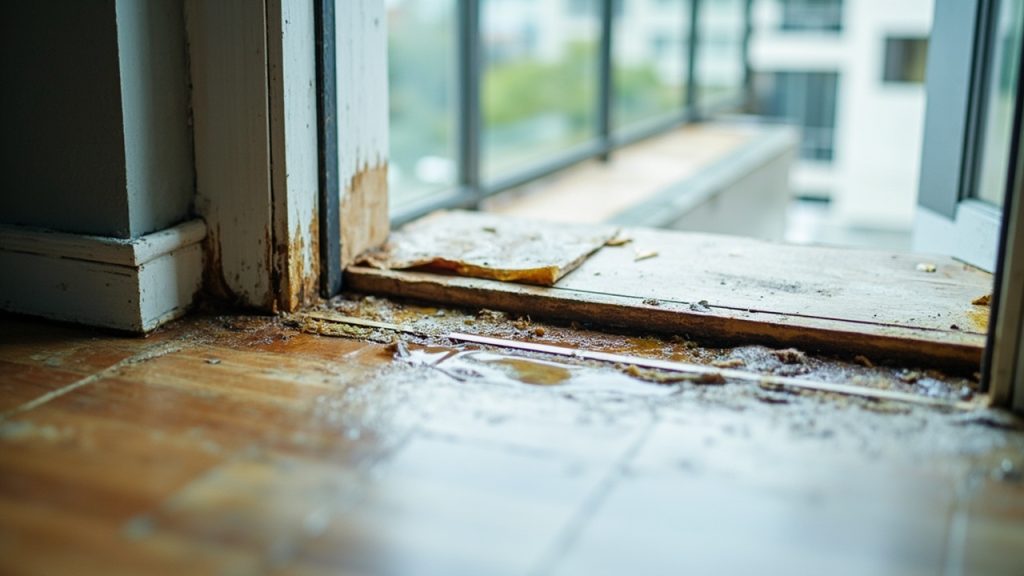
A wet spot on your floor near the sliding door is easy to dismiss as a one-time thing. It is not. In Downtown Detroit condos and Rivertown high-rises, a balcony door threshold leak is one of the most destructive sources of water intrusion a unit owner can face. The damage hides inside your wall assembly, rusts embedded rebar, and feeds mold colonies long before you see any visible sign of a problem.
This guide breaks down exactly why these leaks happen in Detroit’s specific climate, who is responsible for fixing them, and what happens to your building when the problem goes unaddressed.
Why Detroit’s Climate Makes Balcony Threshold Leaks So Common
Detroit sits squarely in the Great Lakes climate zone. That means your building faces some of the most punishing freeze-thaw cycling of any urban market in the Midwest. Temperatures in Metro Detroit regularly swing from well below freezing overnight to above 40°F by afternoon during winter and early spring. That cycling is the number one enemy of balcony waterproofing systems.
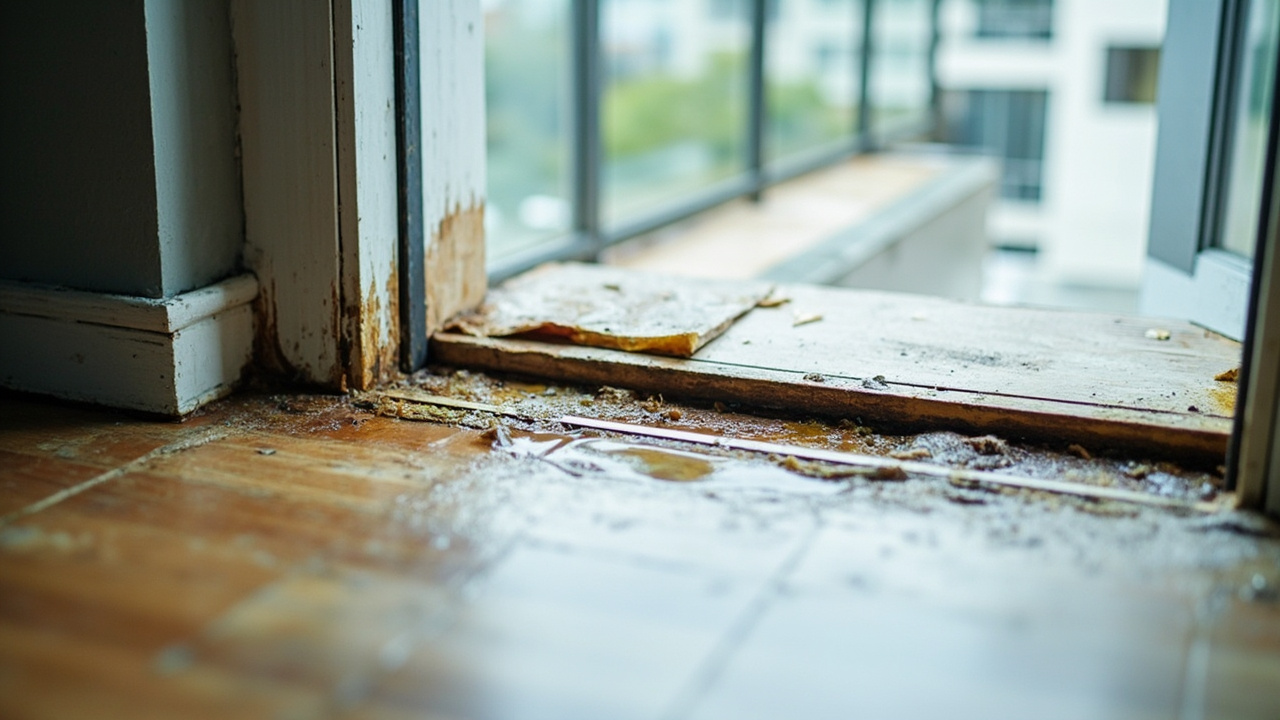
Here is what happens at a concrete balcony slab over a typical Detroit winter. Water seeps into hairline cracks in the deck surface. It freezes, expands, and widens those cracks. When it thaws, more water enters. Repeat that process 30 to 50 times per season and you have a seriously compromised surface. The waterproofing membrane beneath the deck tile or coating starts to fail at its seams and at the door threshold flashing, which is the metal or rubberized strip that bridges the gap between the sliding door frame and the balcony deck.
Snow accumulation on uncovered balconies in Midtown lofts and the newer towers along the Detroit Riverfront compounds the problem. As snow piles against the door frame and melts, it creates sustained hydrostatic pressure right at the threshold seal. Most residential threshold seals are not designed to handle standing water for hours at a time. They channel water away. They do not hold it back.
Clogged weep holes in the door frame track make this worse. Weep holes are small drainage channels built into the bottom rail of your sliding door system. When they pack with dirt, debris, or ice, water has nowhere to go and it forces its way past the threshold into your unit.
Signs You Are Already Dealing With Threshold Leak Damage
- Staining, buckling, or soft spots in flooring within three feet of the balcony door
- Efflorescence on the balcony slab face (white chalky mineral deposits that signal water movement through concrete)
- Musty odor near the exterior wall, especially after rain or snow melt
- Visible rust streaks on the balcony soffit below your unit, which indicates rebar oxidation inside the slab
- Paint bubbling or drywall discoloration on the interior wall adjacent to the door frame
- Condensation inside the door track that does not dry out within a few hours
If you are seeing two or more of these signs, the water has already moved beyond the threshold. You are dealing with moisture inside the building envelope, and that requires professional moisture mapping, not a tube of caulk from the hardware store.
The Liability Question That Most Condo Owners Get Wrong
The single biggest source of frustration after a condo balcony leak is figuring out who pays for it. The answer depends almost entirely on your building’s Master Deed and the Michigan Condominium Act (Public Act 59 of 1978), which governs how condominium property is defined and maintained throughout Wayne County and the broader state.
Under the Michigan Condominium Act, property is divided into three categories. General Common Elements are shared by all owners. Limited Common Elements are assigned to individual units but are technically common property. Unit interiors are the sole responsibility of the individual owner. Balconies in most Detroit condo buildings fall under the Limited Common Elements category.
| Component | Typical Classification | Who Is Usually Responsible |
|---|---|---|
| Balcony structural slab | General Common Element | HOA / Condo Association |
| Balcony waterproofing membrane | General Common Element | HOA / Condo Association |
| Door threshold seal and flashing | Varies by Master Deed | Check your specific Master Deed |
| Sliding door frame and hardware | Often Limited Common Element | Unit Owner in many buildings |
| Interior flooring and drywall damage | Unit Interior | Unit Owner (may involve HOA insurance) |
| Balcony drain and weep holes | General Common Element | HOA / Condo Association |
The door threshold and its associated flashing sit in a gray zone. Some Master Deeds in older Corktown conversions and Downtown loft buildings define the threshold as part of the unit’s exterior wall, making the owner responsible. Others classify it as part of the building envelope, putting it on the HOA. You need to pull your Master Deed and read the definitions section before you assume either way.
Document everything before you call your property management company. Take photos, note dates, and put your complaint in writing. If the HOA is responsible and delays repairs that cause damage to your unit interior, you have a stronger legal position if you have a documented paper trail. Understanding how to file correctly can also affect your insurance recovery. Our guide on filing a successful water damage insurance claim for your Corktown home walks through the documentation process in detail.
What Happens Inside Your Building When the Leak Goes Untreated
A threshold leak that gets patched with caulk and ignored at the structural level does not go away. It migrates. Water follows the path of least resistance through the building assembly, and in a concrete high-rise, that path runs in directions you cannot see without thermal imaging equipment.

Concrete Spalling and Rebar Corrosion
This is the structural consequence that property managers in Rivertown and the downtown corridor are most concerned about. When water penetrates the balcony slab and reaches the embedded steel reinforcement, the rebar begins to oxidize. Rust expands at roughly three times the volume of the original steel. That expansion exerts enormous outward pressure on the surrounding concrete, causing it to crack and flake off in chunks. That process is concrete spalling.
Spalling on a balcony soffit is a safety issue, not just a cosmetic one. Chunks of concrete falling from a fourth-floor balcony are a serious liability. Buildings in Detroit’s Downtown and Midtown districts that were constructed in the mid-twentieth century are especially vulnerable because the concrete cover over the rebar was often thinner than current standards require.
Mold Growth Inside the Wall Assembly
The interior framing and insulation around a balcony door in a condo unit creates a perfect environment for mold when moisture gets in. The cavity is enclosed, it has organic material like wood framing or paper-faced insulation, and it rarely dries out on its own once saturated. Mold colonies can establish within 48 to 72 hours of a significant water intrusion event.
Many condo owners in Detroit assume that if they cannot see mold on the wall surface, it is not there. Thermal imaging tells a different story. A FLIR thermal camera shows temperature differentials that reveal wet cavities inside walls. Wet insulation holds a slightly different thermal signature than dry insulation, and trained technicians can map the full extent of moisture migration without opening a single wall. That data drives the remediation scope and prevents incomplete repairs.
If mold is already present, surface cleaning is not enough. The reason bleach does not fix mold problems applies just as much in a high-rise condo wall cavity as it does in a basement.
The Professional Restoration Process for a Balcony Threshold Leak
Restoring a condo unit after a balcony door threshold leak is a multi-phase process. Each phase has a specific purpose, and skipping steps creates callbacks and callbacks mean more damage and more cost.
| Phase | What Happens | Typical Timeframe |
|---|---|---|
| 1. Thermal Imaging Assessment | FLIR camera mapping of moisture extent behind walls and under floors | 2 to 4 hours on-site |
| 2. Moisture Mapping | Pin and pinless moisture meters establish baseline readings at all affected surfaces | Same day as assessment |
| 3. Controlled Demolition | Removal of wet flooring, baseboard, drywall sections as indicated by moisture data | 1 to 2 days |
| 4. Structural Drying | Commercial desiccant dehumidifiers and air movers run continuously; readings checked daily | 3 to 7 days depending on saturation level |
| 5. Mold Remediation (if present) | Antimicrobial treatment, HEPA air scrubbing, containment barriers | 1 to 3 days |
| 6. Source Repair Coordination | Threshold flashing replacement, membrane repair, or full balcony waterproofing | Varies by scope (HOA coordination often required) |
| 7. Reconstruction | New drywall, insulation, flooring reinstallation | 3 to 10 days |
Source repair is the step that gets skipped most often in condo situations. Interior restoration gets completed, the unit looks fine, and then the threshold continues to leak through the next rain event. Coordinating the structural or membrane repair with the HOA while doing the interior restoration work is the only way to close the loop permanently.
For high-rise exterior work, OSHA standards for elevated work surfaces apply. Any contractor accessing the exterior of a building above certain heights needs proper fall protection equipment and, depending on the scope, swing-stage rigging. Make sure anyone you hire carries a Certificate of Insurance that covers this type of work. Uninsured high-rise exterior contractors are a liability exposure for you and your building association.
Emergency Steps to Take Before the Restoration Crew Arrives
If you are dealing with an active leak right now, these steps reduce the damage while you wait for professional help. Do not skip them. Every hour of uncontrolled water contact extends the drying time and the restoration cost.
- Identify the water path. Look at where water is pooling inside and trace it back to the threshold. Do not assume you know the source without checking the door track, the threshold plate, and the base of the door frame on both sides.
- Clear the door track. If the track weep holes are blocked with debris or ice, carefully clear them. This alone sometimes stops the immediate inflow.
- Place absorbent towels at the threshold and change them frequently. Do not let standing water sit against the baseboard or drywall.
- Move rugs, furniture, and electronics away from the affected area. Furniture left in contact with wet flooring can cause secondary staining and create additional moisture sources.
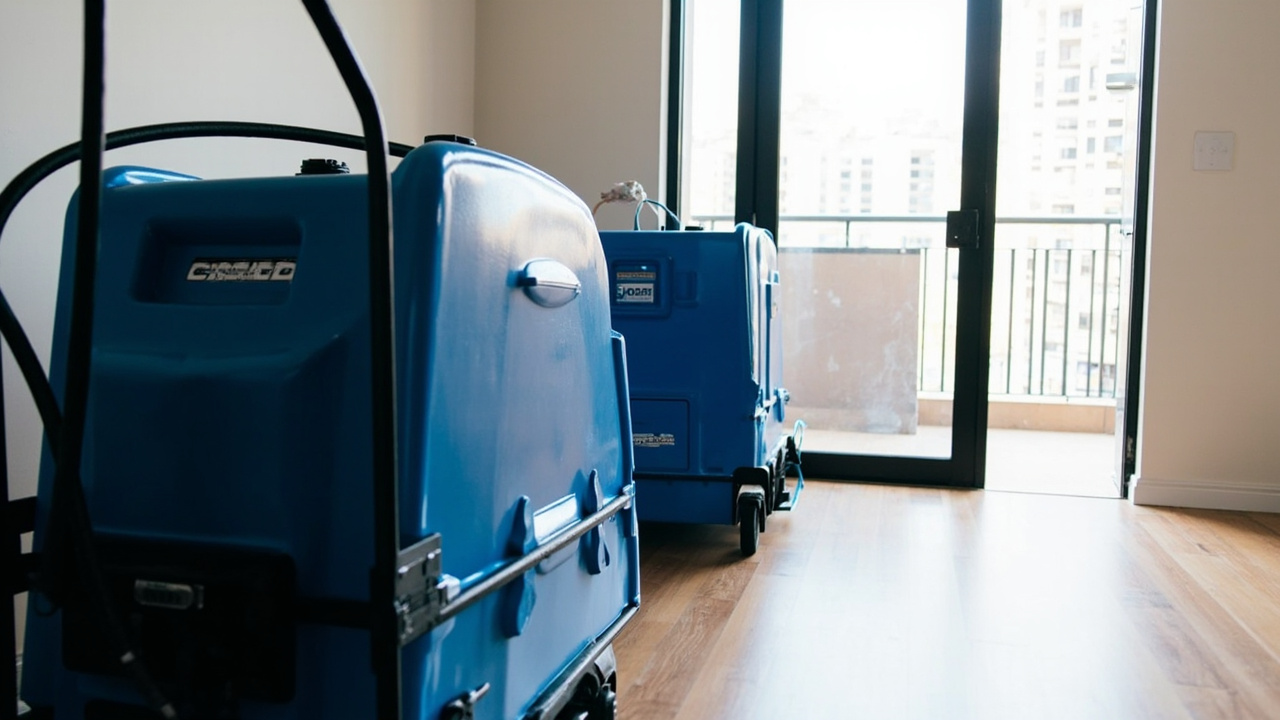
- Do not use a standard household fan to dry the area. Fans without dehumidification just move moisture-laden air around and can spread it to adjacent rooms. Commercial drying equipment works because it removes moisture from the air while moving it.
- Take photos and video of everything before you clean anything up. Your insurance claim starts right now, and documentation is what separates a paid claim from a disputed one.
- Notify your building’s property management company in writing, even if it is a text message. Timestamp matters.
If water damage has reached your flooring, the materials matter. Hardwood floors have a narrow window for successful drying before warping becomes permanent. The process for saving hardwood floors after a water leak is time-sensitive and requires the right equipment from the start.
Navigating Your Insurance Claim as a Condo Owner
Most condo owners carry an HO-6 policy, which covers the interior of your unit. The building association carries a master policy that covers the structure and common elements. When a threshold leak damages your unit interior, your HO-6 policy is the starting point for your claim.
The complication comes when the source of the leak is a common element or another unit’s negligence. In those cases, subrogation becomes relevant. Your insurer may pay your claim and then pursue the HOA’s master policy for reimbursement. This process is your insurer’s problem, not yours, as long as you document the source of the leak properly from day one.
Getting your insurer to actually pay out on a water damage claim requires knowing how to present the evidence. The full breakdown of how to get your Detroit home insurance to pay for water restoration covers what adjusters look for and what documentation you need to support your claim.
Choosing a Restoration Company That Understands Condo Work
Not every water damage restoration company has experience working in multi-unit buildings. Condo restoration involves coordination with property management, access restrictions, work hour limitations in occupied buildings, and liability questions that do not exist in a single-family home job.
Look for a company with IICRC certification, specifically the Water Damage Restoration Technician (WRT) credential and Applied Structural Drying (ASD) certification. These are the industry benchmarks set by the Institute of Inspection, Cleaning and Restoration Certification that indicate a technician understands drying science, not just water removal.
Ask specifically whether the company has worked on high-rise buildings in Detroit. Working in a Midtown loft conversion is different from working in a 25-story Riverfront tower. Equipment staging, waste removal, and coordination with building management are all different. A company that has done this work in Wayne County will know the local process. One that has not will learn it on your job.
Balcony door threshold leaks in Downtown Detroit condos are not a small problem. They sit at the intersection of climate, structural engineering, insurance law, and building policy. Treating them as a caulk job is how a manageable repair becomes a six-figure structural issue. Get a professional assessment, understand who is responsible, and fix the source before you restore the interior. That sequence is what protects your investment and your unit long-term.
{
“@context”: “https://schema.org”,
“@type”: “BlogPosting”,
“headline”: “What Every Downtown Detroit Condo Owner Should Know About Balcony Door Threshold Leaks”,
“description”: “Balcony door threshold leaks in Detroit condos cause hidden structural damage. Learn the causes, liability rules, and restoration steps that actually work.”,
“wordCount”: 2211,
“datePublished”: “2026-04-27T07:42:00.000Z”,
“dateModified”: “2026-04-27T07:42:00.000Z”,
“inLanguage”: “en-US”,
“mainEntityOfPage”: {
“@type”: “WebPage”,
“@id”: “https://ironwoodwaterdamagerestorationdetroit.com”
},
“publisher”: {
“@type”: “LocalBusiness”,
“name”: “Ironwood Water Damage Restoration Detroit”,
“url”: “https://ironwoodwaterdamagerestorationdetroit.com”
},
“author”: {
“@type”: “Organization”,
“name”: “Ironwood Water Damage Restoration Detroit”,
“url”: “https://ironwoodwaterdamagerestorationdetroit.com”
},
“image”: {
“@type”: “ImageObject”,
“url”: “https://ironwoodwaterdamagerestorationdetroit.com/wp-content/uploads/2026/03/managing-balcony-door-threshold-leaks-in-your-down-1.jpg”
}
}
{
“@context”: “https://schema.org”,
“@type”: “LocalBusiness”,
“name”: “Ironwood Water Damage Restoration Detroit”,
“url”: “https://ironwoodwaterdamagerestorationdetroit.com”,
“address”: {
“@type”: “PostalAddress”,
“addressLocality”: “Detroit”
},
“areaServed”: {
“@type”: “City”,
“name”: “Detroit”
}
}
{
“@context”: “https://schema.org”,
“@type”: “BreadcrumbList”,
“itemListElement”: [
{
“@type”: “ListItem”,
“position”: 1,
“name”: “Home”,
“item”: “https://ironwoodwaterdamagerestorationdetroit.com”
},
{
“@type”: “ListItem”,
“position”: 2,
“name”: “Blog”,
“item”: “https://ironwoodwaterdamagerestorationdetroit.com/blog”
},
{
“@type”: “ListItem”,
“position”: 3,
“name”: “What Every Downtown Detroit Condo Owner Should Know About Balcony Door Threshold Leaks”
}
]
}
{
“@context”: “https://schema.org”,
“@type”: “Service”,
“serviceType”: “Water Damage Restoration”,
“provider”: {
“@type”: “LocalBusiness”,
“name”: “Ironwood Water Damage Restoration Detroit”,
“url”: “https://ironwoodwaterdamagerestorationdetroit.com”
},
“areaServed”: {
“@type”: “City”,
“name”: “Detroit”
},
“description”: “Balcony door threshold leaks in Detroit condos cause hidden structural damage. Learn the causes, liability rules, and restoration steps that actually work.”
}