

Flat roofs fail quietly. By the time you see a water stain on your exposed brick ceiling, the membrane above it has probably been compromised for weeks. If you own or manage a loft in Detroit’s Eastern Market district, this is information you need right now.
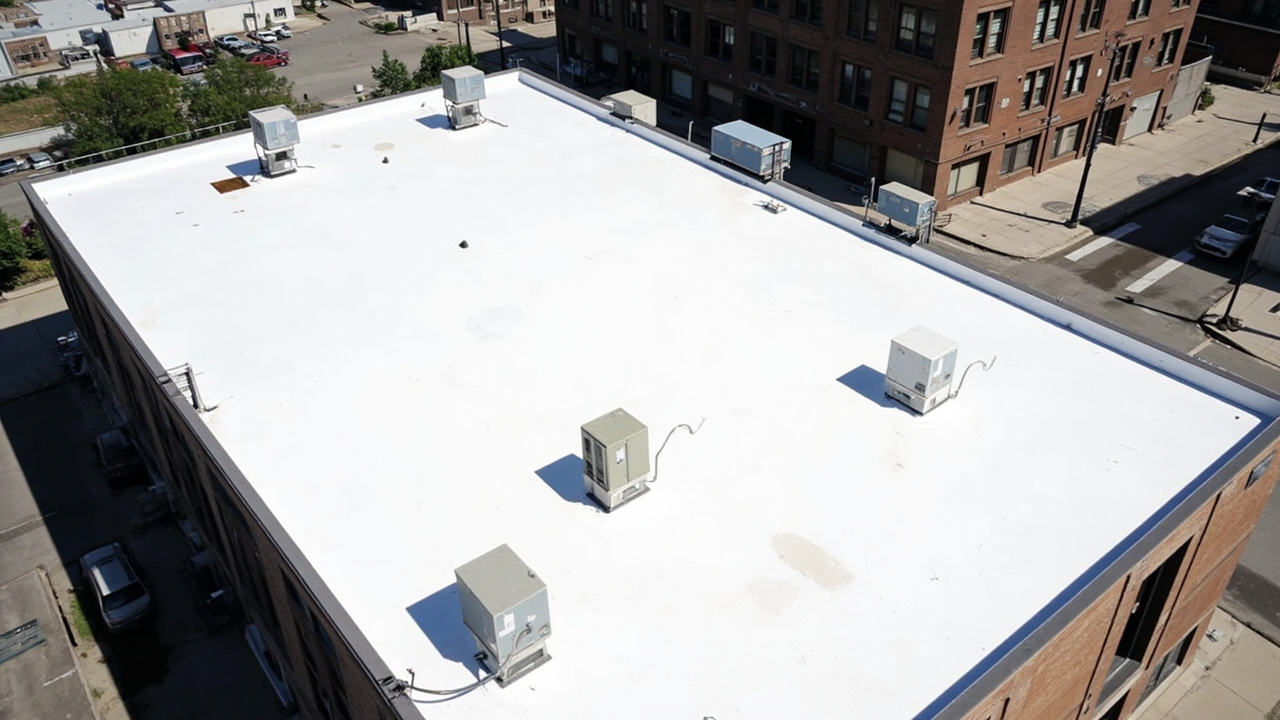
Eastern Market is packed with former warehouses, cold storage buildings, and manufacturing facilities converted into residential and mixed-use lofts. These buildings share one thing in common: large, flat or low-slope roofs that behave very differently from the pitched roofs on a traditional Detroit bungalow. The failure points are different. The warning signs are different. And the water damage that follows can be severe.

Why Detroit’s Climate Punishes Flat Roofs
Wayne County averages significant freeze-thaw cycles every winter. Temperatures can swing from well below freezing to above 40°F multiple times in a single week. That repeated expansion and contraction works against every seam, every flashing joint, and every membrane edge on a flat roof.
Add to that the weight of Michigan snow loads. A flat roof accumulates snow differently than a pitched roof. Snow sits. It compresses. When it melts unevenly, it pools in low spots and pushes water toward seams and drains. EPDM (Ethylene Propylene Diene Terpolymer) and TPO (Thermoplastic Polyolefin) membranes, the two most common materials on Eastern Market loft roofs, are designed for thermal movement. But they are not bulletproof, especially as they age past 15 years.
Many of the industrial conversions in Eastern Market were re-roofed during renovation. Depending on when that work was done, those membranes are now approaching or past their typical service life. Regular inspection is not optional. It is the difference between a repair bill and a full water damage restoration project.
The 7 Warning Signs of a Flat Roof Leak
These are the indicators that show up in real Detroit loft buildings. Some you can see from inside. Some require getting on the roof or calling a certified inspector.
- Ponding water that sits longer than 48 hours. A properly designed flat roof drains within 48 hours of a rain event. Water that lingers past that point indicates a drainage problem, a low spot, or a clogged scupper or interior drain. Ponding water accelerates membrane degradation and adds structural load.
- Membrane blistering and bubbling. If you walk the roof and see raised bubbles in the EPDM or TPO surface, that is trapped moisture or air beneath the membrane. Blisters are pre-failure zones. When they rupture, water has a direct path into the roof assembly.
- Cracked or gapping seams. Flat roof membranes are installed in overlapping sections. Those seams are the most common failure point. On EPDM, look for seams that have lifted or separated. On TPO, watch for discoloration or cracking along heat-welded seams, which signals thermal stress failure.
- Water stains on interior ceilings or upper walls. In a loft building, this often shows up on the underside of the structural deck, on exposed ductwork, or running down interior masonry walls. The stain location rarely matches the leak source directly. Water travels horizontally through insulation before it drops.
- Musty odors or visible mold on upper floors. Mold growth in the top floor of a flat-roof building almost always traces back to a slow roof leak, not a plumbing issue. If you’re smelling something earthy and damp in your upper unit, the roof assembly above you may already have significant moisture saturation. Read more about why surface-level mold treatments miss the source in our article on why bleach won’t fix mold and when to call a pro.
- Flashing and scupper blockages. Flashings seal the roof membrane to vertical surfaces like parapet walls, HVAC curbs, and skylights. When flashings lift, crack, or separate, water enters the roof system at the edges. Clogged scuppers (the drainage openings through parapet walls) cause water to back up and push under membrane edges.
- Unexplained increases in energy costs. Wet insulation loses R-value. If your heating costs have jumped without a clear reason, it may be because the insulation layer in your roof assembly is saturated. This is one of the least obvious signs of a flat roof leak and one of the most expensive to ignore.

What You See Inside vs. What a Pro Finds on the Roof
The gap between what a building owner notices and what a certified inspector finds on the roof surface is significant. This table shows why calling a professional early changes the outcome.
| What You Observe Inside | What the Pro Finds on the Roof | Likely Cause |
|---|---|---|
| Brown stain on ceiling near a wall | Failed flashing at parapet wall base | Freeze-thaw movement separating the flashing membrane bond |
| Water dripping from a light fixture | Ponding water pooled over an HVAC curb seam | Clogged roof drain pushing water toward low-slope zones |
| Musty smell in top-floor unit | Saturated polyiso insulation board beneath an intact membrane | Pinhole puncture or failed seam allowing slow water infiltration |
| Mold on ceiling drywall | Multiple membrane blisters near rooftop HVAC equipment | Condensation from equipment combined with membrane aging |
| Peeling paint on upper interior wall | Scupper blocked with debris, water backing up into parapet | Deferred maintenance on drainage system |
| Higher energy bills in winter | Infrared scan showing wet insulation zones across 30% of roof | Long-term slow leak never addressed at the surface |
Certified inspectors use thermal imaging and calibrated moisture meters to identify wet insulation zones that are invisible to the naked eye. The IICRC (Institute of Inspection, Cleaning and Restoration Certification) sets the standards that guide how professionals document and respond to moisture intrusion. An inspection built around those standards gives you defensible data for insurance purposes and a clear scope for remediation.
How Flat Roof Leaks Transition Into Full Water Damage Restoration Projects
A small roof leak rarely stays small. Here is the progression that happens inside Eastern Market loft buildings when a membrane failure goes unaddressed.
Water enters through a failed seam or compromised flashing. It saturates the polyiso or mineral wool insulation board below the membrane. Saturated insulation holds moisture for months, even after the surface breach is repaired. That sustained moisture creates ideal conditions for mold colonies to establish in the roof assembly and on the structural deck above finished spaces.
From there, water migrates. It follows steel deck flutes, travels along structural beams, and drips onto gypsum board ceilings. By the time visible staining appears inside the building, Category 1 clean water has often become Category 2 or Category 3 contaminated water through contact with building materials and biological growth.
At that stage, you are dealing with a multi-trade restoration project, not just a roofing repair. Insulation removal, structural drying, mold remediation, and interior rebuild all become part of the scope. The cost difference between catching a leak at the membrane blistering stage versus the mold remediation stage is substantial.
If you find yourself dealing with water damage that has already progressed, understanding your insurance coverage options is critical. Our guide on how to get your Detroit home insurance to actually pay for water restoration walks through the documentation and claim process in detail.
The Inspection Timeline for Flat Roof Buildings in Eastern Market
Knowing when to inspect matters as much as knowing what to look for. This table reflects a schedule appropriate for the Detroit climate and the age profile of most Eastern Market loft conversions.
| Inspection Timing | What to Check | Who Should Do It |
|---|---|---|
| After every significant snowmelt (late winter) | Ponding water, scupper and drain function, visible membrane damage | Building owner or property manager (visual) |
| Spring (April to May) | Full membrane surface inspection, flashing condition, seam integrity | Licensed roofing contractor or certified inspector |
| After any hail event | TPO or EPDM surface for impact punctures, metal flashing dents | Licensed roofing contractor within 72 hours |
| Fall (September to October) | Drain clearing, flashing re-sealing, insulation moisture check via infrared | Certified inspector with thermal imaging equipment |
| Any time interior signs appear | Moisture meter readings, infrared scan of roof and ceiling assembly | IICRC-certified water damage restoration professional immediately |
DIY Roof Checks vs. When to Call a Detroit Professional
There are things a building owner can reasonably check from the roof surface or from inside the building. And there are limits.
You can walk the roof after a rain event and look for standing water. You can clear debris from scupper openings and check that roof drains are not clogged with leaves or sediment. You can look at the interior ceiling after heavy rain and note any new staining or dripping.
What you cannot do is locate moisture trapped between the membrane and the structural deck without specialized equipment. You cannot determine whether mold colonies have established in the roof assembly by looking at the surface. You cannot assess whether your insulation R-value has been compromised without thermal imaging.
If you have already found water stains, smelled mold, or noticed membrane damage, the inspection phase is over. At that point, you need a restoration professional who can assess total moisture load, not just the visible damage. Scope creep is real in flat roof water damage projects. Getting an accurate scope from a certified professional up front protects you from discovering hidden damage mid-project.
For loft owners dealing with finished hardwood floors on lower levels that may have been affected by water intrusion from above, the damage to flooring is often the most visible and emotionally difficult part of the project. Our guide on how to save hardwood floors after a significant water leak covers the decision-making process around drying versus replacement.
If your loft building has multiple units and shared common areas, water damage from a roof leak can also affect carpeted spaces. Understanding what can be salvaged versus what needs to go is covered in our resource on deciding whether wet carpet can be saved or needs replacement.
What Makes Eastern Market Loft Buildings Specifically High Risk
The Dequindre Cut runs directly through this neighborhood. The Gratiot corridor borders it. The area sits in a part of Detroit where the building stock includes structures that are 80 to 120 years old at their core, with roofing systems that were added or replaced during the conversion boom of the past two decades.
That means you often have an old structural deck, a relatively newer membrane, and flashings that have gone through many freeze-thaw cycles. The interface between old masonry parapet walls and newer TPO or EPDM membranes is a chronic weak point. Masonry moves. Membranes try to accommodate that movement. Eventually, the bond at the flashing fails.
Buildings near Gratiot and Russell Street that converted large cold storage spaces have especially deep roof assemblies, sometimes with multiple layers of old insulation beneath a newer membrane. When those assemblies get wet, drying them completely takes specialized equipment and time. Trapped moisture in a thick roof assembly feeds mold for months if it is not extracted properly.
Understanding how to file a successful claim when this damage occurs is essential for property owners in this situation. Our article on filing a successful water damage insurance claim covers the documentation requirements that most owners miss on their first attempt.
Act on the Early Signs, Not the Obvious Ones
Membrane blistering is an early sign. A water stain on your ceiling is a late one. Musty odors from your upper floor are a sign that mold has already established. The pattern with flat roof leaks is consistent: the visible interior damage always lags behind the actual membrane failure by weeks or months.
Eastern Market loft buildings are worth protecting. If you have noticed any of the warning signs covered here, get a professional moisture assessment scheduled before Detroit’s next freeze-thaw cycle does more damage. An inspection now is a fraction of the cost of a full remediation project later.
Contact our Detroit restoration team for an assessment of your building. We work with IICRC-certified standards and have documented moisture damage in flat-roof buildings throughout the Eastern Market district, Midtown, New Center, and across Wayne County. We will tell you exactly what we find and what it means for your building.
{
“@context”: “https://schema.org”,
“@type”: “BlogPosting”,
“headline”: “How to Spot a Flat Roof Leak in Your Eastern Market Loft Before It Gets Expensive”,
“description”: “Flat roof leaks in Eastern Market lofts can hide for weeks. Learn the 7 warning signs Detroit property owners miss before water damage spreads.”,
“wordCount”: 2002,
“datePublished”: “2026-05-03T12:06:00.000Z”,
“dateModified”: “2026-05-03T12:06:00.000Z”,
“inLanguage”: “en-US”,
“mainEntityOfPage”: {
“@type”: “WebPage”,
“@id”: “https://ironwoodwaterdamagerestorationdetroit.com”
},
“publisher”: {
“@type”: “LocalBusiness”,
“name”: “Ironwood Water Damage Restoration Detroit”,
“url”: “https://ironwoodwaterdamagerestorationdetroit.com”
},
“author”: {
“@type”: “Organization”,
“name”: “Ironwood Water Damage Restoration Detroit”,
“url”: “https://ironwoodwaterdamagerestorationdetroit.com”
},
“image”: {
“@type”: “ImageObject”,
“url”: “https://ironwoodwaterdamagerestorationdetroit.com/wp-content/uploads/2026/03/spotting-the-early-warning-signs-of-a-flat-roof-le-1.jpg”
}
}
{
“@context”: “https://schema.org”,
“@type”: “LocalBusiness”,
“name”: “Ironwood Water Damage Restoration Detroit”,
“url”: “https://ironwoodwaterdamagerestorationdetroit.com”,
“address”: {
“@type”: “PostalAddress”,
“addressLocality”: “Detroit”
},
“areaServed”: {
“@type”: “City”,
“name”: “Detroit”
}
}
{
“@context”: “https://schema.org”,
“@type”: “BreadcrumbList”,
“itemListElement”: [
{
“@type”: “ListItem”,
“position”: 1,
“name”: “Home”,
“item”: “https://ironwoodwaterdamagerestorationdetroit.com”
},
{
“@type”: “ListItem”,
“position”: 2,
“name”: “Blog”,
“item”: “https://ironwoodwaterdamagerestorationdetroit.com/blog”
},
{
“@type”: “ListItem”,
“position”: 3,
“name”: “How to Spot a Flat Roof Leak in Your Eastern Market Loft Before It Gets Expensive”
}
]
}
{
“@context”: “https://schema.org”,
“@type”: “Service”,
“serviceType”: “Water Damage Restoration”,
“provider”: {
“@type”: “LocalBusiness”,
“name”: “Ironwood Water Damage Restoration Detroit”,
“url”: “https://ironwoodwaterdamagerestorationdetroit.com”
},
“areaServed”: {
“@type”: “City”,
“name”: “Detroit”
},
“description”: “Flat roof leaks in Eastern Market lofts can hide for weeks. Learn the 7 warning signs Detroit property owners miss before water damage spreads.”
}