
A slow leak inside a hydronic radiant floor system is one of the most destructive problems a Grosse Pointe Park homeowner can face. The water never shows itself immediately. It saturates your subfloor, feeds mold colonies, and warps everything above it while your boiler quietly loses pressure. By the time you notice something is wrong, the damage is often already significant.
This guide walks you through every symptom, from the ones you can spot with your eyes to the ones only a thermal imaging camera will reveal. If you own a high-end home in Grosse Pointe Park, Grosse Pointe Farms, or anywhere along the Lake St. Clair shoreline corridor, this information is worth reading carefully.
Why Radiant Floor Leaks Are Harder to Catch Than Standard Pipe Leaks
A burst supply line under a kitchen sink makes itself known within minutes. A pinhole leak in PEX piping embedded in a concrete slab or beneath tile mortar can go weeks without any visible sign. The water disperses slowly through the substrate. The heat from the system itself accelerates evaporation at the surface, masking moisture beneath.
Metro Detroit’s freeze-thaw cycles make this worse. Soil movement around foundations in neighborhoods like Indian Village and East English Village puts stress on older PEX runs and manifold connections. Homes built with radiant systems before modern push-fit fittings became standard are especially vulnerable to micro-fractures at connection points.
Understanding how moisture and mold interact in building materials matters here. Once subfloor moisture content climbs above 19 percent, wood degradation and mold growth become near-certain outcomes. That threshold can be reached in days when a hydronic system leaks continuously, even at low pressure.
Physical Signs You Can See and Hear
Tile Movement and Grout Cracking
Walk your tiled floors and press down gently at different points. If you feel flex or hear a hollow sound where there was none before, subfloor saturation may have compromised the mortar bond. Saturated mortar loses its grip on tile backer board fast.
Check your grout lines closely. Grout cracking in a radial pattern around a single tile is a specific warning sign. It suggests the substrate beneath that tile has shifted from moisture swelling, not from normal settling.
Warped Hardwood Near the Transition Zone
Many Grosse Pointe Park homes mix tile in main living areas with hardwood flooring in adjacent rooms. Moisture migrating from a leak in the tile zone will travel laterally through the subfloor and cause hardwood cupping or crowning at the transition. If your hardwood edges are lifting near a doorway that borders a tiled room, trace that back to the tile side before assuming the hardwood itself is the source of the problem. Our guide on saving hardwood floors after a water leak covers what can and cannot be restored once moisture damage sets in.
Warm or Damp Spots on the Surface
Run your bare hand slowly across the tile surface when the system is off and has been off for at least two hours. A localized warm area when the system should be cold suggests water is pooling and retaining heat near a leak point. Damp spots on grout lines, particularly ones that appear without any recent spill, are also red flags.
Sounds From Beneath the Floor
A hissing sound coming from under the floor when the system is running indicates air entering the system through the leak point. You may also hear a faint gurgling near the manifold or in adjacent wall cavities where the supply and return lines run. These sounds tend to be subtle. Listen in a quiet room with the HVAC system off.
System Performance Symptoms That Indicate a Leak
Unexplained Drops in Boiler Pressure
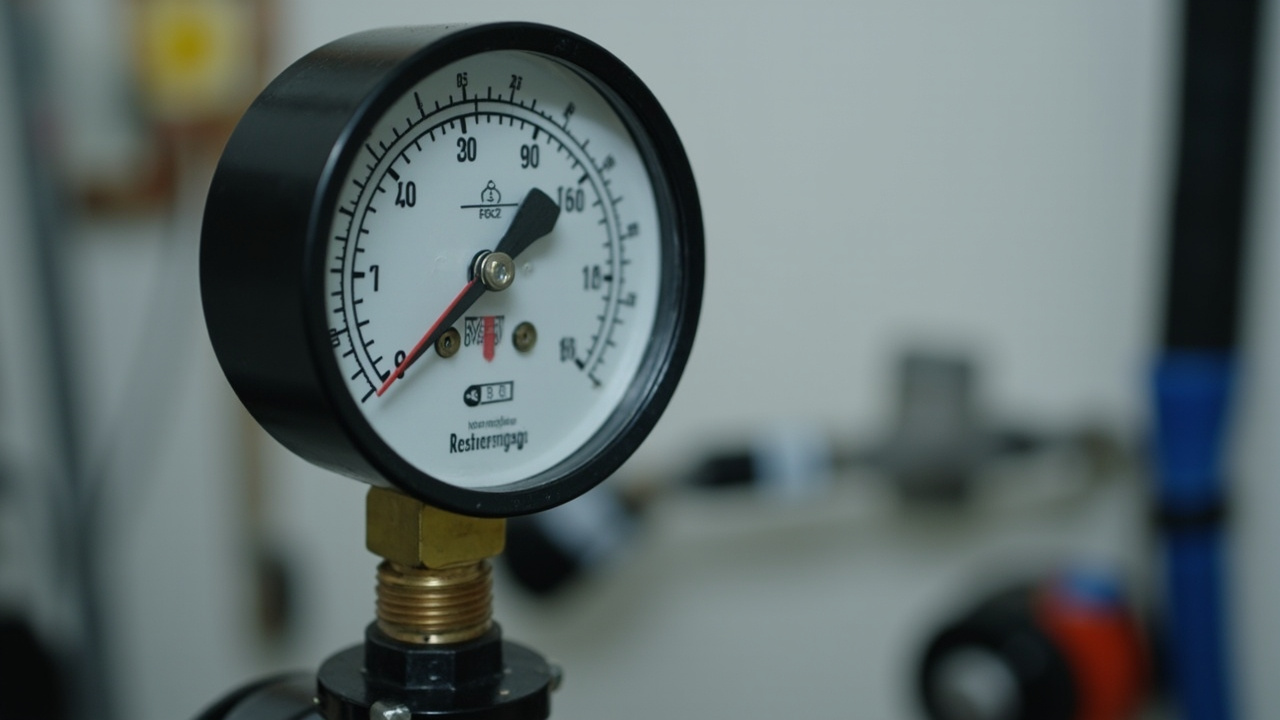
Your boiler pressure gauge is one of the most direct indicators of a leak in a closed hydronic system. A properly sealed system should hold pressure within a narrow range during normal operation. If you are adding water to the system regularly to bring pressure back up, that water is going somewhere. It is leaving through a leak.
Normal operating pressure for most residential hydronic systems runs between 12 and 25 PSI. A drop of more than 2 PSI over a 24-hour period without any recent bleeding or service work is worth investigating immediately. Document your gauge readings morning and evening for three days and bring that log to any professional you call.
Frequent Boiler Short-Cycling
When a leak causes water loss, the boiler works harder to maintain temperature because the circulating volume decreases. This leads to short-cycling, where the boiler fires up, reaches temperature quickly, shuts off, then fires again too soon. Short-cycling strains the heat exchanger and burns through fuel at a higher rate. If your gas bill has climbed without a change in usage habits, factor this into your assessment.
Cold Spots in Specific Zones
Hydronic systems are divided into zones controlled by a manifold. If one zone of your floor runs cold while others heat normally, and your zone valve is functioning, the most likely explanation is either a blockage or a pressure loss from a leak within that specific loop. Cold zones that were previously heating well are a priority for investigation.
| Pressure Drop Pattern | Likely Cause | Urgency Level |
|---|---|---|
| Less than 1 PSI per week | Normal micro-seepage or temperature variation | Monitor only |
| 1 to 2 PSI per week | Possible small leak or failing fitting | Schedule inspection within 2 weeks |
| 2 to 5 PSI per 24 hours | Active leak in PEX loop or manifold connection | Inspect within 48 hours |
| Greater than 5 PSI per 24 hours | Significant breach, possible multiple failure points | Shut down system, call immediately |
Secondary Signs That Point to Hidden Water Damage
Musty Odors at Floor Level
Mold growth producing a musty odor tends to originate at or below floor level when the source is a slab or subfloor leak. Kneel down and smell near baseboard transitions, particularly in corners and along exterior walls. Musty odors that dissipate higher up but concentrate near the floor strongly suggest biological growth in the subfloor assembly.
This is not something to address with bleach or surface sprays. Mold inside a subfloor cavity or beneath tile mortar requires professional remediation. Our breakdown of why bleach does not work on structural mold explains why surface treatments fail in these situations.
Mold Growth at Baseboard Level
Paint bubbling or black spotting at the base of drywall along exterior or interior walls is a specific indicator of moisture wicking up from a wet subfloor. In Grosse Pointe Park homes with plaster walls and original wood baseboards, this often looks like paint peeling from the baseboard itself rather than obvious mold spotting. Do not assume it is a cosmetic issue from age.
Spikes in Water Utility Bills
A closed hydronic system should never need water added under normal conditions. If your household water consumption has increased noticeably and you have not changed your habits, the system may be pulling makeup water automatically through an autofill valve. That water is replacing what is leaking out. Check your water meter reading at 10 PM and again at 6 AM with all household fixtures off. Any movement on the meter indicates active water loss somewhere in the building.
How Professionals Find Leaks Without Tearing Up Your Floors
An IICRC Certified Technician experienced with hydronic system water damage will use a combination of non-invasive diagnostic tools before any floor demolition takes place. This matters significantly when you are dealing with expensive tile work or custom stone floors.
Thermal Imaging
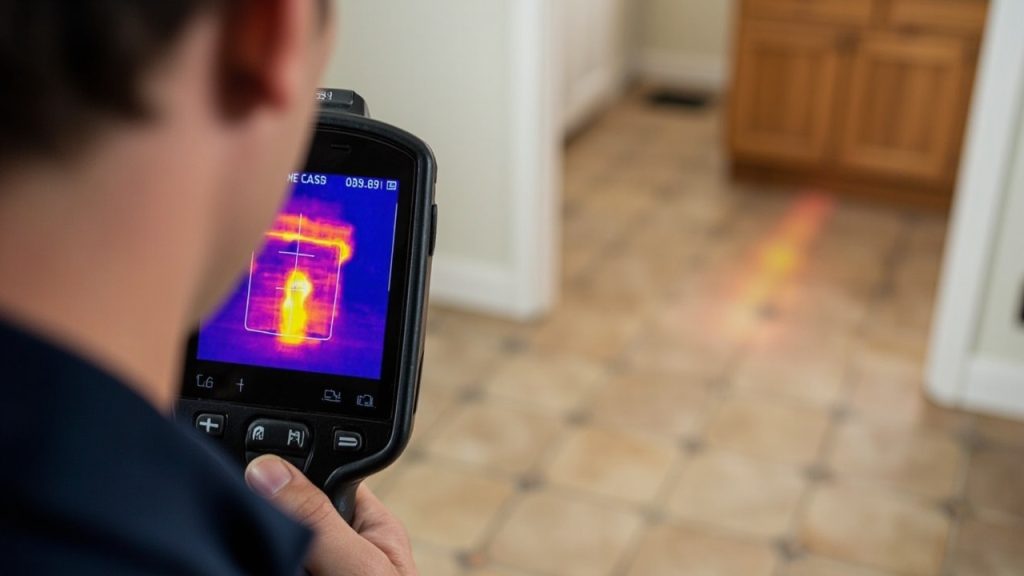
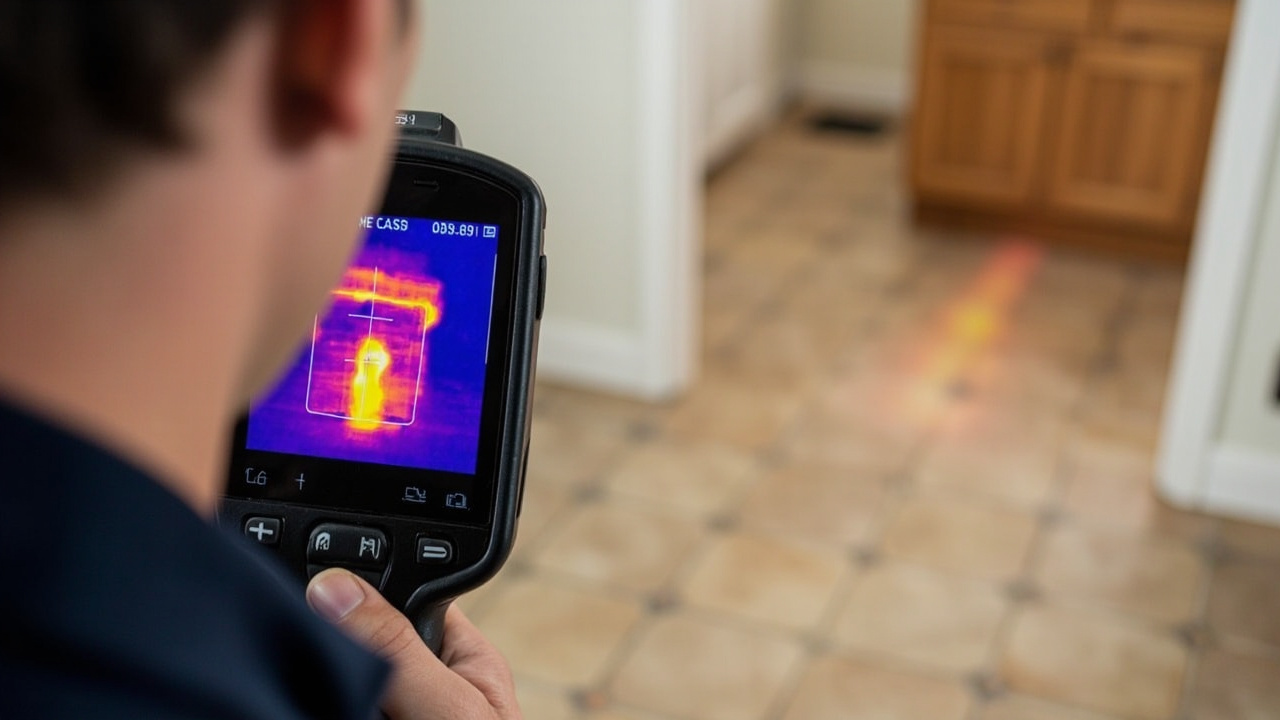
Infrared thermal imaging cameras detect temperature differentials at the floor surface. A leak point in a PEX loop shows up as an anomalous hot or cold spot depending on system state at the time of imaging. A trained operator can map the entire loop layout and identify where temperature patterns break from the expected serpentine pattern. This is the first diagnostic tool used in most in-floor leak investigations.
Hydrostatic Pressure Testing
Hydrostatic testing involves pressurizing each loop individually with water or inert gas and monitoring for pressure loss over a set time period. This confirms whether a leak exists in a specific loop and gives a rough indication of leak size based on the rate of pressure loss. It does not pinpoint the exact location on its own, but combined with thermal imaging, it narrows the search area substantially.
Ultrasonic Leak Detection
Ultrasonic detectors pick up the sound signature of water escaping under pressure through a small opening. The frequency of that escape is above the range of human hearing but falls within the detection range of a calibrated ultrasonic instrument. Technicians move the sensor slowly across the floor surface and listen for signal spikes that indicate the leak location beneath.
Moisture Mapping
After the leak location is identified, moisture mapping documents the full extent of subfloor saturation using pin-type and non-invasive moisture meters. This tells the restoration team how far the water has migrated and informs the drying plan. Moisture mapping also creates a baseline record for insurance documentation.
| Method | What It Detects | Invasive? | Best Used For |
|---|---|---|---|
| Thermal Imaging | Temperature anomalies at floor surface | No | Initial sweep and loop mapping |
| Hydrostatic Testing | Pressure loss in individual loops | No (system access required) | Confirming leak presence per zone |
| Ultrasonic Detection | Sound signature of escaping water | No | Pinpointing leak location |
| Moisture Mapping | Subfloor saturation levels | Minimal (pin meter) | Damage extent and drying baseline |
| Invasive Inspection | Direct visual confirmation | Yes | Post-diagnostic confirmation when needed |
What to Do Right Now If You Suspect a Leak
Take these steps in order. Speed matters because every hour of continued operation pushes more water into your subfloor assembly.
- Shut down the boiler. Turn the system to off at the thermostat and at the boiler itself. This stops additional water from circulating through the leak point.
- Close the manifold supply valves. Locate your manifold, typically in a utility closet or mechanical room, and close the supply valves for all zones. This isolates the in-floor loops from the boiler and reduces system pressure.
- Document everything before you touch it. Photograph the boiler pressure gauge, any visible moisture, damaged tile or grout, and baseboard discoloration. Video works even better. This documentation supports your insurance claim.
- Do not attempt to dry with fans alone. Surface fans will not address moisture trapped in the mortar bed, subfloor decking, or concrete slab. Improper drying can drive moisture deeper into the assembly and create conditions for mold growth that is even harder to remediate later.
- Call a water damage restoration company with hydronic system experience. This is a specialized situation. General contractors or plumbers alone are not equipped to assess and mitigate the full scope of water damage in a radiant floor system failure.
The Restoration and Drying Process for In-Floor Leaks
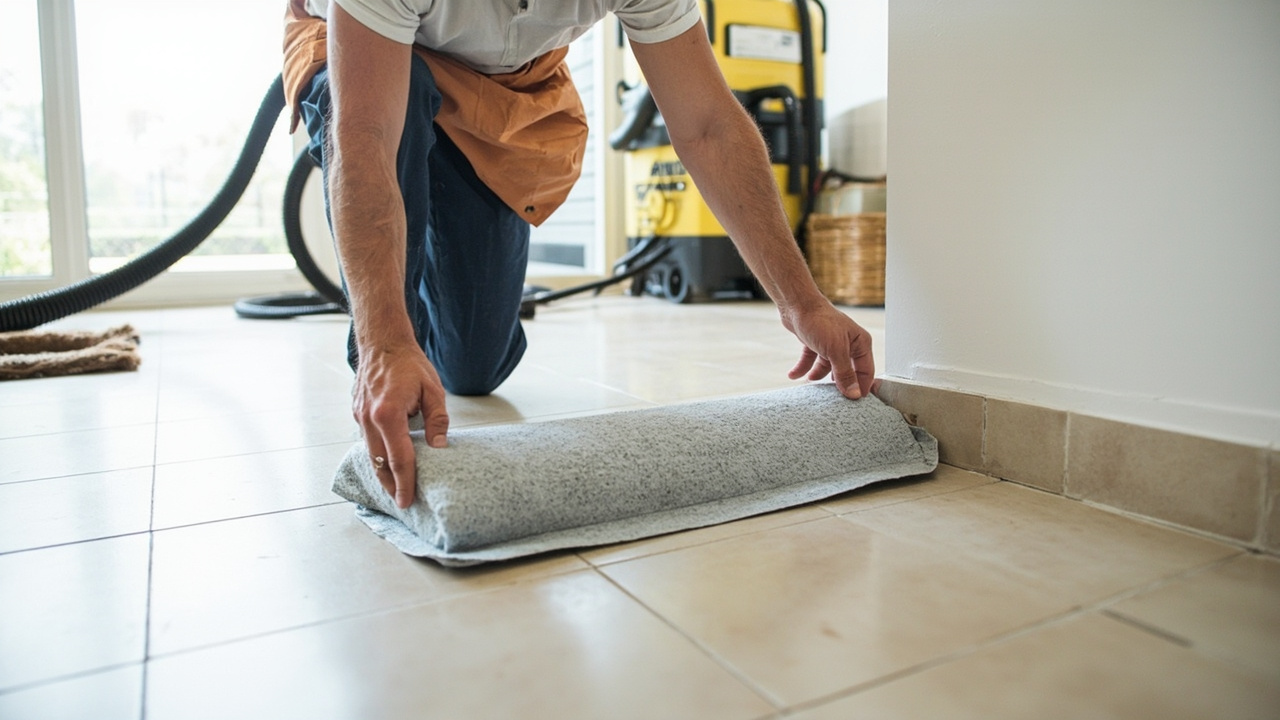
Once the leak is located and the plumbing repair is completed, the restoration phase begins. In most cases, IICRC-certified technicians use structural drying equipment specifically positioned to draw moisture from the subfloor assembly without full floor demolition. This may include desiccant dehumidifiers, floor mat drying systems, and carefully placed air movers to create directed airflow through the assembly.
In cases where the subfloor decking has reached saturation levels that compromise structural integrity, selective demolition of tile sections may be necessary to allow direct drying access and to assess whether the OSB or plywood decking requires replacement. Evaporative drying through a compromised tile surface is rarely sufficient when moisture content in the wood substrate is elevated significantly above the 19 percent threshold.
Mold remediation, if required, follows its own protocol separate from structural drying. If you need to understand how insurance covers these costs, our guide on getting Detroit home insurance to pay for water restoration is a useful starting point before you file your claim. For a more detailed walkthrough of the claims process itself, the resource on filing a successful water damage insurance claim covers documentation requirements and common denial reasons.
Why Grosse Pointe Park Homes Face Specific Risks
Grosse Pointe Park’s housing stock skews toward larger homes built between the mid-20th century and the early 2000s, many of which had radiant heating systems installed or retrofitted during a period when PEX fitting technology was still evolving. Early-generation crimp-style PEX fittings are more susceptible to failure at the fitting body itself rather than in the tubing run. Homes along Alter Road and the residential blocks between Jefferson Avenue and the lakefront corridor tend to have more of these older systems than newer construction elsewhere in the metro.
Soil movement from freeze-thaw cycling in Wayne County and Macomb County puts lateral stress on any piping that crosses a foundation or runs near exterior walls. That mechanical stress, compounded over many heating seasons, creates the conditions for fitting fatigue and micro-cracking that presents as a slow, invisible leak.
If your home has both radiant floors and a finished basement, a subfloor leak can track downward through the assembly and appear first as water staining or wet carpet on the level below. Understanding when that lower-level damage crosses from salvageable to requiring replacement is covered in our guide on deciding whether wet carpet can be saved or needs to go.
Early detection is the only cost-effective outcome in a radiant floor leak scenario. The longer a hydronic system leak runs, the more the repair scope expands from a plumbing fix into a full structural drying and mold remediation project. If any of the symptoms described above match what you are experiencing in your home, do not wait for the damage to become visible. Invisible damage is already expensive damage.
Ironwood Water Damage Restoration serves Metro Detroit homeowners with 24/7 emergency response. Call us today to schedule a thermal imaging inspection and moisture assessment for your Grosse Pointe Park home. The earlier we assess it, the more we can protect.
{
“@context”: “https://schema.org”,
“@type”: “BlogPosting”,
“headline”: “How to Tell If Your In-Floor Radiant Heating System Is Leaking Under Your Tiles in Grosse Pointe Park”,
“description”: “Spot radiant floor heating leak symptoms before they destroy your subfloor. A Detroit restoration expert explains what to look for and what to do next.”,
“wordCount”: 2305,
“datePublished”: “2026-06-05T09:39:00.000Z”,
“dateModified”: “2026-06-05T09:39:00.000Z”,
“inLanguage”: “en-US”,
“mainEntityOfPage”: {
“@type”: “WebPage”,
“@id”: “https://ironwoodwaterdamagerestorationdetroit.com”
},
“publisher”: {
“@type”: “LocalBusiness”,
“name”: “Ironwood Water Damage Restoration Detroit”,
“url”: “https://ironwoodwaterdamagerestorationdetroit.com”
},
“author”: {
“@type”: “Organization”,
“name”: “Ironwood Water Damage Restoration Detroit”,
“url”: “https://ironwoodwaterdamagerestorationdetroit.com”
},
“image”: {
“@type”: “ImageObject”,
“url”: “https://ironwoodwaterdamagerestorationdetroit.com/wp-content/uploads/2026/03/signs-your-in-floor-radiant-heating-system-is-leak-1.jpg”
}
}
{
“@context”: “https://schema.org”,
“@type”: “LocalBusiness”,
“name”: “Ironwood Water Damage Restoration Detroit”,
“url”: “https://ironwoodwaterdamagerestorationdetroit.com”,
“address”: {
“@type”: “PostalAddress”,
“addressLocality”: “Detroit”
},
“areaServed”: {
“@type”: “City”,
“name”: “Detroit”
}
}
{
“@context”: “https://schema.org”,
“@type”: “BreadcrumbList”,
“itemListElement”: [
{
“@type”: “ListItem”,
“position”: 1,
“name”: “Home”,
“item”: “https://ironwoodwaterdamagerestorationdetroit.com”
},
{
“@type”: “ListItem”,
“position”: 2,
“name”: “Blog”,
“item”: “https://ironwoodwaterdamagerestorationdetroit.com/blog”
},
{
“@type”: “ListItem”,
“position”: 3,
“name”: “How to Tell If Your In-Floor Radiant Heating System Is Leaking Under Your Tiles in Grosse Pointe Park”
}
]
}
{
“@context”: “https://schema.org”,
“@type”: “Service”,
“serviceType”: “Water Damage Restoration”,
“provider”: {
“@type”: “LocalBusiness”,
“name”: “Ironwood Water Damage Restoration Detroit”,
“url”: “https://ironwoodwaterdamagerestorationdetroit.com”
},
“areaServed”: {
“@type”: “City”,
“name”: “Detroit”
},
“description”: “Spot radiant floor heating leak symptoms before they destroy your subfloor. A Detroit restoration expert explains what to look for and what to do next.”
}