

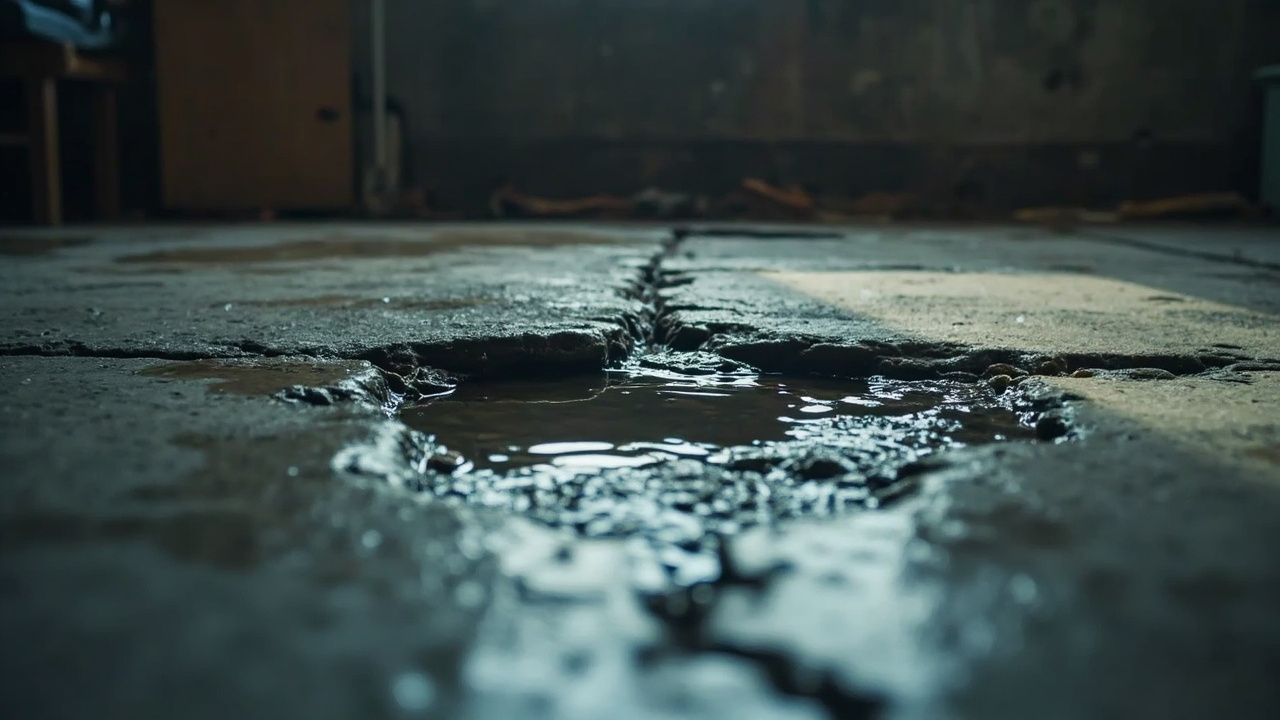
If your basement walls are bone dry but there’s water pooling on the floor, you’re not imagining things. You’re dealing with hydrostatic pressure, and in Melvindale, it’s one of the most common and most misunderstood basement problems homeowners face. The water isn’t coming from a burst pipe or a leaking wall. It’s being pushed up from below, through the concrete slab itself.
This is exactly the situation where people waste weeks and hundreds of dollars on the wrong fixes. Understanding what’s actually happening under your foundation is the first step toward stopping it for good.
What Hydrostatic Pressure Is and Why Melvindale Gets Hit Hard
Hydrostatic pressure is the force that saturated soil exerts against your foundation and slab. When the ground around and beneath your home holds more water than it can drain away, that water has to go somewhere. It finds the path of least resistance, which is usually the tiny pores, hairline cracks, and control joints in your basement floor.
Melvindale sits in one of the lowest-lying areas in Wayne County. The city shares a border with the Rouge River corridor, and the surrounding soil is predominantly clay-heavy. Clay soil expands when wet and drains slowly. That combination creates conditions where groundwater builds up fast after rain or snowmelt and stays elevated for extended periods.
The U.S. Geological Survey monitors water table levels across Southeast Michigan, and the data for Wayne County consistently shows elevated groundwater during the spring thaw and following significant rainfall events. In low-lying communities like Melvindale, Allen Park, and Lincoln Park, the water table can rise to within a few feet of the surface after a heavy storm.
When that happens, your basement floor is essentially sitting on top of pressurized, saturated soil. Concrete looks solid, but it’s porous. Water under pressure will move through it.
Why Your Basement Walls Are Dry but Your Floor Is Wet
This is the detail that confuses most homeowners. If water were entering through cracks in the wall or around window frames, you’d see staining, efflorescence (those white chalky mineral deposits), or moisture near the base of the walls. When the floor is wet and the walls are dry, the pressure is coming from directly below the slab, not from the sides.
This usually means one of three things is happening.
- Your sump pump has failed or is undersized for the volume of groundwater your lot receives.
- Your basement has no interior drainage system, so there’s no path for the water to escape before it pressurizes under the slab.
- The original drainage tile or French drain around your foundation has collapsed, clogged with clay, or degraded. Many Melvindale homes were built in the mid-20th century, and those systems are well past their useful life.
Concrete floor cracks, particularly cracks that run along the control joints or appear in a starburst pattern near the center of the slab, are a clear sign that hydrostatic pressure has been building over time. If you see water seeping from these cracks after rain or during snowmelt, that’s confirmation.
Immediate Safety Steps Before You Do Anything Else
Standing water in a basement is a serious hazard, and the risks go beyond a wet floor. Before you start assessing damage or moving items, you need to address two immediate dangers.
Electrical Hazards Come First
If the water has reached or is near any electrical outlets, your breaker box, a water heater, a furnace, or any appliance plugged in at floor level, do not enter the basement. Turn off the power to the basement from your main panel before you go down. If your main panel is in the basement and the floor is wet, call an electrician or your utility before doing anything else. Detroit Edison (DTE Energy) has an emergency line available around the clock for situations exactly like this.
Know What Type of Water You’re Dealing With
Not all water intrusion is equal. Groundwater pushing up through your floor is typically classified as grey water, which means it’s not sewage but it may carry soil contaminants, bacteria, and trace chemicals from the ground. If you have any reason to believe the intrusion is connected to a sewer backup, the classification changes to black water, which is a serious biohazard requiring full protective equipment and professional remediation.
The Detroit Water and Sewerage Department (DWSD) manages the combined sewer system that serves Melvindale and much of Wayne County. During heavy rain events, these systems can surcharge, meaning sewage mixes with stormwater and can back up into connected drains. If you smell sewage in your basement during a flood event, treat it as black water immediately.
| Water Type | Source | Health Risk | Recommended Response |
|---|---|---|---|
| Clean Water (Category 1) | Supply line break, rain through window | Low | Extract and dry within 24-48 hours |
| Grey Water (Category 2) | Groundwater, sump failure, appliance overflow | Moderate | Professional extraction, sanitize affected surfaces |
| Black Water (Category 3) | Sewage backup, flood water with contamination | High, biohazard | Do not enter without PPE, require certified remediation |

What Happens If You Wait It Out
Some Melvindale homeowners have been dealing with seasonal basement seepage for years and have treated it as a nuisance rather than a structural problem. That approach carries real consequences.
Within 24 to 48 hours of water intrusion, mold colonies can begin forming on any organic material. That includes drywall, wood framing, carpet, stored cardboard, and insulation. Melvindale basements are often used for storage or as finished living space, which puts a significant amount of material at risk. If you’ve already noticed musty odors or visible mold growth in your basement, the seepage has been ongoing longer than you realize. Our article on why bleach won’t fix your Ferndale basement mold explains why surface treatments fail and what actually works.
Beyond mold, repeated hydrostatic pressure cycles cause cumulative damage to your slab. The concrete heaves, cracks widen, and eventually the structural integrity of the floor is compromised. At that point, you’re looking at slab replacement rather than drainage correction, which is a dramatically more expensive outcome.
The Real Solutions for Hydrostatic Pressure in Wayne County Basements
There is no single product or patch that stops hydrostatic pressure. The solution requires redirecting or relieving the water before it builds up enough force to push through your floor. Here are the approaches used by experienced restoration professionals in Metro Detroit.
Interior Drainage Systems and French Drains
An interior drainage system involves cutting a channel along the perimeter of the basement floor, laying a perforated pipe (French drain) in a bed of gravel, and routing that pipe to a sump pit. When groundwater rises, it enters the drainage channel before it can pressurize under the slab. This approach is highly effective for homes where the exterior drainage cannot be excavated or replaced.
This is the most common solution for mid-century Melvindale homes where exterior waterproofing would require extensive excavation around the foundation.
Sump Pump Repair and Replacement
If your home already has a sump pit but water is still coming through the floor, the pump may be undersized, failing, or running on a float switch that activates too late. A properly sized submersible pump can move a significant volume of water per hour. For Wayne County’s water table conditions, most restoration professionals recommend a primary pump paired with a battery backup unit. Power outages and heavy rainfall often happen simultaneously, which is exactly when you need that redundancy.
Brands like Zoeller and Liberty Pumps are commonly specified for high-water-table conditions in Southeast Michigan because of their track record in continuous-duty applications.
Vapor Barriers and Moisture Barriers
For crawl space foundations or as a supplementary measure in finished basements, a heavy-mil vapor barrier installed over the floor can block moisture vapor transmission. This isn’t a solution for active water intrusion under pressure, but it’s an important component of a complete waterproofing system after the drainage issue is resolved.
Exterior Foundation Waterproofing
In severe cases, the most permanent solution is excavating around the foundation perimeter, applying a waterproof membrane to the exterior wall, and replacing the drainage tile at the footing. This approach is more invasive and more expensive, but it addresses the problem at the source. It’s most practical during major renovation projects or when the foundation itself shows significant deterioration.
| Solution | Best For | Disruption Level | Long-Term Effectiveness |
|---|---|---|---|
| Interior French Drain System | Active seepage through floor, older homes | Moderate (requires jackhammering perimeter) | High when paired with sump pump |
| Sump Pump Replacement | Existing pit, failing or undersized pump | Low | High with battery backup added |
| Vapor Barrier Installation | Crawl spaces, moisture vapor control | Low to moderate | Moderate (supplementary measure) |
| Exterior Excavation and Membrane | Severe foundation deterioration | High (major excavation) | Very high, most permanent |
| Crack Injection (Epoxy or Polyurethane) | Isolated wall or floor cracks | Low | Moderate (does not address pressure source) |
What the Restoration Process Actually Looks Like
When a certified restoration team responds to a Melvindale basement water intrusion, the process follows a structured protocol based on IICRC (Institute of Inspection Cleaning and Restoration Certification) standards. This isn’t a loose set of guidelines. It’s the industry benchmark that determines whether your insurance claim gets paid and whether the work is done to a standard that prevents mold growth after the job is closed.
The first step is moisture mapping using calibrated moisture meters and thermal imaging cameras to determine exactly how far water has migrated into the structure. Water travels further than it appears. A wet floor can mean the bottom courses of drywall, the base plates of interior walls, and the subfloor above the slab are all saturated.
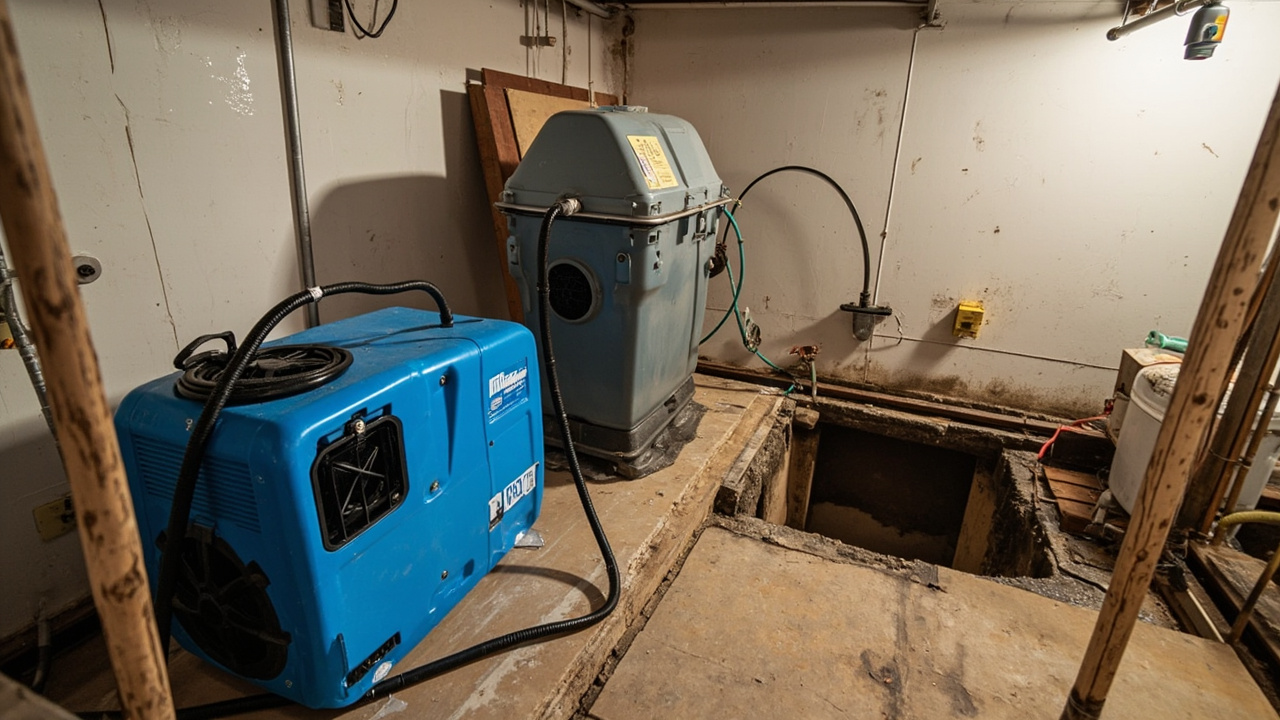
Next, water extraction using truck-mounted or portable extraction units removes standing water and pulls moisture from porous materials. Then drying equipment, specifically commercial-grade dehumidifiers and high-velocity air movers, is placed throughout the space. Drying timelines in a Wayne County basement typically run three to five days depending on the extent of saturation and the ambient conditions.
Affected materials are documented throughout, which is critical if you’re filing an insurance claim. Wayne County homeowners dealing with water damage claims should read through how to get your Detroit home insurance to actually pay for water restoration before contacting your adjuster.
Insurance Coverage for Hydrostatic Pressure Damage
This is where many homeowners in Melvindale, and throughout the broader Metro Detroit area, run into frustration. Standard homeowners insurance policies typically exclude groundwater intrusion and flooding from natural sources. Hydrostatic pressure damage falls into a gray area that insurers often deny.
That said, if your intrusion is connected to a sump pump failure and you carry a water backup endorsement, you may have coverage. If a covered peril, such as a broken pipe, contributed to or worsened the intrusion, that portion may be claimable. Documentation from an IICRC-certified restoration company is often the deciding factor in disputed claims. The more detailed the moisture mapping data and the more clearly the cause is documented, the better your position with the adjuster.
If your situation involves storm-related flooding, a separate flood insurance policy through the National Flood Insurance Program (NFIP) would be required. Melvindale properties in certain FEMA flood zones may qualify, and given the area’s proximity to the Rouge River, some parcels do carry mandatory flood insurance requirements.
For homeowners in Corktown and other Detroit neighborhoods dealing with similar insurance navigation challenges, our detailed walkthrough on filing a successful water damage insurance claim for your Corktown home covers the documentation process step by step.
When Secondary Damage Becomes the Bigger Problem
Basement water intrusion rarely travels alone. Once moisture gets into a space, it affects everything it contacts. Hardwood flooring above the basement level can cup and buckle from moisture vapor rising through the subfloor. Carpet in finished basement areas absorbs water and becomes a mold substrate within two days. Drywall that appears dry on the surface can hold moisture in the paper facing and core for weeks.
If your home has hardwood floors and you’re concerned about what moisture from below might be doing, the guidance in our article on saving hardwood floors after a significant water leak applies directly. The principles are the same regardless of whether the moisture source is above or below.
For basements with carpet, the decision to save or replace depends on how long the carpet has been wet, what water category it was exposed to, and whether the pad underneath can be adequately dried. The breakdown in our piece on deciding whether wet carpet can be saved gives you a clear framework for that decision.
Getting Help from a Team That Knows Melvindale
Responding to hydrostatic pressure problems in Wayne County requires knowing the local soil conditions, the age and construction type of the homes, and the drainage patterns of specific neighborhoods. A restoration company that works exclusively in, say, northern Oakland County doesn’t have the same ground-level familiarity with what’s happening under a 1950s Melvindale ranch versus a 1970s split-level near the Allen Park border.
Our team responds to basement water emergencies throughout Metro Detroit with a 60-minute target response time. We bring moisture meters, thermal cameras, commercial extraction equipment, and a working knowledge of what Wayne County basements actually look like from the inside. We also work directly with your insurance company from the first call, so you’re not managing two conversations during a stressful situation.
If water is coming up through your basement floor right now, the worst thing you can do is wait. Call us at any hour. We’ll assess the situation, stop the active intrusion where possible, and give you a clear picture of what needs to happen next.
{
“@context”: “https://schema.org”,
“@type”: “BlogPosting”,
“headline”: “Why Hydrostatic Pressure in Melvindale Is Forcing Water Through Your Basement Floor”,
“description”: “Water coming up through your basement floor in Melvindale? Learn why hydrostatic pressure is the cause and what Detroit homeowners can do right now.”,
“wordCount”: 2271,
“datePublished”: “2026-06-22T09:49:00.000Z”,
“dateModified”: “2026-06-22T09:49:00.000Z”,
“inLanguage”: “en-US”,
“mainEntityOfPage”: {
“@type”: “WebPage”,
“@id”: “https://ironwoodwaterdamagerestorationdetroit.com”
},
“publisher”: {
“@type”: “LocalBusiness”,
“name”: “Ironwood Water Damage Restoration Detroit”,
“url”: “https://ironwoodwaterdamagerestorationdetroit.com”
},
“author”: {
“@type”: “Organization”,
“name”: “Ironwood Water Damage Restoration Detroit”,
“url”: “https://ironwoodwaterdamagerestorationdetroit.com”
},
“image”: {
“@type”: “ImageObject”,
“url”: “https://ironwoodwaterdamagerestorationdetroit.com/wp-content/uploads/2026/03/why-hydrostatic-pressure-in-melvindale-is-forcing-1.jpg”
}
}
{
“@context”: “https://schema.org”,
“@type”: “LocalBusiness”,
“name”: “Ironwood Water Damage Restoration Detroit”,
“url”: “https://ironwoodwaterdamagerestorationdetroit.com”,
“address”: {
“@type”: “PostalAddress”,
“addressLocality”: “Detroit”
},
“areaServed”: {
“@type”: “City”,
“name”: “Detroit”
}
}
{
“@context”: “https://schema.org”,
“@type”: “BreadcrumbList”,
“itemListElement”: [
{
“@type”: “ListItem”,
“position”: 1,
“name”: “Home”,
“item”: “https://ironwoodwaterdamagerestorationdetroit.com”
},
{
“@type”: “ListItem”,
“position”: 2,
“name”: “Blog”,
“item”: “https://ironwoodwaterdamagerestorationdetroit.com/blog”
},
{
“@type”: “ListItem”,
“position”: 3,
“name”: “Why Hydrostatic Pressure in Melvindale Is Forcing Water Through Your Basement Floor”
}
]
}
{
“@context”: “https://schema.org”,
“@type”: “Service”,
“serviceType”: “Water Damage Restoration”,
“provider”: {
“@type”: “LocalBusiness”,
“name”: “Ironwood Water Damage Restoration Detroit”,
“url”: “https://ironwoodwaterdamagerestorationdetroit.com”
},
“areaServed”: {
“@type”: “City”,
“name”: “Detroit”
},
“description”: “Water coming up through your basement floor in Melvindale? Learn why hydrostatic pressure is the cause and what Detroit homeowners can do right now.”
}