
Expert Pool House Water Damage Restoration in Novi, MI
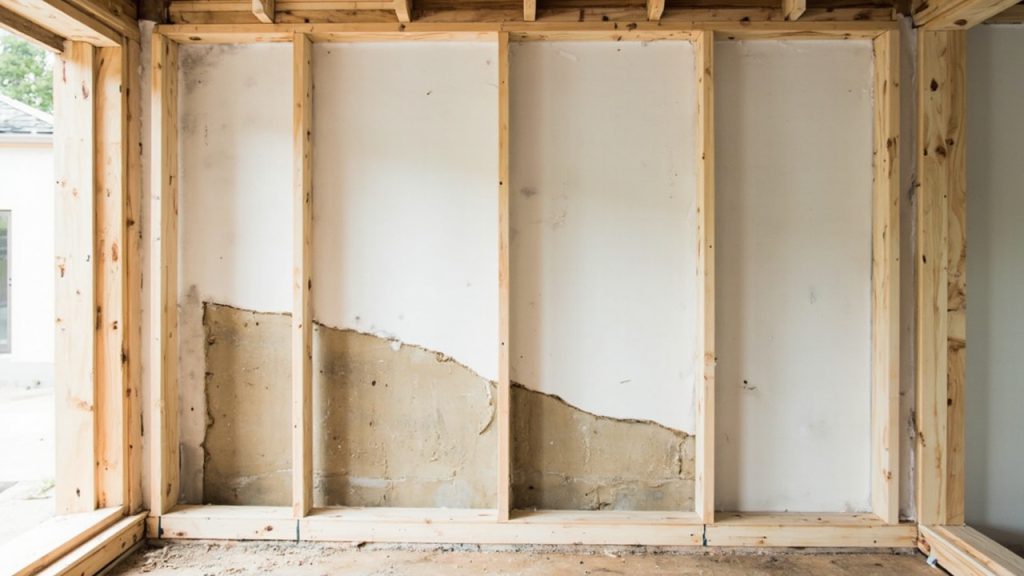
A pool house looks solid from the outside. But behind the drywall, underneath the wood framing, and inside the equipment room, hidden moisture is doing damage you cannot see. By the time you notice a musty smell or a soft spot in the floor, the rot has likely spread farther than you expect.
Novi homeowners deal with a unique combination of problems. Michigan winters push moisture through vapor barriers. Summer humidity inside pool enclosures stays high for months. And pool pump failures or drainage line failures can saturate the subfloor overnight. This guide walks you through exactly how to find those leaks, what happens when you miss them, and what proper restoration actually looks like.
Why Pool Houses in Novi Are Especially Vulnerable to Water Damage
Novi sits in Oakland County, one of the most densely developed suburban markets in Southeast Michigan. Homes in neighborhoods like Island Lake, Chase Farms, and the areas surrounding Lakeshore Park routinely feature detached pool houses, cabanas, and indoor pool enclosures. These structures are built to be near water, but that proximity creates real problems for the building materials inside them.
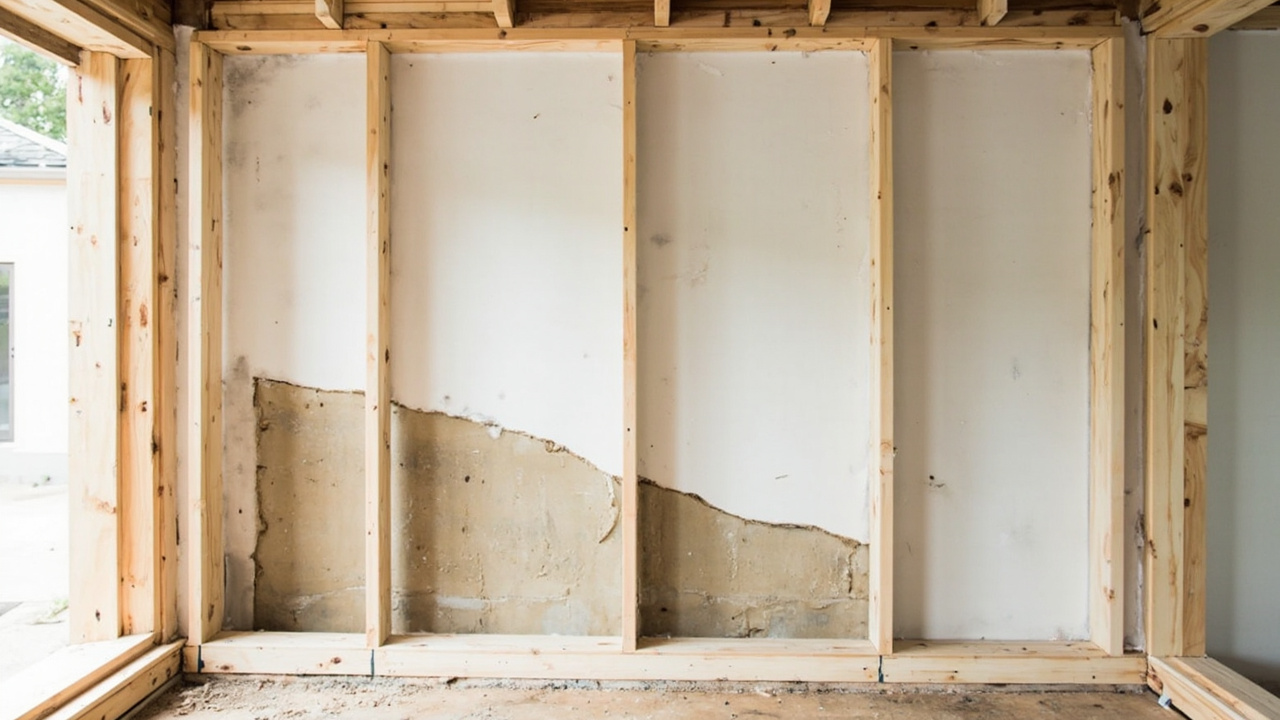
Standard residential framing is not designed for constant exposure to pool-adjacent humidity. A typical indoor pool enclosure maintains relative humidity levels well above what OSB sheathing and dimensional lumber can handle long-term. When vapor barriers fail or were never installed correctly, that moisture soaks into the wall cavity and starts breaking down the framing from the inside out.
Chlorine and salt compounds from pool water accelerate the process. Chlorine off-gassing attacks metal fasteners, corrodes copper wiring, and degrades adhesives in engineered wood products. This is not the same environment as a wet basement in Ferndale or a flooded first floor in Corktown. Pool house water damage has its own chemistry, and that chemistry requires specific remediation methods.
Common Causes of Pool House Flooding in Oakland County
Understanding the source of the leak is the first step in stopping ongoing damage. Pool houses fail for a predictable set of reasons, and most of them are avoidable with the right maintenance schedule.
Pool Pump and Equipment Room Failures
The equipment room is the most common origin point for hidden water damage. Pool pump seals fail, filter housings crack, and backwash line fittings work loose over time. A slow leak from the return manifold can saturate the equipment room floor for weeks before anyone notices. By then, the water has wicked into the sole plate, traveled up the stud bays, and created a perfect mold environment inside a closed wall cavity.
Pump room floors in most residential pool houses are not sloped to a floor drain. Water pools against the walls and sits. This is one of the first things an IICRC Certified Technician checks during a pool house assessment.
Michigan Freeze-Thaw Damage to Supply and Return Lines
Southeast Michigan winters are hard on buried pool plumbing. When winterization is incomplete or the pool house lacks adequate insulation around supply and return lines, the freeze-thaw cycle fractures PVC at joints and fittings. The leak is often below grade and does not surface until spring, by which point the surrounding soil has been saturated and moisture has already migrated into the foundation of the pool house.
This is a recurring issue for pool houses built in the 1990s and early 2000s throughout Oakland County, where underground plumbing was often installed without the insulation sleeves now required by current Michigan Residential Code. Proper Michigan winterization of pool plumbing lines is not optional in this climate. It is the difference between a minor repair and a framing replacement.
Drainage Failures During Heavy Midwest Storm Events
Novi sits in a drainage basin that has historically experienced flash flooding during heavy rain events. Pool house structures are often low-lying relative to the main house, and their drainage systems are frequently undersized. When the main pool deck drain backs up or the yard drainage overwhelms the system, water enters through door thresholds, through foundation cracks, or through inadequate window flashing. It collects in the lowest point of the structure and sits.
How to Find Hidden Leaks Before They Destroy the Framing
Most pool house leaks are not dramatic. There is no burst pipe spraying water across the room. The damage happens slowly and quietly, which is why you need to look for it deliberately.
- Check the equipment room floor at the base of all wall connections. Press the drywall near the floor. Soft or crumbling material is a red flag.
- Look at the bottom of door frames leading from the pool deck into the cabana or enclosure. Rot at the base of door jambs indicates chronic water intrusion at the threshold.
- Inspect the ceiling directly beneath any skylight or vent penetration. Pool house skylights deal with extreme condensation. Improper flashing around penetrations is a leading cause of hidden roof leaks in these structures.
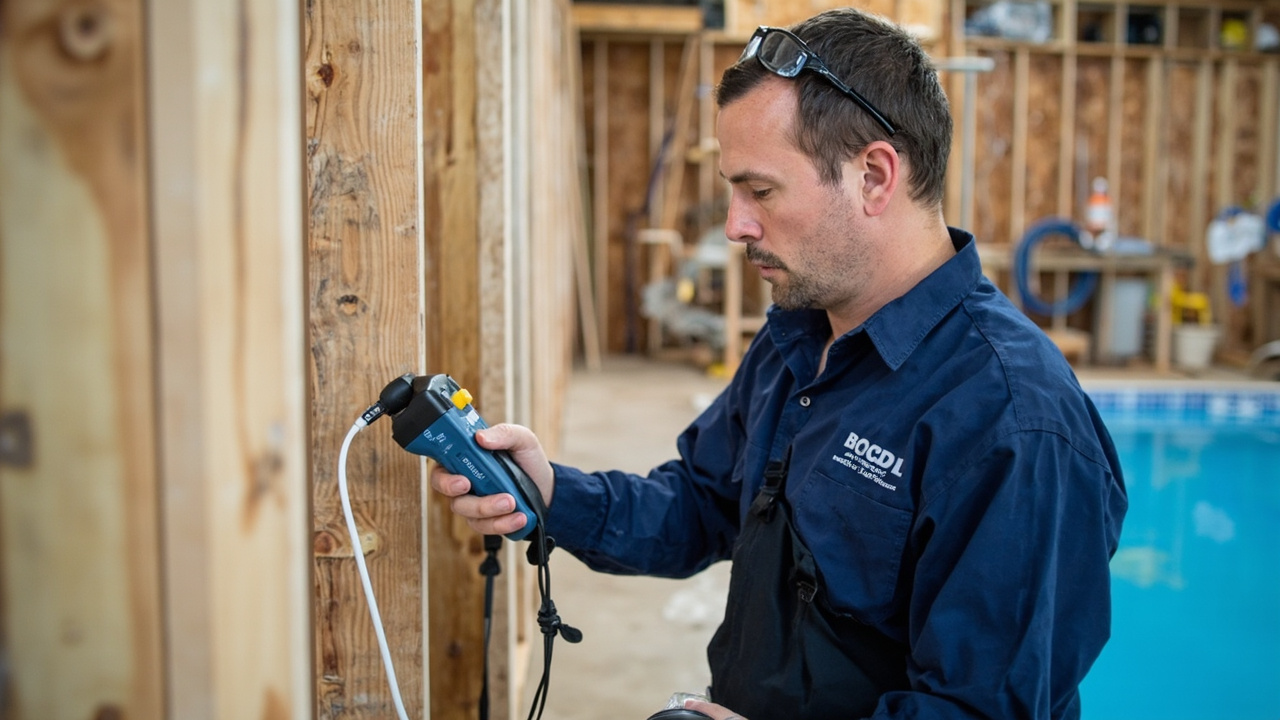
- Use a moisture meter on the lower 24 inches of all exterior and interior walls. Readings above 16 percent in wood framing indicate a problem. Readings above 20 percent signal active decay risk.
- Smell the space carefully. A chlorine smell is normal. An earthy, musty odor underneath the chlorine smell points to mold growth inside a wall or floor cavity.
- Check the vapor barrier on any crawl space or slab perimeter. Tears, gaps, or missing sections allow ground moisture to migrate upward into the floor assembly.
What Happens to Framing When Moisture Goes Unchecked
Wood rot is a biological process driven by fungi. Those fungi need moisture content above roughly 19 percent to become active. In a pool house that stays humid year-round, framing members can sit at elevated moisture content for months, giving rot fungi exactly what they need to establish colonies inside the wall cavity.
Once structural rot begins, it spreads faster than most homeowners expect. A single compromised stud can transmit decay to the top plate, the bottom plate, and adjacent sheathing within one season. By the time a floor feels soft underfoot or a wall develops visible staining, the structural integrity of the framing may already be compromised. This is not a cosmetic problem. It is a load-bearing problem that affects the safety of the structure.
The EPA’s guidance on mold and moisture in building materials confirms that structural wood decay and mold growth are directly linked to chronic elevated moisture conditions. Treating the mold without addressing the underlying moisture source is pointless. The mold comes back.
The Restoration Process for Pool House Water Damage
Pool house restoration is not the same process as restoring a flooded basement in Sterling Heights or pulling wet carpet in a Birmingham home. The chemistry, the humidity levels, and the structural considerations are different. Restoration in this environment follows a specific sequence.
Step 1 – Emergency Water Extraction and Safety Isolation
The first priority is removing standing water and isolating electrical systems near the pool equipment. Pool houses combine high-voltage equipment with a water-rich environment. Before any restoration work begins, the electrical panel serving the pool equipment room must be assessed and isolated if needed. This is not optional.
Truck-mounted extraction equipment removes standing water from the equipment room floor, the pool deck area, and any finished interior spaces. Submersible pumps handle deeper accumulation in low-lying areas.
Step 2 – Structural Drying with Commercial Dehumidification
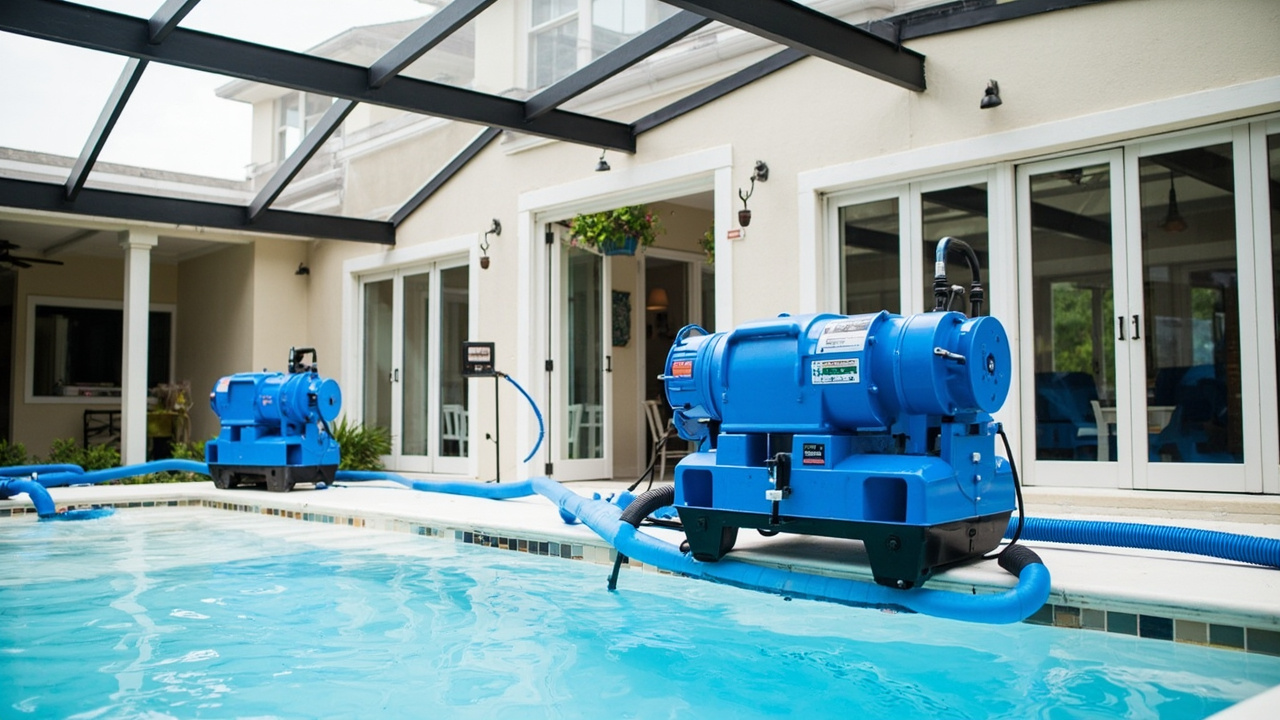
Standard residential dehumidifiers are not adequate for pool house environments. LGR (Low Grain Refrigerant) dehumidifiers and desiccant dehumidifiers are deployed depending on the ambient conditions. Pool enclosures require aggressive dehumidification because the concrete and tile surfaces continue releasing moisture into the air even after the visible water is gone.
Structural drying targets are set based on IICRC S500 Standard protocols. Temperature, humidity, and moisture content readings are logged daily. Drying typically requires 3 to 5 days for minor intrusions and up to 14 days for severe framing damage, depending on the extent of the affected area.
Step 3 – Chlorine Residue Cleaning and Neutralization
This is the step that separates pool house restoration from standard water damage work. Pool water carries chlorine compounds, algaecides, and pH-adjusting chemicals that leave residue on surfaces after the water dries. These residues are corrosive to metal fasteners, HVAC components, and copper wiring. They also interfere with adhesives used during reconstruction.
Proper chlorine neutralization uses specific chemical neutralizers applied to affected surfaces before any antimicrobial treatment. Skipping this step leads to ongoing corrosion of structural fasteners and electrical components even after the visible damage is repaired.
Step 4 – Mold Remediation and Vapor Barrier Repair
If mold colonies are found in wall cavities or under flooring, remediation follows IICRC S520 Standard protocols for mold remediation. Affected materials are removed, contained, and disposed of properly. After structural drying confirms moisture levels are within acceptable ranges, antimicrobial treatments are applied and vapor barriers are repaired or replaced.
Vapor barrier repair in a pool house is critical. A failed or improperly installed vapor barrier is often the root cause of recurring moisture problems. Replacement should use a minimum 20-mil reinforced polyethylene sheeting rated for high-humidity environments.
Why Pool House Damage Requires Specialized Expertise
The table below compares pool house water damage restoration to standard basement flood restoration to illustrate why the same crew and equipment cannot handle both situations equally well.
| Factor | Pool House Restoration | Standard Basement Flood |
|---|---|---|
| Water Chemistry | Chlorinated, chemical-laden water requiring neutralization | Clean water, gray water, or groundwater |
| Ambient Humidity | Chronically elevated, often 70 to 90 percent RH year-round | Elevated only during and after flood event |
| Electrical Hazards | High-voltage pool equipment, bonding grid, GFCI requirements | Standard residential wiring |
| Structural Materials | Often includes engineered wood, tile backer, specialty panels | Standard drywall, dimensional lumber, concrete block |
| Vapor Barrier Requirements | High-mil reinforced barrier for continuous moisture exposure | Standard 6-mil poly sheeting |
| Dehumidification Equipment | LGR and desiccant units required | Standard LGR units typically sufficient |
If you need context on how insurance interacts with this type of specialized restoration, the process for getting your Detroit home insurance to actually pay for water restoration matters here. Pool house claims are often contested by insurers because adjusters unfamiliar with these structures may undervalue the scope of work required.
Restoration Timelines and What to Expect at Each Stage
| Stage | Typical Timeframe | Key Actions |
|---|---|---|
| Emergency Response and Assessment | Within 2 to 4 hours of call | Electrical isolation, moisture mapping, water extraction begins |
| Initial Drying Phase | Days 1 through 3 | LGR and desiccant dehumidifiers deployed, air movers positioned |
| Monitoring and Adjustment | Days 3 through 7 | Daily moisture readings logged, equipment adjusted based on psychrometric data |
| Mold Remediation (if needed) | Days 5 through 10 | Containment, removal, antimicrobial application, clearance testing |
| Structural Assessment and Rebuild Scope | After drying is confirmed complete | Framing inspection, vapor barrier replacement, documentation for insurance |
| Reconstruction | 1 to 4 weeks depending on scope | Framing replacement, sheathing, insulation, finished surfaces |
Insurance Claims for Pool House Water Damage
Pool house claims are more complicated than standard water damage claims. Most homeowners insurance policies cover sudden and accidental water damage but exclude damage caused by long-term moisture intrusion, poor maintenance, or flooding from surface water. The line between those categories is where disputes happen.
Document everything before any work begins. Photograph the moisture readings on your meter, the visible damage to framing and drywall, and the condition of the pool equipment. A restoration company that generates a detailed scope of work with moisture logs and psychrometric data gives your insurance adjuster the documentation they need to process the claim accurately.
If your insurer pushes back on the scope, the process of filing a successful water damage insurance claim is worth reviewing before you sign anything with your adjuster. The same principles that apply to residential claims apply here, with the added complexity of the pool house being classified as a secondary structure.
Mold in Pool Houses Is a Different Animal
The mold you find in a pool house is not the same as typical basement mold. High chlorine environments initially suppress some mold species. But certain chlorine-tolerant strains thrive in exactly these conditions, and they establish deep into porous materials before they become visible on the surface.
If you have found mold in your pool house, the same logic applies as with any high-humidity structure. Bleach on a painted surface does not reach the mold growing inside the wall cavity. If you want to understand why surface treatments fail and when professional remediation is the only answer, the breakdown on why bleach won’t fix basement mold explains the underlying biology clearly.
Protecting Wood Floors and Finished Surfaces Inside Pool Houses
Some Novi pool houses include finished interior spaces with hardwood or engineered wood flooring. These surfaces face an almost impossible moisture environment. When water intrusion reaches wood flooring in a pool house, the response timeline is critical. The same cupping, crowning, and delamination issues that affect flooded hardwood in a main residence apply here, but the ambient humidity makes drying far more difficult.
If your pool house has wood flooring that has been exposed to water, the guidance on saving hardwood floors after a water leak gives you a realistic picture of what can be saved and what cannot.
Serving Novi and the Greater Oakland County Area
The restoration team responding to your pool house in Novi also services West Bloomfield, Wixom, Northville Township, South Lyon, and the surrounding Oakland and Washtenaw County communities. If you are closer to Twelve Oaks Mall on the east side of Novi or out near the wetlands near Lakeshore Park, the response time is the same. 24-hour emergency response means exactly that, not business hours with an after-hours number.
Pool house water damage does not wait for Monday morning. Hidden framing rot does not pause on weekends. The faster the drying process begins, the smaller the scope of reconstruction becomes. Every hour matters when wood framing is saturated.
If you are seeing signs of moisture in your Novi pool house, or if you have just discovered standing water in an equipment room or cabana, call for an assessment now. A moisture mapping inspection takes less than an hour and gives you a clear picture of what is actually happening inside those walls before you are looking at a full framing replacement.
{
“@context”: “https://schema.org”,
“@type”: “BlogPosting”,
“headline”: “Tracking Down Hidden Leaks in Your Novi Pool House Before They Rot the Framing”,
“description”: “Pool house water damage in Novi moves fast. Learn how hidden leaks destroy framing, and when to call an IICRC-certified restoration team in Oakland County.”,
“wordCount”: 2365,
“datePublished”: “2026-07-02T10:29:00.000Z”,
“dateModified”: “2026-07-02T10:29:00.000Z”,
“inLanguage”: “en-US”,
“mainEntityOfPage”: {
“@type”: “WebPage”,
“@id”: “https://ironwoodwaterdamagerestorationdetroit.com”
},
“publisher”: {
“@type”: “LocalBusiness”,
“name”: “Ironwood Water Damage Restoration Detroit”,
“url”: “https://ironwoodwaterdamagerestorationdetroit.com”
},
“author”: {
“@type”: “Organization”,
“name”: “Ironwood Water Damage Restoration Detroit”,
“url”: “https://ironwoodwaterdamagerestorationdetroit.com”
},
“image”: {
“@type”: “ImageObject”,
“url”: “https://ironwoodwaterdamagerestorationdetroit.com/wp-content/uploads/2026/03/tracking-down-hidden-leaks-in-your-novi-pool-house-1.jpg”
}
}
{
“@context”: “https://schema.org”,
“@type”: “LocalBusiness”,
“name”: “Ironwood Water Damage Restoration Detroit”,
“url”: “https://ironwoodwaterdamagerestorationdetroit.com”,
“address”: {
“@type”: “PostalAddress”,
“addressLocality”: “Detroit”
},
“areaServed”: {
“@type”: “City”,
“name”: “Detroit”
}
}
{
“@context”: “https://schema.org”,
“@type”: “BreadcrumbList”,
“itemListElement”: [
{
“@type”: “ListItem”,
“position”: 1,
“name”: “Home”,
“item”: “https://ironwoodwaterdamagerestorationdetroit.com”
},
{
“@type”: “ListItem”,
“position”: 2,
“name”: “Blog”,
“item”: “https://ironwoodwaterdamagerestorationdetroit.com/blog”
},
{
“@type”: “ListItem”,
“position”: 3,
“name”: “Tracking Down Hidden Leaks in Your Novi Pool House Before They Rot the Framing”
}
]
}
{
“@context”: “https://schema.org”,
“@type”: “Service”,
“serviceType”: “Water Damage Restoration”,
“provider”: {
“@type”: “LocalBusiness”,
“name”: “Ironwood Water Damage Restoration Detroit”,
“url”: “https://ironwoodwaterdamagerestorationdetroit.com”
},
“areaServed”: {
“@type”: “City”,
“name”: “Detroit”
},
“description”: “Pool house water damage in Novi moves fast. Learn how hidden leaks destroy framing, and when to call an IICRC-certified restoration team in Oakland County.”
}