
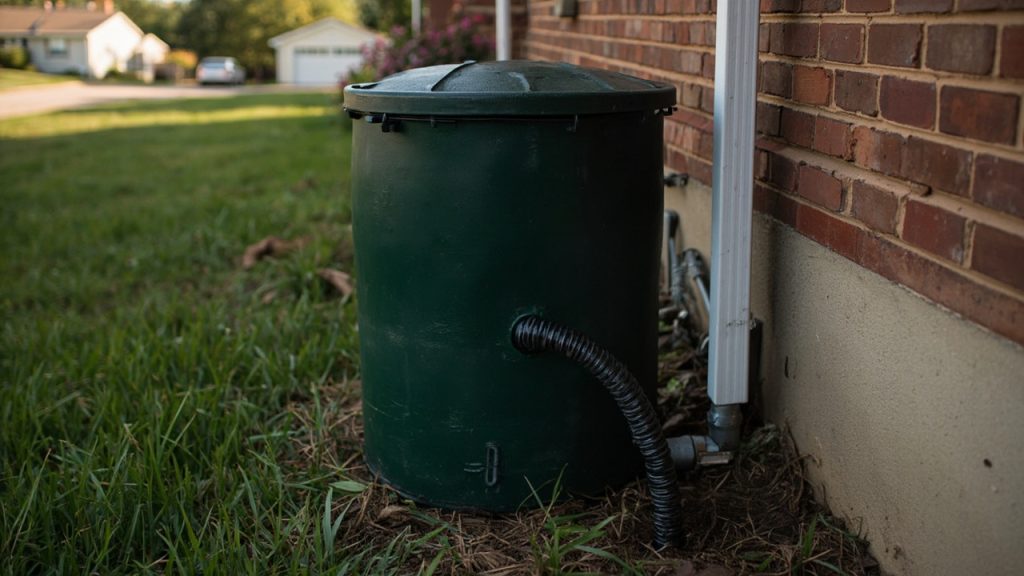
Your rain barrel is sitting right next to your foundation, collecting runoff from your downspout, and you feel good about doing something green for the neighborhood. That good intention might be sending water straight into your basement wall.
Across Detroit, rain barrel adoption has increased significantly as the Detroit Water and Sewerage Department (DWSD) has promoted green infrastructure and stormwater credit programs. But installation guides rarely explain what happens when a 55-gallon barrel fills up and the overflow has nowhere safe to go.
If you have a rain barrel near your home and you are seeing water in your basement, this article explains exactly how that connection works and what you need to do about it.
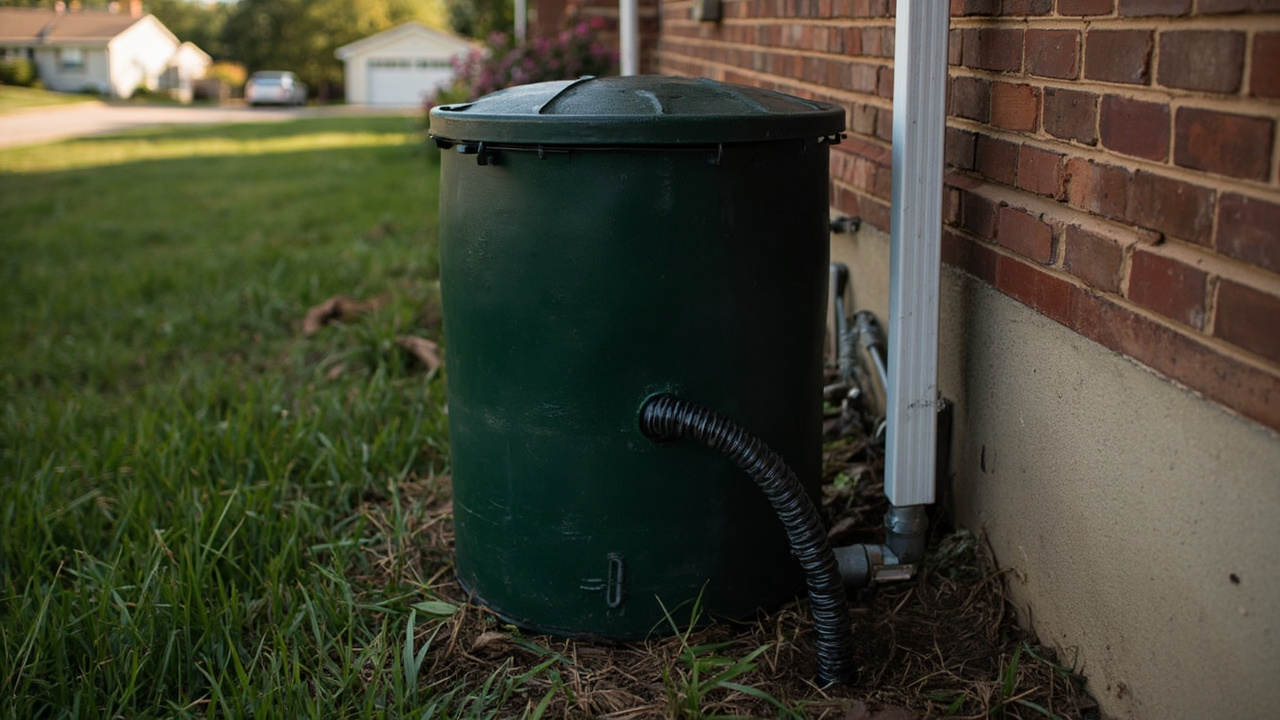
How a Rain Barrel Creates a Foundation Problem
A standard 55-gallon rain barrel fills up fast. During a one-inch rainfall event, a 1,000 square foot roof sheds roughly 600 gallons of water. Your barrel reaches capacity in the first few minutes. Everything after that is overflow.
When your overflow spout is not directed far enough from your foundation, that excess water dumps directly into the soil at the base of your house. Day after day, storm after storm, that soil becomes saturated. Saturated soil pushes back against your foundation walls through a force called hydrostatic pressure.
Hydrostatic pressure is the weight and force of water-logged soil pressing against a surface. Basement walls are not designed to resist that kind of sustained lateral force indefinitely. Over time, cracks form, seams open, and water finds a path inside.
Why Detroit’s Clay Soil Makes Rain Barrel Placement Critical
Detroit sits on a thick layer of glacial clay soil. This soil type does not drain well. Water sits in it. And clay has another characteristic that makes it particularly dangerous for foundations: it expands when wet and contracts when dry.
That expansion and contraction cycle is sometimes called the bowl effect. When clay near your foundation absorbs water, it swells and pushes inward against your basement walls. When it dries out, it pulls away, leaving gaps that future water rushes into. Each cycle puts mechanical stress on your foundation that compounds over time.
Neighborhoods like East English Village, Rosedale Park, and Palmer Woods all have older homes sitting on dense clay subsoil. Rain barrel overflow in these areas does not dissipate the way it might in sandy or loamy regions. It pools, it saturates, and it builds pressure.
Detroit also averages around 33 inches of rainfall annually, with the heaviest events concentrated in spring and early summer. That is enough to fill and overflow an average rain barrel dozens of times per season.
5 Warning Signs Your Rain Barrel Is Damaging Your Foundation
These signs appear near the area of your foundation closest to the barrel. Do not ignore them.
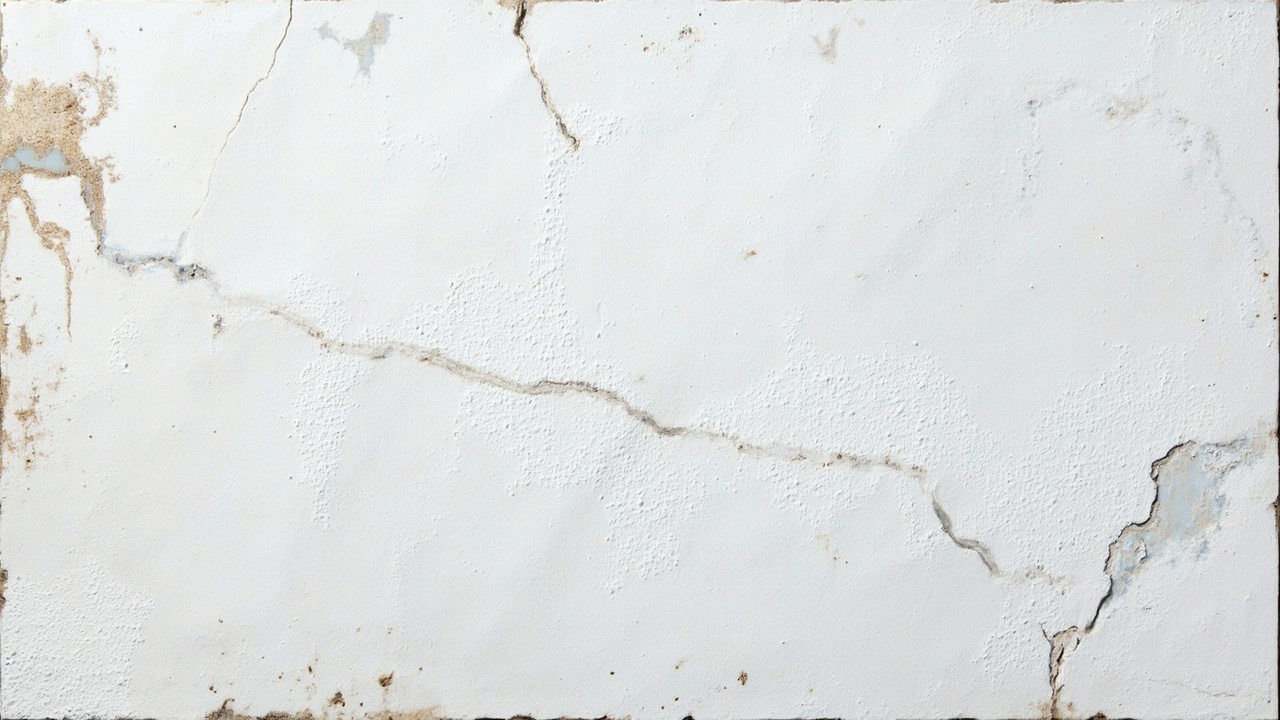
- Hairline cracks in the basement wall near the barrel side of the house. These look minor but can widen quickly once hydrostatic pressure finds a weak point.
- Efflorescence on block or poured concrete walls. That white, chalky powder is mineral salt left behind when water moves through concrete and evaporates. It is a reliable indicator of water migration through the wall.
- Musty odor concentrated in one area of the basement. This usually means moisture has been present long enough for microbial growth to begin. If you suspect mold, read our guide on why bleach won’t fix your Ferndale basement mold before reaching for a cleaning product.
- Bowing or bulging basement walls. Any visible inward curve in a foundation wall is a structural emergency. This means hydrostatic pressure has already exceeded the wall’s resistance.
- Soil erosion or depression near the barrel base. A visible dip or washout in the soil next to your foundation means water is already moving through that area at high volume.
Hydrostatic Pressure and What It Actually Does to a Basement Wall
Most homeowners understand that water can come in through a crack. Fewer understand that water can create the crack itself.
When soil around your foundation becomes saturated, every cubic foot of that wet soil exerts pressure. That pressure does not stay still. It looks for the path of least resistance. In an older Detroit home, that path is often a mortar joint in a block wall, a cold joint in poured concrete, or a tie hole left over from original construction.
The force compounds with depth. Water pressure at the base of a standard 8-foot basement wall is significantly higher than near the top. That is why you often see the worst seepage or cracking near the floor-to-wall joint, not at eye level.
Freeze-thaw cycles make everything worse. Detroit winters regularly push water inside cracks through repeated expansion and contraction of ice. A hairline crack that lets in a small amount of moisture in October can be a quarter-inch gap by March. Any water that entered through your rain barrel’s overflow in the fall is still sitting in that clay soil, working against your wall through winter.
Comparing Common Rain Barrel Problems and Foundation Risk
| Rain Barrel Issue | Foundation Risk Level | Typical Timeline to Visible Damage |
|---|---|---|
| Overflow spout aimed at foundation | High | One to two seasons |
| Barrel placed within 2 feet of wall | High | One to three seasons |
| Overflow hose less than 4 feet long | Moderate | Two to four seasons |
| No winterization, ice formation at base | Moderate to High | After first freeze-thaw cycle |
| Barrel on level or negative-grade ground | Moderate | Two to five seasons |
| Properly set up with 6+ foot overflow discharge | Low | Not typical if maintained |
Best Practices for Safe Rain Barrel Installation in Michigan
Getting the benefits of rainwater collection without damaging your foundation requires attention to a few non-negotiable details.
Overflow Discharge Distance
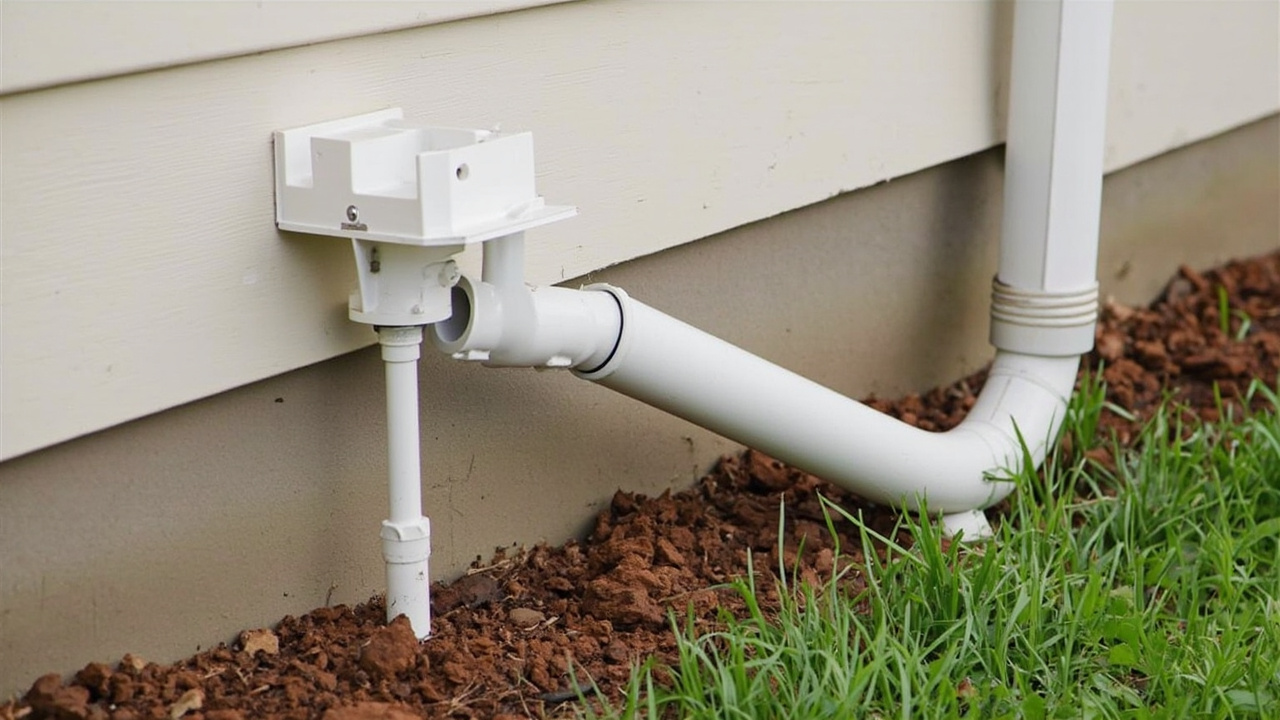
Your overflow hose needs to direct water a minimum of 6 feet away from your foundation, and 10 feet is better on Detroit’s clay soil. The overflow should also discharge onto a slope that grades away from the house, not toward it. A flat discharge onto level ground just pools water in place.
Downspout Diverter Placement
Use a downspout diverter kit to connect your barrel to the gutter system. When the barrel is full, the diverter should automatically redirect water back into the downspout extension, which should run at least 4 to 6 feet from the foundation. Do not rely on a simple overflow bung hole at the top of the barrel as your only overflow management.
Ground Grading Around the Barrel
The soil around your barrel should slope away from the house at a minimum grade of 1 inch per foot for the first 6 feet. If the ground near your foundation is flat or slopes toward the house, fix that grading problem before adding any water collection system nearby.
Winterization Before First Freeze
Detroit’s freeze-thaw cycle is aggressive. A barrel left full through a freeze will crack, and more importantly, any standing water at its base will freeze against your foundation. Drain and disconnect your barrel before temperatures drop consistently below freezing. Reconnect the downspout extension for winter months.
Barrel Elevation and Stability
A full 55-gallon barrel weighs roughly 450 pounds. Make sure it sits on a stable, level platform. An unstable barrel that tips or shifts can direct concentrated overflow in the wrong direction. Cinder block platforms work well and prevent the barrel from sinking into soft soil over time.
Rain Barrel Setup Quick Reference for Detroit Homeowners
| Installation Factor | Minimum Recommendation | Ideal for Detroit Clay Soil |
|---|---|---|
| Overflow discharge distance | 5 feet from foundation | 8 to 10 feet |
| Ground slope away from house | 1 inch per foot | 1.5 inches per foot for 6+ feet |
| Barrel distance from foundation wall | 2 feet | 4 to 6 feet |
| Winterization deadline | Before first hard freeze | By mid-October in most years |
| Overflow hose length | 4 feet | 6 to 8 feet |
| Downspout diverter auto-redirect | Recommended | Required for clay soil sites |
How to Tell If Your Foundation Already Has Water Damage
You can do a basic self-inspection before calling a professional. Walk your basement perimeter and look for the five signs listed earlier in this article. Pay close attention to the wall section closest to where your rain barrel sits outside.
Run a dehumidifier in your basement for 48 hours, then check the collection tank. Excessive moisture output in a short period indicates elevated ambient humidity, which is often the first measurable sign of foundation seepage before visible cracks appear.
Check your sump pump if you have one. If it is running more frequently than usual during dry weather, that is a signal that groundwater is entering the space around your foundation at a higher rate than normal. Sump pump failure during a wet season on a saturated site is one of the most common calls we handle across Detroit metro neighborhoods like Jefferson-Chalmers, Grandmont, and Bagley.
The EPA’s green infrastructure guidance emphasizes proper discharge management as a core requirement of responsible rainwater harvesting. The environmental benefit disappears quickly if your system is funneling water into a place it was never meant to go.
When This Becomes a Professional Job
There is a clear line between a drainage adjustment you can make yourself and structural damage that requires professional assessment.
You can handle repositioning the barrel, extending the overflow hose, correcting the ground grade, and winterizing the system on your own. Those are maintenance tasks.
The moment you see bowing walls, active water seeping through cracks, efflorescence covering large sections of your basement, or a floor-to-wall joint that is separating, you need a professional inspection. These are signs that hydrostatic pressure has already done structural work on your foundation.
Foundation seepage also creates conditions for mold growth within 24 to 72 hours of a moisture event. If you have had standing water in your basement, that secondary damage can become a significant remediation project. Understanding your coverage options matters at that point. Our resource on how to get your Detroit home insurance to actually pay for water restoration walks through what is typically covered and how to document the claim correctly.
If the damage happened near a specific area of your home and you are dealing with secondary damage like wet flooring, the situation escalates. Water migrating through a foundation wall can reach hardwood floors, carpet, and drywall. For flooring-specific guidance, see our article on how to save your hardwood floors after a significant water leak.
IICRC-certified technicians use moisture meters, infrared cameras, and structural assessment tools to map exactly where water is entering and how far it has traveled inside wall cavities and subfloor systems. This is not guesswork. It is a systematic diagnostic process that tells you precisely what you are dealing with before any remediation work begins.
What Detroit Homeowners Often Overlook After Fixing the Drainage
Repositioning your rain barrel is the right first step. But if water has already entered your basement, stopping the source does not reverse the damage already done.
Concrete and block walls that have experienced sustained moisture often have compromised mortar joints, mineral deposits inside the pore structure, and elevated interior humidity that persists for weeks after the exterior source is removed. Mold can establish in wall cavities within days of a seepage event and remain invisible until it has colonized a large area.
If you have had visible water in your basement this season, and you have a rain barrel near your foundation, a professional moisture assessment is worth scheduling before winter. Catching damage in the early stage is significantly less disruptive than finding it after a freeze-thaw cycle has widened every crack the water opened.
For homeowners in Corktown and other older neighborhoods with brick or block foundations, insurance documentation also matters. Our guide on filing a successful water damage insurance claim for your Corktown home covers exactly what adjusters look for and what documentation you need from the start.
Rain barrels are a good tool for Detroit homeowners. They reduce stormwater runoff, lower utility costs, and help manage the volume of water entering the combined sewer system. None of that benefit is worth a damaged foundation. A few simple adjustments to your setup protect both goals at once.
If you have questions about what you are seeing in your basement, or you want a professional to assess the situation before it gets worse, reach out. A site visit takes less than an hour and gives you a clear picture of what you are working with.