

If you live in one of West Village’s older brick apartment buildings and keep finding that fuzzy gray-green growth in your closet, you are not dealing with bad luck. You are dealing with physics. Specifically, the physics of cold walls, trapped air, and Great Lakes humidity colliding inside a space that gets almost zero airflow. This is one of the most common complaints we hear from Detroit renters, and the fix is more specific than just “crack the door open.”. Read more about Managing Unexpected Humidity in Your New Ferndale Basement Apartment.

Why Detroit Closets Are a Perfect Mildew Breeding Ground
West Village sits between East Jefferson and Mack Avenue, filled with apartment buildings constructed mostly between the 1920s and 1950s. These structures were built with solid brick masonry, which was excellent for durability but creates a significant problem in Michigan winters. Brick conducts cold from the outside directly into your wall cavity. That cold surface then meets the warm, humid interior air inside your closet.
This is called thermal bridging. The exterior wall behind your hanging clothes sits at a much lower temperature than the air in your living room. When warm, moist air migrates into that small, dark closet space and contacts that cold wall surface, it drops below its dew point. Water vapor becomes liquid water. That thin layer of moisture on drywall, wood trim, or clothing fibers is all a mildew colony needs to establish itself.
Detroit’s climate makes this worse than most cities. Summers along the Great Lakes push outdoor relative humidity (RH) past 80% for weeks at a time. Then winter drops outdoor RH dramatically, but your heating system runs constantly, and cooking, showering, and breathing add moisture indoors. The cycle creates two distinct mildew seasons, not one.
The Science Behind Closet Moisture Buildup
Relative humidity measures how much water vapor air holds compared to its maximum capacity at a given temperature. The EPA recommends keeping indoor RH between 30% and 50% to suppress mold and mildew growth. Closets almost always run higher than the rest of your apartment.
Here is why. Your living room benefits from air movement, HVAC circulation, and heat from lighting and electronics. Your closet gets none of that. The door stays closed most of the day. Clothes trap moisture from your body. Shoes bring in outdoor humidity. The result is a microenvironment that can sit at 65% to 75% RH even when your living room reads a comfortable 45%.
Dew point is the specific temperature at which air becomes saturated and water condenses. In Detroit’s humid summers, the outdoor dew point regularly reaches 65°F or higher. In a poorly insulated closet with a cold exterior wall, that dew point threshold gets crossed easily, even indoors. That is the moment mildew growth begins.
Microbial Volatile Organic Compounds (mVOCs) are the chemical byproducts mildew and mold release as they metabolize. That musty smell you notice when you open the closet door? That is mVOCs. The presence of that odor means biological growth is already active, even if you cannot see it yet.
Detroit Humidity Risk Calendar for Apartment Closets
| Season | Months | Primary Risk Factor | Avg Outdoor RH | Closet Risk Level |
|---|---|---|---|---|
| Late Spring | April, May | Thawing walls, rising outdoor humidity | 65 to 72% | Moderate |
| Summer | June, July, August | Great Lakes humidity, high dew points | 72 to 82% | High |
| Early Fall | September, October | Temperature swings, condensation on walls | 68 to 75% | High |
| Winter | November through March | Cold wall surfaces, indoor heat trapping moisture | 55 to 65% (indoor spike) | Moderate to High |
Seven Prevention Steps That Actually Work in Older Detroit Apartments
Generic advice like “buy a dehumidifier” misses the specific challenges of an older West Village or Islandview apartment. These steps are ranked by impact.
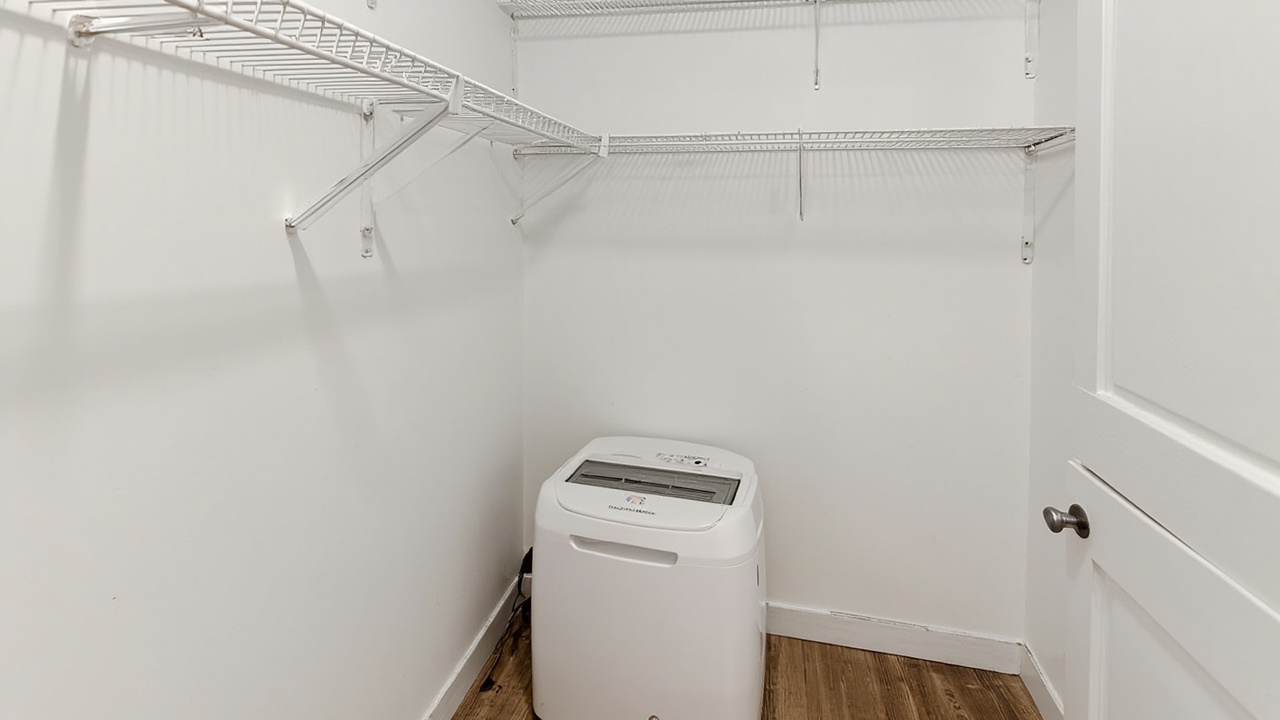
- Install a small clip-on or plug-in mini dehumidifier inside the closet. Units designed for enclosed spaces (look for models rated for 100 to 150 cubic feet) pull moisture directly from the closet air rather than relying on the room’s HVAC to do the job.
- Switch from wood rod and shelf systems to wire shelving. Wire shelving allows air to circulate around hanging clothes. Solid wood shelves create dead air pockets directly against the back wall, which is almost always the exterior wall in West Village units.
- Place desiccant packets (silica gel) in the corners and on shelves. Silica gel is a passive moisture absorber that works without electricity. Replace or recharge them every 4 to 6 weeks during summer months. Look for rechargeable silica gel containers with a color indicator.
- Leave the closet door cracked or slightly open when the room is occupied. Even a 2-inch gap introduces enough cross-ventilation to break the stagnant air cycle and equalize humidity between the closet and the room.
- Switch to LED lighting inside the closet if you have a fixture. Incandescent bulbs generate heat, which creates minor convective air currents that can slightly warm the back wall. LED bulbs run cooler, which sounds counterintuitive, but they also reduce the temperature differential that drives condensation when the light is off for hours.
- Store dry-cleaned items outside the plastic garment bags. Dry-cleaning plastic seals moisture against fabric. Clothes release moisture slowly over days, and that moisture has nowhere to go inside a sealed bag except onto the garment and surrounding surfaces.
- Check the exterior wall inside your closet for efflorescence. Efflorescence is the white, chalky salt residue left when water migrates through masonry and evaporates. If you see it on your closet wall, water is actively moving through the brick. That requires a conversation with your landlord about waterproofing, not just a desiccant pack.
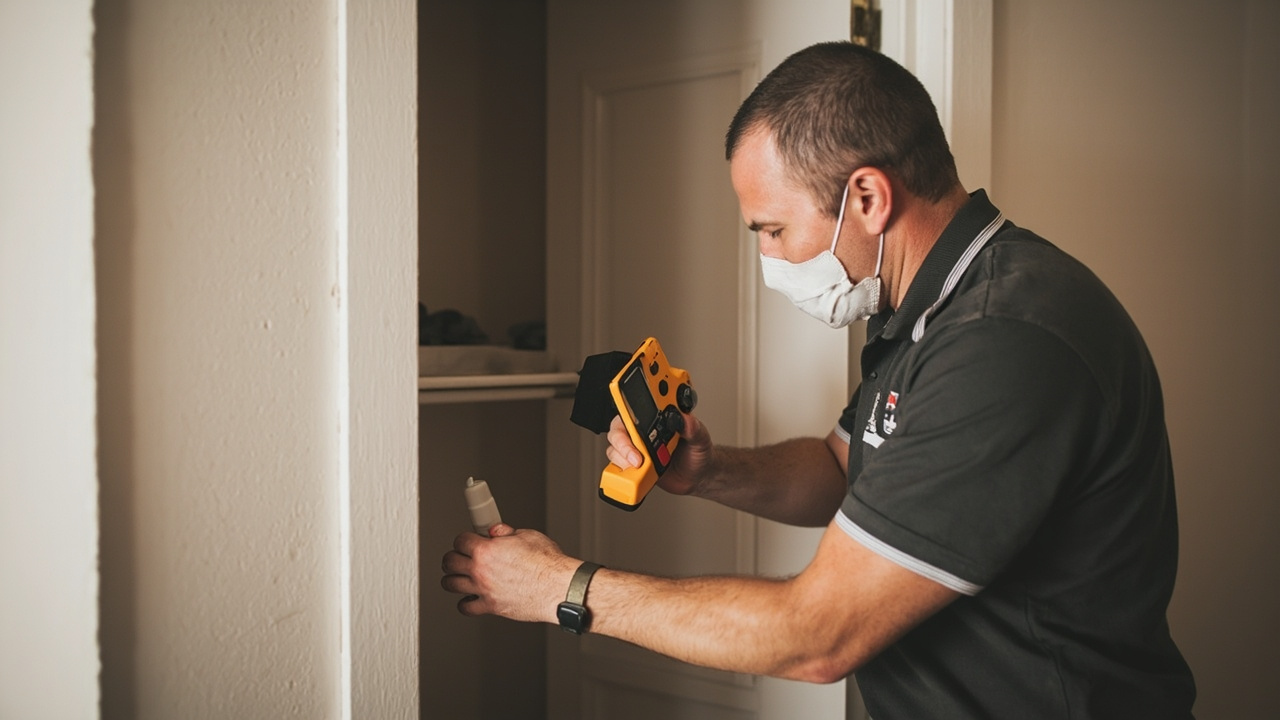
Mildew vs. Mold in Your Closet — What You Are Actually Looking At
Mildew and mold are not the same thing, and knowing the difference matters for your health and for deciding what to do next.
Mildew is a surface-level fungal growth. It appears flat, powdery, and usually gray or white. It grows on the surface of materials, which means it can often be wiped away with an antimicrobial cleaner. It smells musty but generally does not cause structural damage to walls or wood.
Mold grows into the material. It is typically fuzzy or raised, often black, green, or dark brown. Stachybotrys chartarum (what people call “black mold”) thrives in consistently wet cellulose materials like drywall and wood framing. If you wipe it away and it comes back within days, or if you see discoloration spreading behind baseboards or beneath the carpet at the closet threshold, you are past mildew territory.
A note worth making here: bleach does not fix mold in porous materials. It bleaches the surface color but does not kill the mycelium growing inside drywall or wood. This is one of the most common DIY mistakes we see across Detroit, from Ferndale to the Corktown flats.
Comparing Prevention Tools for Detroit Renters
| Tool | How It Works | Best For | Maintenance Required | Effectiveness in Small Closets |
|---|---|---|---|---|
| Mini Electric Dehumidifier | Pulls water vapor from air via refrigerant coil | Summer months, high-humidity apartments | Empty reservoir weekly | High |
| Silica Gel Desiccant | Passive adsorption of moisture into gel beads | Small closets, winter months | Recharge or replace every 4 to 6 weeks | Moderate |
| DampRid Crystals | Calcium chloride absorbs moisture into liquid | Short-term use, seasonal closets | Replace container when dissolved | Moderate |
| Wire Shelving System | Improves air circulation around stored items | All closets in older buildings | None | High (combined with other tools) |
| Antimicrobial Paint (Mildew-Resistant) | Surface coating that inhibits fungal growth | Prevention after remediation | Reapply every 3 to 5 years | Moderate (preventive only) |
When Your Closet Mildew Points to a Bigger Problem
Sometimes the mildew in your closet is not about humidity management at all. It is about water intrusion. In older West Village and East Jefferson corridor apartments, these are the most common hidden sources we find during inspections.. Read more about The Hidden Reason Your Corktown Art Studio Always Feels Damp in the Summer.
A slow pipe leak inside the wall cavity will create persistent moisture no dehumidifier can overcome. If one corner of your closet is always wetter than the rest, or if the baseboard feels soft when you press on it, a pipe may be seeping. This is especially common in buildings where galvanized steel supply lines were never replaced.
Roof drainage problems show up in top-floor closet corners. Detroit’s flat and low-slope roofs, common on the area’s brick apartment blocks, collect standing water when drains clog. That water eventually finds a path through the roof deck, down through the top-floor ceiling, and into the wall cavity. You may not see a water stain on the ceiling, but you will smell it in the closet.
If you suspect hidden water damage behind your closet wall, this is not a situation to address with more silica gel. Water trapped inside a wall cavity causes structural damage quickly, and the IICRC (Institute of Inspection, Cleaning and Restoration Certification) standards for water damage restoration require identifying the moisture source before any remediation work begins. Skipping that step means the mold comes back.
What IICRC-Certified Remediation Actually Involves
When prevention has already failed and you are looking at active mold growth, the process a certified restoration professional follows is specific. It is not a spray-and-wipe job.
The first step is containment. Poly sheeting and negative air pressure prevent spores from spreading to adjacent rooms during the removal process. This matters because disturbing mold without containment can increase airborne spore counts significantly throughout the apartment.
HEPA filtration is non-negotiable during and after remediation. Standard shop vacuums recirculate fine particles. HEPA-rated vacuums capture particles down to 0.3 microns, which includes mold spores. After physical removal of affected materials, air scrubbers with HEPA filters run for a minimum of 24 to 48 hours.
Antimicrobial treatment is applied to cleaned surfaces to suppress regrowth. The specific product and application method depend on the substrate. Drywall, concrete block, and wood framing each respond differently to antimicrobials.
Post-remediation clearance testing, performed by an independent industrial hygienist, confirms that spore counts have returned to normal background levels. This is the documentation you want if you are dealing with a landlord dispute or an insurance claim. Speaking of which, navigating a Detroit home insurance claim for water damage and mold requires specific documentation from a certified professional, and the process is easier when you start it correctly.
Renter Responsibilities vs. Landlord Responsibilities in Detroit
Detroit building codes place the responsibility for habitable conditions on the property owner. If mold growth in your closet is caused by a structural defect, a failing vapor barrier, inadequate ventilation built into the original construction, or an active roof or plumbing leak, that is a landlord issue. Document the mold with dated photos. Submit a written maintenance request. Keep copies.
If the mold is caused by lifestyle factors — drying clothes inside the apartment, running a humidifier, never opening the closet — that conversation is different. In practice, most closet mildew situations in older West Village apartments involve both factors. A building with poor insulation and a renter who rarely opens the closet creates a problem faster than either condition alone.
For renters dealing with an unresponsive landlord and confirmed mold affecting their health, Detroit’s Buildings, Safety Engineering, and Environmental Department (BSEED) handles code enforcement complaints. An inspection creates an official record that protects you if the situation escalates.
The Type of Detroit Home Changes the Mildew Pattern
West Village apartments show specific patterns compared to other Detroit housing stock. In the Tudor-style apartment buildings near the Detroit Golf Club neighborhood and Palmer Park, closets often sit in interior hallways with no exterior wall exposure at all. Their mildew problem is almost purely about ventilation and accumulated moisture from stored items, not thermal bridging.
In the brick bungalows common in Bagley, Rosedale Park, and the outer northwest neighborhoods, closets frequently share a wall with the attic or crawlspace. Insulation failures in those spaces create extreme cold surfaces and direct condensation. The fix there involves insulation work, not just dehumidifiers.
East Jefferson high-rise units from the 1960s and 1970s suffer from a different problem. Their curtain wall construction and aging window seals allow exterior air infiltration directly into closet corners. You can sometimes feel a slight draft in the closet even when the windows appear closed.
If you are dealing with persistent mold in a multi-unit building and your neighbors report the same issue, the source is almost certainly structural. Coordinating documentation with neighbors strengthens any insurance or code enforcement action, and professional inspection findings in one unit are often directly applicable to adjacent units.
What to Do Right Now If You See Mildew Today
If the growth is surface-level, flat, and limited to a small area, clean it with an EPA-registered antimicrobial spray and a disposable cloth. Do not scrub aggressively. Wear an N95 mask and gloves. Dispose of the cloth immediately. Then address the underlying humidity problem using the steps above.
If the growth is fuzzy, covers more than a square foot, appears in multiple spots, or smells heavily even after cleaning, contact a certified restoration professional for an assessment. An inspection with moisture metering takes less than an hour and tells you whether the problem is surface mildew or something deeper inside the wall cavity.
You should not have to live with a musty closet because of a building design problem that has a real solution. The mildew did not appear randomly. It appeared because specific physical conditions exist in your space. Understanding those conditions is the first step to stopping them permanently.
If your situation has moved past prevention and into active mold or confirmed water intrusion, reach out to an IICRC-certified restoration team familiar with Detroit’s housing stock. A proper assessment will tell you exactly what you are dealing with and what it takes to resolve it at the source.
You may also find this helpful. The Real Reason Your Bloomfield Hills Walk-In Closet Always Smells Musty.
{
“@context”: “https://schema.org”,
“@type”: “BlogPosting”,
“headline”: “Why Your Tiny West Village Apartment Closet Keeps Growing Mildew (And How to Stop It)”,
“description”: “Detroit renter? Learn why West Village apartment closets breed mildew and get science-backed prevention steps from a local restoration expert.”,
“wordCount”: 2271,
“datePublished”: “2026-08-14T10:59:00.000Z”,
“dateModified”: “2026-08-14T10:59:00.000Z”,
“inLanguage”: “en-US”,
“mainEntityOfPage”: {
“@type”: “WebPage”,
“@id”: “https://ironwoodwaterdamagerestorationdetroit.com”
},
“publisher”: {
“@type”: “LocalBusiness”,
“name”: “Ironwood Water Damage Restoration Detroit”,
“url”: “https://ironwoodwaterdamagerestorationdetroit.com”
},
“author”: {
“@type”: “Organization”,
“name”: “Ironwood Water Damage Restoration Detroit”,
“url”: “https://ironwoodwaterdamagerestorationdetroit.com”
},
“image”: {
“@type”: “ImageObject”,
“url”: “https://ironwoodwaterdamagerestorationdetroit.com/wp-content/uploads/2026/03/why-your-tiny-closet-in-a-west-village-apartment-k-1.jpg”
}
}
{
“@context”: “https://schema.org”,
“@type”: “LocalBusiness”,
“name”: “Ironwood Water Damage Restoration Detroit”,
“url”: “https://ironwoodwaterdamagerestorationdetroit.com”,
“address”: {
“@type”: “PostalAddress”,
“addressLocality”: “Detroit”
},
“areaServed”: {
“@type”: “City”,
“name”: “Detroit”
}
}
{
“@context”: “https://schema.org”,
“@type”: “BreadcrumbList”,
“itemListElement”: [
{
“@type”: “ListItem”,
“position”: 1,
“name”: “Home”,
“item”: “https://ironwoodwaterdamagerestorationdetroit.com”
},
{
“@type”: “ListItem”,
“position”: 2,
“name”: “Blog”,
“item”: “https://ironwoodwaterdamagerestorationdetroit.com/blog”
},
{
“@type”: “ListItem”,
“position”: 3,
“name”: “Why Your Tiny West Village Apartment Closet Keeps Growing Mildew (And How to Stop It)”
}
]
}
{
“@context”: “https://schema.org”,
“@type”: “Service”,
“serviceType”: “Water Damage Restoration”,
“provider”: {
“@type”: “LocalBusiness”,
“name”: “Ironwood Water Damage Restoration Detroit”,
“url”: “https://ironwoodwaterdamagerestorationdetroit.com”
},
“areaServed”: {
“@type”: “City”,
“name”: “Detroit”
},
“description”: “Detroit renter? Learn why West Village apartment closets breed mildew and get science-backed prevention steps from a local restoration expert.”
}