
Professional Terrazzo Floor Water Damage Restoration in Detroit
Your Eastside Detroit home has terrazzo floors that survived decades of Michigan winters, and now a flood threatens to end them. The good news is that terrazzo is far more salvageable than most homeowners expect. The bad news is that the window for action is narrow, and the wrong response can turn a recoverable situation into a permanent loss.. Read more about Why Your Bamboo Floors in Berkley Might Be Bubbling After a Minor Spill.
This guide covers what water actually does to terrazzo, what restoration looks like when done correctly, and what factors determine whether your floors come back looking original or end up needing full replacement.
What Makes Terrazzo Different From Other Flooring
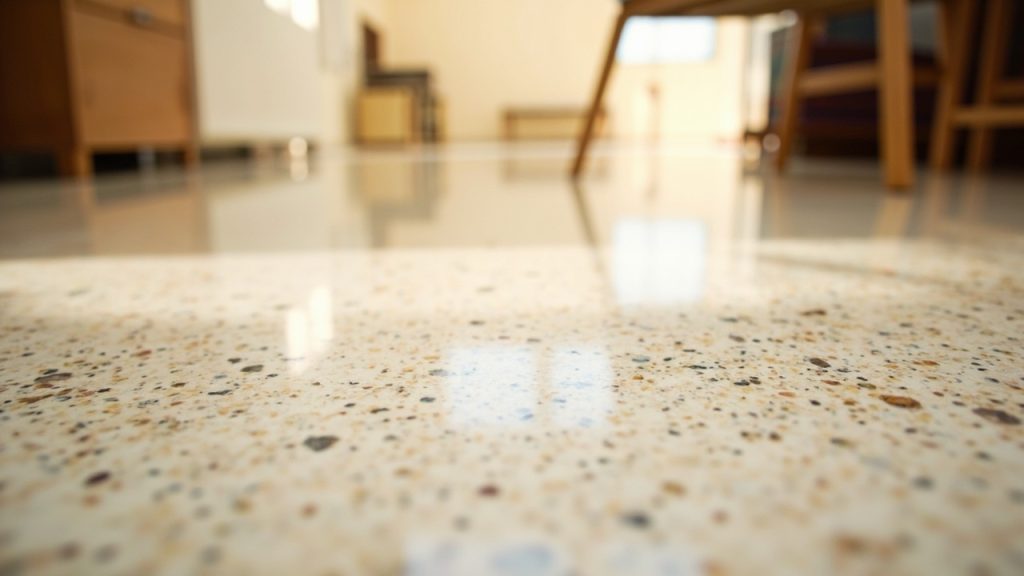
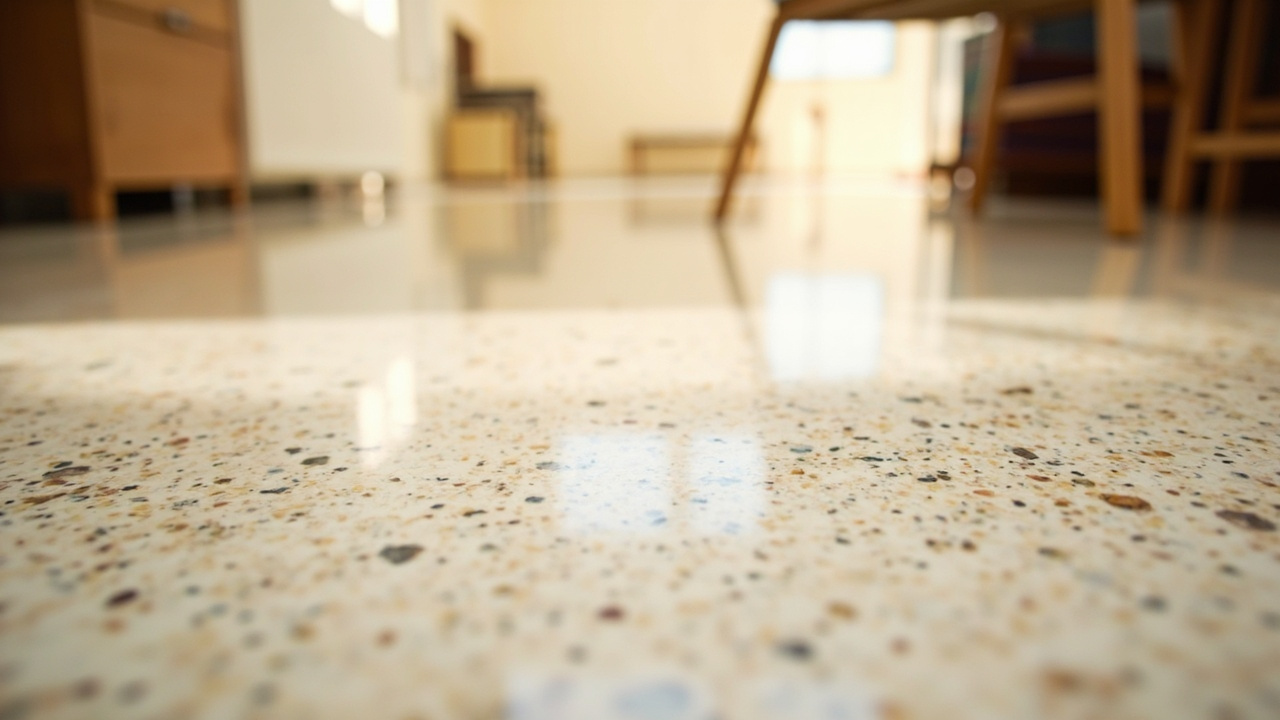
Terrazzo is not tile. It is not hardwood. It is a composite material poured in place, made from marble chips, glass, or granite aggregate set into a Portland cement base or an epoxy resin binder. In most mid-century Detroit homes built between the post-war era and the early 1970s, you are looking at cement-based terrazzo, which is inherently porous.
That porosity is what makes water damage both predictable and treatable when you move fast. Water wicks into the cement base, travels laterally through the slab, and begins a chain of problems that get worse with every day you wait.
Terrazzo common in neighborhoods like East English Village, Chandler Park, and Jefferson-Chalmers tends to sit on a concrete subfloor. That means you are dealing with two layers of moisture absorption, not one. Understanding that distinction changes everything about the restoration approach.
What Happens to Terrazzo When Water Sits
The first thing water does to cement-based terrazzo is carry soluble salts to the surface. This process is called efflorescence. You will see it as a white, powdery or crystalline crust forming on the floor’s surface. Efflorescence is a sign that moisture is migrating through the slab, and it can cause pitting if left untreated.
Second, the bond between the terrazzo topping and the concrete subfloor can weaken. This is subfloor delamination, and it produces a hollow sound when you tap the floor. Areas that delaminate cannot simply be re-adhered without grinding back the affected section and re-pouring. That is a significant repair, but not an impossible one.
Third, standing water and high ambient humidity feed mold growth inside the Portland cement base. Unlike a hardwood floor where mold is visible on the surface, mold inside terrazzo is hidden. It grows in the pores and can spread to the subfloor and substructure before you see any surface signs.. Read more about Tracking Down Hidden Leaks in Your Historic Grosse Pointe Butler’s Pantry.
Fourth, prolonged moisture exposure causes aggregate chips to loosen from the cement matrix. Once that bond breaks, no amount of polishing restores the original surface. Those areas require patching with color-matched terrazzo mix, which is a skilled repair requiring an NTMA-certified or IICRC-trained technician who stocks the right aggregate.
Immediate Steps When Your Terrazzo Floors Flood
The first 24 to 48 hours determine the outcome more than anything else. Here is the sequence that gives your floors the best chance.
- Stop the water source. Nothing else matters until the water intrusion stops completely.
- Extract standing water immediately. Use a wet-dry vacuum or a truck-mounted extraction unit. Do not mop water into the floor. Extraction removes it from the surface before it has time to wick deeper.
- Set up drying equipment. Commercial-grade dehumidifiers and air movers must be placed within hours. Household fans are not sufficient. The Great Lakes climate in Southeast Michigan means ambient humidity is already elevated, especially in spring and fall. You need equipment rated for the moisture load.
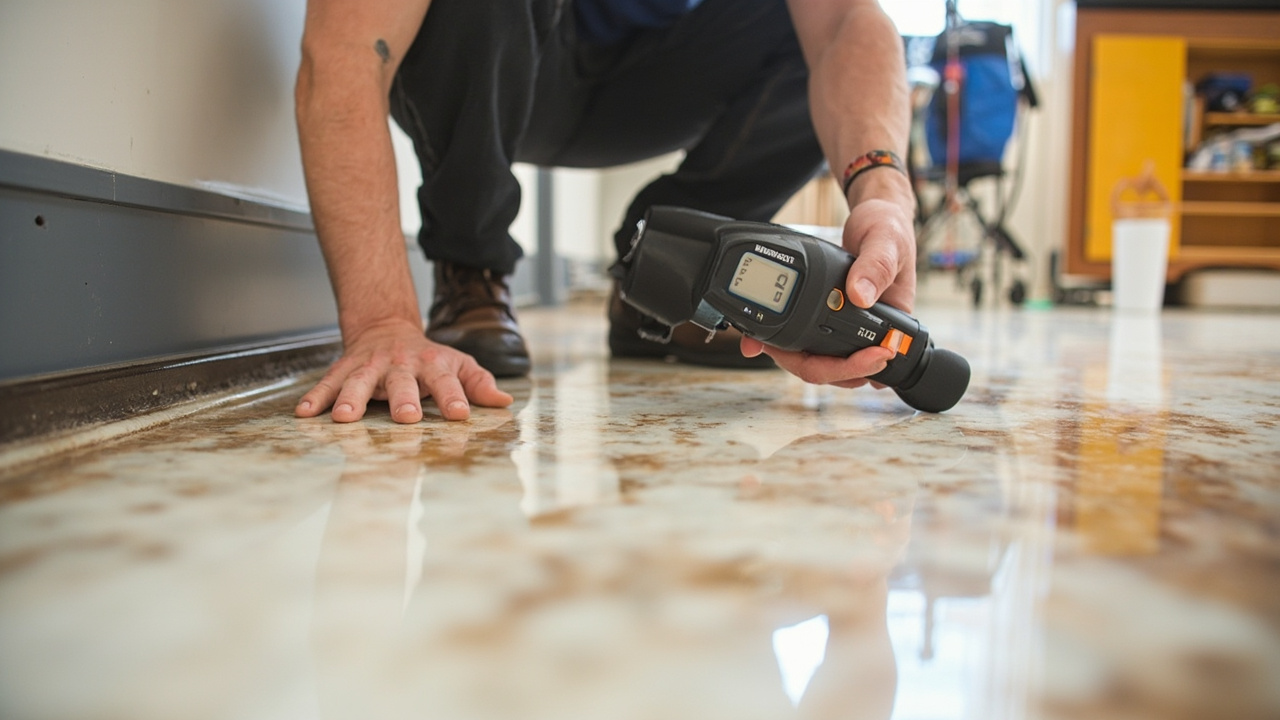
- Conduct moisture mapping. A calibrated moisture meter or thermal imaging camera shows where moisture has traveled inside the slab. This step is non-negotiable because drying without mapping means you stop when the surface reads dry, not when the slab is actually dry.
- Do not seal the floor. Applying any coating or sealer while moisture is still present traps it inside the slab and accelerates delamination and efflorescence.
Air drying alone is not a viable strategy for cement-based terrazzo. A flooded terrazzo slab in a Wayne County home can hold elevated moisture levels for three to six weeks without active drying equipment. That timeline is long enough for mold to establish and for aggregate bond failure to begin.
The Restoration Process Step by Step
Once the slab reaches acceptable moisture content, confirmed by meter readings rather than visual assessment, restoration follows a specific sequence. Skipping steps or changing their order produces poor results.
Step 1: Diamond Grinding
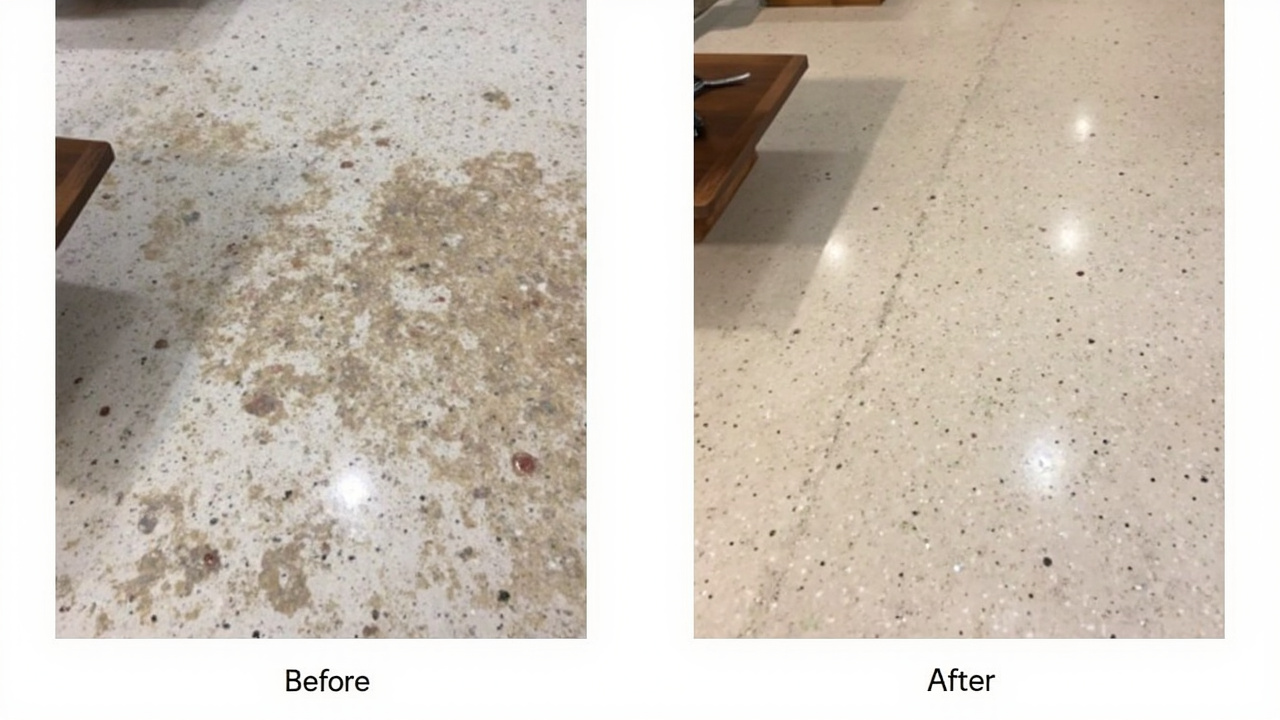
Technicians use planetary diamond grinding machines fitted with progressively finer grit diamond segments. Coarse segments remove efflorescence, surface staining, and damaged or pitted material. This is not an aggressive process. The goal is to remove the minimum amount of material necessary to reach sound, undamaged terrazzo. Lippage removal, which means leveling uneven areas caused by subfloor movement or delamination repair, also happens at this stage.
Step 2: Repair of Delaminated or Missing Aggregate Areas
Hollow sections identified during moisture mapping are opened, cleaned, and re-poured with color-matched terrazzo mix. Matching aggregate color and chip size to original material requires experience with regional suppliers who stock the marble and glass varieties used in Detroit-era construction. A generic patch stands out permanently.
Step 3: Honing
Progressively finer diamond abrasive pads smooth the ground surface. Honing removes scratch patterns from the grinding stage and begins to bring aggregate to a consistent plane. This step also reveals whether subsurface staining or efflorescence requires additional passes before moving forward.
Step 4: Densifier Application
A silicate-based densifier is applied to the honed surface. The densifier reacts with free calcium hydroxide in the Portland cement, forming calcium silicate hydrate inside the pores. This chemically hardens the surface and significantly reduces future porosity. Densifiers are not a coating. They become part of the slab, which is why they are a critical step in flood restoration specifically.
Step 5: Final Polishing
Fine to ultra-fine diamond pads bring the floor to the desired finish level, from a low-sheen satin to a high-gloss mirror finish. Historic terrazzo in Detroit homes typically had a medium to high gloss finish, which is achievable with a properly executed restoration.
Step 6: Guard or Sealer Application
A penetrating sealer or guard product is applied to reduce ongoing porosity and protect against future moisture penetration. pH-neutral maintenance products must be used going forward. Acidic cleaners etch the cement matrix and damage the aggregate bond over time.
DIY Methods Versus Professional Restoration
Hardware store terrazzo restoration products exist, and some homeowners in Grosse Pointe and Royal Oak have attempted DIY repairs on water-damaged floors. The results are consistently poor for one reason: those products are designed for maintenance, not restoration.
| Factor | DIY Approach | Professional Restoration |
|---|---|---|
| Moisture Detection | Visual only, misses subsurface moisture | Calibrated moisture meters, thermal imaging |
| Efflorescence Removal | Surface scrubbing, returns within weeks | Diamond grinding removes source layer |
| Surface Porosity | Topical coatings peel under moisture pressure | Silicate densifiers become part of the slab |
| Delamination Repair | Not addressable without professional equipment | Section removal and color-matched re-pour |
| Finish Quality | Uneven, visible scratch patterns | Progressive grit sequencing, uniform finish |
| Mold Risk | Surface treatment only, subsurface mold grows | Moisture mapping confirms full drying before sealing |
The pH issue is worth a separate note. Many common floor cleaners are acidic or alkaline. Both damage terrazzo over time. After flood restoration, using a pH-neutral cleaner is not optional. It is the only way to maintain the investment you made in restoration. Your technician should specify the correct maintenance product before leaving the job.
If your home was built before the mid-1970s, there is also a lead-based paint concern when grinding and cutting into original substrates. EPA Lead-Safe certification is required for any renovation work that disturbs these materials in pre-1978 housing. Confirm that any contractor working in your Eastside home or elsewhere in Wayne County holds this certification before grinding begins.
When Terrazzo Cannot Be Saved
Not every floor is recoverable. Honest assessment matters here. Terrazzo that has experienced extended submersion, meaning more than 72 hours of standing water, often shows aggregate loss that exceeds what grinding and patching can address cost-effectively. Similarly, floors where the subfloor has suffered structural damage may require removal of the terrazzo topping to address what is underneath.
A thorough moisture mapping assessment tells you where you stand. If more than 30 to 40 percent of a room’s surface shows delamination, the math often favors removal and re-pour over patch restoration. A reputable contractor will give you this assessment honestly rather than overselling a restoration that will not hold up.
For floors that do require removal, it is worth consulting with the National Terrazzo and Mosaic Association for referrals to contractors who specialize in historic recreation. Original terrazzo patterns in Detroit homes are part of the architectural record of the city, and matched re-pours are possible when the right expertise is engaged.
Cost Factors and Insurance Documentation for Detroit Homeowners
| Restoration Stage | Key Cost Drivers | Typical Timeline |
|---|---|---|
| Emergency Water Extraction and Drying | Square footage, depth of intrusion, number of dehumidifiers required | 3 to 7 days for slab drying |
| Moisture Mapping Assessment | Room count, slab thickness, equipment used | Same day as initial response |
| Diamond Grinding and Honing | Square footage, severity of efflorescence or pitting, number of grit passes required | 1 to 3 days depending on area |
| Delamination Repair and Patching | Percentage of floor affected, aggregate match complexity | 1 to 2 days plus cure time |
| Densifier, Polish, and Sealing | Square footage, finish level selected | 1 to 2 days |
Detroit homeowners filing insurance claims for terrazzo damage should document everything from the first hour forward. Photograph the standing water depth, the floor surface condition, and any visible efflorescence or aggregate loss. A professional moisture mapping report with thermal images is the documentation your adjuster needs to authorize restoration rather than replacement. Replacement costs for terrazzo are significantly higher than restoration costs, which actually works in your favor when negotiating a claim.
Standard homeowner’s policies in Michigan typically cover sudden and accidental water damage, such as a burst pipe or appliance failure, but not gradual seepage or flood events without a separate flood endorsement. Knowing which category your damage falls into before the adjuster arrives matters. For a detailed breakdown of how to document and present your claim, read how to get your Detroit home insurance to actually pay for water restoration.
If your flood damage affected a home in Corktown or a similarly historic district, the documentation process has some additional considerations. The guide on filing a successful water damage insurance claim for your Corktown home covers those specifics.
Mold Risk Inside Terrazzo Slabs
One concern homeowners often overlook is mold growth inside a flooded slab. The porous Portland cement base holds moisture long after the surface appears dry, and that residual moisture creates conditions where mold can establish in the substrate and spread to wall bases, subfloor framing, and adjacent materials.
The EPA’s guidance on mold cleanup is clear that porous materials with confirmed mold growth typically require removal rather than surface treatment. For terrazzo specifically, this means that if mold is confirmed in the cement base, restoration scope expands to include remediation before any grinding or polishing begins. Running a restoration process over an active mold problem seals contamination inside the slab.
If you have also noticed mold in adjacent areas like your basement or lower walls, the article on why bleach won’t fix your Ferndale basement mold explains why surface treatments miss the root problem.
How Detroit’s Climate Affects Terrazzo Flood Risk
The Great Lakes climate creates a specific set of challenges for terrazzo in Detroit homes. High ambient humidity through late spring and summer means that even after extraction and drying, re-absorption of moisture from the air is an active concern. Drying equipment must account for ambient conditions, not just the moisture content of the slab.
Freeze-thaw cycling in Wayne County winters creates movement in concrete subfloors that stresses the terrazzo topping’s bond over time. A flooded floor that returns to service without addressing subsurface moisture is significantly more vulnerable to delamination when that first freeze-thaw cycle hits. That is a specific risk for Detroit homes that does not apply in the same way to terrazzo in southern states.
Vapor barriers beneath slabs in older Detroit homes are often absent or degraded. A flood event is a good time to assess whether vapor barrier installation or sub-slab drainage improvements make sense as part of the broader restoration scope. A restoration contractor experienced in Metro Detroit properties will flag this during the assessment.
Other Flooring Types Affected by the Same Flood
Most flooded Detroit homes have more than one flooring type affected. If hardwood floors in adjacent rooms were also hit by water, the timeline and process differ significantly from terrazzo. The guide on how to save hardwood floors after a water leak covers that process in detail. If carpeted areas were involved, the salvageability question is different again. See deciding whether wet carpet can be saved or needs to go for that assessment.
Getting an Honest Assessment for Your Eastside Home
Terrazzo restoration after flood damage is one of the more technically specific services in the water damage industry. Most general contractors lack the diamond grinding equipment, aggregate inventory, and moisture mapping tools to do it correctly. The IICRC designation for water damage restoration (WRT) is a baseline qualification. For terrazzo specifically, look for documented experience with cement-based terrazzo in mid-century residential properties, not just commercial terrazzo work, which tends to be less complex from a matching standpoint.
If you are in East English Village, Morningside, Chandler Park, Jefferson-Chalmers, or anywhere on the Eastside, the age of your home likely means you have cement-based terrazzo that responds well to professional restoration when caught within the right window. The floors that were installed in those homes were built to last. With the right response, most of them can last considerably longer.
Call for an assessment as soon as the water is out. Moisture mapping takes an hour. That one hour of data determines the entire scope and cost of what comes next. The longer you wait, the fewer options you have.
{
“@context”: “https://schema.org”,
“@type”: “BlogPosting”,
“headline”: “Can You Save the Historic Terrazzo Floors in Your Eastside Detroit Home After a Flood”,
“description”: “Flooded terrazzo floors in your Detroit home? Learn what restoration actually looks like, what damage is permanent, and when to call a pro.”,
“wordCount”: 2344,
“datePublished”: “2026-08-12T07:38:00.000Z”,
“dateModified”: “2026-08-12T07:38:00.000Z”,
“inLanguage”: “en-US”,
“mainEntityOfPage”: {
“@type”: “WebPage”,
“@id”: “https://ironwoodwaterdamagerestorationdetroit.com”
},
“publisher”: {
“@type”: “LocalBusiness”,
“name”: “Ironwood Water Damage Restoration Detroit”,
“url”: “https://ironwoodwaterdamagerestorationdetroit.com”
},
“author”: {
“@type”: “Organization”,
“name”: “Ironwood Water Damage Restoration Detroit”,
“url”: “https://ironwoodwaterdamagerestorationdetroit.com”
},
“image”: {
“@type”: “ImageObject”,
“url”: “https://ironwoodwaterdamagerestorationdetroit.com/wp-content/uploads/2026/03/can-you-actually-save-the-historic-terrazzo-floors-1.jpg”
}
}
{
“@context”: “https://schema.org”,
“@type”: “LocalBusiness”,
“name”: “Ironwood Water Damage Restoration Detroit”,
“url”: “https://ironwoodwaterdamagerestorationdetroit.com”,
“address”: {
“@type”: “PostalAddress”,
“addressLocality”: “Detroit”
},
“areaServed”: {
“@type”: “City”,
“name”: “Detroit”
}
}
{
“@context”: “https://schema.org”,
“@type”: “BreadcrumbList”,
“itemListElement”: [
{
“@type”: “ListItem”,
“position”: 1,
“name”: “Home”,
“item”: “https://ironwoodwaterdamagerestorationdetroit.com”
},
{
“@type”: “ListItem”,
“position”: 2,
“name”: “Blog”,
“item”: “https://ironwoodwaterdamagerestorationdetroit.com/blog”
},
{
“@type”: “ListItem”,
“position”: 3,
“name”: “Can You Save the Historic Terrazzo Floors in Your Eastside Detroit Home After a Flood”
}
]
}
{
“@context”: “https://schema.org”,
“@type”: “Service”,
“serviceType”: “Water Damage Restoration”,
“provider”: {
“@type”: “LocalBusiness”,
“name”: “Ironwood Water Damage Restoration Detroit”,
“url”: “https://ironwoodwaterdamagerestorationdetroit.com”
},
“areaServed”: {
“@type”: “City”,
“name”: “Detroit”
},
“description”: “Flooded terrazzo floors in your Detroit home? Learn what restoration actually looks like, what damage is permanent, and when to call a pro.”
}