

If you live in Marygrove, Palmer Park, or University District, your home sits under one of Detroit’s most beautiful tree canopies. Those massive oaks and maples are part of what makes these neighborhoods desirable. They are also some of the most aggressive destroyers of residential sewer lines in the entire city.
Sewage backing up into your basement floor drain is not a plumbing inconvenience. It is a biohazard. And in a neighborhood where homes regularly date back 80 to 100 years, the problem is more common than most homeowners realize until the damage is already done.
Why Marygrove Homes Are Especially Vulnerable
The original sewer laterals serving most homes in Marygrove, Sherwood Forest, and Indian Village were installed using vitrified clay pipe (VCP). Clay pipe was the standard through most of the 20th century, and millions of linear feet of it still run beneath Detroit’s older residential neighborhoods.
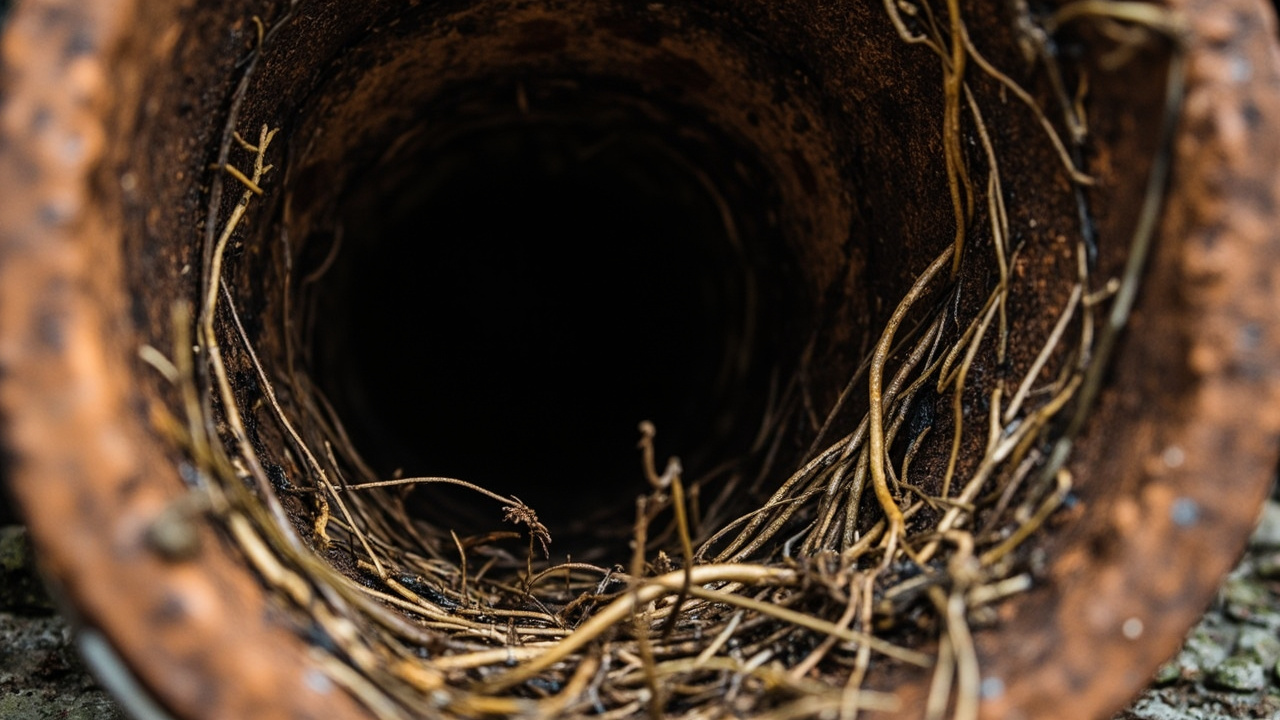
VCP is not inherently bad. It is chemically stable and resistant to corrosion. The problem is the joints. Clay pipe sections were typically laid in 2-foot to 4-foot segments, and those joints were sealed with oakum and mortar. Over decades, those seals crack, shift, and separate. Tree roots detect the moisture and warm air escaping from those gaps and grow directly toward them.
Detroit’s freeze-thaw cycles make this worse every single year. When the ground freezes and thaws repeatedly between November and April, it shifts soil around your lateral. That movement stresses already-aging pipe joints further. What was a hairline crack in October can become a significant gap by March. By the time you notice slow drains or a faint sewage odor in your basement, roots may have been growing inside your pipe for two to three years.
The Trees Most Likely to Cause Problems on Your Block
Not all trees are equal when it comes to sewer line damage. The species that dominate Marygrove’s parkways and front yards are some of the worst offenders.
- Silver and Norway Maples produce dense, fast-growing root systems that spread aggressively. A mature silver maple can send feeder roots 40 to 50 feet from the trunk.
- American Elms were widely planted in Detroit before Dutch elm disease and still exist in many older yards. Their roots are shallow and wide-spreading.
- White Oaks grow slowly but develop enormous root zones over 80 to 100 years. Their roots are powerful enough to crack concrete foundations, let alone clay pipe joints.
- Cottonwood and Poplar trees have some of the most water-seeking root systems of any species in the upper Midwest. Any cottonwood within 60 feet of your lateral is a risk.
- Weeping willows, while less common, are planted near detention areas and low-lying lots. Their roots follow water with precision.
Signs Your Sewer Line Has Root Intrusion
The symptoms build gradually, which is exactly why so many Marygrove homeowners miss them until there is raw sewage on the basement floor.
Multiple slow drains throughout the house at the same time is the most telling early sign. One slow drain usually means a clog near a fixture. Multiple slow drains on different floors mean the blockage is in the main lateral, downstream from everything.
Gurgling sounds coming from your toilet when you run the kitchen sink or drain a bathtub indicate a partial obstruction in the line. Air is trapped behind a root mass and gets displaced by moving water.
Sewage odor in the basement, particularly near floor drains, means wastewater is backing up to the lowest point in the drain system before gravity pulls it back down. That is a sign of a partial blockage becoming a full blockage.
A wet or unusually green patch of grass over your lateral line in the yard, especially in dry summer months, suggests your pipe is cracked and leaking effluent into the soil. Roots find this leak and grow toward it aggressively.

Getting a Diagnosis Right the First Time
The only way to know exactly what is happening inside your pipe is a high-definition sewer camera inspection. A licensed plumber runs a waterproof camera through the lateral from a cleanout access point and records everything in real time.
A proper camera inspection shows you the pipe material, the condition of joints, the size and location of root intrusion, and whether any sections have collapsed or offset. You receive footage, not guesswork. That footage also matters for insurance documentation and Wayne County permit applications if excavation becomes necessary.
Camera inspections typically take 45 minutes to 90 minutes depending on the length of your lateral and access conditions. If you live in a home built before 1960, request that the technician note the pipe material at every visible joint. Knowing whether you have VCP, cast iron, or an already-repaired segment of PVC changes the repair strategy significantly.
The Detroit Water and Sewerage Department (DWSD) maintains the public sewer main. Your lateral from your foundation to the property line, and often to the point of connection at the main, is your responsibility. Understanding that boundary matters when you get repair estimates.
Root Removal Methods and When Each One Applies
There is no single answer that works for every pipe. The right method depends on how severe the intrusion is, the condition of the pipe itself, and whether you want a permanent fix or a temporary clearing.
Mechanical Snaking
A mechanical drain snake with a root-cutting blade physically cuts through root masses inside the pipe. It is the fastest and least expensive option. The problem is that it does not remove the roots completely. It shaves them back to the pipe wall, but the root tips remain embedded and regrow within 6 to 18 months. Snaking is a stopgap measure, not a permanent solution.
Hydro Jetting
Hydro jetting uses water pressurized at 3,000 to 4,000 PSI to blast roots, grease, and debris completely out of the pipe. It is more thorough than snaking and leaves the pipe walls clean. A plumber inserts a jetting nozzle through the cleanout and works the stream in both directions through the line.
Hydro jetting works best when the pipe is structurally sound. Jetting a severely deteriorated clay pipe can cause section collapse. This is why a camera inspection before jetting is not optional. It is necessary.
Trenchless Pipe Lining (CIPP)
Cured-in-place pipe lining (CIPP) is the method that solves the root problem permanently without digging up your yard. A flexible liner saturated with epoxy resin is pulled through the existing pipe and inflated against the pipe wall. The resin cures into a new pipe within the old one, sealing all cracks and joints from the inside.
CIPP has a strong track record in older Detroit neighborhoods specifically because it works with the existing pipe route. There is no excavation, no permit for soil disturbance, and no replanting. The new inner pipe diameter is slightly reduced, typically by a few millimeters, but that reduction has no meaningful effect on residential drainage flow.
Open Excavation and Full Replacement
When a lateral has collapsed sections, severe offsets from root damage, or multiple simultaneous failures, full replacement via open trench is necessary. This requires a permit from Wayne County and coordination with DWSD if work approaches the main connection. The advantage is that you end up with modern PVC pipe rated for a 50-year or longer service life with no organic joints for roots to penetrate.
| Method | Best For | Permanence | Yard Disruption | Typical Timeline |
|---|---|---|---|---|
| Mechanical Snaking | Minor root intrusion, temporary clearing | 6 to 18 months | None | Same day |
| Hydro Jetting | Moderate buildup, pre-lining prep | 2 to 4 years without lining | None | Same day |
| CIPP Trenchless Lining | Cracked but intact clay pipe | 40 to 50 years | Minimal | 1 to 2 days |
| Open Trench Replacement | Collapsed or offset pipe sections | 50 or more years | Significant | 3 to 7 days |
What Happens After a Sewage Backup Gets Into Your Home
A sewer backup is a Category 3 water loss under IICRC S500 standards. Category 3 means the water is grossly contaminated. It contains bacteria, pathogens, and human waste. You cannot clean this up with a shop vac and bleach.
The affected area requires professional biohazard extraction, antimicrobial treatment, and controlled drying. Flooring materials that absorbed sewage, including concrete, drywall at the base of walls, and any wood framing that was contacted, must be assessed for contamination depth. Porous materials that cannot be fully decontaminated need to be removed and properly disposed of.
Mold can colonize in 24 to 48 hours under the right conditions. A Detroit basement in summer with standing sewage creates ideal conditions. If you are seeing visible growth after a backup, bleach will not fix the problem, and treating it yourself creates liability with your insurance claim.
Professional restoration following a sewage backup follows this sequence:
- Emergency extraction of all standing sewage water.
- Removal of contaminated porous materials, including carpet, drywall, and insulation that cannot be decontaminated.
- Application of EPA-registered antimicrobial agents to all affected surfaces.
- Placement of commercial air movers and dehumidifiers to dry the structural assembly.
- Moisture monitoring over 3 to 5 days to confirm complete drying before any reconstruction begins.
- Post-remediation verification testing if required by your insurance adjuster.

Does Your Homeowners Insurance Cover This
This is the question every homeowner asks after a backup, and the answer depends entirely on your specific policy language.
Standard homeowners policies in Michigan do not automatically cover sewer backup damage. You need a sewer and drain backup rider added to your policy. Many homeowners discover they do not have this endorsement after the loss has already occurred.
Even with a backup rider, coverage for the cost of the sewer line repair itself is typically excluded. The rider usually covers the interior water damage cleanup and restoration, not the pipe repair that caused the backup. That distinction matters when you are budgeting for the full cost of recovery.
Documenting everything before any cleanup work begins is critical to a successful claim. Take video of every affected area, photograph the sewage backup level on walls and floors, and save any damaged personal property for the adjuster’s inspection. If you want a detailed walkthrough of how to manage the claims process, read our guide on how to get your Detroit home insurance to actually pay for water restoration.
| Coverage Type | Typically Covers | Typically Excludes |
|---|---|---|
| Standard Homeowners Policy | Sudden and accidental water damage from inside the home | Sewer backup, gradual damage, pipe repair costs |
| Sewer and Drain Backup Rider | Interior cleanup, flooring, drywall after a backup | The lateral repair itself, landscaping restoration |
| Service Line Coverage | Repair or replacement of the lateral from home to street | Interior water damage (needs separate backup rider) |
If you need specific guidance on putting together your claim documentation, the process for Corktown homeowners applies directly to Marygrove as well. Read through filing a successful water damage insurance claim for step-by-step guidance.
Secondary Damage That Shows Up Days or Weeks Later
A sewage backup in the basement does not stay in the basement in most older homes. Water follows gravity and wicks through porous materials. If your basement has a wood subfloor above it, or if the backup reached finished wall cavities, secondary damage can appear on the first floor weeks after the event.
Hardwood floors above a wet basement are particularly vulnerable. If you have hardwood on the main level and a sewage backup below it, cupping and buckling can begin within a week. Early intervention with proper drying equipment can often save hardwood that looks damaged. For guidance on that specific situation, see our resource on saving hardwood floors after a significant water leak.
Carpet on the main level that was not directly contacted by the backup but sits above a wet basement subfloor is also at risk. Moisture migrates upward. If your carpet padding absorbed moisture, the question becomes whether it can be saved or needs replacement. That decision depends on moisture readings, contact time, and whether the water source was sanitary or contaminated. Our breakdown on whether wet carpet can be saved or needs to go walks through the decision factors clearly.
Preventing Root Intrusion Before It Becomes a Crisis
If your lateral is currently flowing fine but you have mature trees within 30 feet of the line, you are managing risk whether you know it or not. These steps reduce that risk substantially.
Annual or biennial hydro jetting clears early-stage root intrusion before it builds into a full blockage. Many plumbers servicing the Marygrove and Palmer Woods area recommend this as standard maintenance for any home over 50 years old with trees in the yard.
Chemical root inhibitors, specifically copper sulfate or foaming dichlobenil products applied through a cleanout, kill feeder roots inside the pipe without harming the tree above. These are not a permanent fix but can extend the interval between mechanical interventions significantly. The EPA’s WaterSense program provides guidance on responsible water system maintenance that applies to residential lateral care as well.
Physical root barriers installed during landscaping projects or new tree planting redirect root growth away from underground utilities. If you are adding any new trees near the house, installing a vertical linear barrier at least 24 inches deep between the planting location and the lateral route is worth the cost.
If you already know your lateral is clay pipe and your last camera inspection was more than five years ago, scheduling a new inspection is the single most useful thing you can do before winter.
When to Call a Restoration Company Versus Just a Plumber
The plumber fixes the pipe. The restoration company addresses what the backup left behind. These are two separate scopes of work, and confusing them creates problems.
If sewage entered your living space at any level, a licensed water damage restoration contractor with IICRC certification handles the cleanup, drying, and structural assessment. The plumber restores the flow. The restoration company handles everything the water touched. Both are necessary, and the order matters. Do not start drywall repairs or flooring replacement until a restoration contractor has verified the structure is fully dry and decontaminated.
If your basement had a backup and you are dealing with the aftermath right now, do not wait on the moisture readings. Call for a professional assessment today. What looks dry on the surface often is not dry inside the wall assembly or under the slab.
{
“@context”: “https://schema.org”,
“@type”: “BlogPosting”,
“headline”: “How Older Trees in Marygrove Are Quietly Destroying Your Sewer Lines and Causing Backups”,
“description”: “Mature trees in Marygrove can crack and block your sewer line. Learn how to spot the signs, fix root intrusion, and handle sewage backup cleanup in Detroit.”,
“wordCount”: 2382,
“datePublished”: “2026-04-12T05:25:00.000Z”,
“dateModified”: “2026-04-12T05:25:00.000Z”,
“inLanguage”: “en-US”,
“mainEntityOfPage”: {
“@type”: “WebPage”,
“@id”: “https://ironwoodwaterdamagerestorationdetroit.com”
},
“publisher”: {
“@type”: “LocalBusiness”,
“name”: “Ironwood Water Damage Restoration Detroit”,
“url”: “https://ironwoodwaterdamagerestorationdetroit.com”
},
“author”: {
“@type”: “Organization”,
“name”: “Ironwood Water Damage Restoration Detroit”,
“url”: “https://ironwoodwaterdamagerestorationdetroit.com”
},
“image”: {
“@type”: “ImageObject”,
“url”: “https://ironwoodwaterdamagerestorationdetroit.com/wp-content/uploads/2026/03/why-older-trees-in-marygrove-might-be-destroying-y-1.jpg”
}
}
{
“@context”: “https://schema.org”,
“@type”: “LocalBusiness”,
“name”: “Ironwood Water Damage Restoration Detroit”,
“url”: “https://ironwoodwaterdamagerestorationdetroit.com”,
“address”: {
“@type”: “PostalAddress”,
“addressLocality”: “Detroit”
},
“areaServed”: {
“@type”: “City”,
“name”: “Detroit”
}
}
{
“@context”: “https://schema.org”,
“@type”: “BreadcrumbList”,
“itemListElement”: [
{
“@type”: “ListItem”,
“position”: 1,
“name”: “Home”,
“item”: “https://ironwoodwaterdamagerestorationdetroit.com”
},
{
“@type”: “ListItem”,
“position”: 2,
“name”: “Blog”,
“item”: “https://ironwoodwaterdamagerestorationdetroit.com/blog”
},
{
“@type”: “ListItem”,
“position”: 3,
“name”: “How Older Trees in Marygrove Are Quietly Destroying Your Sewer Lines and Causing Backups”
}
]
}
{
“@context”: “https://schema.org”,
“@type”: “Service”,
“serviceType”: “Water Damage Restoration”,
“provider”: {
“@type”: “LocalBusiness”,
“name”: “Ironwood Water Damage Restoration Detroit”,
“url”: “https://ironwoodwaterdamagerestorationdetroit.com”
},
“areaServed”: {
“@type”: “City”,
“name”: “Detroit”
},
“description”: “Mature trees in Marygrove can crack and block your sewer line. Learn how to spot the signs, fix root intrusion, and handle sewage backup cleanup in Detroit.”
}