

If you own a home on one of the canals in Jefferson-Chalmers, you already know the water is never far away. What you may not know is how dramatically Detroit River flood risk has shifted in recent years, and why the standard advice about basement flooding does not apply to your situation.
This is not a typical rain-driven flooding problem. It is a riverine, hydrological problem with its own causes, timelines, and solutions.
Why Jefferson-Chalmers Faces a Different Kind of Flood Risk
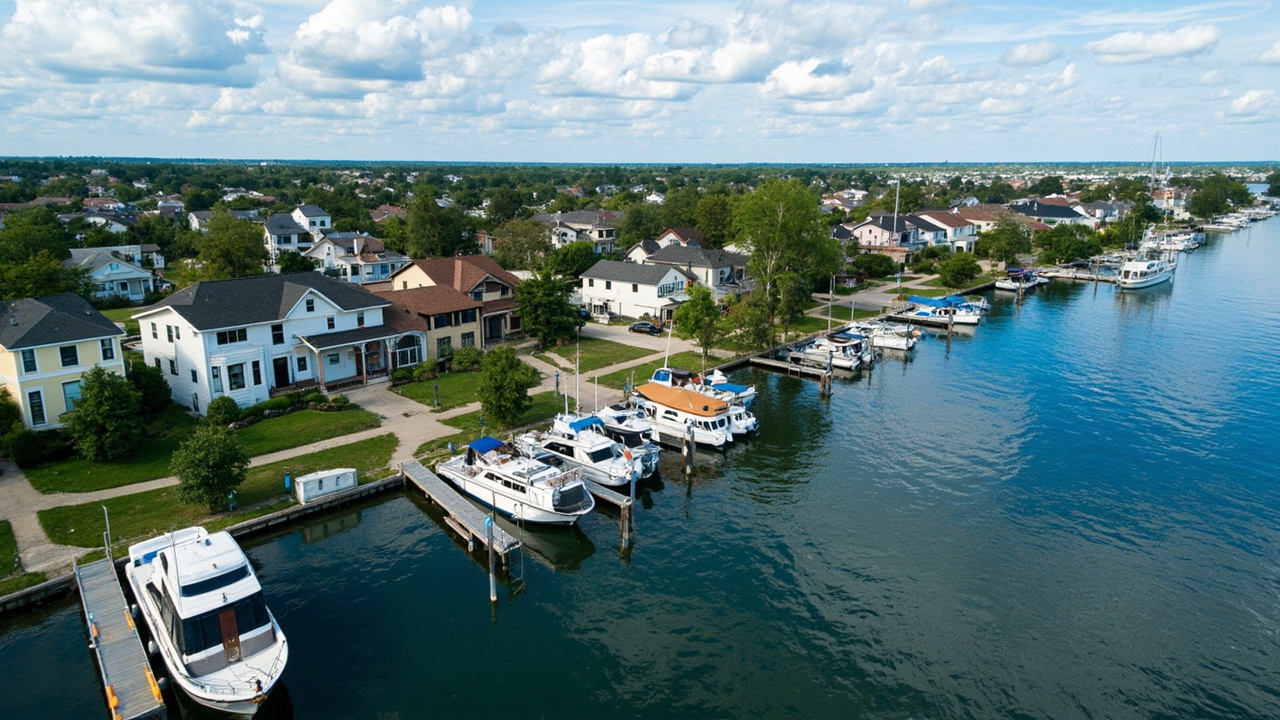
The Jefferson-Chalmers neighborhood, sometimes called Detroit’s “Little Venice,” sits on a grid of man-made canals that connect directly to the Detroit River. When river levels rise, water does not have to find a crack in your foundation. It can simply push up through the canal and into your yard, your seawall, and eventually your structure.
This is hydrostatic pressure at its most direct. The river and your property share the same water table. A sustained rise of even a few inches in the river translates immediately to elevated canal levels at your dock.
Unlike neighborhoods further inland, Jefferson-Chalmers homeowners cannot just install a better sump pump and call it a day. You need a layered approach that accounts for where the water is actually coming from.
The Role of Great Lakes Seiches in Canal Flooding
A seiche is a standing wave that sloshes back and forth across a large body of water, driven by sustained wind and pressure changes. Lake Erie, which feeds into the Detroit River, is particularly prone to seiches because of its relatively shallow depth and elongated shape.
A strong northeast wind event can push water from Lake Erie up the Detroit River in hours. The NOAA Great Lakes Environmental Research Laboratory monitors water levels across all five lakes in real time. Checking their gauges when storm systems approach from the southwest is something every Jefferson-Chalmers homeowner should make a habit of doing.
Seiches can raise river levels by one to three feet in under 24 hours. That is enough to push water over low seawalls and into canal-adjacent yards throughout the east riverfront.
The Neighborhoods Carrying the Highest Exposure Along Detroit’s East Riverfront
Jefferson-Chalmers is the most concentrated area of canal-front residential property in Detroit, but it is not the only vulnerable neighborhood. Rivertown, just west of Jefferson-Chalmers, sits at low elevation along the river corridor. Properties near the Belle Isle bridge approach and along East Jefferson Avenue face periodic street flooding when the river surges. Even residents in adjacent Grosse Pointe Park, just across the city line, deal with similar Lake St. Clair and river backpressure conditions.
Wayne County’s FEMA flood maps designate large portions of the Jefferson-Chalmers canal grid as being within the Special Flood Hazard Area (SFHA). If your mortgage lender has required you to carry flood insurance, that is why. But insurance is a recovery tool, not a prevention tool.

How Detroit’s Combined Sewer System Makes River Flooding Worse
Detroit operates on a Combined Sewer Overflow (CSO) system, which means stormwater and sanitary sewage run through the same pipes. The Great Lakes Water Authority (GLWA) manages this regional infrastructure, and it has a finite capacity.
When the Detroit River rises and sewer outfalls are submerged or under backpressure, the system cannot drain properly. Surface water has nowhere to go. Stormwater backs up through floor drains and basement toilets. In Jefferson-Chalmers, this problem compounds the direct canal flooding because both are happening simultaneously during major events.
Water that backs up through a sewer system is classified as Category 3 water, also called black water, under IICRC S500 standards. This is the most contaminated classification, and it requires full containment, professional remediation, and often the removal of porous materials like drywall and carpet. This is not a shop-vac situation.
Seawall Maintenance and What to Look For Before It Fails
Your seawall is the first and most critical line of defense for a canal home. Most Jefferson-Chalmers seawalls are constructed of steel sheet piling or concrete, many of them installed decades ago. They corrode, they crack, and the soil behind them erodes.
Signs that your seawall needs immediate professional assessment include visible tilting or bowing, sinkholes or depressions in your yard near the wall, rust staining along the cap, and any separation between the cap and the piling. A licensed engineer, ideally one familiar with Detroit riverfront conditions, should inspect the wall. This is not a job for a general contractor.
The U.S. Army Corps of Engineers issues permits for seawall repair and replacement work along navigable waterways. Any work you do on a canal-connected seawall requires USACE Section 404 and Section 10 permit compliance. Starting work without proper permits can result in fines and forced removal.
Emergency Seawall Stop-Gap Options
If a storm is imminent and your seawall shows weakness, you have limited but useful options. Heavy-duty water-filled barriers, sandbag staging at the base of the wall, and temporary sheet metal flashing extensions can slow overtopping during a single event. These are short-term measures only. They do not address structural failure.
Sump Pump Systems, Backwater Valves, and What Detroit Canal Homes Actually Need
Canal homeowners need redundant systems, not a single sump pump. Here is why. When the Detroit River rises, your sump pump discharge line may be discharging into ground that is already saturated or at a level higher than the pump’s exit point. The pump runs, but the water goes nowhere.
A battery backup sump pump gives you continued operation during power outages, which are common during the same storm systems that drive river flooding. A water-powered backup pump uses municipal water pressure to pull water out via the venturi effect, independent of electricity entirely.
A backwater valve (also called a backflow preventer) is a one-way check valve installed in your main sewer line. When sewage or Category 3 stormwater tries to back up through your drain, the valve’s flap closes and blocks it. Detroit building code requires backwater valves in new construction, but many older Jefferson-Chalmers homes were never retrofitted. This is one of the highest-ROI flood protection investments you can make for under a few hundred dollars in parts.
| Flood Protection Measure | What It Addresses | Relative Cost Tier | DIY Possible? |
|---|---|---|---|
| Backwater Valve Installation | CSO/sewer backflow | Low | No (requires licensed plumber) |
| Battery Backup Sump Pump | Power outage during storm | Low to Medium | Partial (pump swap is DIY, electrical is not) |
| Seawall Inspection and Repair | Canal overtopping and structural breach | High | No (requires licensed engineer and USACE permit) |
| Interior Drain Tile System | Hydrostatic pressure through foundation | High | No (structural work) |
| Temporary Flood Barriers | Surface overland flow | Low to Medium | Yes |
| Flood Vent Installation | Reduces pressure on foundation walls | Medium | No |
What to Do When the Detroit River Overflows and Water Gets In
Speed is everything once water enters your structure. The clock on mold growth starts within 24 to 48 hours under Michigan’s typical interior humidity conditions. Here is the correct order of operations.
- Cut power to any affected areas at the breaker panel before entering flooded spaces. Do not wade into standing water where electrical outlets, appliances, or wiring may be submerged.
- Document everything before touching it. Video walk-through, photos of all water levels, affected materials, and the source point. Your insurance claim depends on this.
- Identify the water category. Canal and river water is Category 3. Do not treat it like a burst pipe situation. Personal protective equipment is required for any contact.
- Call a professional water mitigation company that uses IICRC S500 protocols. This is not the time to experiment with rental fans and consumer dehumidifiers.
- Notify your insurance carrier. If you carry both homeowners and separate NFIP flood insurance, notify both. Keep your adjuster information accessible. Our guide on how to get your Detroit home insurance to actually pay for water restoration walks through the documentation and communication steps that most homeowners get wrong.
- Do not discard materials before the adjuster visits unless directed to do so by a restoration professional citing health hazards. Category 3 contamination can override this, but document before removal.
How Professional Restoration Limits Long-Term Water Damage in Canal Homes
The structural drying process for a canal home is more complex than a standard basement flood. River water carries sediment, biological matter, and sometimes fuel or chemical contamination depending on what is upstream. This changes the remediation protocol significantly.
Restoration technicians use psychrometric calculations to set up drying equipment correctly. This means measuring temperature, relative humidity, and the dew point to determine the exact number and placement of air movers and commercial dehumidifiers. Consumer-grade equipment does not operate at the airflow or extraction rates needed for structural materials like subfloor OSB, concrete block, or original plaster walls common in Jefferson-Chalmers homes.
Mold is the long-term consequence that most homeowners underestimate. Mold can colonize inside wall cavities and under flooring without any visible sign on the surface for weeks. By the time you smell it or see it, remediation costs are substantially higher than if it had been caught during the initial drying phase. You can read more about why surface-level treatments consistently fall short in our article on why bleach won’t fix basement mold and when to call a pro.
Hardwood floors in older canal homes are a particular concern. Many Jefferson-Chalmers homes have original hardwood that, if dried properly and fast enough, can be saved. Delayed response almost always means replacement. The detailed process for saving hardwood is covered in our guide on how to save hardwood floors after a significant water leak.

Comparing the Cost of Prevention vs. Restoration After a Flood
| Scenario | Typical Damage Scope | Cost Tier | Timeline to Resolution |
|---|---|---|---|
| Seawall holds, backwater valve blocks CSO backup | None or minimal surface water | Prevention cost only | N/A |
| Minor canal overtopping, caught within 12 hours | Crawlspace or slab moisture, limited flooring | Low to Medium | 3 to 7 days drying, limited demo |
| Canal breach, Category 3 water in finished basement | Full demo to studs, flooring removal, mold testing | High | 2 to 6 weeks minimum |
| River surge, main floor affected with structural saturation | Subfloor, wall assemblies, HVAC contamination | Very High | 6 to 12 weeks or more |
Detroit Flood Insurance and Local Resources Every Canal Homeowner Should Know
Standard homeowners insurance policies in Michigan do not cover flood damage. That bears repeating. If the water source is external, meaning it comes from a river, canal, or overland surface flow, your homeowners policy will deny the claim.
Flood insurance through the National Flood Insurance Program (NFIP), managed by FEMA, is the correct product. If your property sits in a designated SFHA on the current FEMA flood maps for Wayne County, your mortgage lender likely mandates it. If you own your home outright, it is still worth carrying. There is a 30-day waiting period before NFIP coverage activates, so buying it the day a storm watch is issued does nothing.
Private flood insurance carriers have entered the Michigan market in recent years with higher coverage limits than the NFIP’s standard caps. If your home’s rebuild cost or contents value exceed those caps, a private policy or an excess flood policy is worth reviewing with your broker.
For filing your claim correctly after a loss event, our guide on filing a successful water damage insurance claim covers the documentation, timing, and adjuster communication steps in detail.
Local resources worth bookmarking include the U.S. Army Corps of Engineers water resources division, which manages the permits and structural oversight for canal and riverfront work throughout the Detroit River corridor. Wayne County also maintains a flood mitigation assistance program through its Department of Public Services for qualifying residential properties.
Monitoring Water Levels Before a Storm Hits Jefferson-Chalmers
Real-time Great Lakes water level data from NOAA’s GLERL gives you 24 to 48 hours of lead time before a surge reaches the Jefferson-Chalmers canals. Set a bookmark on your phone. When Lake Erie levels spike or a sustained southwest wind event is in the forecast, that is your signal to pre-position flood barriers, confirm your sump pumps are running, and move belongings off basement floors.
The Detroit Riverfront is a dynamic system. Belle Isle sits just downstream and acts as a partial buffer, but it does not stop a river surge. Knowing the river gauge readings at the Michigan Avenue bridge and comparing them to the Detroit Riverfront Conservancy’s historical baseline is something local contractors in this area have done for years. You can do the same with about five minutes of reading on the GLERL dashboard.
Wet carpet decisions also come down to response time. If you are dealing with saturation from a surge event, Category 3 contamination almost always means carpet removal regardless of how fast you act. You can review the full framework for those decisions in our guide on deciding whether wet carpet can be saved or needs to go.
Building a Pre-Flood Protection Plan for Your Canal Property
The homeowners who come through Detroit River flood events with the least damage are the ones who planned before the water moved. Here is what a reasonable pre-flood plan looks like for a Jefferson-Chalmers canal property.
- Annual seawall inspection by a licensed structural engineer familiar with Detroit River conditions, ideally before spring thaw and Great Lakes high-water season.
- Backwater valve installed on the main sewer line, inspected annually to confirm the flap is clear and operational.
- Primary sump pump tested monthly. Battery backup confirmed charged. Water-powered backup installed if municipal pressure is available.
- FEMA flood zone designation confirmed and NFIP or private flood insurance policy in force with no coverage gaps.
- GLERL and NOAA water level alerts set as phone notifications for the Detroit River gauge station.
- Documentation of home contents, finish materials, and appliances on a cloud-stored photo or video inventory updated each year.
- Pre-established contact with a local IICRC-certified restoration contractor who offers 24-hour emergency response.
Living on the canals in Jefferson-Chalmers is a genuine quality of life asset in Detroit. The goal of this planning is to keep it that way. The river is going to do what it does. How your property responds depends entirely on what you have done before it moves.
If you have questions about your specific property’s flood exposure or need a professional assessment of your current mitigation systems, reach out to our team. We have worked throughout the Jefferson-Chalmers canal grid, along the Rivertown corridor, and across the east Detroit riverfront for many years. We can tell you what the water is likely to do before it does it.
{
“@context”: “https://schema.org”,
“@type”: “BlogPosting”,
“headline”: “How to Protect Your Jefferson Chalmers Canal Home from Rising Detroit River Levels”,
“description”: “Canal homeowners in Jefferson-Chalmers face unique flood risks. Learn how Detroit River water levels threaten your property and what you can do right now.”,
“wordCount”: 2413,
“datePublished”: “2026-05-26T12:30:00.000Z”,
“dateModified”: “2026-05-26T12:30:00.000Z”,
“inLanguage”: “en-US”,
“mainEntityOfPage”: {
“@type”: “WebPage”,
“@id”: “https://ironwoodwaterdamagerestorationdetroit.com”
},
“publisher”: {
“@type”: “LocalBusiness”,
“name”: “Ironwood Water Damage Restoration Detroit”,
“url”: “https://ironwoodwaterdamagerestorationdetroit.com”
},
“author”: {
“@type”: “Organization”,
“name”: “Ironwood Water Damage Restoration Detroit”,
“url”: “https://ironwoodwaterdamagerestorationdetroit.com”
},
“image”: {
“@type”: “ImageObject”,
“url”: “https://ironwoodwaterdamagerestorationdetroit.com/wp-content/uploads/2026/03/protecting-your-jefferson-chalmers-canal-home-from-1.jpg”
}
}
{
“@context”: “https://schema.org”,
“@type”: “LocalBusiness”,
“name”: “Ironwood Water Damage Restoration Detroit”,
“url”: “https://ironwoodwaterdamagerestorationdetroit.com”,
“address”: {
“@type”: “PostalAddress”,
“addressLocality”: “Detroit”
},
“areaServed”: {
“@type”: “City”,
“name”: “Detroit”
}
}
{
“@context”: “https://schema.org”,
“@type”: “BreadcrumbList”,
“itemListElement”: [
{
“@type”: “ListItem”,
“position”: 1,
“name”: “Home”,
“item”: “https://ironwoodwaterdamagerestorationdetroit.com”
},
{
“@type”: “ListItem”,
“position”: 2,
“name”: “Blog”,
“item”: “https://ironwoodwaterdamagerestorationdetroit.com/blog”
},
{
“@type”: “ListItem”,
“position”: 3,
“name”: “How to Protect Your Jefferson Chalmers Canal Home from Rising Detroit River Levels”
}
]
}
{
“@context”: “https://schema.org”,
“@type”: “Service”,
“serviceType”: “Water Damage Restoration”,
“provider”: {
“@type”: “LocalBusiness”,
“name”: “Ironwood Water Damage Restoration Detroit”,
“url”: “https://ironwoodwaterdamagerestorationdetroit.com”
},
“areaServed”: {
“@type”: “City”,
“name”: “Detroit”
},
“description”: “Canal homeowners in Jefferson-Chalmers face unique flood risks. Learn how Detroit River water levels threaten your property and what you can do right now.”
}