
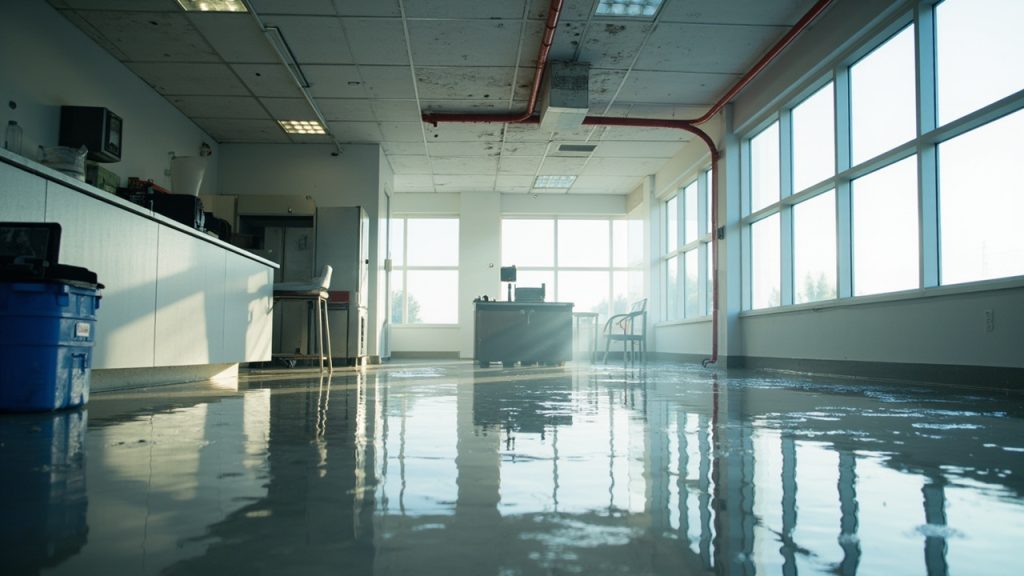
When the Sprinkler Goes Off in Your Office Kitchen, Every Minute Counts
A single activated fire sprinkler head in a downtown Detroit office kitchen can discharge between 15 and 25 gallons of water per minute. In the time it takes your building manager to find the shutoff valve, you could be dealing with hundreds of gallons of water soaking into drop ceilings, hardwood floors, drywall partitions, and commercial-grade carpet. This is not a mop-and-bucket situation.
If your sprinkler system activated in your office in the Midtown corridor, the Corktown district, or anywhere in the Central Business District, the cleanup process needs to start within the first hour. Waiting causes secondary damage that multiplies your costs and your downtime significantly.
This guide walks you through exactly what to do, what not to do, and why professional water extraction is the only real option for a commercial space.
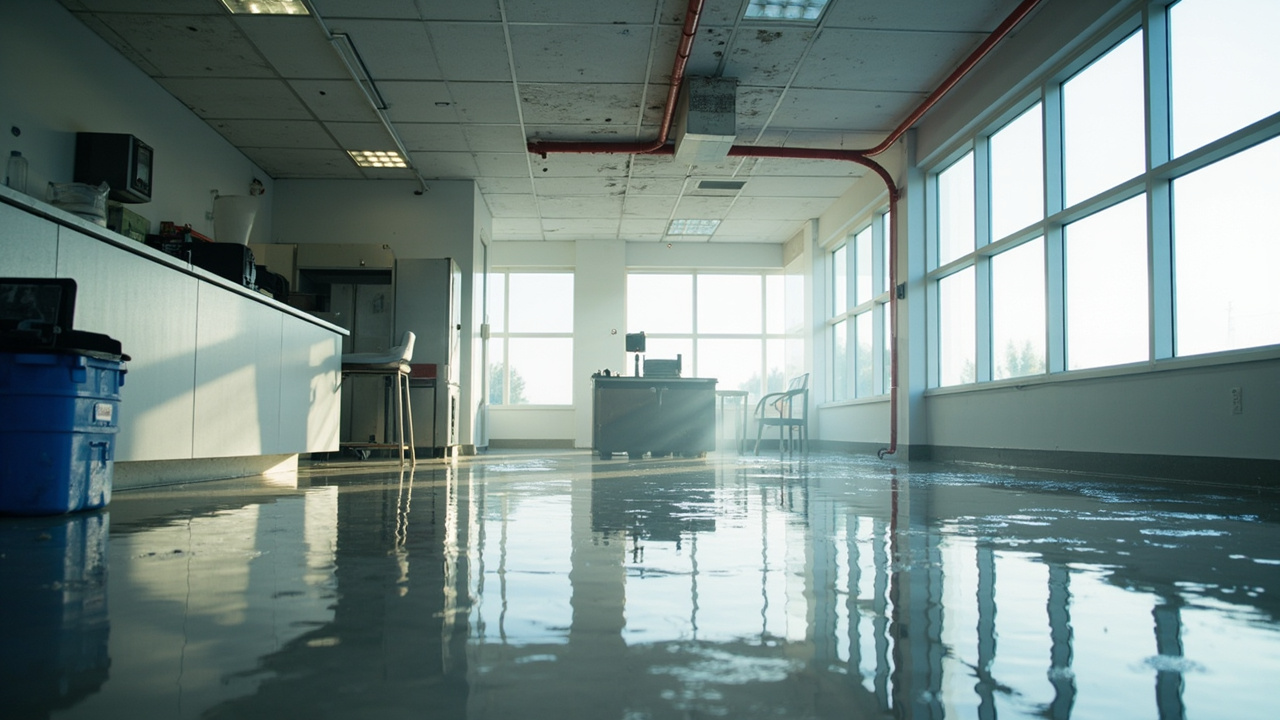
The First 30 Minutes After a Sprinkler Discharge in a Commercial Space
Your immediate priority is stopping the water flow. Fire suppression systems in Detroit commercial buildings typically connect to a dedicated shutoff, separate from your main water supply. Your building’s fire suppression contractor or your property manager should have this location documented. If you are in a leased space in one of the older Midtown office buildings or a renovated Corktown warehouse conversion, that shutoff may not be obvious. Contact your building engineer immediately.
Once the water stops, do not let employees start soaking up water with towels or running wet-dry vacs. Here is why that matters. The water sitting in those sprinkler pipes is classified as Category 2 or Category 3 water under the IICRC S500 Standard for Professional Water Damage Restoration. It is not clean tap water. It has been sitting in metal pipes for months or years, collecting sediment, rust, and biological material. Direct contact without protective gear is a health hazard.
Your second priority is electrical safety. Water and live circuits do not mix. Shut off power to any affected circuits before anyone walks through the water. If your breaker panel is in the affected area, call your electrician or building maintenance before touching anything.
Immediate Steps to Take Before the Restoration Crew Arrives
- Locate and close the fire suppression shutoff valve for the affected zone.
- Contact your building manager or property engineer immediately.
- Shut off electrical power to affected rooms or zones at the breaker panel.
- Do not allow employees to re-enter the soaked area without proper footwear and awareness of slip hazards.
- Begin photographing and documenting everything for your insurance claim before moving a single item.
- Contact your commercial property insurance carrier to open a claim and report the incident to your fire marshal if required under Michigan Building Code.
- Call a certified water damage restoration company that operates 24/7 and can respond within 60 minutes.
Why Sprinkler Water Is Categorized as a Biohazard Risk
This is the part most office managers do not fully understand. They see clean-looking water and assume the cleanup is straightforward. It is not.
Sprinkler pipes in commercial buildings sit dormant for years. The water inside them stagnates and supports microbial growth. When that water discharges at high pressure across your kitchen surfaces, countertops, food prep areas, and into adjacent office spaces, it carries those contaminants with it. The IICRC classifies this as Category 2 or Category 3 water depending on the age of the system and the conditions inside the pipes.
Category 3 water, often called black water in the industry, requires specific personal protective equipment during extraction, disposal protocols for contaminated materials, and antimicrobial treatment of all affected surfaces. This is not something you can handle with a cleaning crew and a few gallons of bleach. Bleach, in fact, does very little against established microbial contamination in porous materials. If you want to understand why surface treatments alone fail, read our breakdown on why bleach will not fix mold contamination.
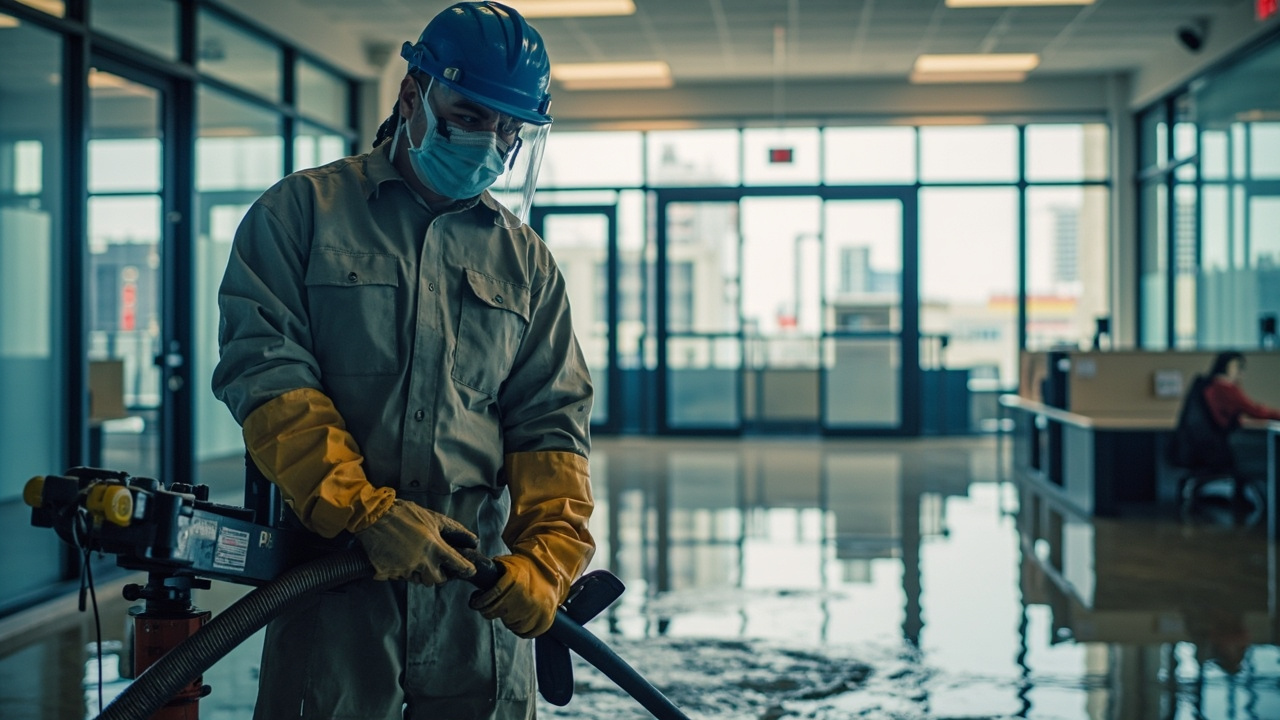
The Full Commercial Water Damage Restoration Process
Understanding what a professional restoration team actually does helps you set realistic expectations for your business continuity timeline. Here is what the process looks like from the moment the crew arrives to the day you reopen that kitchen.
Step 1 — Inspection and Moisture Mapping
The crew performs a full inspection using thermal imaging cameras and calibrated moisture meters. Thermal imaging detects hidden moisture behind walls and inside ceiling cavities that look dry on the surface. In downtown Detroit office buildings, especially the older brick and concrete structures common in Capitol Park or the East Riverfront district, water travels in unexpected directions through wall assemblies and beneath raised flooring. Moisture mapping gives you a complete picture before a single piece of equipment gets placed.
Step 2 — Water Extraction
Industrial truck-mounted extractors remove standing water fast. A standard commercial extraction unit moves several hundred gallons per hour. This is not comparable to a shop vac. The goal is to remove bulk water within the first two to four hours to prevent saturation from spreading into structural materials.
Step 3 — Structural Drying with Psychrometric Monitoring
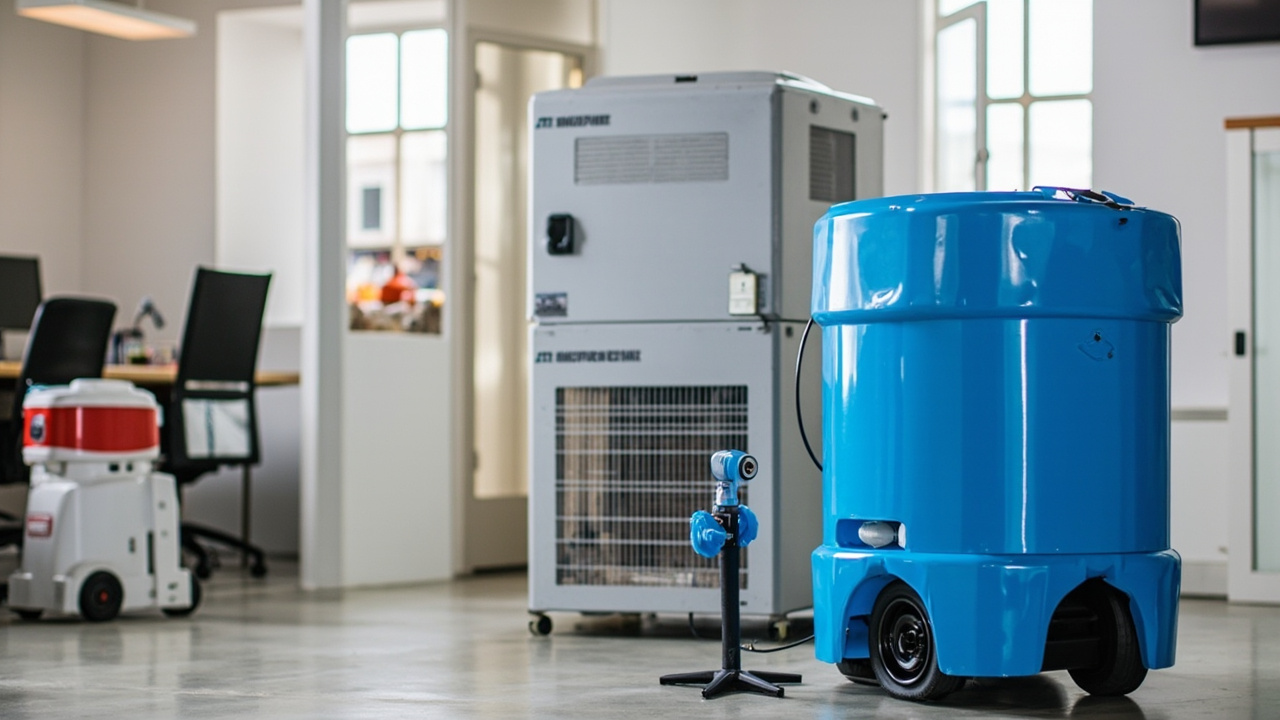
This is where the science of drying takes over. Psychrometry is the measurement and control of air temperature, humidity, and dew point to drive moisture out of building materials. A certified restorer reads psychrometric charts and places high-velocity air movers and industrial dehumidifiers in a calculated pattern to create optimal drying conditions specific to your building’s layout and current ambient conditions.
Detroit summers carry real humidity loads. In July and August, outdoor relative humidity in the greater Detroit metro regularly climbs above 80 percent. That outdoor air cannot be used to dry a building. Sealed drying with dehumidification is required. Without proper psychrometric management, your building will not dry. It will mold.
Step 4 — Antimicrobial Treatment
Given the Category 2 or 3 classification of sprinkler water, all affected surfaces receive antimicrobial treatment after extraction and before drying equipment is staged. This includes subflooring, wall framing if exposed, and any cabinetry that absorbed water.
Step 5 — Deodorization and Soot Residue Removal
Kitchen fires, even small ones, leave soot and smoke odor on surfaces. If your sprinkler activated because of an actual fire event, you are dealing with two damage types simultaneously. Soot is acidic and continues to damage surfaces it contacts. Thermal fogging and hydroxyl generators are the standard commercial tools for neutralizing smoke odor in office environments without requiring extended occupancy shutdowns.
Step 6 — Documentation and Clearance Testing
Before drying equipment comes out, moisture readings confirm that all structural materials have returned to acceptable levels per IICRC S500 standards. That documentation goes directly to your insurance adjuster and supports your claim payout.
Realistic Timelines for Commercial Sprinkler Cleanup in Detroit
| Damage Scope | Water Extraction Timeline | Full Structural Drying Timeline | Return to Occupancy |
|---|---|---|---|
| Single room, hard surface floors | 1 to 2 hours | 2 to 3 days | 3 to 5 days |
| Single room, carpet and subfloor affected | 2 to 3 hours | 3 to 5 days | 5 to 7 days |
| Multi-room spread, ceiling cavity involved | 3 to 6 hours | 5 to 7 days | 7 to 14 days |
| Full floor saturation, structural material removal required | 6 to 12 hours | 7 to 14 days | 14 to 30 days |
These timelines assume professional equipment is on-site within 60 minutes of the discharge. Every hour of delay adds roughly one additional day to the drying timeline for materials like concrete and wood subfloor.
The Hidden Damage Risks in Detroit Commercial Buildings
Downtown Detroit office buildings span a wide range of construction types. You have post-war concrete frame buildings in the New Center area, turn-of-the-century masonry structures in Capitol Park, and contemporary glass and steel builds along the waterfront. Each type behaves differently when flooded.
Masonry and concrete absorb enormous amounts of water and release it slowly. A concrete floor slab can hold moisture for weeks even after surface water is removed. Without proper drying equipment monitoring that slab, you will get mold growth under vinyl composition tile or carpet within five to seven days.
Older buildings with original wood framing or legacy plaster walls present their own challenges. Michigan Building Code sets standards for occupancy after water events, and your fire marshal may require a formal inspection before the space reopens. Factor that into your business continuity planning.
If your office has hardwood floors, the window for saving them is narrow. High-volume sprinkler discharge causes cupping and buckling in hardwood within 24 to 48 hours. Read more about the specific recovery process for wood flooring in our guide on saving hardwood floors after a major water event.
Water Damage Category Comparison for Commercial Sprinkler Events
| Water Category | Source | Health Risk Level | Required PPE | Material Disposal Requirements |
|---|---|---|---|---|
| Category 1 (Clean) | Broken supply line, overflow from clean source | Low | Standard gloves | Drying preferred, removal only if unsalvageable |
| Category 2 (Gray) | Stagnant pipe water, appliance discharge | Moderate | Gloves, eye protection, respirator | Porous materials often require removal |
| Category 3 (Black) | Long-standing sprinkler pipe water, sewage-influenced sources | High | Full PPE including Tyvek suit, N95 or better respirator | All porous materials require removal and proper disposal |
Navigating Your Commercial Insurance Claim After a Sprinkler Event
Commercial property insurance claims for sprinkler discharge are common and generally covered, but the documentation requirements are strict. Your insurer will want a scope of loss that identifies every affected material, square footage of damage, and equipment placement logs from your restoration contractor. Gaps in documentation result in partial denials or lowball settlement offers.
A credentialed restoration company provides detailed moisture logs, psychrometric data, equipment placement records, and photo documentation that supports your adjuster’s assessment. If you manage the property yourself, this documentation is also your protection against tenant liability claims.
For guidance on working directly with your insurance carrier through the claims process, see our detailed resource on getting your Detroit insurance to actually pay for water restoration. The commercial claims process shares many of the same friction points as residential claims, and the strategies for protecting your payout are similar.
If your business is in a leased space, notify your landlord and their insurance carrier in writing within 24 hours of the incident. Lease agreements in Michigan commercial properties typically specify notification timelines for damage events. Missing that window can affect your coverage.
Why Mold Risk Is Especially High in Detroit’s Climate
Detroit sits in a Great Lakes climate zone where summer humidity is a constant factor from late spring through September. When a sprinkler event happens in June, July, or August, the ambient conditions outside your building are already close to the threshold that supports active mold growth. Interior temperatures in an office with HVAC running can create condensation patterns in wall cavities that become mold incubators within 48 to 72 hours of a water event.
Mold remediation in a commercial space is dramatically more disruptive and expensive than preventing it. Remediation requires containment barriers, negative air pressure machines, HEPA vacuuming, and in many cases the removal of drywall and insulation. A three-day drying project that gets skipped becomes a two-week remediation project that forces you to relocate your staff.
For context on what professional mold remediation actually involves and why surface treatments do not cut it, the team at Ironwood has detailed information on the remediation process that applies equally to commercial and residential spaces.
What to Ask a Restoration Company Before You Hire Them
Not every company that shows up after a water event has the training or equipment to handle a commercial sprinkler discharge properly. Ask these questions before anyone starts work.
- Is your team IICRC certified in Water Damage Restoration (WRT) and Applied Structural Drying (ASD)?
- Do you carry the liability insurance required for commercial projects in the State of Michigan?
- Can you provide psychrometric monitoring logs daily throughout the drying process?
- Do you have experience with Category 2 and Category 3 water events in commercial buildings?
- Can you work directly with our insurance adjuster and provide a complete scope of loss?
- What is your guaranteed response time for commercial emergencies in the Detroit metro area?
A restoration company that hesitates or cannot clearly answer these questions is not equipped for this type of project. Commercial sprinkler cleanup is a specialized service, and your building, your employees, and your business continuity depend on getting it right the first time.
Getting Your Downtown Detroit Office Back to Normal
The path from a sprinkler discharge to a fully restored, safe, and operational office space is predictable when you work with the right team from the start. Fast response, proper water categorization, IICRC-compliant drying, full documentation, and direct insurance coordination are the factors that determine how quickly you get back to business.
If you manage office space anywhere in the greater Detroit metro, from the New Center and Midtown corridors to the Rivertown district and beyond, and you are dealing with the aftermath of a sprinkler event right now, do not wait. Every hour matters when standing water is involved.
Contact Ironwood Water Damage Restoration Detroit for emergency commercial sprinkler cleanup. Response within 60 minutes. IICRC-certified crews. Full insurance documentation provided from day one.
{
“@context”: “https://schema.org”,
“@type”: “BlogPosting”,
“headline”: “How to Safely Clean Up After a Small Kitchen Fire Sprinkler Accident in Your Downtown Detroit Office”,
“description”: “Fire sprinkler went off in your Detroit office? Learn the exact steps for safe, effective cleanup before mold sets in. Local restoration guidance inside.”,
“wordCount”: 2179,
“datePublished”: “2026-06-25T08:05:00.000Z”,
“dateModified”: “2026-06-25T08:05:00.000Z”,
“inLanguage”: “en-US”,
“mainEntityOfPage”: {
“@type”: “WebPage”,
“@id”: “https://ironwoodwaterdamagerestorationdetroit.com”
},
“publisher”: {
“@type”: “LocalBusiness”,
“name”: “Ironwood Water Damage Restoration Detroit”,
“url”: “https://ironwoodwaterdamagerestorationdetroit.com”
},
“author”: {
“@type”: “Organization”,
“name”: “Ironwood Water Damage Restoration Detroit”,
“url”: “https://ironwoodwaterdamagerestorationdetroit.com”
},
“image”: {
“@type”: “ImageObject”,
“url”: “https://ironwoodwaterdamagerestorationdetroit.com/wp-content/uploads/2026/03/how-to-safely-clean-up-after-a-small-kitchen-fire-1.jpg”
}
}
{
“@context”: “https://schema.org”,
“@type”: “LocalBusiness”,
“name”: “Ironwood Water Damage Restoration Detroit”,
“url”: “https://ironwoodwaterdamagerestorationdetroit.com”,
“address”: {
“@type”: “PostalAddress”,
“addressLocality”: “Detroit”
},
“areaServed”: {
“@type”: “City”,
“name”: “Detroit”
}
}
{
“@context”: “https://schema.org”,
“@type”: “BreadcrumbList”,
“itemListElement”: [
{
“@type”: “ListItem”,
“position”: 1,
“name”: “Home”,
“item”: “https://ironwoodwaterdamagerestorationdetroit.com”
},
{
“@type”: “ListItem”,
“position”: 2,
“name”: “Blog”,
“item”: “https://ironwoodwaterdamagerestorationdetroit.com/blog”
},
{
“@type”: “ListItem”,
“position”: 3,
“name”: “How to Safely Clean Up After a Small Kitchen Fire Sprinkler Accident in Your Downtown Detroit Office”
}
]
}
{
“@context”: “https://schema.org”,
“@type”: “Service”,
“serviceType”: “Water Damage Restoration”,
“provider”: {
“@type”: “LocalBusiness”,
“name”: “Ironwood Water Damage Restoration Detroit”,
“url”: “https://ironwoodwaterdamagerestorationdetroit.com”
},
“areaServed”: {
“@type”: “City”,
“name”: “Detroit”
},
“description”: “Fire sprinkler went off in your Detroit office? Learn the exact steps for safe, effective cleanup before mold sets in. Local restoration guidance inside.”
}