

How to Spot Wine Cellar Water Damage in Bloomfield Hills Before It Ruins Your Collection
Your wine cellar represents years of careful selection and real financial investment. A single moisture event can destroy labels, push corks, and introduce mold spores that spread across an entire rack within 48 to 72 hours. In Bloomfield Hills, where finished basement wine cellars are common in homes along Long Lake Road and Quarton Road, the threat is more specific than most homeowners expect.
Michigan’s freeze-thaw cycles put enormous hydrostatic pressure on basement walls every spring. Add in the naturally high water table across Oakland County and a sump pump that fails during a storm, and your climate-controlled cellar can take on water faster than your cooling unit can compensate.
Here is how to read the warning signs early, before the damage reaches your bottles.
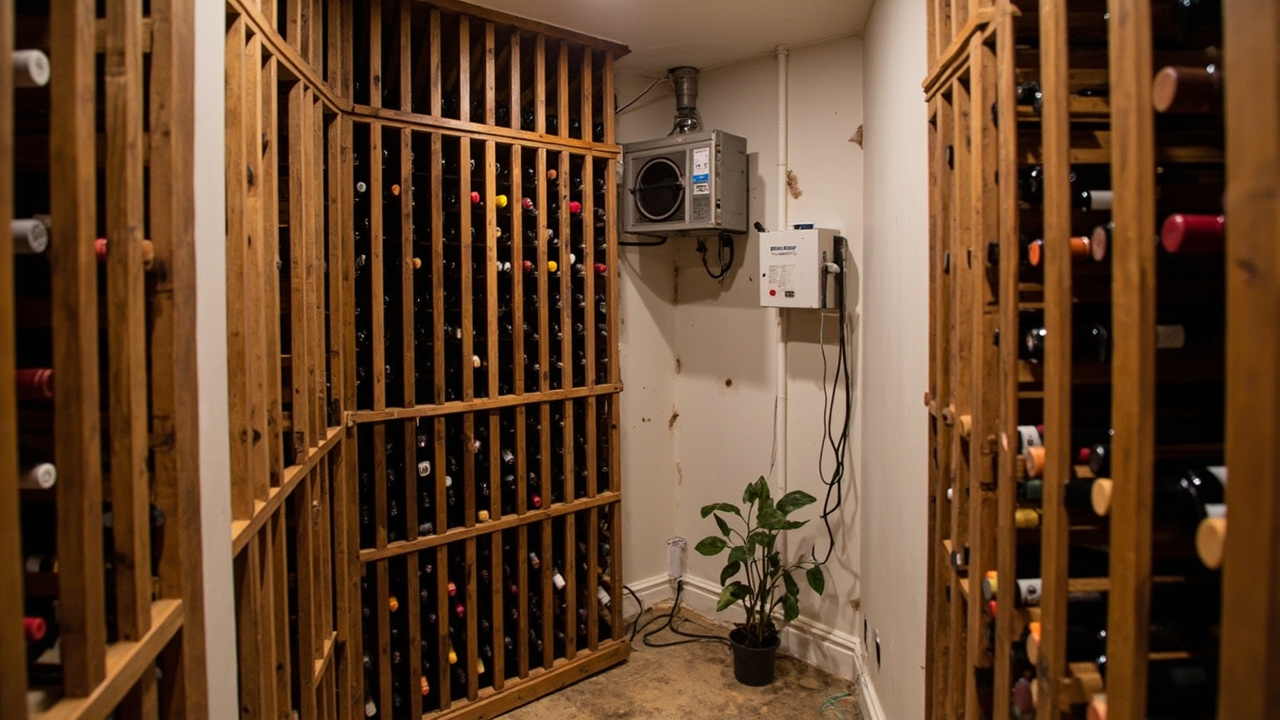
The Early Warning Signs Most Bloomfield Hills Homeowners Miss
Water damage in a wine cellar rarely starts with a flood. It usually starts quietly. By the time you see standing water, the structural and microbial damage is already well underway.
Watch for these specific indicators.
- Cork protrusion or seepage. If the cork on a bottle is pushing outward or you notice wine weeping around the seal, the storage environment has experienced temperature or humidity spikes. This signals either a cooling unit failure or moisture intrusion affecting ambient conditions.
- Label separation or bubbling. Paper wine labels absorb moisture rapidly. If labels are curling at the edges, separating from the bottle, or developing brown tide lines, relative humidity (RH) in your cellar has exceeded the safe 50 to 70 percent range, likely due to an external moisture source.
- White efflorescence on walls or flooring. That chalky white residue on concrete or stone is a mineral salt deposit left behind when water migrates through the wall and evaporates. It means water is actively moving through your foundation, even if the floor feels dry.
- Musty odor concentrated near the floor or corners. Mold and mildew produce volatile organic compounds (VOCs) that you smell before you see them. A wine cellar should smell of wood and earth, not dampness. A musty concentration in one corner often points to a specific moisture intrusion point.
- Condensation on cooling unit components or racking. Light surface condensation on a cooling unit is normal during normal operation. Persistent condensation spreading to the wood racking or walls indicates elevated ambient moisture that the cooling system is struggling to process.
- Discoloration or warping on wooden racking. Wood racking is a moisture indicator. Swelling, warping, or dark staining on the wood grain means the material has absorbed water above its equilibrium moisture content (EMC). At that point, structural integrity of the racking is compromised.
- Visible mold growth on bottles, corks, or walls. At this stage, the problem is already serious. Black or green mold colonies on corks can penetrate the seal and contaminate the wine itself. This requires professional mold remediation, not just cleaning.
Why Bloomfield Hills Basements Are Particularly Vulnerable
The geology under Oakland County is not forgiving to finished basements. Much of the soil in the Bloomfield Hills area is dense clay with poor drainage. During spring snowmelt and heavy rain events, that clay becomes saturated and directs water pressure directly at your foundation walls.
Homes in the Quarton Lake Estates neighborhood and along Telegraph Road corridors frequently deal with lateral water infiltration through block foundations. Older homes built before modern vapor barrier standards are especially susceptible.
Sump pump failure is the single most common cause of sudden wine cellar flooding in this area. A power outage during a spring storm, a failed float switch, or a discharge line freezing in a Michigan winter can allow water to rise quickly. If your sump pump lacks a battery backup, your cellar is one power outage away from a significant loss event.
The high water table across much of Oakland County also means that even without active surface water, groundwater can wick upward through a concrete slab, raising the RH in your cellar slowly and consistently over weeks or months.

What Water Does to a Wine Collection Over Time
The damage progression in a wine cellar follows a predictable pattern. Understanding the timeline helps you act at the right moment.
| Time After Moisture Intrusion | Primary Damage Type | Affected Materials | Reversibility |
|---|---|---|---|
| 0 to 24 hours | Elevated RH, label softening | Paper labels, cooling unit efficiency | High, if caught and dried properly |
| 24 to 48 hours | Mold spore activation, wood absorption | Wooden racking, cork integrity | Moderate, professional drying required |
| 48 to 72 hours | Active mold colony growth | Walls, floor, insulation, bottle labels | Low without remediation |
| 72 hours and beyond | Structural degradation, wine contamination risk | Subfloor, wall framing, wine itself | Very low, demolition of materials likely needed |
The 48-hour threshold is critical. This is the window referenced in the IICRC S500 Standard for Professional Water Damage Restoration, which defines the industry benchmark for responding to water intrusion events. Beyond that window, materials move from water-damaged to mold-contaminated, which requires a completely different scope of work and significantly higher restoration costs.
Ideal Wine Cellar Conditions and When You Have Crossed the Line
Maintaining proper storage conditions requires precise environmental control. A cooling unit alone does not guarantee those conditions if your building envelope has failed.
| Environmental Factor | Ideal Range for Wine Storage | Damage Threshold | Primary Risk When Exceeded |
|---|---|---|---|
| Relative Humidity (RH) | 50% to 70% | Above 75% or below 45% | Mold growth above, cork desiccation below |
| Temperature | 55°F to 65°F (13°C to 18°C) | Above 70°F | Accelerated aging, flavor degradation |
| Temperature Fluctuation | Less than 5°F variation daily | Any rapid swing exceeding 10°F | Cork expansion and contraction, seepage |
| Air Circulation | Gentle, consistent airflow | Stagnant or high-velocity air | Uneven drying, mold concentration in dead zones |
When a water intrusion event occurs, a standard residential dehumidifier is not sufficient to restore these conditions. Restoration-grade desiccant dehumidifiers, psychrometric calculations, and calibrated temperature management are required to bring a wine cellar back to its proper environmental state without causing further stress to the collection.
The Professional Restoration Process for a Wine Cellar
A wine cellar is not a standard basement room. The restoration approach must account for the high-value contents, the vapor barrier system, the specialized racking, the cooling unit, and the finished wall assemblies that typically include rigid foam insulation.
Here is how a professional water damage restoration team should approach a Bloomfield Hills wine cellar job.
Step 1 — Moisture Mapping with Thermal Imaging
Before a single piece of equipment goes in, a technician should perform a full thermal imaging scan using an infrared camera. Thermal imaging identifies cold spots where water has migrated behind walls, under flooring, and inside insulation cavities. You cannot treat what you cannot find, and in a wine cellar, cutting open finished walls unnecessarily is an expensive mistake. Moisture meters confirm what the thermal scan identifies.
Step 2 — Safe Relocation of the Collection
Bottles must be moved to a climate-controlled space before extraction and drying equipment operates. Drying equipment generates heat and airflow that exceeds safe wine storage parameters. An experienced team will document the collection’s condition and handle bottles with care, separating damaged labels for inventory purposes, which is relevant for insurance documentation.
Step 3 — Water Extraction and Source Control
Submersible pumps handle any standing water. Wet vacuums address residual moisture from flooring and wall bases. If the source of intrusion is an active crack or failed sump pump, that issue must be resolved before drying begins. Drying a space with an active water source is pointless.
Step 4 — Controlled Drying with Psychrometric Monitoring
This is where wine cellars differ most from standard restoration jobs. Restoration technicians use psychrometrics, the science of measuring moisture in air and materials, to calculate the precise number and placement of dehumidification and air movement units needed. Desiccant dehumidifiers work better in cooler environments like wine cellars than refrigerant-based units. Readings are logged daily to track the drying curve and ensure materials are returning to their target moisture content without over-drying, which can crack wood racking.
Step 5 — Mold Assessment and Remediation if Needed
If mold colonies are present, drying alone does not resolve the problem. Mold remediation must follow the drying phase, including removal of contaminated materials, HEPA vacuuming, and antimicrobial treatment of structural surfaces. If you are dealing with mold in your Bloomfield Hills basement, read our breakdown of why bleach does not fix basement mold and when you need a professional before attempting any self-treatment.
Step 6 — Vapor Barrier and Envelope Restoration
Once structural materials reach their target moisture content, the vapor barrier system must be inspected and restored. Any compromised sections of rigid foam insulation or poly sheeting must be replaced before the space is resealed. Skipping this step means the next Michigan winter will drive moisture right back in through the same pathways.

Filing an Insurance Claim for Wine Cellar Water Damage
Standard homeowner policies in Michigan often cover sudden and accidental water damage but exclude gradual moisture intrusion. The distinction matters enormously when you are filing a claim for a wine collection that may be worth tens of thousands of dollars.
Document everything before restoration begins. Photograph every affected bottle, every stained wall, every warped rack board. Get the moisture mapping report from your restoration contractor in writing. That data becomes your evidence file.
For guidance on navigating the claims process specific to the Detroit metro area, our article on how to get your Detroit home insurance to actually pay for water restoration walks through the documentation steps that adjusters need to see. If your cellar is in a Bloomfield Hills home and you are unsure how to frame the claim, the process detailed in our guide to filing a successful water damage insurance claim applies broadly across Wayne and Oakland County policies.
One important note on high-value wine collections. Your standard homeowner policy likely has a personal property sublimit that does not adequately cover a curated cellar. A separate inland marine or fine wine insurance rider is worth discussing with your broker before a loss event, not after.
Other Finished Basement Materials At Risk During a Water Event
A wine cellar water event rarely stays contained to just the cellar space. Finished basements in Bloomfield Hills typically include hardwood flooring in adjacent media rooms or lounges, carpeting in sitting areas, and drywall construction throughout.
If your hardwood floors in the surrounding space took water, our article on how to save hardwood floors after a significant water leak in Birmingham MI covers the drying window and when floors can be saved versus when they must come out. For any adjacent carpeted areas, our piece on deciding whether wet carpet can be saved or needs to go gives you a clear decision framework based on water category and exposure time.
Choosing a Restoration Contractor Who Understands Wine Cellars
Not every water damage restoration company has experience with climate-controlled specialty spaces. Ask specifically whether the technicians hold IICRC certification and whether they have completed wine cellar or specialty climate room projects in the Detroit metropolitan area before. Ask how they handle the collection during the drying phase and whether they use psychrometric logging, not just periodic manual readings.
Response time matters as much as expertise. The 48-hour mold activation window means a contractor who cannot be on-site within 60 minutes of your call in Bloomfield Hills is a contractor who may cost you your collection. Confirm that 24/7 emergency dispatch is genuinely available, not just listed on a website.
We serve Bloomfield Hills, Birmingham, Grosse Pointe, Bloomfield Township, Troy, and surrounding Oakland and Wayne County communities. If you notice any of the warning signs above in your wine cellar, contact us immediately. Early intervention is the difference between a drying job and a full reconstruction.