
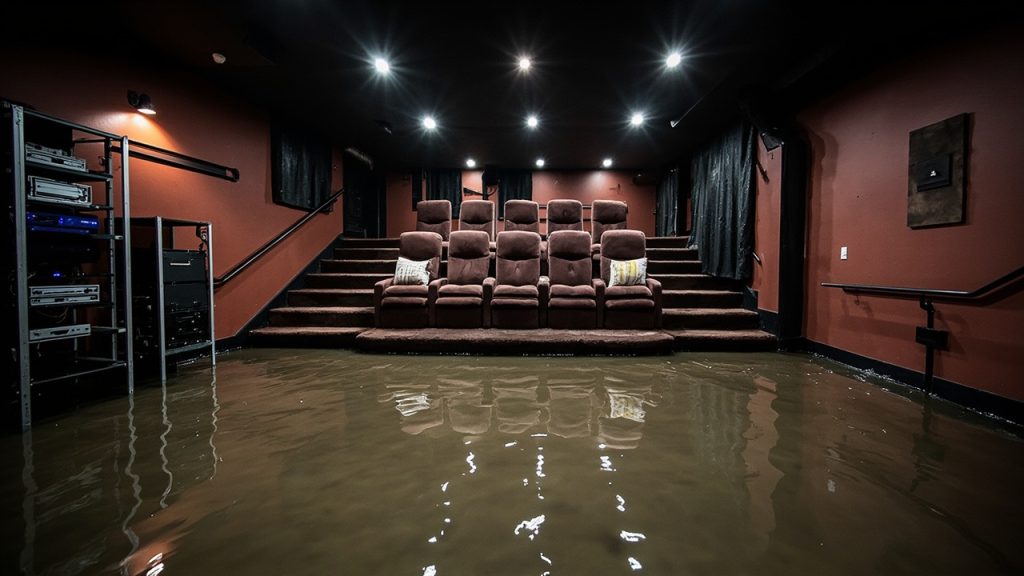
Your Home Theater Took on Water — Here Is What Happens Next
Water in a home theater is not the same as water in a bathroom. The materials are different. The stakes are higher. And the window for action is shorter than most Birmingham homeowners realize. If you are dealing with Birmingham home theater water damage right now, the decisions you make in the next few hours determine whether your acoustic treatments, projector, and automation system survive. Professional drying Birmingham crews with theater-specific experience approach this differently than a standard restoration job, and that difference matters enormously.. Read more about Why Curbless Showers in Your Birmingham Remodel Might Be Leaking Into the Subfloor.
Birmingham and the surrounding communities in Oakland County are home to some of the most custom-built basement theaters in Southeast Michigan. We are talking Dolby Atmos setups, 4K laser projectors, in-wall subwoofers, Control4 and Crestron automation systems, and acoustic treatments that cost more than most people’s entire basement renovations. When a sump pump fails or a hot water heater lets go near that room, the damage compounds fast.. Read more about Finding an Emergency Water Restoration Team in Bloomfield Hills When Every Minute Counts.
This guide walks you through what professional home theater water damage restoration actually looks like, why standard dryout methods can ruin your acoustic treatments, and what you can do right now to protect your investment.
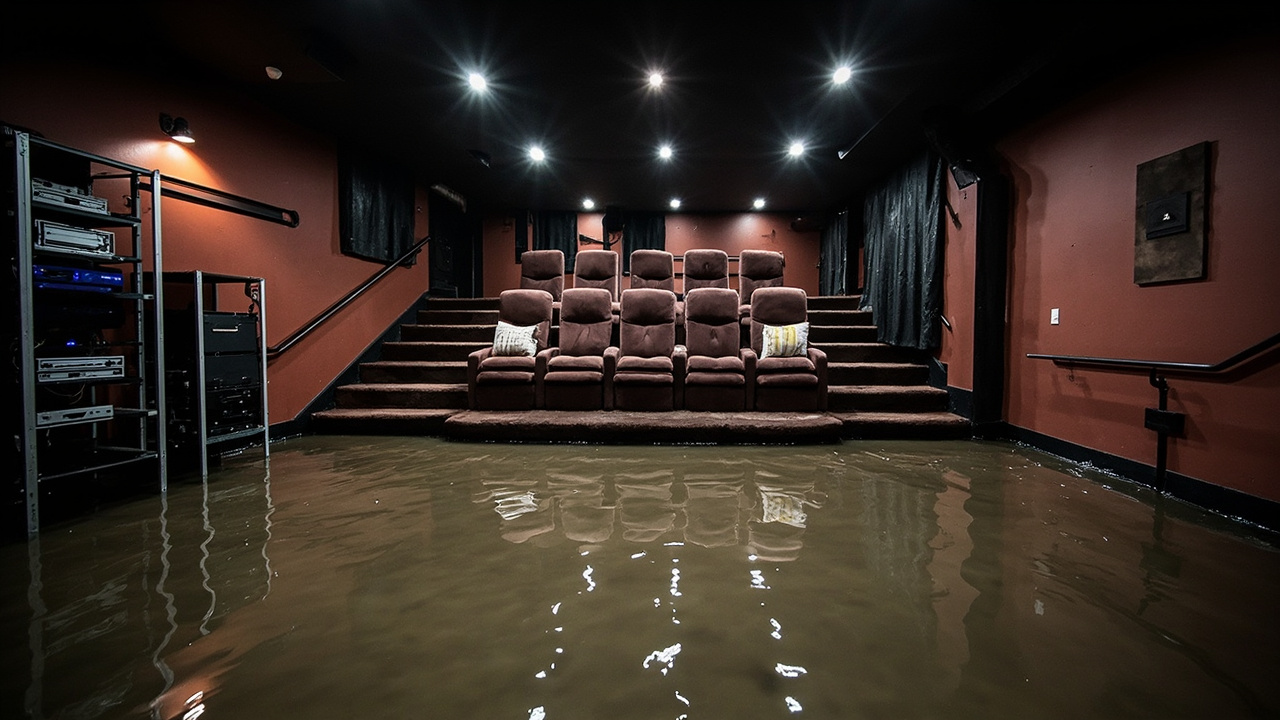
Immediate Steps for Birmingham and Oakland County Homeowners After a Flood
Do Not Touch the Power
The first rule is non-negotiable. Do not flip any switches, plug anything in, or attempt to power on AV equipment that has been exposed to moisture. This includes wall plates, rack-mounted amplifiers, and automation processors. Water and electrical current in a confined basement space is a life-safety issue, not just an equipment concern.
Call your utility provider or shut off the main breaker at the panel before anyone enters the space. If you are unsure whether the panel itself is in a flood zone, stay out and call a licensed electrician first.
Start Documenting Before You Move Anything
Walk the perimeter if it is safe to do so. Use your phone to photograph and video every affected surface, every piece of equipment, every inch of standing water. This documentation becomes the foundation of your insurance claim. Do not let a well-meaning family member start carrying equipment upstairs before you have captured the full scene.
For guidance on making insurance actually work in your favor, read our breakdown on how to get your home insurance to actually pay for water restoration.
Ventilation Is Not Your Friend Right Now
Many homeowners open windows or run box fans immediately after a flood. In a home theater, this is often a mistake. Acoustic panels, bass traps, and wall-mounted fabric systems absorb ambient humidity quickly. Pulling in warm Michigan summer air or cold basement air can accelerate moisture migration into materials that are still dry. Controlled drying is the goal, not fast drying.
Why Home Theaters Require a Specialized Restoration Process
A standard water damage crew treats every room like drywall and carpet. A home theater is neither. The materials, the construction methods, and the embedded systems all demand a different approach rooted in IICRC S500 standards for professional water damage restoration. Our lead IICRC-certified technician, who has worked exclusively in Southeast Michigan restoration for over a decade, puts it plainly: the first crew in a theater sets the outcome for everything that follows.
The Acoustic Layer Problem
Most custom theaters use rockwool or mineral wool insulation behind fabric-wrapped panels. These materials trap and hold moisture at a cellular level. Standard thermal imaging may not catch saturation in these panels because the surface reads dry while the core stays wet. That hidden moisture is where mold colonies begin, typically within 48 to 72 hours under Michigan’s ambient humidity conditions.
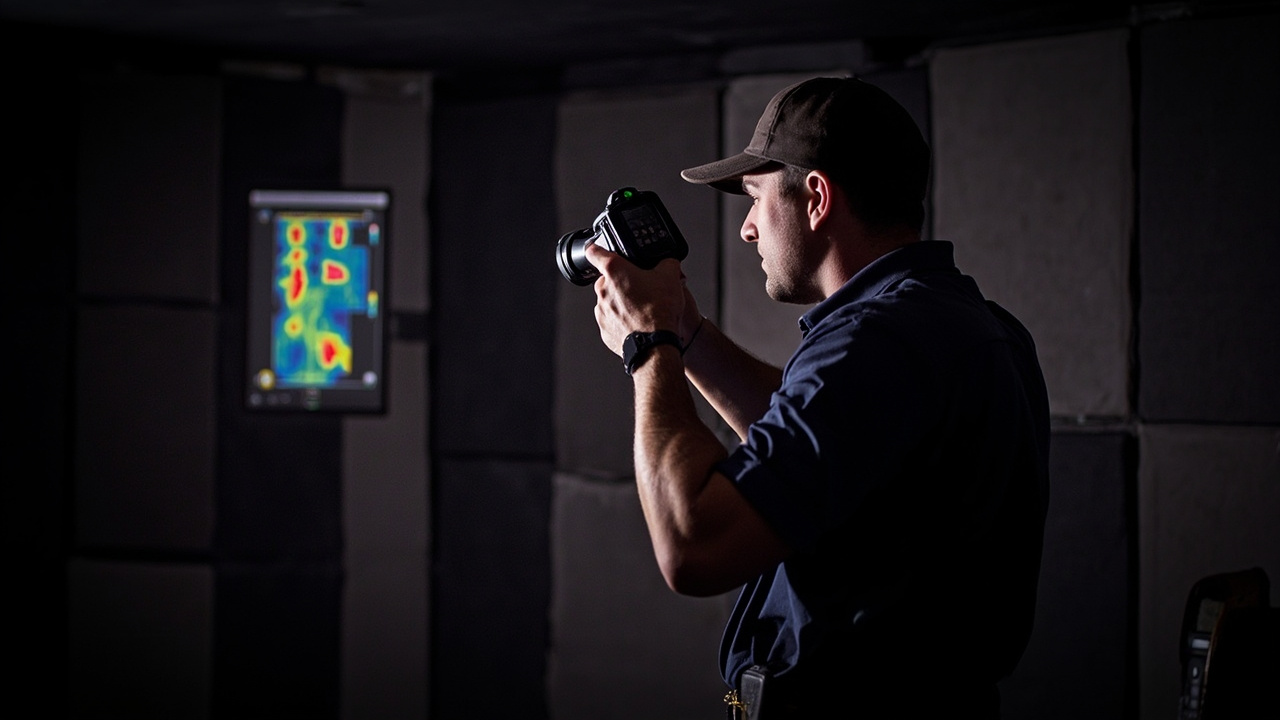
Bass traps installed in corners and ceiling clouds made from compressed fiberglass present the same challenge. They look fine. They feel borderline dry. But psychrometrics — the science of measuring heat, humidity, and air properties — tells a different story. A trained technician with a pin-type moisture meter and a thermal imaging camera will find what your eyes cannot.
Subfloor Risers and the Water You Cannot See
Tiered theaters use subfloor risers to create elevated seating rows. Water loves to travel beneath those platforms and sit there undisturbed. In a standard home, wet subflooring is a problem. In a tiered theater, the riser system creates a series of enclosed chambers that trap water and humidity with no natural airflow.
Accessing that moisture requires removing riser sections, mapping the moisture gradient underneath using psychrometric calculations, and placing drying equipment strategically beneath the platform deck. Skipping this step means mold behind your carpet and an odor problem six weeks later.
The Professional Drying Process Step by Step
Here is how a qualified restoration team approaches a home theater in Birmingham or the surrounding Oakland County area.
- Safety assessment and power isolation. Technicians confirm all electrical circuits in the theater and adjacent spaces are de-energized before any moisture mapping begins.
- Thermal imaging and moisture mapping. A full psychrometric reading is taken of every surface, including wall panels, ceiling treatments, subfloor sections, and equipment racks. This creates the baseline drying goal.
- Water extraction. Standing water is removed using truck-mounted or portable extraction units. Any saturated carpet or carpet pad on raised platforms is pulled and assessed for salvageability.
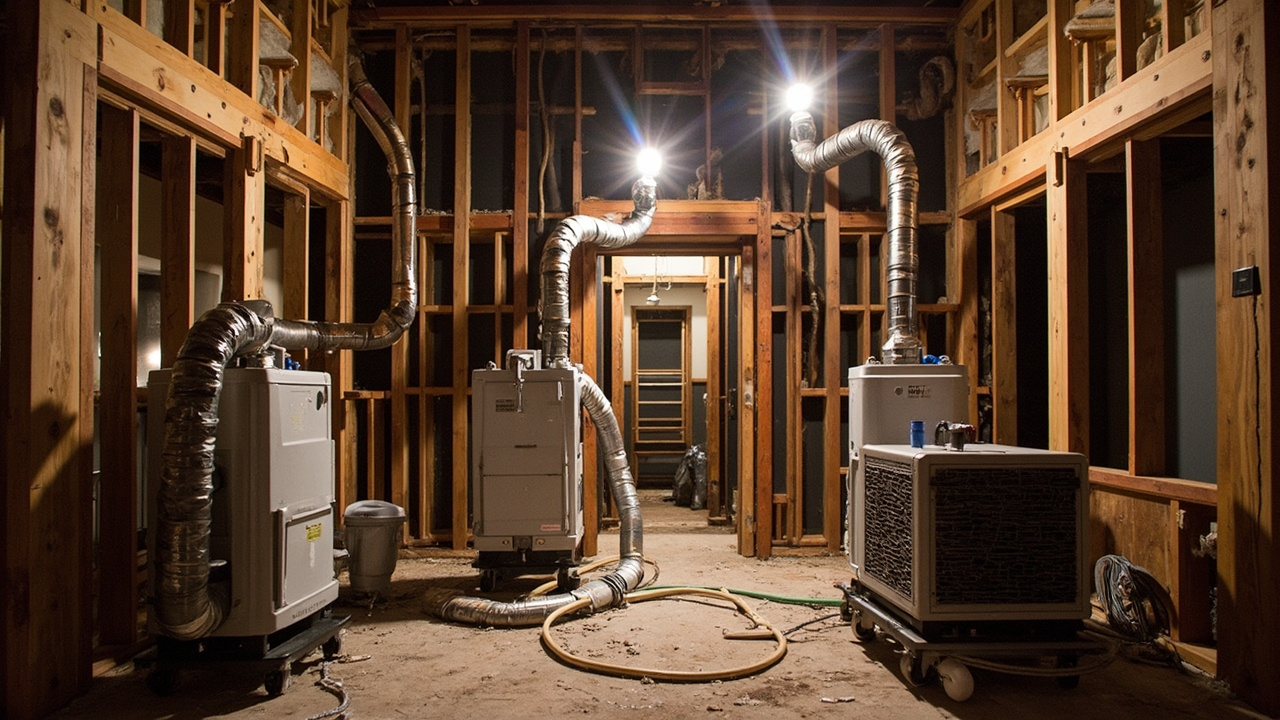
- Strategic equipment placement. Low-grain refrigerant (LGR) dehumidifiers are positioned to pull moisture from the air column. HEPA air scrubbers run continuously to capture particulates, including any mold spores that may already be airborne.
- Panel and acoustic material assessment. Fabric panels are tested individually. Those that can be dried in place are treated with directed airflow. Those that cannot are carefully removed, labeled, and dried off-site to preserve their framing and fabric integrity.
- Daily monitoring and psychrometric logging. Moisture readings are taken every 24 hours and logged against the drying goal. Dehumidifiers are adjusted as the materials dry at different rates.
- Electronics assessment referral. AV equipment is never powered on at the job site. Affected components are referred to a qualified electronics restoration specialist who can assess corrosion, board damage, and recalibration needs.
What Happens to Your AV Equipment and Why You Cannot Rush It
A 4K laser projector that sat in a humid room for 18 hours has condensation on internal optical components. Powering it on before the optics dry can permanently fuse that moisture to the lens array. The same logic applies to amplifier boards in rack systems and the processor cores inside Control4 or Crestron hubs.
The standard protocol is a minimum 72-hour desiccant or controlled-environment dry-out before any power is applied. Some electronics restoration labs in the Detroit metro use vacuum desiccant chambers for projector optics. This is not cheap, but it is far less expensive than a full projector replacement.
In-wall speakers present a separate issue. The speaker cone and surround material in an in-wall subwoofer can warp if dried too quickly using direct heat. Slow, controlled drying at a stable temperature is the only safe method.
| AV Component | Primary Risk from Water Exposure | Safe Drying Window | Recovery Likelihood |
|---|---|---|---|
| 4K Laser Projector | Optical condensation, board corrosion | 72 to 96 hours before power-on | High if dried before power-on attempt |
| In-Wall Subwoofer | Cone warping, surround material swelling | 48 to 72 hours controlled dry | Moderate, depends on submersion time |
| Control4 / Crestron Processor | Board corrosion, firmware corruption | 72 hours minimum desiccant dry | High if no power was applied while wet |
| Rack-Mounted Amplifiers | Transformer rust, capacitor damage | 96 hours before any power attempt | Variable, age and submersion depth matter |
| Acoustic Panels (Rockwool) | Core saturation, mold growth | 3 to 7 days with LGR dehumidification | High if addressed within 48 hours |
Mold Behind Soundproofing Is a Real and Specific Risk
Soundproofing fabric stretched over wooden frames creates a perfect mold environment. The fabric blocks visual inspection. The wood frame absorbs moisture. The dead air space behind the panel provides zero airflow. In a basement theater in Oakland County, where ambient humidity in summer regularly climbs into the 60 to 75 percent range, mold can colonize within 48 hours of a water event.
This is not hypothetical. We have pulled panels in Birmingham-area theaters and found mold growth on the back face of the panel and the wall surface behind it, with the front of the panel still looking and smelling completely clean.
If your theater took on water and more than 48 hours passed before remediation started, mold testing before reconstruction is the responsible path. For a clear explanation of why surface treatments alone will not solve that problem, our article on why bleach will not fix basement mold covers the chemistry in plain language.
Acoustic Material Drying vs. Standard Drywall Drying
| Material Type | Standard Dryout Method | Theater-Specific Method | Why It Differs |
|---|---|---|---|
| Painted Drywall | Air movers, LGR dehumidifier | Same, with moisture logging | Standard approach works here |
| Fabric-Wrapped Acoustic Panel | Air movers (surface only) | Panel removal, core drying, off-site if needed | Surface drying misses saturated core |
| Rockwool / Mineral Wool Batt | Replacement recommended | Moisture mapping first, then targeted dehumidification | Rockwool can often be dried if caught early |
| Subfloor Riser Platform | Surface extraction only | Riser removal, sub-platform extraction, directed airflow | Water pools in enclosed chambers below deck |
| Carpet on Raised Platform | Extraction, assess in place | Remove, assess pad separately, check subfloor moisture | Multilayer system traps moisture at multiple levels |
Navigating Your Insurance Claim for a High-Value Theater Space
A home theater claim is not a simple contents claim. You are dealing with built-in components, structural acoustic treatments, and custom millwork that may not have a straightforward replacement cost on a standard homeowner’s policy. The adjuster assigned to your claim may have never dealt with an in-wall speaker system or a custom projection screen before.
Document everything before the restoration crew does any work. Get itemized estimates from AV specialists, not just a general contractor. The acoustic panels, the automation system, and the projector calibration after humidity exposure all represent legitimate line items.
Our detailed guide on filing a successful water damage insurance claim walks through the documentation strategy that gets claims paid in full rather than settled at a fraction of actual cost.
What Adjusters Often Miss on Theater Claims
Recalibration costs for a Dolby Atmos system after humidity exposure are real and billable. ISF projector calibration after an optics dryout is a legitimate expense. Automation system reprogramming after a Control4 processor replacement is not a luxury — it is a necessary restoration cost. Push back if these items are excluded from your claim estimate.
If other rooms in your home were affected by the same water event, those claims compound. Water that entered through a basement theater often travels. If you have hardwood floors upstairs that took moisture from below, that is a separate line item worth pursuing. See our resource on saving hardwood floors after a water leak in Birmingham for specifics on that process.
Commonly Excluded Theater Claim Line Items and How to Respond
| Claim Line Item | Typical Adjuster Pushback | Recommended Documentation Response |
|---|---|---|
| Dolby Atmos system recalibration | “Calibration is routine maintenance, not a restoration cost” | Provide written statement from AV technician confirming calibration was altered by humidity exposure and is required to restore pre-loss performance |
| ISF projector calibration after optics dryout | “Projector was not physically damaged per our assessment” | Submit electronics restoration lab report documenting optical condensation, desiccant treatment performed, and ISF recalibration requirement post-dryout |
| Control4 or Crestron reprogramming | “Software costs are not covered under structural or contents loss” | Itemize reprogramming as a necessary labor cost to restore automation functionality lost due to processor replacement, supported by original programming invoice and replacement scope |
| Acoustic panel off-site drying labor | “Panels could have been dried in place” | Provide psychrometric log showing in-place drying was not viable, with moisture readings confirming core saturation and restoration firm’s written methodology justification |
| Subfloor riser removal and reinstallation | “Riser platforms are cosmetic, not structural” | Submit moisture mapping report showing water pooling beneath platform deck and mold risk assessment confirming access was necessary to achieve drying standard |
Who Should Handle a Birmingham Area Home Theater Restoration
Not every restoration company has the training or equipment to handle a space like this. The questions to ask before you hire anyone are direct and specific.
- IICRC Certification. Are your technicians certified under the S500 standard, and can you provide documentation on request?
- Thermal Imaging and Psychrometric Logging. Do you use thermal imaging cameras and psychrometric logging on every job, and will those logs be included in your written report?
- Acoustic Panel Experience. Do you have documented experience with acoustic panel removal and off-site drying, specifically in custom theater environments?
- LGR Equipment Capacity. Do you carry low-grain refrigerant dehumidifiers capable of operating efficiently in low-temperature basement conditions common to Michigan winters?
- AV Electronics Coordination. Can you work alongside a qualified AV electronics restoration specialist for equipment assessment rather than leaving that step to the homeowner?
- Insurance-Ready Documentation. Do you provide written moisture logs formatted for submission to an insurance adjuster, including baseline and daily readings?
If the answer to any of those questions is vague or a flat no, keep calling. A theater restoration done wrong costs more to correct than the original damage. Mold remediation behind reconstructed panels, replacing equipment that was powered on too early, and re-pulling riser platforms that were never properly dried are all scenarios we have been called in to fix after a first crew missed the mark.
We have served homeowners across the greater Birmingham and Oakland County area, including Bloomfield Hills, Grosse Pointe, Royal Oak, Troy, and throughout Wayne County, with water damage restoration work that holds up under insurance scrutiny. Response time matters. Moisture migrates, mold grows, and electronics corrode on a timeline that does not wait for business hours.
If your theater also has carpet that may need replacement, the same moisture assessment principles apply. Our guide on whether wet carpet can be saved or needs to go covers the decision framework in detail.
Get Your Theater Properly Assessed Before Anything Dries Wrong
The difference between a full theater recovery and a partial loss often comes down to the first 24 hours. Acoustic materials that are caught early can be dried in place. Electronics that are kept unpowered have a strong recovery rate. Mold that is caught before it colonizes behind panels saves you a full reconstruction.
Call us at any hour. We respond to Birmingham and the greater Oakland County area around the clock. Bring your documentation, your insurance policy number, and your questions. We will walk through the space with you, give you an honest assessment of what can be saved, and start the drying process using equipment and methods designed for the materials actually in your theater.
Your theater took years to build and significant money to equip. A restoration crew that understands that will treat it differently than a flooded laundry room. That distinction is what we bring to every job in Southeast Michigan.
{
“@context”: “https://schema.org”,
“@type”: “BlogPosting”,
“headline”: “How Your Birmingham Home Theater Can Be Professionally Dried Without Ruining the Acoustics”,
“description”: “Birmingham home theater water damage requires a specialized drying process. Learn what professional restoration looks like before acoustics and AV equipment are lost.”,
“wordCount”: 2470,
“datePublished”: “2026-08-13T04:47:00.000Z”,
“dateModified”: “2026-08-13T04:47:00.000Z”,
“inLanguage”: “en-US”,
“mainEntityOfPage”: {
“@type”: “WebPage”,
“@id”: “https://ironwoodwaterdamagerestorationdetroit.com”
},
“publisher”: {
“@type”: “LocalBusiness”,
“name”: “Ironwood Water Damage Restoration Detroit”,
“url”: “https://ironwoodwaterdamagerestorationdetroit.com”
},
“author”: {
“@type”: “Organization”,
“name”: “Ironwood Water Damage Restoration Detroit”,
“url”: “https://ironwoodwaterdamagerestorationdetroit.com”
},
“image”: {
“@type”: “ImageObject”,
“url”: “https://ironwoodwaterdamagerestorationdetroit.com/wp-content/uploads/2026/03/how-your-birmingham-home-theater-can-be-profession-1.jpg”
}
}
{
“@context”: “https://schema.org”,
“@type”: “LocalBusiness”,
“name”: “Ironwood Water Damage Restoration Detroit”,
“url”: “https://ironwoodwaterdamagerestorationdetroit.com”,
“address”: {
“@type”: “PostalAddress”,
“addressLocality”: “Detroit”
},
“areaServed”: {
“@type”: “City”,
“name”: “Detroit”
}
}
{
“@context”: “https://schema.org”,
“@type”: “BreadcrumbList”,
“itemListElement”: [
{
“@type”: “ListItem”,
“position”: 1,
“name”: “Home”,
“item”: “https://ironwoodwaterdamagerestorationdetroit.com”
},
{
“@type”: “ListItem”,
“position”: 2,
“name”: “Blog”,
“item”: “https://ironwoodwaterdamagerestorationdetroit.com/blog”
},
{
“@type”: “ListItem”,
“position”: 3,
“name”: “How Your Birmingham Home Theater Can Be Professionally Dried Without Ruining the Acoustics”
}
]
}
{
“@context”: “https://schema.org”,
“@type”: “Service”,
“serviceType”: “Water Damage Restoration”,
“provider”: {
“@type”: “LocalBusiness”,
“name”: “Ironwood Water Damage Restoration Detroit”,
“url”: “https://ironwoodwaterdamagerestorationdetroit.com”
},
“areaServed”: {
“@type”: “City”,
“name”: “Detroit”
},
“description”: “Birmingham home theater water damage requires a specialized drying process. Learn what professional restoration looks like before acoustics and AV equipment are lost.”
}