
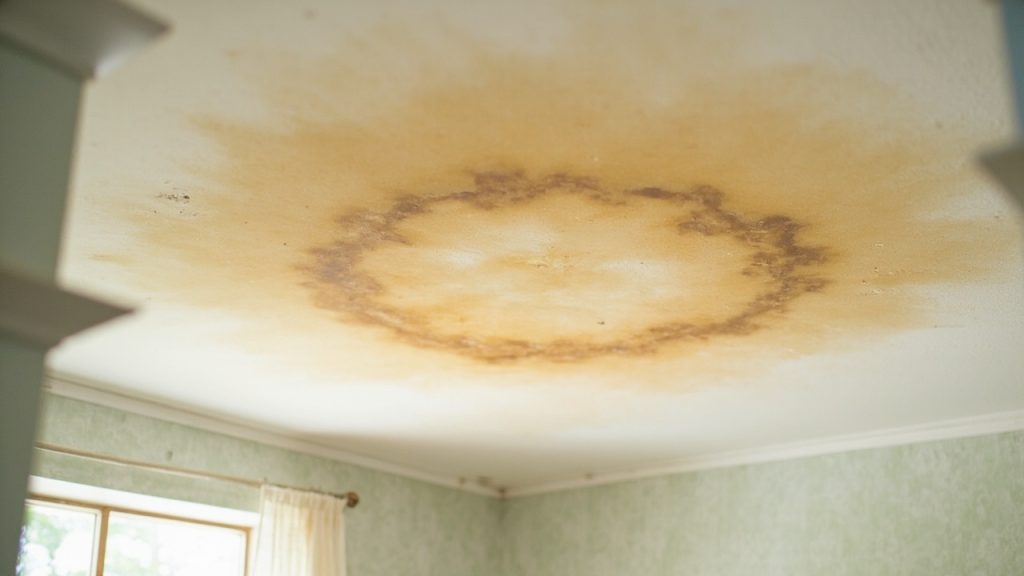
A yellowish ring on your ceiling. A soft, spongy spot when you press on the drywall. Maybe a slow drip that only happens at 2 a.m. Whatever it looks like, a mystery damp spot on your ceiling in Grosse Pointe Park deserves immediate attention, not a wait-and-see approach.
Water damage is deceptive. What looks like a small stain on the surface can hide saturated insulation, rotting joists, and the early stages of black mold (Stachybotrys chartarum) inside the wall cavity. The source of that moisture is often nowhere near the stain itself.
This guide walks you through how to find the real source, what to do right now, and when the problem has moved past DIY territory.

Stop the Immediate Damage Before You Do Anything Else
Before you start playing detective, protect what you can. If the ceiling is actively dripping or the drywall is visibly sagging, place buckets under the drip and clear the area of furniture, electronics, and rugs.
Drywall sagging is a warning sign. A saturated ceiling panel can hold a surprising amount of water before it fails, and when it does, it fails fast. If you see a pronounced bulge, poke a small hole in the center with a screwdriver to release the water in a controlled way. This sounds counterintuitive, but it prevents a full ceiling collapse.
If the leak is directly above an electrical panel, light fixture, or ceiling fan, shut off the circuit breaker for that area. Water and live wiring are a serious hazard. Do not turn the power back on until the area has been fully dried and inspected.
The Grosse Pointe Park Housing Stock Makes Diagnosis Trickier
Grosse Pointe Park is dense with homes built between the 1920s and 1960s. These are beautiful, well-built houses, but their age introduces failure points that newer construction simply does not have.
Original cast-iron drain stacks corrode from the inside out. Knob-and-tube or early copper plumbing runs can develop pinhole leaks that drip for months before anyone notices. Flat or low-slope roof sections, common on additions and garages in this neighborhood, hold standing water in ways that pitched roofs do not.
The proximity to Lake St. Clair also plays a role. Humidity levels along the Lakeshore Drive corridor stay elevated through most of the summer, and that moisture finds its way into attic spaces and wall cavities, accelerating the damage from even a minor water intrusion.
Common Sources of a Ceiling Leak When It Is Not Raining
This is the question that confuses most homeowners. If it is not raining, why is my ceiling wet? The answer is almost always one of these four sources.
Upstairs Bathroom Plumbing
A toilet wax ring that has shifted. A supply line fitting that has been weeping for months. A P-trap under the sink that drips only when the drain is full. These are the most common culprits when the damp spot appears below a bathroom.
Run water in the upstairs bathroom for 30 to 60 seconds, then go back to the ceiling below and watch. If the drip increases or starts fresh, you have found your general area. The specific fixture still needs to be isolated.
HVAC Condensate Line Blockages
Air handlers installed in attics or second-floor utility closets produce condensation as a normal part of cooling your home. That condensate drains through a PVC line to the outside or to a floor drain. When that line clogs with algae or debris, the condensate pan overflows.
A clogged HVAC condensate line is one of the most frequently missed sources of ceiling moisture in Grosse Pointe Park homes because homeowners associate the ceiling stain with rain rather than their air conditioning system.
Refrigerator and Appliance Water Lines
If the stain is on a first-floor ceiling below a kitchen, check the refrigerator ice maker line and the dishwasher drain connection. These thin supply lines, especially the older braided or plastic varieties, crack over time. The leak can be slow enough that it only saturates the subfloor and does not appear on the ceiling below for weeks.
Roof Flashing Failures
Roof flashing is the metal sheeting that seals the joints around chimneys, skylights, and where a roof meets a wall. When flashing corrodes or pulls away from the substrate, water channels directly into the structure during rain. The stain appears on your ceiling days or weeks later, long after the rain has stopped, because the water travels through insulation and framing before it finally soaks through the drywall.
The Detroit Freeze-Thaw Cycle and Ice Dam Damage
Southeast Michigan winters are uniquely punishing for roofing systems. Detroit and its neighboring communities like Grosse Pointe Park, Harper Woods, and East English Village experience repeated freeze-thaw cycles through January, February, and into March. Those cycles create ice dams.
An ice dam forms when heat escaping from your living space warms the roof deck enough to melt snow. That meltwater runs down to the cold eave, where it refreezes into a ridge of ice. Subsequent meltwater backs up behind that ridge and finds any crack or gap in the roofing material, forcing its way under shingles and into the attic.
The critical detail here is timing. Ice dam leaks often do not show up inside the house until the ice melts in late winter or early spring. A homeowner sees a ceiling stain in March and assumes it is a spring rain leak, when the actual damage happened in February. By the time the stain appears, the insulation above it has been wet for weeks, which is more than enough time for mold growth to begin. The EPA notes that mold can begin developing within 24 to 48 hours of a moisture event, a timeline that makes fast response critical.
Signs that point to ice dam damage rather than a plumbing leak include stains that run along the exterior wall, discoloration near the soffit line, and damage that appears in multiple rooms along the same exterior wall rather than in one isolated spot.
How to Narrow Down the Leak Source Yourself
A systematic approach saves time and prevents you from tearing open the wrong section of ceiling. Work through this checklist before calling anyone.
- Check the weather history. Did the stain appear or grow after a specific rain event? If yes, the source is likely roofing or flashing. If it appeared during dry weather, look at plumbing and HVAC first.
- Identify what is directly above the stain. Use your home’s floor plan or measure from exterior walls to locate the space above the ceiling. Is it a bathroom, a kitchen, an attic, or a mechanical room?
- Look for secondary clues. Water stains that run along a seam or joint suggest the water is traveling from a distant source. A stain directly below a fixture is more likely a direct drip from that fixture.
- Check your attic if you have safe access. Look for wet insulation, water stains on the rafters, or daylight visible through the roof deck. Do this during daylight hours with a flashlight.
- Run water deliberately. Flush toilets, run faucets, and run the dishwasher one at a time while watching the ceiling below. This isolates the source to a specific fixture.
- Check your HVAC condensate pan. If your air handler is in the attic or a closet, find the drip pan and see if it is holding standing water.
What Professional Diagnostic Tools Actually Show
When the source is not obvious from visual inspection, professionals use tools that see through building materials without demolition.
Thermal Imaging Cameras
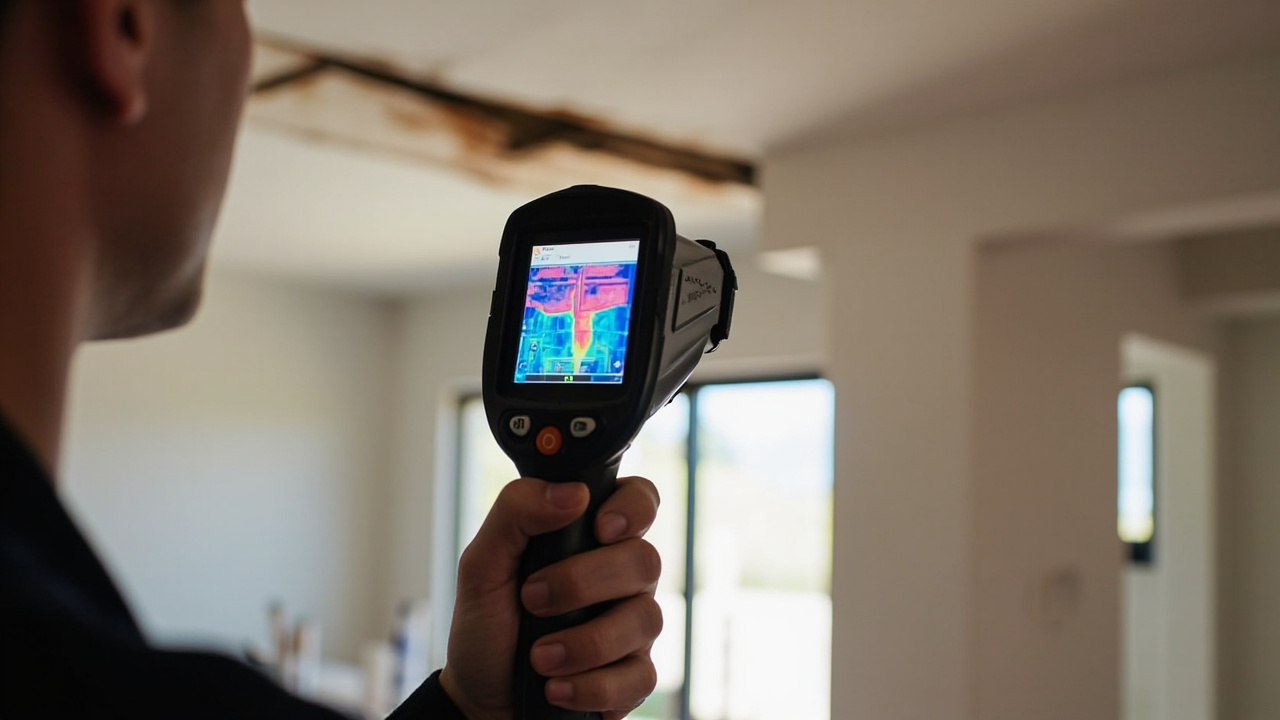
Infrared (thermal imaging) cameras detect temperature differences in building surfaces. Wet materials hold heat differently than dry materials, which shows up as a distinct color signature on the camera display. A trained technician can trace the moisture migration path through a wall or ceiling system in minutes, pinpointing the entry point rather than just the visible stain.
This technology is genuinely useful for Grosse Pointe Park homes with plaster ceilings and complex framing, where cutting exploratory holes is both destructive and expensive.
Calibrated Moisture Meters
A moisture meter measures the moisture content of drywall, wood framing, and subfloor materials as a percentage. The IICRC S500 Standard for Professional Water Damage Restoration defines acceptable moisture content thresholds for different building materials, and readings above those thresholds confirm active water intrusion even when the surface looks dry to the eye.
Moisture meters also track drying progress over the days following remediation, confirming that materials have returned to safe levels before reconstruction begins.
| Leak Source | Typical Detection Method | How Fast It Appears on Ceiling | Season Most Common in Detroit |
|---|---|---|---|
| Ice Dam | Thermal imaging, attic inspection | Days to weeks after the ice event | January through March |
| HVAC Condensate Overflow | Visual pan inspection, moisture meter | Within hours of overflow | June through September |
| Bathroom Plumbing Drip | Run-water test, moisture meter | Days to weeks depending on leak rate | Year-round |
| Roof Flashing Failure | Roof inspection, thermal imaging | Hours to days after rain event | April through November |
| Appliance Supply Line | Visual inspection, moisture meter | Weeks to months of slow travel | Year-round |

The Mold Clock Starts Immediately
The 24 to 48 hour window for mold growth is not a scare tactic. It is the biological reality of how mold spores behave in a wet cellulose environment like drywall and wood framing. Grosse Pointe Park homes with older, denser plaster-over-lath construction can actually hold moisture longer than modern drywall, which extends the exposure window but does not stop mold from colonizing.
Black mold (Stachybotrys chartarum) requires sustained moisture over a longer period to establish, but other mold species like Cladosporium and Penicillium can begin growing in under 48 hours. Any ceiling stain that has been present for more than two days without a dry-out process underway should be treated as a potential mold situation until proven otherwise.
If you are dealing with a finished basement ceiling or a bathroom ceiling that has been visibly damp for a week or more, read our guide on why bleach does not fix mold in your ceiling or walls before you reach for a spray bottle.
How the Restoration Process Works After the Source Is Found
Finding the leak source is only step one. Once the entry point is confirmed and the plumbing or roofing repair is complete, the affected building materials need a controlled dry-out before any reconstruction happens.
Professional water mitigation uses commercial-grade air movers and dehumidifiers calibrated to the square footage and material types in your specific area. A standard bedroom ceiling with minor saturation might dry in three to five days. A ceiling with saturated insulation above it, or water that has migrated into wall cavities, can take seven to ten days under active drying conditions.
Skipping the dry-out and going straight to patching the drywall traps moisture inside the assembly, guaranteeing mold growth behind the new material.
| Damage Scenario | Typical Dry-Out Period | Materials Likely Affected | Mold Risk if Untreated |
|---|---|---|---|
| Small drip, caught within 24 hours | 3 to 5 days | Drywall face, minor insulation | Low if dried promptly |
| Slow leak present 1 to 2 weeks | 5 to 8 days | Drywall, insulation, framing | Moderate, inspect for existing growth |
| Ice dam intrusion with attic saturation | 7 to 14 days | Insulation, rafters, drywall, possibly subfloor | High, professional assessment required |
| Appliance line failure, weeks undetected | 10 to 14 days or more | Subfloor, framing, multiple ceiling layers | Very high, mold likely already present |
Navigating a Wayne County Insurance Claim for Ceiling Water Damage
Most homeowner insurance policies in Wayne County cover sudden and accidental water damage, which includes burst pipes and appliance failures. They generally do not cover damage from long-term neglected leaks or gradual deterioration. The distinction matters because the insurance company will ask how long the stain has been there.
Document everything before you touch anything. Take photos and video of the stain, the ceiling condition, and any visible water. Write down when you first noticed the problem and what weather events preceded it. This record is critical when your adjuster comes out.
If you have not been through a water damage claim before, our detailed guide on getting your Detroit home insurance to actually pay for water restoration walks through the specific documentation and process steps that move claims forward. If you are in Corktown or another neighborhood with older housing stock where claim disputes are more common, there is also a specific guide on filing a successful water damage insurance claim worth reviewing before your adjuster visit.
A professional restoration company that works directly with insurance adjusters can also provide a detailed scope of work and moisture documentation that supports your claim and prevents underpayment on the repair estimate.
When Ceiling Damage Spreads to Floors and Walls
Water from a ceiling leak does not stay on the ceiling. It runs down wall cavities, saturates flooring on the level below, and pools under baseboards. If the source was a second-floor bathroom, check the hardwood or tile on that floor as well. Our guide on saving hardwood floors after a water leak covers the decisions you will need to make quickly, since hardwood has a narrow window for successful restoration before cupping and delamination become permanent.
Carpet on the floor below a ceiling leak is a separate triage decision. Wet carpet that has been down for more than 24 hours in a warm environment almost always requires professional evaluation. Read through our breakdown on whether wet carpet can be saved or needs to be replaced to understand the factors that determine the outcome.
What You Should Do Right Now
If you are reading this because you are staring at a damp spot on your ceiling right now, here is the short version of what to do.
- Protect the area below the stain. Move furniture and valuables. Place buckets if it is actively dripping.
- If the ceiling is sagging, relieve the water pressure with a controlled puncture at the lowest point of the bulge.
- Shut off power to any circuits running through the wet area.
- Work through the diagnostic checklist above to identify the likely source category.
- Take photos and video of the damage in its current state.
- If the stain is larger than a dinner plate, has been present for more than 24 hours, or you cannot identify the source, call a water mitigation professional the same day.
Grosse Pointe Park homes are worth protecting. The architecture is irreplaceable, the neighborhoods are genuinely walkable, and property values reflect the care that owners put into maintenance. A damp ceiling spot is a solvable problem, but only if it gets addressed while the damage is still contained.
If you need a professional diagnostic inspection in Grosse Pointe Park or anywhere in the Detroit metro area, our team uses thermal imaging and calibrated moisture meters to find the source without unnecessary demolition. We are IICRC-certified and respond the same day. Call us and we will tell you exactly what you are dealing with before any work begins.
{
“@context”: “https://schema.org”,
“@type”: “BlogPosting”,
“headline”: “Tracking Down the Source of That Mystery Damp Spot on Your Grosse Pointe Park Ceiling”,
“description”: “Damp ceiling in Grosse Pointe Park? Learn how to diagnose roof leaks, plumbing drips, and ice dam damage before calling a Detroit water restoration pro.”,
“wordCount”: 2486,
“datePublished”: “2026-06-24T12:35:00.000Z”,
“dateModified”: “2026-06-24T12:35:00.000Z”,
“inLanguage”: “en-US”,
“mainEntityOfPage”: {
“@type”: “WebPage”,
“@id”: “https://ironwoodwaterdamagerestorationdetroit.com”
},
“publisher”: {
“@type”: “LocalBusiness”,
“name”: “Ironwood Water Damage Restoration Detroit”,
“url”: “https://ironwoodwaterdamagerestorationdetroit.com”
},
“author”: {
“@type”: “Organization”,
“name”: “Ironwood Water Damage Restoration Detroit”,
“url”: “https://ironwoodwaterdamagerestorationdetroit.com”
},
“image”: {
“@type”: “ImageObject”,
“url”: “https://ironwoodwaterdamagerestorationdetroit.com/wp-content/uploads/2026/03/tracking-down-the-source-of-that-mystery-damp-spot-1.jpg”
}
}
{
“@context”: “https://schema.org”,
“@type”: “LocalBusiness”,
“name”: “Ironwood Water Damage Restoration Detroit”,
“url”: “https://ironwoodwaterdamagerestorationdetroit.com”,
“address”: {
“@type”: “PostalAddress”,
“addressLocality”: “Detroit”
},
“areaServed”: {
“@type”: “City”,
“name”: “Detroit”
}
}
{
“@context”: “https://schema.org”,
“@type”: “BreadcrumbList”,
“itemListElement”: [
{
“@type”: “ListItem”,
“position”: 1,
“name”: “Home”,
“item”: “https://ironwoodwaterdamagerestorationdetroit.com”
},
{
“@type”: “ListItem”,
“position”: 2,
“name”: “Blog”,
“item”: “https://ironwoodwaterdamagerestorationdetroit.com/blog”
},
{
“@type”: “ListItem”,
“position”: 3,
“name”: “Tracking Down the Source of That Mystery Damp Spot on Your Grosse Pointe Park Ceiling”
}
]
}
{
“@context”: “https://schema.org”,
“@type”: “Service”,
“serviceType”: “Water Damage Restoration”,
“provider”: {
“@type”: “LocalBusiness”,
“name”: “Ironwood Water Damage Restoration Detroit”,
“url”: “https://ironwoodwaterdamagerestorationdetroit.com”
},
“areaServed”: {
“@type”: “City”,
“name”: “Detroit”
},
“description”: “Damp ceiling in Grosse Pointe Park? Learn how to diagnose roof leaks, plumbing drips, and ice dam damage before calling a Detroit water restoration pro.”
}