
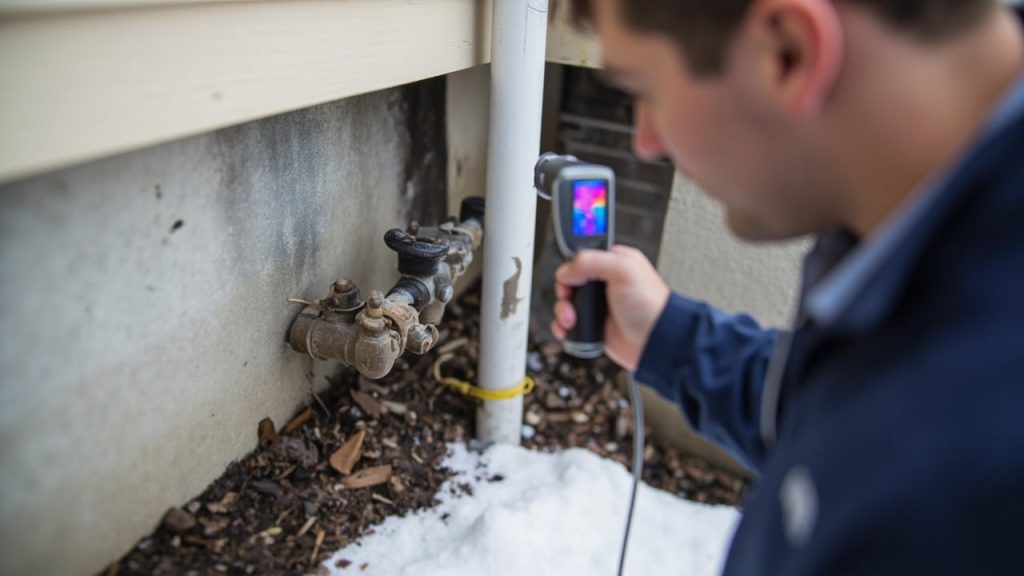
A Burst Outdoor Spigot Is Rarely Just a Plumbing Problem
A frozen and burst outdoor faucet might look like a simple plumbing repair. Replace the sillcock, done. But after 15 years of working through Michigan winters in Wayne County and across the greater Detroit metro, I can tell you the pipe is almost never the whole story.
Water follows the path of least resistance. When a hose bib or sillcock fractures from ice expansion, that water does not stay at the faucet. It migrates. It soaks into the rim joist. It saturates wall cavities. By the time the spring thaw arrives and you spot a watermark or smell something musty, the damage has been spreading for weeks.
This guide covers what actually happens during a deep freeze burst, how to stop it fast, and what signs tell you the damage goes beyond the faucet itself.
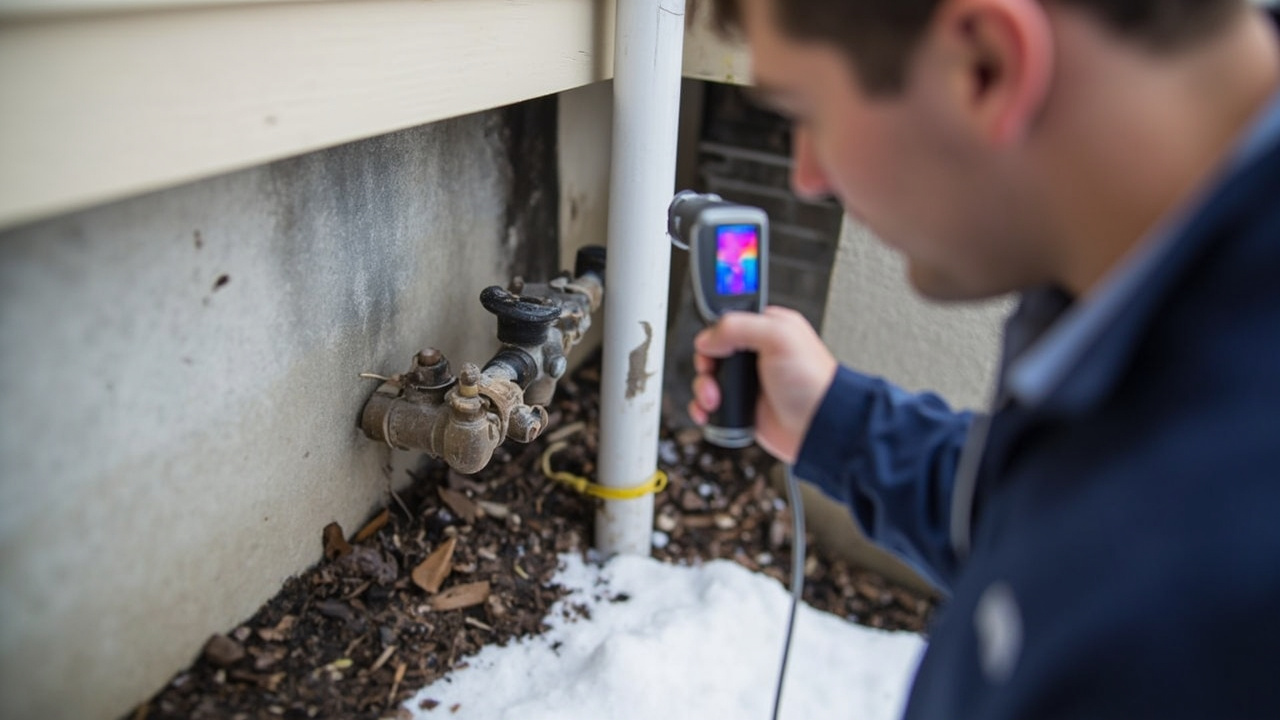
Why Michigan Winters Split Outdoor Faucets
Southeast Michigan regularly sees ground temperatures that challenge even well-installed plumbing. The frost line in SE Michigan sits at roughly 42 inches below grade. Outdoor faucets, mounted at foundation height, are exposed directly to ambient air temperatures that can swing 40 to 50 degrees in a single week during a typical freeze-thaw cycle.
When water freezes, it expands by about 9 percent in volume. Inside the narrow bore of a sillcock or hose bib, that expansion generates thousands of pounds of pressure per square inch. Brass and copper fittings fail under that load. The fracture usually happens inside the wall, not at the exterior spout.
The Vacuum Breaker Problem
Frost-proof faucets were designed to solve this. They extend the valve seat deeper inside the heated wall, so water drains back past the freeze line when the faucet is closed. The problem is the anti-siphon vacuum breaker at the exterior end. If a garden hose was left connected before the freeze, the vacuum breaker could not drain. The trapped water froze, expanded, and cracked the assembly from the inside out.
This is one of the most common failure points we see in Westland, Livonia, and older Dearborn-area homes where the hose is left on through October. The homeowner thinks the frost-proof design protects them. It does, but only if the hose is disconnected before temperatures drop.
Stop the Water First, Then Assess
If you have a burst hose bib right now, here is the sequence that limits damage.
- Locate the interior shut-off valve for your outdoor faucet. In most Westland homes built before 1990, this valve is in the basement or crawlspace, mounted on the supply line near the exterior wall. Turn it clockwise to close it.
- Open the exterior faucet handle to release any remaining pressure and let residual water drain out.
- Do not attempt to thaw a pipe with an open flame. A heat gun or warm towels work. More important, if the pipe has already burst, thawing it just opens the floodgates.
- Check the interior wall directly behind the faucet. Press on the drywall. If it gives, feels soft, or shows discoloration, water is already inside the wall cavity.
- Look at the floor of the basement directly below that exterior wall. Water intrusion through the rim joist often pools at the base of the foundation wall before spreading across the slab.
If you find any softness, discoloration, or pooling water, stop treating this as a plumbing call. You need water damage restoration, not just a pipe replacement.
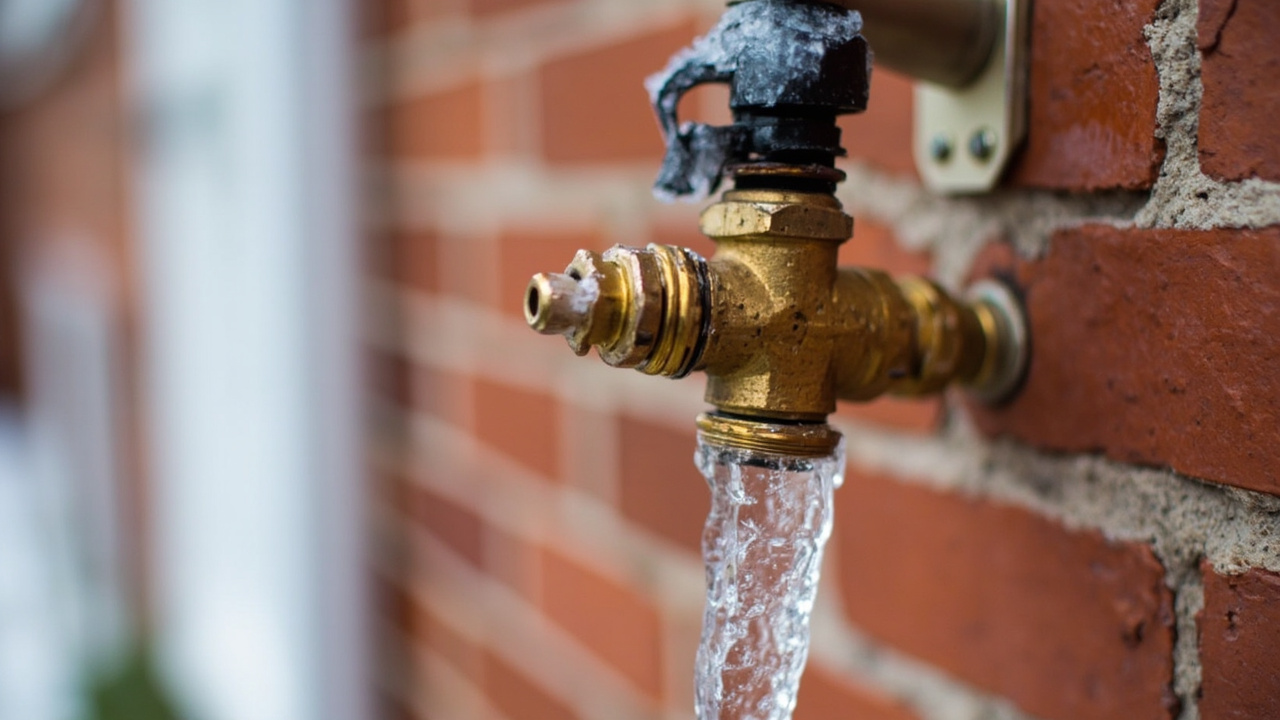
What Hidden Water Damage Looks Like in a Westland Home
The rim joist, the framing member that sits on top of your foundation and runs along the perimeter of your home, is the most vulnerable point when an outdoor faucet fails. Water wicks directly into it. Fiberglass batt insulation, common in Westland homes built during the 1960s through 1980s, holds moisture like a sponge and gives mold exactly what it needs to colonize.
Signs the Leak Has Gone Deeper Than the Faucet
- Soft or spongy drywall on the interior wall near the faucet location
- Peeling paint or bubbling on exterior siding around the spigot escutcheon plate
- A musty odor in the basement, especially near the exterior wall below the faucet
- Efflorescence (white mineral deposits) on the basement wall below the penetration point
- Discoloration or rot on exposed wood framing in the basement or crawlspace
- Elevated humidity readings above 60 percent relative humidity in the basement during winter months
If you notice any of these, the plumber can fix the broken sillcock, but they are not equipped to dry out your rim joist, test for mold, or document the damage for your insurance claim. That is restoration work.
How Professional Restoration Handles a Burst Spigot
When we respond to a burst outdoor faucet call in Westland or anywhere across the Wayne County metro, the process goes well beyond swapping out the hose bib.
Thermal Imaging and Moisture Mapping
We use infrared thermal imaging cameras to identify temperature differentials in the wall and floor assembly. Wet materials hold temperature differently than dry ones. This lets us trace exactly how far water traveled without tearing into walls unnecessarily. Moisture meters then confirm the readings and give us measurable benchmarks for the drying process.
This matters for your insurance claim too. Objective data from calibrated equipment supports what the adjuster needs to authorize a payout. If you are navigating a claim, read through our guide on how to get your Detroit home insurance to actually pay for water restoration before you talk to your adjuster.
Structural Drying With Industrial Equipment
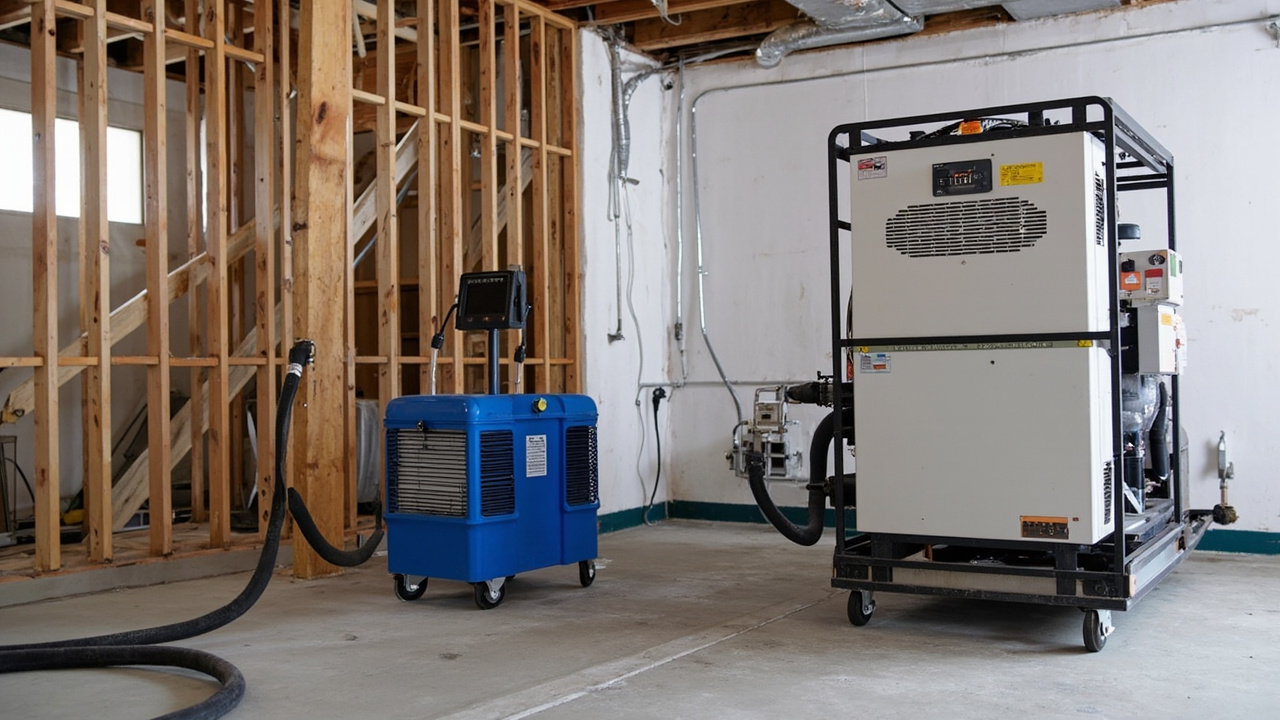
Residential box fans do not dry out a saturated rim joist. We use IICRC-compliant drying protocols, placing high-velocity air movers and refrigerant dehumidifiers strategically based on the moisture map. Drying a rim joist assembly typically takes three to five days of continuous equipment operation, with daily moisture readings to verify progress.
The IICRC S500 Standard for Professional Water Damage Restoration defines the moisture content thresholds that wood framing must reach before a structure is considered dry. We document every reading. You get a full drying log, which your insurance company expects to see.
Mold Prevention and Remediation
Mold can begin colonizing wet wood within 24 to 48 hours at the right temperature and humidity. Michigan basements in winter are cold, which slows growth, but not enough to prevent it entirely. If the burst went unnoticed for more than a day or two, there is a real chance mold has started.
We test, contain, and remediate according to Michigan Department of Environment, Great Lakes, and Energy guidelines. If mold is present, you cannot just dry around it. Remediation has to happen first, or you are sealing spores inside the wall. For more on why surface treatments fail, check out our article on why bleach will not fix basement mold and when to call a pro.
Detroit Metro Response Times and What to Expect
Timing matters more than most homeowners realize. The difference between a contained dryout and a full mold remediation project is often measured in hours, not days. Here is a realistic breakdown of what the response and restoration timeline looks like for a burst outdoor faucet in the Westland and greater Detroit area.
| Phase | Typical Timeframe | What Happens |
|---|---|---|
| Emergency Response Arrival | 60 to 90 minutes (Wayne County) | Water extraction, moisture mapping, thermal imaging |
| Equipment Setup | Same day as arrival | Air movers and dehumidifiers placed based on moisture map |
| Active Structural Drying | 3 to 5 days | Daily moisture readings, equipment adjustments, drying log documentation |
| Mold Assessment | After drying is confirmed | Air and surface sampling if mold growth is suspected |
| Reconstruction Coordination | After clearance | Rim joist insulation replacement, drywall repair, paint |
| Insurance Claim Closeout | Varies by carrier | Full documentation package submitted to adjuster |
Michigan Residential Code and Frost-Proof Faucet Requirements
The Michigan Residential Code, aligned with the International Plumbing Code, requires frost-proof hose bibs in new construction. But code compliance at the time of installation does not prevent future failure if the homeowner leaves a garden hose connected through a freeze event. Many Westland homes also have older standard sillcocks that predate the frost-proof code requirement and have never been upgraded.
When a licensed plumber replaces your burst faucet, they are required to install a frost-proof model with an integrated vacuum breaker to meet current code. Make sure that happens. It will not prevent all future freezes, but it significantly reduces the risk. Disconnecting hoses before November stays on you.
Comparing DIY Attempts vs. Professional Drying Outcomes
A lot of homeowners in Sherwood Forest, Rosedale Park, and older west-side Detroit neighborhoods try to manage the drying themselves after a burst pipe. Here is what the data consistently shows about that approach versus professional drying.
| Factor | DIY Drying | Professional Restoration |
|---|---|---|
| Equipment airflow capacity | Low (box fans, space heaters) | High (industrial air movers, LGR dehumidifiers) |
| Moisture detection | Visual only | Thermal imaging plus calibrated moisture meters |
| Drying verification | Guesswork | Daily readings against IICRC drying goals |
| Insurance documentation | None | Full drying log, moisture maps, photo documentation |
| Mold risk after drying | High (wood often not fully dry) | Low (verified by clearance standards) |
| Hidden damage discovery | Rarely found until visible symptoms appear | Identified during initial thermal scan |
The long-term cost of a failed DIY drying effort almost always exceeds the cost of professional restoration. Rot in a rim joist, mold in wall cavities, and a failed insurance claim because you did not document properly are expensive lessons.
Secondary Damage That Shows Up Months Later
If the burst goes undetected through the rest of winter, which happens more than you would expect in seasonal or vacation properties in the Oakland County lake communities, the damage compounds. Wet rim joists rot. Wet fiberglass insulation compresses, loses its R-value, and becomes a permanent mold host. Hardwood floors above the affected wall can cup and buckle as humidity rises into the subfloor. If you are dealing with floor damage alongside this, see our breakdown of how to save hardwood floors after a significant water leak.
Finished basements take the hardest hit. Carpet and padding trap moisture against the slab and framing, creating exactly the warm, moist, dark environment that mold colonies need. For guidance on when wet carpet can be saved versus when it needs to come out, our article on deciding whether wet carpet can be saved walks through the evaluation criteria.
Filing an Insurance Claim for a Burst Outdoor Spigot
Most standard homeowners insurance policies in Michigan cover sudden and accidental water damage from a burst pipe, including a burst outdoor faucet. The key word is sudden. If an adjuster can argue the damage accumulated over time due to neglect, your claim is at risk.
Document everything before work begins. Photos, video, moisture readings. Keep the broken faucet as evidence. Your restoration company should provide a full written scope of work and drying documentation. If you have already started the claim process, our detailed guide on filing a successful water damage insurance claim covers exactly what adjusters look for and where claims commonly get denied.
When to Call a Restoration Company vs. a Plumber
Call a plumber to fix the broken faucet. Call a restoration company the moment you suspect water has entered your wall, floor assembly, or basement. These are not competing services. They address different parts of the same problem.
A plumber stops the source. A restoration company handles everything that source already damaged. In Westland and across the Wayne County metro, we often work alongside plumbers on the same job. The plumber replaces the sillcock while we map and dry the structure. Trying to do it sequentially, waiting until the pipe is fixed before calling restoration, wastes critical drying time.
If you are unsure, call restoration first. We will tell you honestly whether the damage warrants a professional response or if you can manage it safely on your own. That conversation costs you nothing.
{
“@context”: “https://schema.org”,
“@type”: “BlogPosting”,
“headline”: “What Happens to Your Westland Home When an Outdoor Spigot Bursts After a Deep Freeze”,
“description”: “A burst outdoor spigot in Westland can cause hidden water damage fast. Learn what to do, what to watch for, and when to call a restoration pro.”,
“wordCount”: 1966,
“datePublished”: “2026-04-22T12:13:00.000Z”,
“dateModified”: “2026-04-22T12:13:00.000Z”,
“inLanguage”: “en-US”,
“mainEntityOfPage”: {
“@type”: “WebPage”,
“@id”: “https://ironwoodwaterdamagerestorationdetroit.com”
},
“publisher”: {
“@type”: “LocalBusiness”,
“name”: “Ironwood Water Damage Restoration Detroit”,
“url”: “https://ironwoodwaterdamagerestorationdetroit.com”
},
“author”: {
“@type”: “Organization”,
“name”: “Ironwood Water Damage Restoration Detroit”,
“url”: “https://ironwoodwaterdamagerestorationdetroit.com”
},
“image”: {
“@type”: “ImageObject”,
“url”: “https://ironwoodwaterdamagerestorationdetroit.com/wp-content/uploads/2026/03/dealing-with-a-burst-outdoor-spigot-after-a-deep-f-1.jpg”
}
}
{
“@context”: “https://schema.org”,
“@type”: “LocalBusiness”,
“name”: “Ironwood Water Damage Restoration Detroit”,
“url”: “https://ironwoodwaterdamagerestorationdetroit.com”,
“address”: {
“@type”: “PostalAddress”,
“addressLocality”: “Detroit”
},
“areaServed”: {
“@type”: “City”,
“name”: “Detroit”
}
}
{
“@context”: “https://schema.org”,
“@type”: “BreadcrumbList”,
“itemListElement”: [
{
“@type”: “ListItem”,
“position”: 1,
“name”: “Home”,
“item”: “https://ironwoodwaterdamagerestorationdetroit.com”
},
{
“@type”: “ListItem”,
“position”: 2,
“name”: “Blog”,
“item”: “https://ironwoodwaterdamagerestorationdetroit.com/blog”
},
{
“@type”: “ListItem”,
“position”: 3,
“name”: “What Happens to Your Westland Home When an Outdoor Spigot Bursts After a Deep Freeze”
}
]
}
{
“@context”: “https://schema.org”,
“@type”: “Service”,
“serviceType”: “Water Damage Restoration”,
“provider”: {
“@type”: “LocalBusiness”,
“name”: “Ironwood Water Damage Restoration Detroit”,
“url”: “https://ironwoodwaterdamagerestorationdetroit.com”
},
“areaServed”: {
“@type”: “City”,
“name”: “Detroit”
},
“description”: “A burst outdoor spigot in Westland can cause hidden water damage fast. Learn what to do, what to watch for, and when to call a restoration pro.”
}