
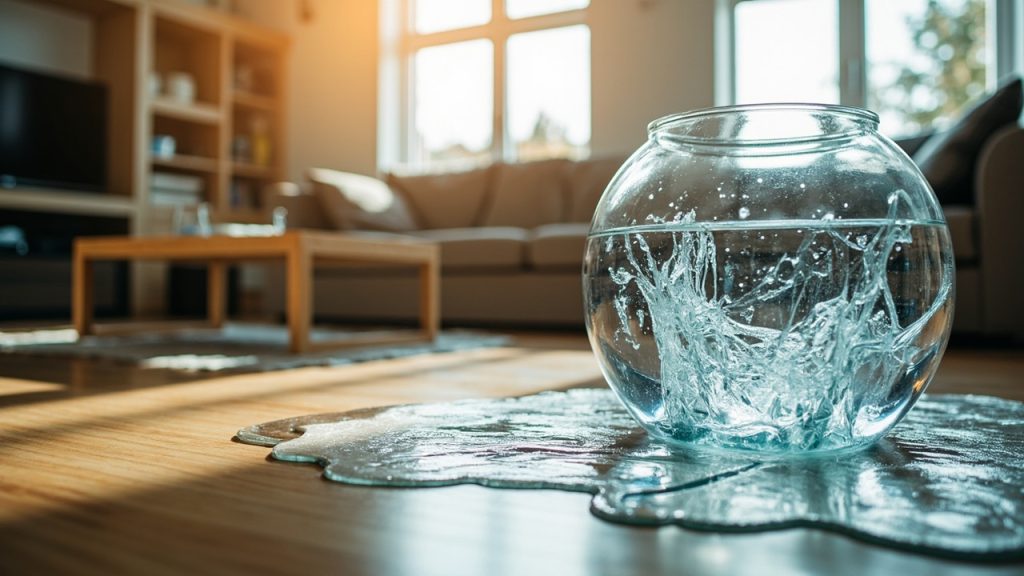
A 150-gallon aquarium hitting the floor releases enough water to soak through your subfloor and into the rooms below it within minutes. If yours just cracked, burst, or toppled, you have a narrow window to act before the damage escalates from a floor refinish to a full structural dry-out. Here is exactly what to do, in order.

Your First Five Minutes After an Aquarium Flood
The first thing you do is cut power to that room. Walk to your breaker panel and flip the circuit that serves your living room. Saltwater and freshwater aquariums both run on electricity, and the combination of water on a hardwood floor and live outlet strips is a real electrocution hazard. Do not step into standing water with power on.
Once power is off, start moving furniture. Water migrates under furniture legs in seconds and creates isolated wet zones that are invisible until mold appears days later. Get sofas, coffee tables, and rugs onto dry ground or elevated on blocks immediately.
Grab every dry towel you own. You are not trying to dry the floor. You are trying to slow migration. Towels at doorways keep water from reaching adjacent rooms and hallways, which is the difference between a single-room remediation job and a multi-room one.
What To Do With Your Fish
Your livestock are secondary to your safety, but they matter. A clean plastic storage bin or a spare cooler filled with dechlorinated water can keep fish alive for several hours. If you run a saltwater reef, you need to preserve salinity or your coral and fish will die quickly. Use remaining water from the tank before it mixes with floor contamination.
Why Aquarium Water Is Treated as Category 1 Clean Water (At First)
According to the Institute of Inspection Cleaning and Restoration Certification (IICRC), water damage is classified by contamination level. Fresh aquarium water starts as Category 1, the cleanest classification. However, once it contacts your subfloor, carpet padding, or any porous material, it degrades rapidly toward Category 2. This matters for the restoration approach your technician takes.
Saltwater aquariums introduce a separate challenge. Salt accelerates corrosion of metal fasteners in your subfloor, including the screws holding down your hardwood planks. In Troy-area homes with solid hardwood floors, saltwater saturation also speeds up the cupping and buckling process. Time is the most important factor here.
Freshwater vs. Saltwater Flood Comparison
| Factor | Freshwater Aquarium | Saltwater Aquarium |
|---|---|---|
| Initial IICRC Category | Category 1 | Category 1 (degrades faster) |
| Hardwood Floor Risk | Moderate cupping within 24 to 48 hours | Severe cupping and fastener corrosion within 12 hours |
| Subfloor Damage Timeline | 48 to 72 hours before structural compromise | 24 to 36 hours before structural compromise |
| Mold Growth Risk | Appears within 24 to 72 hours without treatment | Slightly slower due to salinity, but still present |
| Drying Complexity | Standard structural drying protocol | Salt residue requires additional neutralization steps |
What Is Happening Beneath Your Troy Living Room Floor
Troy and the broader Oakland County area feature a lot of homes built with OSB subfloor panels over a crawlspace or basement. OSB is wood fiber held together with resin, and it absorbs water fast. Once it swells, it loses structural integrity and can delaminate entirely. A floor that feels soft or spongy underfoot after a flood is a sign the OSB is already compromised.
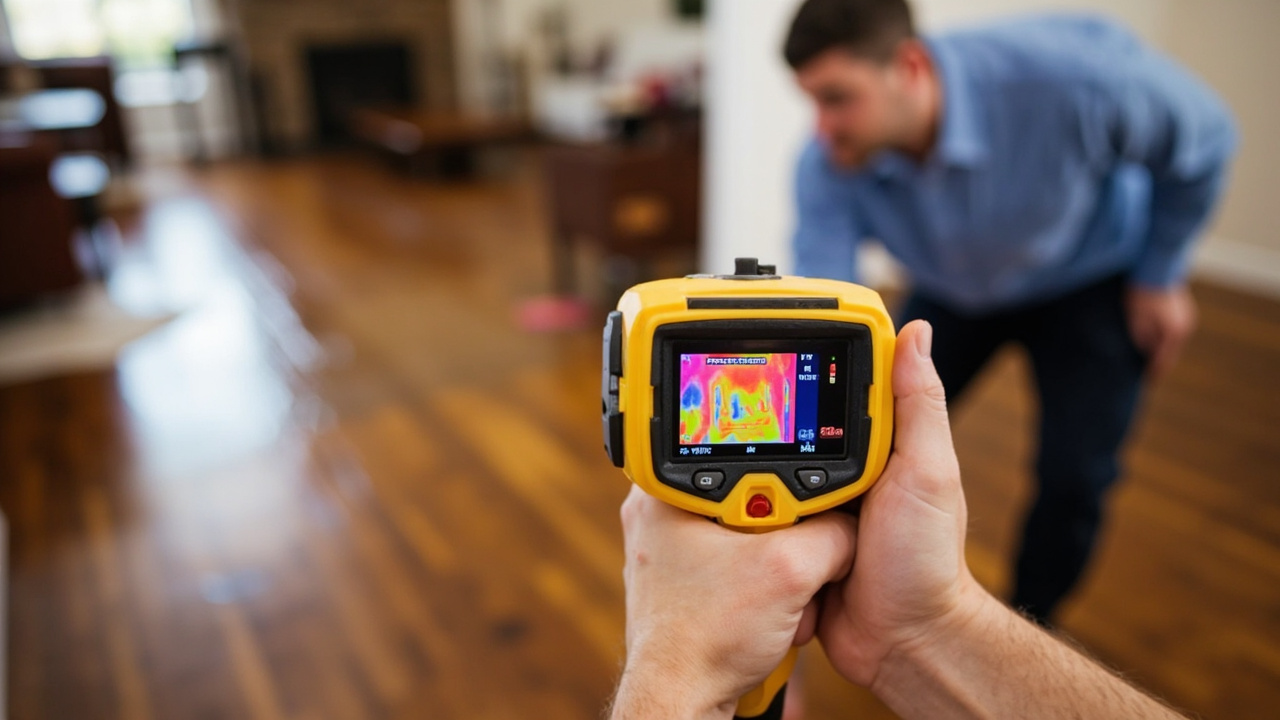
Homes in older Troy neighborhoods sometimes have plank subfloors, which dry differently and require different drying chamber setups. A technician using moisture meters and thermal imaging cameras will map the moisture content across your entire floor assembly, not just the visible surface, before setting up drying equipment.
If your home has a basement directly below the flooded room, check it immediately. Water follows gravity through floor penetrations, light fixture boxes, and gaps around HVAC ducts. A 150-gallon aquarium can saturate a basement ceiling within 30 minutes if the floor assembly has any pathway. Basement humidity in the Detroit metro already runs high from spring through late fall. That existing moisture load makes any fresh water intrusion worse and accelerates mold colonization on drywall and framing.
The Professional Restoration Process Step by Step
When an IICRC-certified technician arrives, the process follows a defined protocol. Understanding what they are doing and why helps you make good decisions throughout.
- Moisture Mapping: The technician uses a thermal imaging camera and pin-type moisture meters to establish a moisture boundary map. This shows exactly how far water traveled, including into walls if the tank was against a wall.
- Water Extraction: Truck-mounted or portable extractors pull standing water and water from carpet and padding. For hardwood floors, technicians use specialty floor mats that draw moisture through the wood surface without causing additional swelling.
- Content Manipulation: Furniture, area rugs, and any remaining aquarium equipment are moved and documented. Your restoration company should photograph everything for your insurance file.
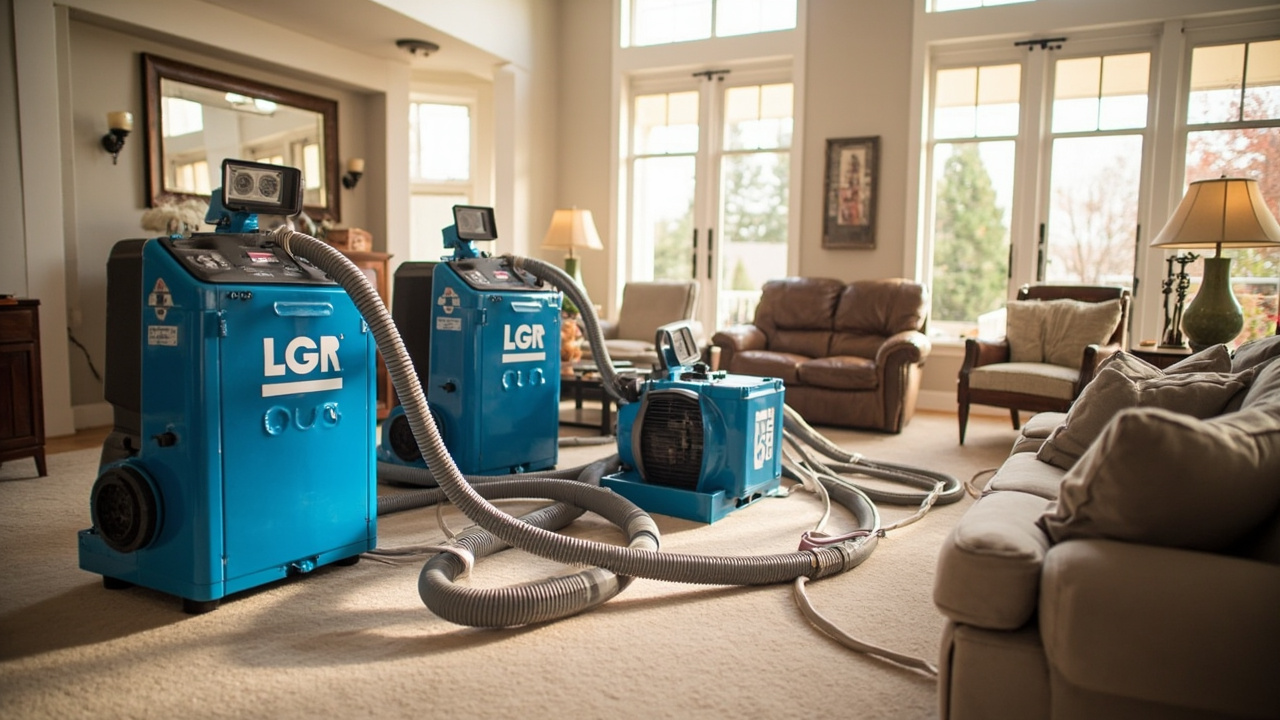
- Drying Chamber Setup: Industrial-grade LGR (low grain refrigerant) dehumidifiers are placed to create a controlled drying environment. These are fundamentally different from the consumer dehumidifiers you buy at a hardware store. They pull significantly more moisture per hour and maintain lower dew points.
- Antimicrobial Application: All affected surfaces receive an EPA-registered antimicrobial treatment to prevent mold colonization before drying is complete. This step matters because mold can begin forming on wet drywall and organic materials within 24 hours.
- Daily Monitoring: Technicians return daily to read psychrometric data, including temperature, relative humidity, and specific humidity readings. Drying is not complete until materials reach their dry standard, typically measured against an unaffected reference area in your home.
- Clearance Readings: Final moisture meter readings across all affected materials confirm that drying goals are met before equipment is removed and reconstruction begins.
How Long Will Drying Take
Most residential aquarium floods in Troy-area homes dry within three to five days when equipment is deployed within the first few hours. Delays push that timeline out significantly. A floor that sits wet overnight before a call is made routinely requires seven to ten days of drying, and frequently requires subfloor replacement that a fast response would have avoided.
If you have hardwood floors, read more about the specific recovery process in our detailed guide on saving hardwood floors after a water leak. The floor type and how quickly you respond are the two variables that determine whether those boards can be saved or need full replacement.
Hardwood Floor Outcomes Based on Response Time
| Response Time | Likely Floor Outcome | Typical Restoration Approach |
|---|---|---|
| Within 2 hours | Mild surface cupping, likely reversible | Floor mat drying system, refinish after drying |
| 2 to 12 hours | Moderate cupping, possible crowning | Aggressive drying, sand and refinish, some board replacement possible |
| 12 to 24 hours | Significant buckling and subfloor saturation | Partial subfloor replacement, extensive board replacement |
| 24 to 48 hours | Structural subfloor damage, mold risk high | Full subfloor replacement likely, mold remediation required |
| 48 hours or more | Active mold, complete floor system failure | Demolition of affected assemblies, full mold remediation protocol |
Does Your Homeowners Insurance Cover a Broken Aquarium in Troy
Most homeowners insurance policies in Michigan cover sudden and accidental water damage from internal sources. A catastrophically failed aquarium seam or structural crack qualifies as sudden and accidental under most HO-3 policy language. What insurers do not cover is damage from neglect, meaning a tank that had a slow leak you ignored for weeks.
Document everything before cleanup. Take photos and video of the aquarium, the standing water depth, affected furniture, and the floor. Note the approximate time the failure occurred. This documentation becomes your claim file.
The question of coverage gets complicated depending on your specific carrier and endorsements. For a detailed breakdown of how to handle this process in Michigan, read our guide on getting your Detroit home insurance to actually pay for water restoration. If you are in Corktown or any of the historic Detroit neighborhoods, there are also specific documentation requirements covered in our Corktown insurance claim guide that apply to older structures.
What Your Adjuster Will Want to See
Your adjuster will ask for proof of the failure cause, moisture readings from a certified technician (not your neighbor with a cheap moisture tester), and a scope of work from a restoration company. A professional moisture report produced by an IICRC-certified firm carries far more weight in a claim than homeowner-documented damage alone.
Some Troy homeowners are surprised to find that their policy also covers hotel stays during restoration if the home is uninhabitable. Ask your agent specifically about additional living expense coverage before you assume you have to stay and live around drying equipment for a week.
Mold Risk After an Aquarium Flood in Southeast Michigan
The Detroit metro sits in a climate zone where summer relative humidity regularly exceeds 70 percent. Wayne County basements and crawlspaces already carry elevated ambient humidity from June through September. When aquarium water floods into a subfloor during those months, the conditions for mold growth are close to perfect before the spill even happens.
Mold on drywall and framing can establish within 24 to 48 hours of a water event. It does not always look like the black fuzzy patches people picture. Early-stage mold growth often appears as a white or gray film on wood framing, or a musty odor that gets stronger when the HVAC runs. If you smell that within a week of your aquarium flood and no remediation was done, treat it as active mold until proven otherwise.
Bleach does not solve mold in a structural context. It discolors surface mold on non-porous materials but does not penetrate into wood grain where the root structure (mycelium) lives. Our guide explaining why bleach does not fix basement mold covers this in detail and explains when you actually need a certified remediation contractor.
Carpet and Padding in the Affected Area
If your Troy living room has carpet rather than hardwood, the calculus changes. Carpet is a secondary concern compared to the structural assembly beneath it. Most carpet padding is polyurethane foam, which holds water efficiently and provides an ideal environment for mold growth against the subfloor surface below it.
Wet carpet padding after a large aquarium flood is almost always replaced rather than dried. It is not cost-effective to dry it in place, and the risk of mold under the pad is too high. The carpet face itself can sometimes be saved depending on its fiber type and how quickly it was extracted. For a thorough breakdown of when carpet can be salvaged versus when it needs to go, see our guide on wet carpet decisions in Sterling Heights. The same evaluation criteria apply in Troy.
Serving Troy and the Surrounding Detroit Metro Area
Emergency water damage calls come from across the 313 and 248 area codes every day. Aquarium floods are more common than most people realize, particularly in Troy, Rochester Hills, and the Bloomfield Township corridor where larger homes and dedicated hobby rooms make 100 to 300-gallon setups feasible. We also serve Indian Village, Palmer Park, and East English Village in the city proper, where older hardwood flooring in historic homes requires specific drying techniques to avoid making irreversible damage worse.
For Wayne County residents, including those in Grosse Pointe, Dearborn, and Livonia, response times from our crews are typically under 60 minutes for emergency calls. Oakland County properties in Troy, Madison Heights, and Ferndale see similar response windows depending on traffic and time of day.
If your aquarium just failed and you are reading this right now, call a certified restoration company immediately. Every hour of delay costs you in floor material, drying time, and potential mold remediation scope. The damage does not pause while you research options.
{
“@context”: “https://schema.org”,
“@type”: “BlogPosting”,
“headline”: “What to Do When Your Large Aquarium Breaks and Floods Your Troy Living Room”,
“description”: “Aquarium burst in Troy, MI? Get immediate steps to stop water damage, protect hardwood floors, and file your insurance claim. Emergency guide from Detroit experts.”,
“wordCount”: 1934,
“datePublished”: “2026-07-14T12:58:00.000Z”,
“dateModified”: “2026-07-14T12:58:00.000Z”,
“inLanguage”: “en-US”,
“mainEntityOfPage”: {
“@type”: “WebPage”,
“@id”: “https://ironwoodwaterdamagerestorationdetroit.com”
},
“publisher”: {
“@type”: “LocalBusiness”,
“name”: “Ironwood Water Damage Restoration Detroit”,
“url”: “https://ironwoodwaterdamagerestorationdetroit.com”
},
“author”: {
“@type”: “Organization”,
“name”: “Ironwood Water Damage Restoration Detroit”,
“url”: “https://ironwoodwaterdamagerestorationdetroit.com”
},
“image”: {
“@type”: “ImageObject”,
“url”: “https://ironwoodwaterdamagerestorationdetroit.com/wp-content/uploads/2026/03/what-to-do-when-your-large-aquarium-breaks-and-flo-1.jpg”
}
}
{
“@context”: “https://schema.org”,
“@type”: “LocalBusiness”,
“name”: “Ironwood Water Damage Restoration Detroit”,
“url”: “https://ironwoodwaterdamagerestorationdetroit.com”,
“address”: {
“@type”: “PostalAddress”,
“addressLocality”: “Detroit”
},
“areaServed”: {
“@type”: “City”,
“name”: “Detroit”
}
}
{
“@context”: “https://schema.org”,
“@type”: “BreadcrumbList”,
“itemListElement”: [
{
“@type”: “ListItem”,
“position”: 1,
“name”: “Home”,
“item”: “https://ironwoodwaterdamagerestorationdetroit.com”
},
{
“@type”: “ListItem”,
“position”: 2,
“name”: “Blog”,
“item”: “https://ironwoodwaterdamagerestorationdetroit.com/blog”
},
{
“@type”: “ListItem”,
“position”: 3,
“name”: “What to Do When Your Large Aquarium Breaks and Floods Your Troy Living Room”
}
]
}
{
“@context”: “https://schema.org”,
“@type”: “Service”,
“serviceType”: “Water Damage Restoration”,
“provider”: {
“@type”: “LocalBusiness”,
“name”: “Ironwood Water Damage Restoration Detroit”,
“url”: “https://ironwoodwaterdamagerestorationdetroit.com”
},
“areaServed”: {
“@type”: “City”,
“name”: “Detroit”
},
“description”: “Aquarium burst in Troy, MI? Get immediate steps to stop water damage, protect hardwood floors, and file your insurance claim. Emergency guide from Detroit experts.”
}