
Water is running through your ceiling right now. Your neighbor upstairs just overflowed their tub. Your floors are soaked, your drywall is bubbling, and you have no idea who is supposed to fix any of this. This is one of the most common calls we get from residents in downtown Detroit condos, especially in dense neighborhoods like Greektown, the Riverfront, and Midtown.
The short answer is that responsibility depends on where the water came from, what the master deed says, and whether your neighbor was negligent. The longer answer is below, and it matters because getting this wrong means paying for damage that someone else should cover.
The Rule of Thumb for Condo Water Damage Responsibility
In most Detroit condo situations, the party responsible for the source of the water is responsible for the damage it causes. If your neighbor left their tub running and it overflowed, they caused the leak. That shifts significant responsibility toward them and their insurance policy.
But here is where it gets complicated. The building’s shared plumbing, the walls between units, and the structural elements all fall under different ownership depending on your condo documents. You cannot assume your neighbor pays for everything just because water came from their unit.
Michigan law gives you a framework. The Michigan Condominium Act (Act 59 of 1978) establishes how condominiums must define ownership of shared and private spaces. Every Detroit condo association is required to operate under this law, and your master deed should reflect it.
Understanding Your Master Deed and Bylaws
Your master deed is the governing document for your building. It defines what you own, what the HOA owns, and what falls in a gray zone. Before you call anyone or file a claim, pull that document out.
Most master deeds in Detroit condo buildings follow three categories of property. Each category has different rules for who maintains it and who pays when something goes wrong.
Common Elements and What They Cover
Common elements are parts of the building that all unit owners share. This includes the roof, the main plumbing stack, hallways, the building envelope, and the foundation. If a main supply line inside a shared wall bursts and floods your unit, the HOA is typically responsible for addressing the source. Their master policy should cover the structural repair.
The HOA’s master insurance policy, often called a bare walls-in or all-in policy depending on your building, determines how much of the interior structure is covered. Older downtown Detroit buildings sometimes have master policies that cover only the bare structure, leaving finishes like flooring and cabinets to individual owners.
Limited Common Elements
Limited common elements are parts of the building that only one unit owner uses but that are technically shared property. Balconies, windows assigned to a specific unit, and HVAC equipment serving only your unit often fall here. Responsibility for these varies by building. Some master deeds put maintenance on the unit owner. Others keep it with the HOA. You have to read your specific document.
Individual Unit Space and Owner Responsibility
This is what you own exclusively. Your appliances, your plumbing fixtures, your flooring, your drywall finishes, and typically the pipes serving only your unit. When your neighbor’s tub overflows, the water source is inside their individual unit. That matters when determining negligence and insurance liability.
The Three-Party Question in Any Condo Water Damage Event
When water damage happens in a Greektown or downtown Detroit condo, one of three parties is going to be primarily responsible. Here is how to think through which one applies to your situation.
| Source of Leak | Likely Responsible Party | Insurance Policy Involved |
|---|---|---|
| Neighbor’s overflowing tub or appliance | Unit owner above (if negligent) | Neighbor’s HO-6 policy liability coverage |
| Main plumbing stack or building pipe | HOA | HOA master insurance policy |
| Roof leak into unit | HOA | HOA master insurance policy |
| Your own appliance or fixture | You | Your HO-6 policy |
| Shared pipe inside a wall between units | HOA or shared responsibility | HOA master policy, possibly both HO-6 policies |
| Sprinkler system malfunction | HOA | HOA master insurance policy |
How Negligence Changes Everything Under Michigan Law
Negligence is the legal concept that shifts responsibility in condo water damage disputes. If your neighbor accidentally left their tub running because they forgot, that is generally considered negligence in Michigan courts. If a pipe inside their wall corroded because they ignored a known leak for months, that is negligence too.
When negligence is established, the responsible party’s HO-6 insurance liability coverage is supposed to step in and cover your losses. This includes your damaged flooring, wet drywall, soaked personal property, and restoration costs.
The concept of proximate cause matters here. Michigan law looks at what directly caused the damage. An overflowing tub is the proximate cause of your water-damaged ceiling. That keeps liability pointed at the unit above you.
Without negligence, the situation gets murkier. If a pipe fails inside a shared wall with no warning and no ignored maintenance, the HOA’s policy often becomes the primary coverage source. Your own HO-6 policy may need to supplement what the HOA’s master policy does not cover.
Master Policy vs HO-6 Policy: What Each Actually Covers
This is where most Greektown and downtown Detroit condo owners get blindsided. They assume either the HOA handles it or the neighbor pays. The reality is usually more layered.
| Policy Type | Who Holds It | What It Typically Covers | What It Misses |
|---|---|---|---|
| HOA Master Policy (Bare Walls-In) | HOA | Structural elements, common areas, building envelope | Interior finishes, appliances, personal property |
| HOA Master Policy (All-In) | HOA | Structure plus original fixtures and finishes | Upgrades, personal property, betterments |
| HO-6 Unit Owner Policy | Individual unit owner | Interior finishes, personal property, liability, loss assessment | Common elements, another owner’s property |
| Neighbor’s HO-6 Liability Coverage | Neighbor above you | Damages you suffer caused by their negligence | Non-negligence events, structural common elements |
One critical detail many Detroit condo owners miss is loss assessment coverage inside their HO-6 policy. If the HOA’s master policy has a large deductible and the water damage event triggers it, the HOA can sometimes assess that deductible amount against all unit owners. Loss assessment coverage in your HO-6 policy can protect you from being billed for your share of that deductible.
For more detail on how to work through a water damage insurance claim in Detroit, read our guide on how to get your Detroit home insurance to actually pay for water restoration.
What to Do Immediately After a Condo Water Leak
The first 24 to 48 hours after water intrusion determine how bad the final damage ends up being. Wet building materials absorb moisture fast. In a closed condo environment, you can see mold begin colonizing porous surfaces within 48 to 72 hours if conditions are right.
Follow these steps in order.
- Stop the water source if you can access it. If the source is in your neighbor’s unit, knock on their door or call building management immediately to get the water shut off.
- Document everything before any cleanup begins. Photograph all affected surfaces, every room, every material. Note the time and date. This documentation is critical for any insurance claim or dispute later.
- Notify your HOA or building manager in writing. Email or text creates a time-stamped record. Do not rely only on a phone call.
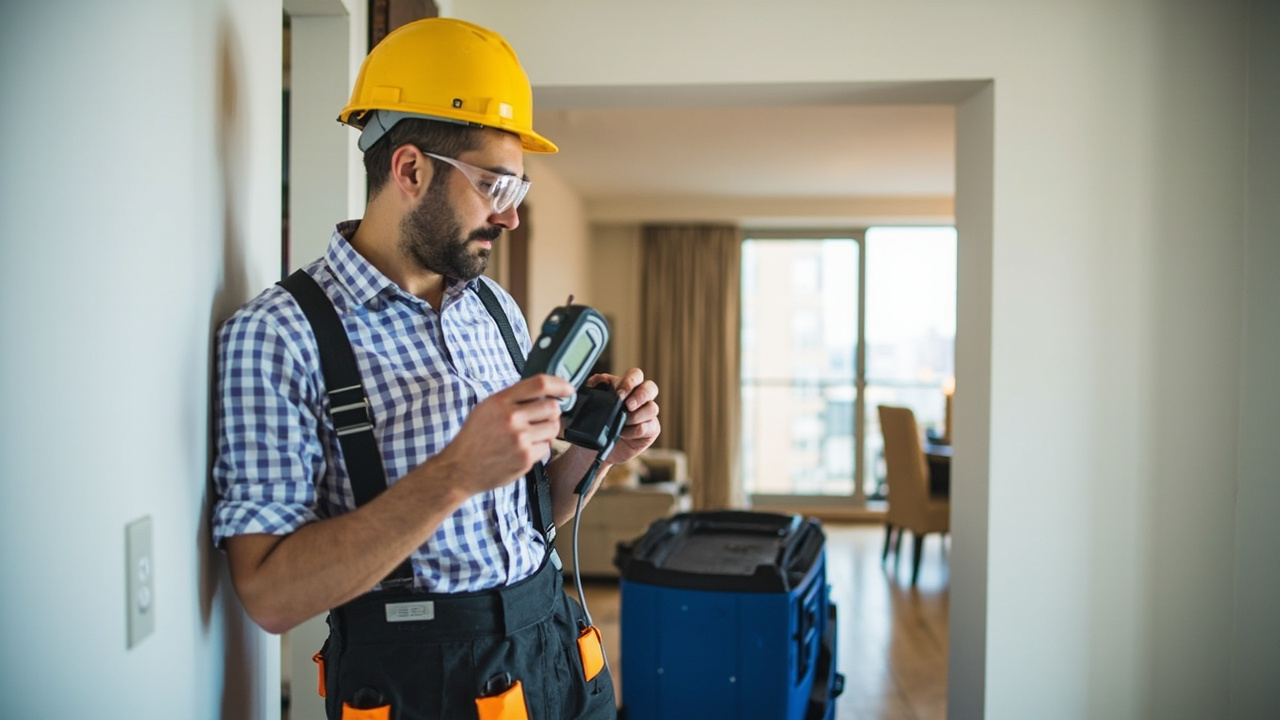
- Contact a water damage restoration company that is IICRC-certified to assess the damage and begin extraction and drying. In Detroit condo buildings with concrete floors and dense insulation between units, moisture hides in cavities that look dry on the surface. Thermal imaging and moisture meters find what you cannot see.
- File a claim with your own HO-6 insurer and let subrogation handle the rest. Subrogation is the legal process where your insurer pays your claim and then recovers those costs from the responsible party’s insurer. You do not have to fight your neighbor directly.
The Subrogation Process and Why You Should Not Wait
Subrogation works in your favor as the damaged party. You file your own HO-6 claim, your insurer pays out, and they pursue your negligent neighbor’s insurance for reimbursement. This keeps you out of a direct legal dispute.
The catch is timing. Water damage in a condo building needs documented evidence of the source and the extent of damage. Waiting too long, either to document or to file, weakens your insurer’s subrogation position. If your neighbor drains their tub, dries their bathroom, and claims nothing happened, your documentation from those first hours is what proves the event.
Detroit condo owners near the Riverfront and in converted Midtown loft buildings face an additional challenge. Many of these buildings have older plumbing infrastructure and shared mechanical systems that complicate the source determination. A qualified restoration contractor can trace moisture pathways and produce a written moisture map that insurers use to determine origin and liability.
When the HOA Tries to Deny Responsibility
HOAs sometimes push back on claims, especially when the master policy deductible is high or when the source is in a gray zone between common elements and individual unit ownership. If your HOA denies responsibility for a leak that originated in common plumbing, you have options.
First, review your master deed and the Michigan Condominium Act language around maintenance obligations. Act 59 of 1978 places clear obligations on associations for maintaining common elements. If the association failed to maintain shared plumbing and that failure caused your damage, the association bears responsibility under Michigan law.
Second, contact Detroit’s Building Safety Engineering and Environmental Department (BSEED) if the building has code violations related to plumbing maintenance. A documented code violation strengthens your position significantly.
Third, consult a Michigan attorney who handles condominium disputes. Many Detroit condo owners in places like the Broderick Tower, the Westin Book Cadillac residences, or newer construction along the M-1 Rail corridor have used this route successfully when HOAs stonewalled legitimate claims.
The Hidden Damage Problem in Detroit Condo Buildings
Detroit has a wide range of condo building types. Newer construction near Little Caesars Arena uses modern materials that dry faster and trap less moisture. But converted historic buildings in Greektown, Corktown, and along Woodward often have original plaster, old-growth lumber framing, and decades of layered materials that hold water for weeks.
We have opened walls in buildings near Campus Martius and found wet insulation that looked completely dry on the exterior surface. The drywall read normal on a pin-type moisture meter, but a non-invasive scanner showed saturation behind it. Standard visual inspection misses this. IICRC S500 standards require moisture mapping of all affected and adjacent materials, not just the obvious wet spots.
Left alone, that hidden moisture becomes mold. If you are worried about what wet building materials can turn into, read our article on why bleach will not fix mold and when to call a pro. The same principles apply in condo units.
Water also follows gravity and voids. A tub overflow on the 8th floor does not just damage the 7th floor unit directly below. Water travels along structural cavities, pipe chases, and electrical conduits and can appear two or three floors down. Every unit along that path needs to be assessed.
Protecting Your Hardwood and High-Value Finishes
Many Greektown and downtown Detroit condo owners have invested in hardwood floors, custom tile, and high-end finishes. These materials respond very differently to water exposure. Hardwood can be saved if extraction and drying begin within the first 24 to 48 hours. After that window, cupping, buckling, and subfloor saturation often make replacement necessary.
Our guide on saving hardwood floors after a significant water leak walks through the drying process in detail. The same techniques apply to condo units in downtown Detroit as in Birmingham.
Carpet is another story. In a condo environment where water has come through a ceiling or adjacent wall, the carpet padding is usually saturated even when the carpet surface feels only damp. Our breakdown of whether wet carpet can be saved or needs to go covers the decision factors clearly.
A Condo Water Damage Dispute Checklist for Detroit Residents
If you are in a dispute over who pays for condo water damage in Detroit, use this checklist to protect your position.
- Pull your master deed and identify the ownership category of the water source location.
- Photograph all damage immediately with timestamps before any remediation begins.
- Notify the HOA in writing with a timestamp, not just verbally.
- Get a written moisture assessment from an IICRC-certified restoration contractor.
- File your own HO-6 claim promptly and let your insurer pursue subrogation.
- Request a copy of the HOA master policy and confirm whether it is bare walls-in or all-in.
- Check your HO-6 policy for loss assessment coverage limits.
- If the source is in a common element, request the HOA’s maintenance records for that system.
- Contact BSEED if you suspect a building code violation contributed to the damage.
- Consult a Michigan condo law attorney if the HOA denies a legitimate claim.
For a detailed walkthrough of the insurance claim process itself, see our guide on filing a successful water damage insurance claim for your Corktown home. The steps translate directly to any Detroit neighborhood.
Getting the Restoration Work Done While the Dispute Gets Sorted
Here is the practical reality. Insurance disputes and HOA disagreements take time. Water damage does not wait. You need extraction, drying, and dehumidification to begin within hours, not after a coverage dispute resolves.
A competent restoration crew can document scope of work in a way that supports your insurance claim, regardless of which policy ultimately pays. Detailed line-item estimates, moisture logs, and photo documentation created during the mitigation process become evidence in the claim dispute later.
Do not let a coverage argument delay the physical work. Delayed water mitigation leads to mold, structural deterioration, and higher final costs. Every party involved, including insurance adjusters, will point to the delay as a reason to reduce your settlement if you wait.
If you are dealing with active water damage in a Greektown, Riverfront, Midtown, or downtown Detroit condo right now, contact our team for a free damage assessment. We work directly with all insurance carriers and handle the documentation from extraction through final restoration. You focus on the living situation. We handle the science of drying your building back out.
{
“@context”: “https://schema.org”,
“@type”: “BlogPosting”,
“headline”: “Who Actually Handles the Cleanup When Your Greektown Condo Neighbor Overflows Their Tub”,
“description”: “Condo water damage in Detroit? Learn who pays, who calls the restoration crew, and what Michigan law says about tub overflows in shared buildings.”,
“wordCount”: 2364,
“datePublished”: “2026-05-01T05:56:00.000Z”,
“dateModified”: “2026-05-01T05:56:00.000Z”,
“inLanguage”: “en-US”,
“mainEntityOfPage”: {
“@type”: “WebPage”,
“@id”: “https://ironwoodwaterdamagerestorationdetroit.com”
},
“publisher”: {
“@type”: “LocalBusiness”,
“name”: “Ironwood Water Damage Restoration Detroit”,
“url”: “https://ironwoodwaterdamagerestorationdetroit.com”
},
“author”: {
“@type”: “Organization”,
“name”: “Ironwood Water Damage Restoration Detroit”,
“url”: “https://ironwoodwaterdamagerestorationdetroit.com”
},
“image”: {
“@type”: “ImageObject”,
“url”: “https://ironwoodwaterdamagerestorationdetroit.com/wp-content/uploads/2026/03/who-handles-the-cleanup-when-your-greektown-condo-1.jpg”
}
}
{
“@context”: “https://schema.org”,
“@type”: “LocalBusiness”,
“name”: “Ironwood Water Damage Restoration Detroit”,
“url”: “https://ironwoodwaterdamagerestorationdetroit.com”,
“address”: {
“@type”: “PostalAddress”,
“addressLocality”: “Detroit”
},
“areaServed”: {
“@type”: “City”,
“name”: “Detroit”
}
}
{
“@context”: “https://schema.org”,
“@type”: “BreadcrumbList”,
“itemListElement”: [
{
“@type”: “ListItem”,
“position”: 1,
“name”: “Home”,
“item”: “https://ironwoodwaterdamagerestorationdetroit.com”
},
{
“@type”: “ListItem”,
“position”: 2,
“name”: “Blog”,
“item”: “https://ironwoodwaterdamagerestorationdetroit.com/blog”
},
{
“@type”: “ListItem”,
“position”: 3,
“name”: “Who Actually Handles the Cleanup When Your Greektown Condo Neighbor Overflows Their Tub”
}
]
}
{
“@context”: “https://schema.org”,
“@type”: “Service”,
“serviceType”: “Water Damage Restoration”,
“provider”: {
“@type”: “LocalBusiness”,
“name”: “Ironwood Water Damage Restoration Detroit”,
“url”: “https://ironwoodwaterdamagerestorationdetroit.com”
},
“areaServed”: {
“@type”: “City”,
“name”: “Detroit”
},
“description”: “Condo water damage in Detroit? Learn who pays, who calls the restoration crew, and what Michigan law says about tub overflows in shared buildings.”
}