

Carpenter ants in your Southfield home are a symptom, not the root problem. The real culprit is wet, softened wood sitting in your attic or wall cavities right now. Until you fix the moisture source, no amount of pest control will keep these insects out for good.

The Biological Link Between Carpenter Ants and Wet Wood
Carpenter ants (genus Camponotus) do not eat wood the way termites do. They excavate it. They chew through wood fiber to carve smooth-walled galleries where they nest and raise their colonies. The critical detail is that they strongly prefer wood with a moisture content (MC%) above 20 percent. Dry, structurally sound wood is hard to excavate. Wet, fungus-softened wood is easy.
When a roof leak or poor attic ventilation raises the MC% of your rafters and sheathing above that 20 percent threshold, the wood begins to break down at the cellulose level. Fungi colonize first. Then the ants arrive, following pheromone trails laid by scouts that detected the soft, damp material from outside. By the time you see ants in your kitchen, a parent colony may already be established in your attic structure.
This is why Metro Detroit homeowners get trapped in a frustrating cycle. A pest control company treats the infestation. The ants come back within a season. The wet wood is still there, and so is the attractant.
Why Southfield and Southeast Michigan Homes Are Especially Vulnerable
Southeast Michigan sits directly in the humidity corridor fed by Lake Erie and Lake Huron. During peak ant season from May through July, outdoor relative humidity in the Detroit metro regularly climbs above 70 percent. That ambient moisture finds its way into attic spaces through soffit vents, ridge vents, and any gap in the building envelope.
Southfield’s housing stock compounds this problem. The city has a significant share of mid-century ranch homes and split-levels built between the postwar era and the 1970s. Many of these homes have minimal attic insulation by current Michigan energy code standards, older asphalt shingles that have lost their granule protection, and aluminum window frames that develop condensation gaps as seals fail. All of these are moisture entry points.
Wayne County and Oakland County inspectors regularly flag ice dam damage in older homes throughout the area. When ice dams form along the eave line during Michigan winters, meltwater backs up under shingles and saturates the roof deck. That wood stays wet well into spring, which is exactly when Camponotus colonies begin their most aggressive expansion phase.
The Most Common Moisture Sources We Find in Attic Investigations
- Ice dam infiltration along the eave line and around chimney flashing
- Failed pipe boot seals around plumbing vent stacks penetrating the roof deck
- Blocked or inadequate soffit ventilation trapping warm, humid air in the attic
- Bath fan ducts that terminate inside the attic instead of exiting through the roof
- Condensation on cold roof decking in winter when warm interior air rises through ceiling gaps
- Leaking skylight curbs and improperly installed step flashing at dormers
Reading the Warning Signs Before Structural Damage Sets In
Carpenter ant activity leaves specific evidence. Knowing what to look for can tell you how far the infestation has progressed and how much structural damage may already exist.
Frass is the most telling sign. Unlike termite frass, which looks like sand, carpenter ant frass resembles fine sawdust mixed with insect body parts and bits of insulation. You will find it below entry points, often near window frames, door frames, or in the corners of the attic floor. Finding frass means the excavation is actively happening right now.
Winged swarmers (also called alates) appearing near moisture sources indicate a mature parent colony that has reached reproductive capacity. When you see swarmers in your attic or near a damp exterior wall, the colony is typically at least three years old. That means three years of gallery excavation inside your structural members.
A faint rustling or clicking sound inside walls, particularly at night when the house is quiet, is another indicator. Carpenter ants are most active after dark, and large colonies working through wall studs or roof rafters produce an audible sound in a silent room.

Moisture Content Levels and What They Mean for Your Structure
| Wood Moisture Content (MC%) | Structural Status | Pest and Fungal Risk | Required Action |
|---|---|---|---|
| Below 15% | Dry, structurally sound | Minimal. Wood-destroying organisms are not attracted. | Monitor. No intervention needed. |
| 15% to 19% | Elevated. Borderline concern. | Low to moderate. Fungi can begin establishing. | Identify and address the moisture source. Increase ventilation. |
| 20% to 28% | Wet. Cellulose degradation begins. | High. Prime carpenter ant and mold colonization zone. | Professional structural drying required. Source must be eliminated. |
| Above 28% | Saturated. Active decay present. | Severe. Wood-destroying fungi actively compromise load-bearing capacity. | Drying plus structural wood replacement. IICRC S500 protocols apply. |
Certified restoration technicians use calibrated hygrometers and pin-type moisture meters to map these readings across every structural member in the affected area. A thermal imaging camera reveals moisture migration patterns invisible to the naked eye, including water that has wicked laterally through rafters or ridge boards far from the original leak point.
Why Pest Control Alone Cannot Solve This Problem
A licensed pest control operator can eliminate the existing colony. That treatment is necessary. But it addresses the population, not the condition that made your home a viable nesting site in the first place.
Satellite colonies make this even more complicated. Mature carpenter ant infestations typically consist of a parent colony and multiple satellite colonies connected by pheromone trails. The parent colony, which contains the queen, may be outside in a rotting tree stump in your yard. The satellite colonies inside your home are extensions of that parent network. Pesticide treatment inside the home may eliminate the satellite population temporarily, but scouts from the parent colony will re-establish satellite nesting sites in your attic as long as the wet wood remains.
The Michigan Department of Agriculture and Rural Development notes that wood-destroying insect infestations frequently recur when the underlying moisture conditions are not corrected. This aligns with what restoration professionals see in the field repeatedly. Pest treatment and water damage remediation are two separate but interdependent steps, and skipping the second one wastes the first.
If your attic wood is already reading above 20 percent MC% and shows visible fungal growth, you may also be dealing with a mold problem in addition to the structural damage from the ants. These conditions often appear together. For more on why surface treatments are not enough when biological growth is involved, read our article on why bleach won’t fix your Ferndale basement mold and when to call a pro.
The Restoration Process That Actually Stops Reinfestation
Effective remediation follows a defined sequence. Skipping steps or rushing the drying phase is the most common reason homeowners end up dealing with the same problem again within two to three seasons.
Step 1. Moisture Source Identification
A restoration technician performs a full inspection using infrared thermal imaging and moisture meters to map all affected areas. This is not a visual inspection. Thermal cameras detect temperature differentials that indicate wet material hidden behind surfaces. Every reading is documented before any work begins.
Step 2. Source Elimination
The water entry point must be sealed before any drying begins. If ice dam damage cracked the flashing around your chimney or if a failed pipe boot is the source, that repair happens first. Drying a structure while it is still taking on water is pointless.
Step 3. Structural Drying to IICRC S500 Standards
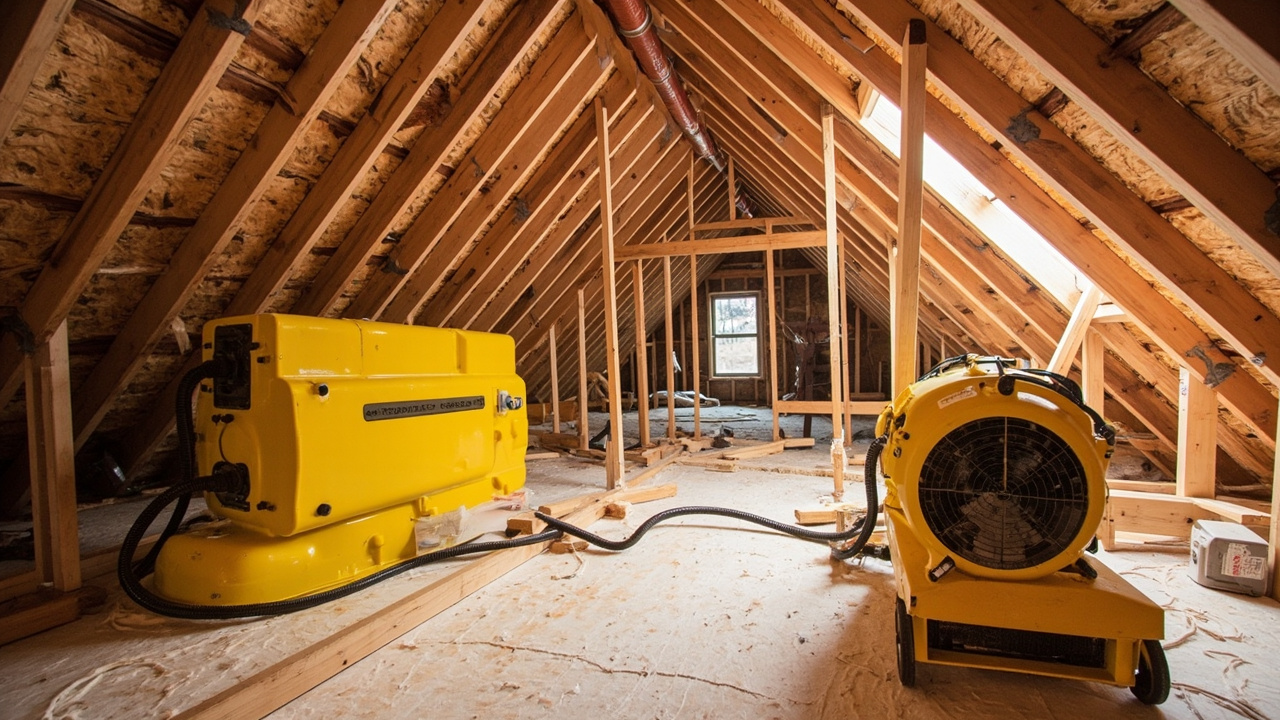
The Institute of Inspection, Cleaning and Restoration Certification (IICRC) S500 standard defines the drying protocols for structural assemblies. This involves placing commercial-grade desiccant dehumidifiers and high-velocity air movers in a calculated configuration to drive moisture out of the wood fiber. The goal is getting MC% readings down to a consistent range at or below 15 percent across all affected members. This process typically takes several days to a week depending on the saturation level and the size of the affected area.
Step 4. Structural Assessment and Wood Replacement
Once drying is complete, every rafter, ridge board, and sheathing panel that the ants excavated gets evaluated for load-bearing integrity. Galleries reduce the cross-sectional area of structural members. Depending on the extent of the damage, remediation may involve sistering damaged rafters, replacing compromised sheathing sections, or in severe cases, more extensive structural repairs. This is where the cost of waiting becomes very clear.
Step 5. Final Moisture Verification
All readings are taken again and documented. The structure must meet target MC% levels before any insulation or drywall goes back in place. Sealing moisture into a wall or ceiling cavity creates exactly the conditions that started the problem.
Proactive Drying vs. Structural Wood Replacement
| Scenario | Typical Scope of Work | Timeline | Relative Cost Factor |
|---|---|---|---|
| Early intervention (MC% 20-25%, minor ant activity) | Source repair, structural drying, moisture monitoring, limited ant damage assessment | 3 to 7 days for drying | Lower. Primarily equipment and labor for drying. |
| Moderate damage (MC% 25-28%, established satellite colony) | Source repair, drying, partial sheathing replacement, sistering of 2 to 4 rafters | 1 to 2 weeks total | Moderate. Material costs increase significantly. |
| Severe damage (MC% above 28%, multi-season infestation, visible decay) | Full source repair, extended drying, significant structural wood replacement, possible mold remediation | 2 to 4 weeks or more | High. Structural carpentry and possible engineering review required. |
The pattern is consistent across every job we’ve worked in the Southfield, Oak Park, and Lathrup Village areas. Homeowners who act when they first notice ant activity or discover attic moisture during a roof inspection pay a fraction of what those who wait through another full Michigan winter end up spending.
What to Do If You Suspect Attic Moisture Right Now
Go into your attic on a dry day and look at the underside of the roof deck. If you see dark staining along the sheathing panels, rust staining around nail heads, or any visible frass, you have an active problem that needs immediate evaluation. Do not attempt to dry this with box fans or consumer-grade dehumidifiers. Those tools are not rated for structural assemblies and will not move enough air to bring MC% readings down in reasonable timeframes.
If you have hardwood floors in your home and are also dealing with water intrusion at lower levels, the stakes extend beyond the attic. Our guide on how to save your hardwood floors after a significant water leak in Birmingham MI covers what the drying window looks like for finished surfaces.
If you are a homeowner dealing with this situation and wondering whether your insurance policy covers water damage remediation in the attic, this depends heavily on the cause. Sudden and accidental water damage from a burst pipe is typically covered. Gradual seepage from a failing roof may be treated differently by your adjuster. Our article on how to get your Detroit home insurance to actually pay for water restoration walks through the documentation steps that matter most when filing this type of claim.
The bottom line is that carpenter ants are a reliable early warning system for moisture problems your home has already been accumulating. They are telling you something is wrong structurally long before visible rot or ceiling staining does. Taking that signal seriously now, before the next Michigan winter adds another freeze-thaw cycle to already wet wood, is the decision that protects your home’s structure and your family’s investment.
If you want to know exactly what moisture readings look like in your attic right now, reach out to a certified restoration inspector for a moisture assessment. The information you get from that single visit will tell you whether you are dealing with a drying job or a structural repair, and that answer is worth having before the problem decides for you.