
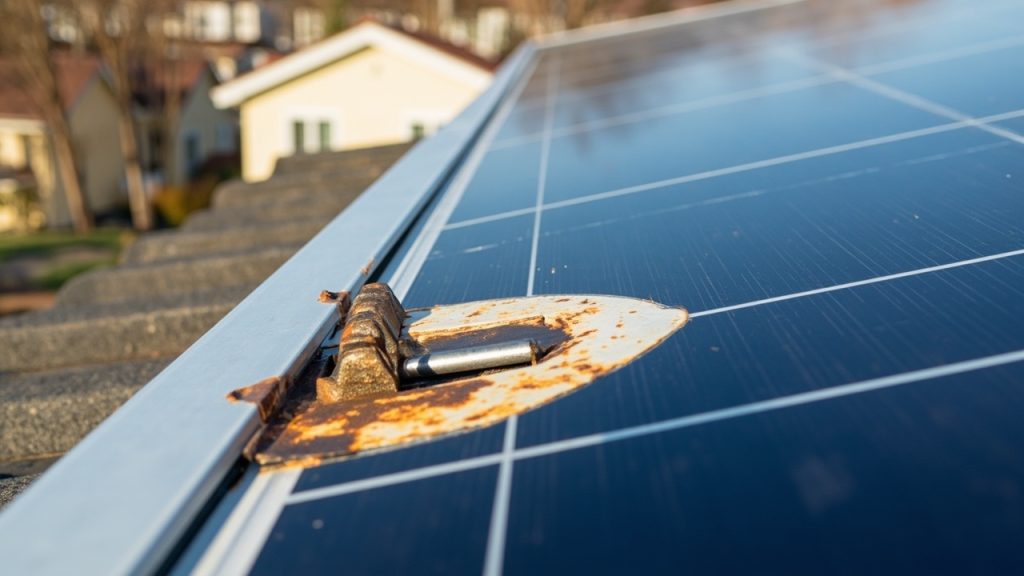
Your solar panels are saving you money on energy bills, but a slow leak around the mounting hardware could be costing you far more in structural damage. In Southfield and across the greater Detroit metro, we respond to water damage calls that trace directly back to poorly sealed solar mounts. The leak is usually small at first. By the time a homeowner notices water staining on a ceiling or smells something musty in the attic, the damage has been building for months.. Read more about Replacing Water Damaged Drywall and Insulation in Your Sterling Heights Family Room.
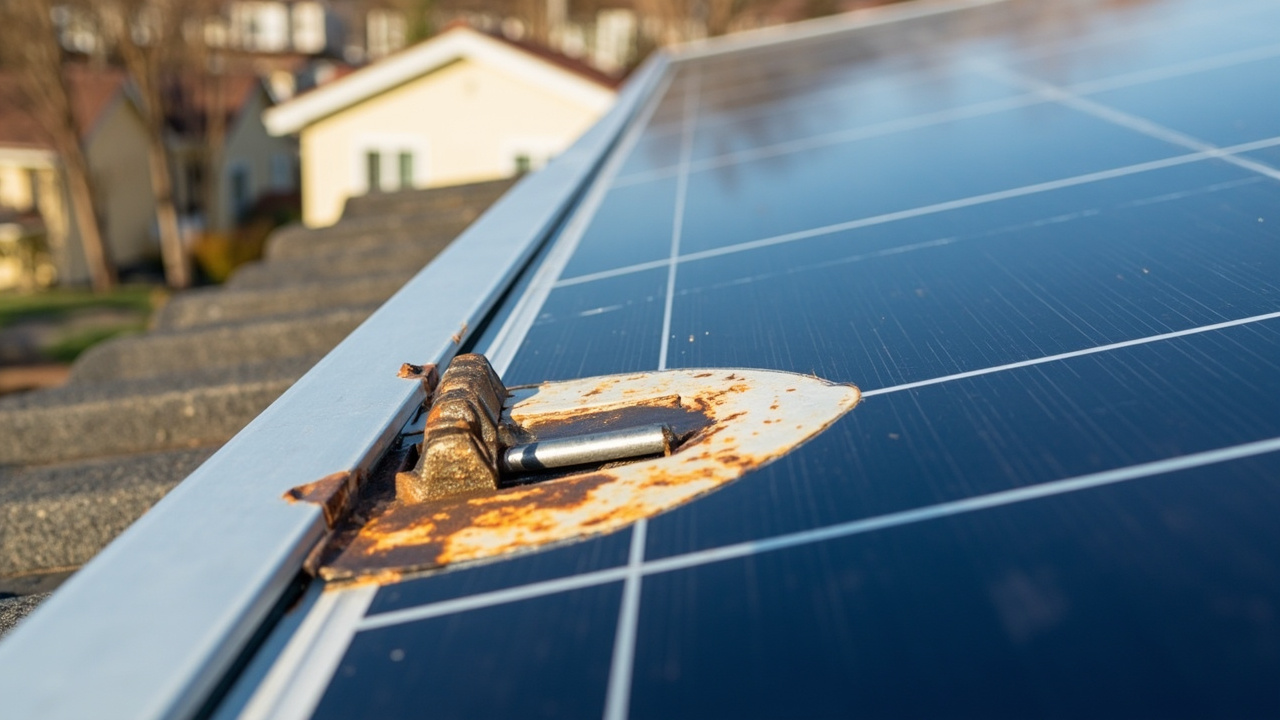
How Solar Panel Mounts Let Water Into Your Roof
Every solar panel on a pitched roof attaches through lag bolts driven directly into the roof deck and rafters. When an installer does this correctly, they seat a flashed mount over the penetration point, seal it with a code-compliant sealant, and ensure water sheds away from the bolt channel. When it is done poorly, or when it degrades over time, that bolt hole becomes a direct path for water into your home.
There are two primary mounting systems used on Michigan homes. Rail-based systems use aluminum rails that span multiple attachment points, while rail-less systems attach each panel directly to individual mounts. Both create roof penetrations. Both can fail.
| Mounting System Type | Common Failure Points | Typical Leak Pattern | Michigan-Specific Risk |
|---|---|---|---|
| Rail-Based | Rail end caps, flashing under rails, lag bolt sealant | Gradual seep along rail length | Ice dam formation behind rail arrays |
| Rail-Less | Individual mount flashing, micro-penetrations at each bolt | Isolated drip points, harder to trace | Thermal expansion loosens sealant faster in freeze-thaw cycles |
| Ballasted (Flat Roof) | Membrane punctures, drain obstruction | Pooling water, widespread saturation | Snow load concentrates weight on membrane edges |
The Freeze-Thaw Problem in Southeast Michigan
Detroit and Southfield sit in a climate zone that sees significant freeze-thaw cycling from late fall through early spring. Water enters a micro-gap around a lag bolt, freezes overnight, expands, and widens that gap. This happens dozens of times over a single winter. By March, what was a hairline gap is now a meaningful void that rain and snowmelt push through freely.
Solar arrays also trap heat on the roof surface during winter days. This accelerates snowmelt on the panels. That water runs down and refreezes at the array perimeter, directly at the mounting hardware. The U.S. Department of Energy’s Solar Energy Technologies Office acknowledges that rooftop PV installations in cold climates require specific installation protocols to manage ice and water infiltration risks. Most standard residential installations don’t fully account for what Michigan winters do to flashing and sealants.
What Happens to Your Attic After a Solar Leak
Water does not fall straight down to your living space in most cases. It follows the path of least resistance, which usually means spreading laterally along the roof deck, soaking into the insulation, and then saturating the structural members before you ever see a drop on your ceiling.
In a typical Southfield home with a truss roof system, water from a solar mount penetration can travel six to ten feet from the entry point before it drips. This means the visible ceiling stain almost never marks where the actual problem is located.
The 24 to 48 Hour Mold Window
Mold colonies establish themselves on wet organic material within 24 to 48 hours under the right temperature conditions. Attic spaces in Southeast Michigan homes stay warm enough for mold growth for most of the year. Blown-in insulation and OSB roof decking are ideal substrates for mold once they become wet. By the time you call a contractor, the mold issue may already be present even if you cannot see it yet.
If you suspect a solar panel roof leak in your Southfield home, time is a real factor. The longer saturated materials stay wet, the deeper the remediation required.

Immediate Steps When You Suspect a Solar Roof Leak
Do not wait for your next sunny day to investigate. If you see water staining on the ceiling near or below your solar array, or you notice a musty odor in the upper level of your home, take these steps immediately.
- Turn off your solar inverter. Water and active electrical systems are a serious hazard. Your inverter typically has a shutdown switch in your electrical panel or on the unit itself. When in doubt, contact your solar installer for the correct shutdown procedure before entering the attic.
- Move belongings out of the affected area. If the ceiling is wet, place buckets and move furniture. Water staining you can see represents far more water you cannot see inside the structure.
- Do not attempt to remove panels yourself. Accessing a wet roof creates a fall hazard, and disturbing the panels can void equipment warranties.
- Document everything before anyone touches it. Take photos of the ceiling staining, any visible attic damage, and the location of the solar panels relative to the damage. This documentation matters for your insurance claim.
- Call a water damage restoration company, not just a roofer. The roof penetration repair is one piece. The water extraction, structural drying, and mold prevention inside the attic are an entirely separate scope of work.
The Full Restoration Process After a Solar Mount Leak
Patching the roof is not the end of the job. It is the beginning. Once water enters a structure, it absorbs into wood framing, insulation, drywall, and any other porous material it contacts. Getting the roof dry does nothing to reverse that damage.
Moisture Mapping With Infrared Thermal Imaging
An IICRC-certified water damage technician begins with a thorough moisture inspection using infrared thermal imaging cameras and calibrated moisture meters. Thermal imaging reveals temperature differentials in the roof deck and ceiling assembly that correspond to saturated areas. This is how we find water that has traveled far from the actual leak point without tearing open walls or ceilings unnecessarily.
In Southfield attic inspections, we frequently find that insulation has absorbed significant water volume while appearing dry to the touch from below. Fiberglass batt and blown cellulose both wick and retain moisture. That retained moisture feeds mold and continues degrading the structural members underneath it long after the leak source is sealed.
Water Extraction and Structural Drying
Standing water in the attic space is removed first. Then the drying process begins using commercial-grade dehumidifiers and high-velocity air movers positioned according to a drying plan calculated from the moisture readings. IICRC S500 standards set the benchmarks for what constitutes a properly dried structure. A residential dehumidifier from a hardware store does not meet those standards. The equipment used in professional structural drying removes many times more moisture per day than consumer units.
Drying typically takes three to five days for moderate attic saturation, longer if structural members have significant moisture content. Technicians monitor and document moisture readings daily to confirm the structure is trending toward dry conditions, not just surface-dry.
Mold Remediation in Attic Spaces
If mold is confirmed through visual inspection or air sampling, remediation follows EPA mold remediation guidelines for the specific scope of the affected area. For attic mold resulting from a solar panel roof leak, this typically involves HEPA vacuuming of surfaces, application of antimicrobial treatment to structural wood, and in more severe cases, removal and replacement of contaminated insulation. Proper containment prevents mold spores from migrating into living spaces during the remediation process.
If you have dealt with a mold situation in another part of your home and tried to address it with household products, read about why bleach won’t fix basement mold and when professional remediation is required. The same principles apply in attic spaces.
Insulation Replacement and Moisture Barrier Repair
Saturated insulation loses its thermal value and cannot be dried effectively in place. It comes out, the roof deck and framing are allowed to dry fully, and new insulation goes in after the structure passes moisture testing. Wayne County building codes require insulation replacement to meet current R-value standards when insulation is removed as part of a repair, which can mean a higher R-value than your original installation if the home is older.

Solar Leak Damage Compared to Standard Roof Leak Damage
Not all roof leaks create the same restoration scope. Solar panel leaks have specific characteristics that affect the complexity and cost of mitigation compared to a standard flashing failure or missing shingle.
| Damage Factor | Standard Roof Leak | Solar Mount Leak |
|---|---|---|
| Time to detection | Days to weeks | Months (concealed by panels) |
| Extent of saturation at discovery | Localized to breach point | Widespread, often involves multiple bays |
| Electrical hazard | Minimal in most cases | Active DC current present until inverter shutdown |
| Roof access for repair | Straightforward | Requires panel removal or repositioning |
| Mold risk level at discovery | Moderate | High due to delayed detection |
| Insurance claim complexity | Standard homeowner claim | May involve solar installer warranty and homeowner policy |
| Parties involved in resolution | Roofer, restoration company | Solar installer, roofer, restoration company, insurer |
How Insurance Handles Solar Panel Water Damage in Michigan
Insurance coverage for a solar panel roof leak depends on how the damage originated and what policies are active on the property. Your homeowner’s insurance typically covers sudden and accidental water damage to the structure. If the leak resulted from a slow, ongoing failure that was not addressed, some adjusters may attempt to classify it as a maintenance issue and limit coverage.
Documentation from a certified restoration company strengthens your position. Moisture maps, thermal images, and written scope reports give your adjuster the objective evidence needed to support the full scope of the claim. For detailed guidance on navigating this process, see our resource on how to get your Detroit home insurance to actually pay for water restoration.
If the solar installation was recent and the leak traces directly to improper installation, the solar company’s workmanship warranty or their general liability insurance may be the primary coverage avenue. Your restoration company can document the source of the leak in a way that supports that claim as well.
Homeowners in Corktown, Royal Oak, and Birmingham have successfully recovered full restoration costs through coordinated claims across multiple policies when the documentation was prepared correctly from the start. For more on the claims documentation process, the guidance in our article on filing a successful water damage insurance claim for your Corktown home covers the key steps in detail.
Secondary Damage You Might Not Think to Check
Attic leaks from solar mounts do not always stay in the attic. Depending on the volume of water and the duration of the leak, secondary damage can appear in other parts of the home.
If your home has hardwood floors on the upper level, slow attic leaks that permeate the ceiling assembly can reach the subfloor and cause hardwood to buckle or cup from below. This type of damage can be addressed if caught early. Our team has written a detailed guide on how to save hardwood floors after a water leak that applies to Southfield homes as well.
Carpet in upper-level rooms adjacent to the leak area can also absorb moisture from a wet ceiling or wet subfloor. Whether that carpet can be restored depends on the type of water involved, how long it has been wet, and the condition of the pad underneath. For reference on that decision, see our guide on deciding whether wet carpet can be saved or needs to go.
What to Look For Before Calling a Roofer or Restoration Company
Not every solar panel installation is a leak waiting to happen. But Southfield homeowners with solar arrays should inspect for these warning signs at least twice per year, ideally after winter ends and after the first heavy fall rains.
- Visible rust streaks running down the roof below mount locations
- Sealant that is cracked, shrunken, or pulling away from the mount base
- Discoloration or water staining on the attic deck near the rafters directly below the array
- Insulation that appears compressed, discolored, or clumped in the attic
- A musty smell in the attic or on the upper floor of the home after rain
- Icicle formation along the solar array perimeter in winter, which signals ice dam activity at the mount points
- Any visible daylight around a mount base when viewed from inside the attic
If you find any of these signs, the first call is to a restoration professional who can assess whether water intrusion has already occurred. A roofer can seal the source. A restoration company determines whether the structure has already been compromised and what it takes to return it to a dry, safe condition.
Getting Professional Help in Southfield and the Detroit Metro
A solar panel roof leak is a problem that requires coordination between multiple trades. The photovoltaic system needs a qualified solar technician to safely remove or reposition panels. The roof penetrations need a roofer with flashing experience. And the water damage inside the attic needs an IICRC-certified water mitigation and structural drying team who understands moisture science, mold prevention, and how to document the work for insurance purposes.
Southfield homeowners dealing with a suspected solar mount leak can reach our team any time of day. We serve the full Wayne County and Oakland County area including neighborhoods across Detroit proper, Ferndale, Royal Oak, Bloomfield Hills, and the Southfield corridor along I-696. Our response time for confirmed active water intrusion in the Detroit metro area is typically within two hours.
If you are seeing the early signs of water damage near your solar array, do not wait for the next rain event to confirm it. By then, what was a mitigation job may have become a full remediation and rebuild. Call us before the damage gets ahead of you.
{
“@context”: “https://schema.org”,
“@type”: “BlogPosting”,
“headline”: “Why Leaking Solar Panel Mounts Are Quietly Wrecking Attics in Southfield Homes”,
“description”: “Solar panel roof leaks cause hidden attic damage in Southfield homes. Learn what causes them, how water spreads, and what professional restoration looks like.”,
“wordCount”: 2257,
“datePublished”: “2026-08-21T07:28:00.000Z”,
“dateModified”: “2026-08-21T07:28:00.000Z”,
“inLanguage”: “en-US”,
“mainEntityOfPage”: {
“@type”: “WebPage”,
“@id”: “https://ironwoodwaterdamagerestorationdetroit.com”
},
“publisher”: {
“@type”: “LocalBusiness”,
“name”: “Ironwood Water Damage Restoration Detroit”,
“url”: “https://ironwoodwaterdamagerestorationdetroit.com”
},
“author”: {
“@type”: “Organization”,
“name”: “Ironwood Water Damage Restoration Detroit”,
“url”: “https://ironwoodwaterdamagerestorationdetroit.com”
},
“image”: {
“@type”: “ImageObject”,
“url”: “https://ironwoodwaterdamagerestorationdetroit.com/wp-content/uploads/2026/03/how-leaking-solar-panel-mounts-can-damage-the-atti-1.jpg”
}
}
{
“@context”: “https://schema.org”,
“@type”: “LocalBusiness”,
“name”: “Ironwood Water Damage Restoration Detroit”,
“url”: “https://ironwoodwaterdamagerestorationdetroit.com”,
“address”: {
“@type”: “PostalAddress”,
“addressLocality”: “Detroit”
},
“areaServed”: {
“@type”: “City”,
“name”: “Detroit”
}
}
{
“@context”: “https://schema.org”,
“@type”: “BreadcrumbList”,
“itemListElement”: [
{
“@type”: “ListItem”,
“position”: 1,
“name”: “Home”,
“item”: “https://ironwoodwaterdamagerestorationdetroit.com”
},
{
“@type”: “ListItem”,
“position”: 2,
“name”: “Blog”,
“item”: “https://ironwoodwaterdamagerestorationdetroit.com/blog”
},
{
“@type”: “ListItem”,
“position”: 3,
“name”: “Why Leaking Solar Panel Mounts Are Quietly Wrecking Attics in Southfield Homes”
}
]
}
{
“@context”: “https://schema.org”,
“@type”: “Service”,
“serviceType”: “Water Damage Restoration”,
“provider”: {
“@type”: “LocalBusiness”,
“name”: “Ironwood Water Damage Restoration Detroit”,
“url”: “https://ironwoodwaterdamagerestorationdetroit.com”
},
“areaServed”: {
“@type”: “City”,
“name”: “Detroit”
},
“description”: “Solar panel roof leaks cause hidden attic damage in Southfield homes. Learn what causes them, how water spreads, and what professional restoration looks like.”
}