
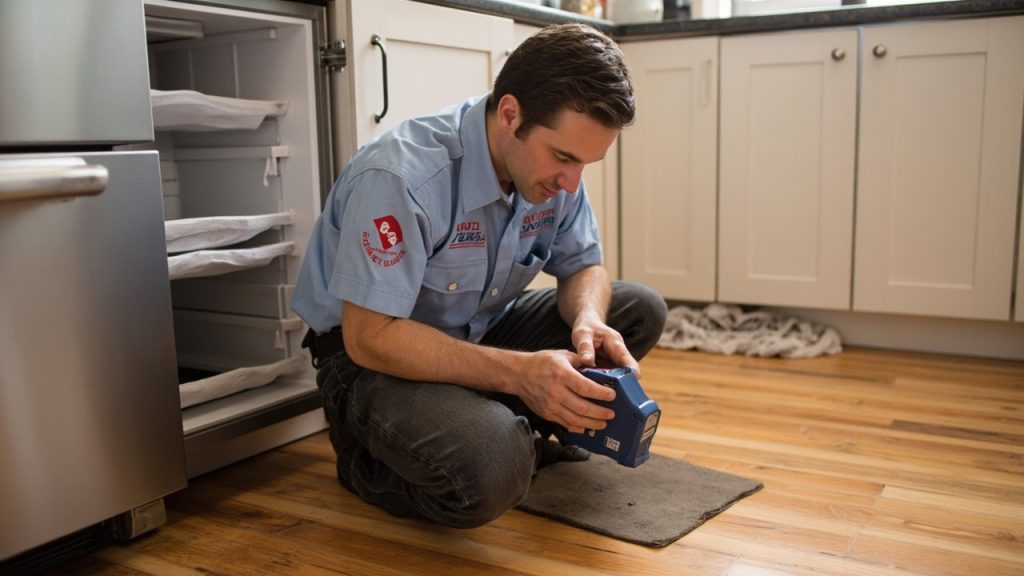
You open the freezer to grab ice and notice the floor feels soft underfoot. Or maybe you spot a faint water stain creeping out from under the fridge. That tiny pinhole leak in your ice maker supply line is not a minor inconvenience. In Metro Detroit homes, it is one of the most destructive slow-burn water damage sources we see all year.
By the time most Shelby Township homeowners notice the damage, the subfloor has already absorbed weeks of moisture. Here is what you need to do right now, what the damage actually looks like behind your walls and under your floors, and when a professional restoration crew needs to take over.
Stop the Water First
Before you do anything else, cut off the water supply. Do not wait for a plumber. Do not mop the floor first. Stop the source.
How to Shut Off Your Ice Maker Water Supply Line
- Pull the refrigerator away from the wall. Most units need about two feet of clearance.
- Find the braided steel or plastic supply line running from the wall to the back of the fridge.
- Trace it to the shut-off valve. This is usually behind the fridge or under the sink nearby.
- Turn the valve clockwise until it stops. If the valve is stuck or corroded (common in older Shelby Township and Sterling Heights homes), shut off the main water supply for the kitchen instead.
- Disconnect the supply line at the compression nut where it enters the refrigerator. Let it drain into a towel.
- Leave the fridge pulled out so air can circulate underneath.
If you cannot locate a dedicated shut-off valve, go to your basement or utility room and close the main house shut-off. It is faster than troubleshooting a stuck valve with water still running.
Why Ice Maker Lines Fail in Michigan Homes
Michigan’s freeze-thaw cycles do real damage to appliance supply lines. Refrigerators in garages or against exterior walls in older Detroit-area homes are especially vulnerable. The plastic tubing used in many stock supply lines becomes brittle after repeated exposure to temperature swings.
Here are the most common failure points we find when we scope these jobs:
Cracked or Kinked Supply Lines
The standard plastic supply line that ships with most refrigerators is only designed for stable indoor conditions. When a fridge gets pushed back against a wall at an angle, that line kinks. Over time, the kink becomes a stress fracture and then a leak. Whirlpool, GE, and Kenmore units are especially common offenders because they still ship with plastic tubing as of today.
Faulty or Worn Solenoid Valve
The solenoid valve controls water flow into the ice maker. When it fails to close fully, water drips continuously into the fill tube. Samsung and LG refrigerators with dual ice makers have two solenoid valves, doubling the failure risk. A valve leaking internally will not show any visible dripping outside the fridge, which is why this type of failure goes unnoticed for weeks.
Loose Compression Nut at the Wall Connection
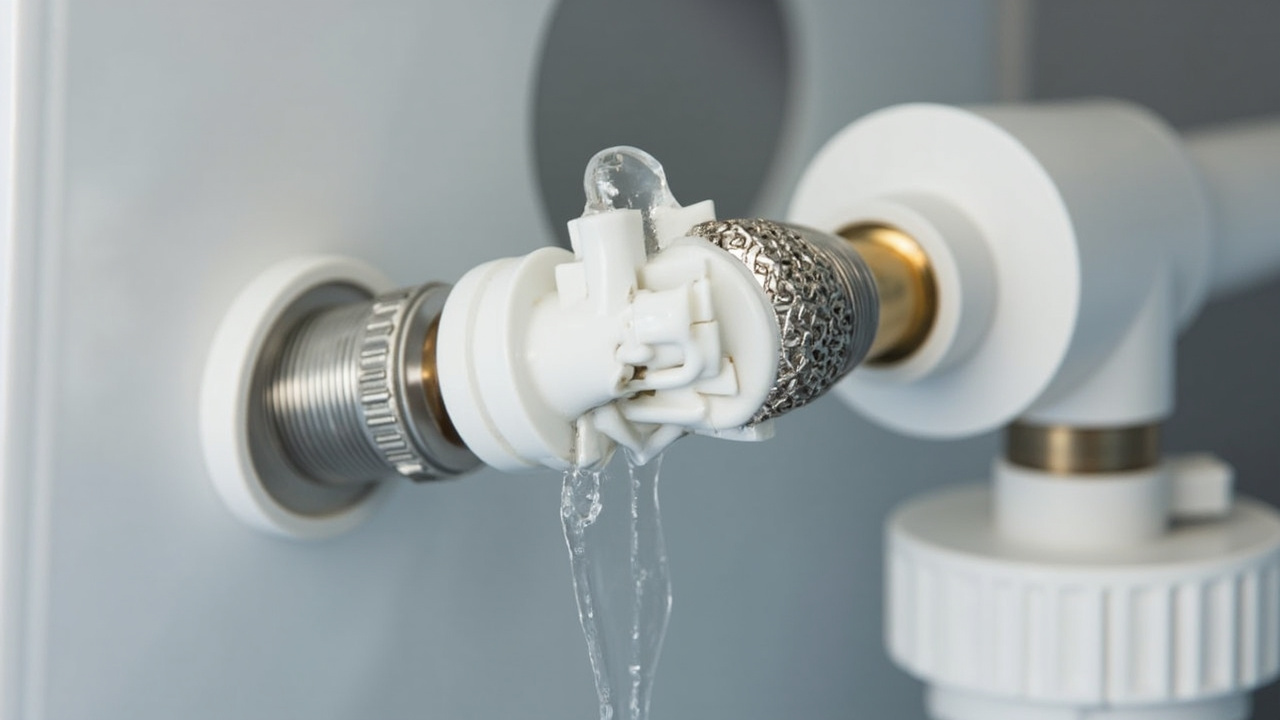
Vibration from the fridge compressor slowly loosens the compression fitting where the supply line meets the shut-off valve. This is a drip-rate leak, not a gush. It saturates the flooring directly behind the fridge without ever puddling visibly in front of it.
Clogged Defrost Drain and Overflow
When the defrost drain clogs with ice or debris, meltwater has nowhere to go. It spills into the condensation pan and then overflows onto the floor. This is often mistaken for a supply line leak because the water appears at the base of the fridge. The distinction matters because one requires a plumber and the other requires an appliance tech.
| Failure Type | Typical Detection Time | Common Brands Affected | Damage Potential |
|---|---|---|---|
| Cracked supply line | Days to weeks | Whirlpool, GE, Kenmore | High (subfloor saturation) |
| Solenoid valve drip | Weeks to months | Samsung, LG, GE | Very High (hidden mold growth) |
| Loose compression nut | Weeks | All brands | High (wall and cabinet damage) |
| Defrost drain overflow | Days | All brands | Moderate to High |
| Frozen fill tube | Hours to days | Whirlpool, Kenmore | Moderate |
What Is Happening Under Your Floor Right Now
This is the part most homeowners underestimate. The water you can see on the surface represents a fraction of the moisture that has already moved into your flooring system.
Hardwood Floor Cupping
Detroit-area homes in neighborhoods like Corktown, Sherwood Forest, and Indian Village are full of original hardwood floors. These floors are beautiful and extremely vulnerable to moisture. When the wood absorbs water from below, the edges of each plank rise higher than the center. This is called cupping. If you catch it within 24 to 48 hours and the subfloor is not compromised, professional structural drying can sometimes reverse it. Check out our detailed guide on how to save your hardwood floors after a water leak for what the recovery process looks like.
Subfloor Saturation and Rot
Below the finish floor is typically a layer of plywood or OSB (oriented strand board) subfloor. OSB absorbs water aggressively and loses structural integrity fast. Once it reaches saturation point, it swells, delaminates, and begins to rot. In Michigan homes built before the 1980s, you may also have board subfloor, which can develop persistent mold channels that are nearly impossible to dry without removing the finish floor above.
Mold Growth Timeline in Metro Detroit Conditions
Mold spores need three things to grow, moisture, a food source (wood, drywall), and time. In Michigan’s warm summer months, visible mold colonies can establish in as little as 24 to 48 hours in a saturated floor cavity. In winter with the heat running, the warm dry air above actually accelerates moisture migration deeper into the subfloor before mold can signal its presence on the surface.
If you have already spotted dark spots under or around your fridge, do not reach for bleach. Surface treatment does not address mold in porous materials. Read more about why bleach will not fix your mold problem and what actually works.
Cabinet Toe-Kick and Wall Cavity Damage
Water behind a refrigerator rarely stays contained to the floor directly beneath it. It wicks sideways under the adjacent cabinet toe-kicks and into the drywall at the base of the wall. This is the kind of damage that does not show itself until the drywall starts to bubble or the baseboard paint peels, often months after the original leak.
The Professional Restoration Process for Kitchen Floor Damage
Fans and towels will not dry a saturated subfloor. Here is what a certified restoration process actually looks like under IICRC S500 standards, the industry benchmark for water damage restoration.
Thermal Imaging and Moisture Mapping
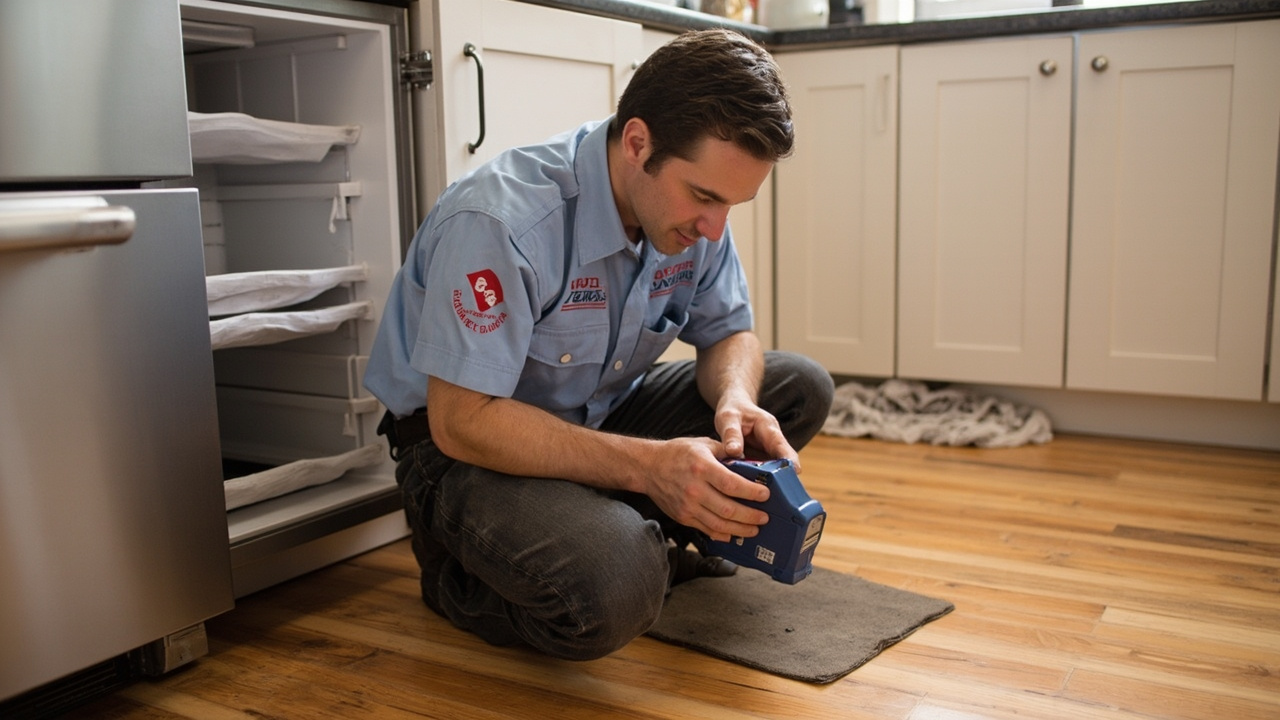
The first step is finding all the water, not just the water you can see. We use thermal imaging cameras and penetrating moisture meters to map exactly where moisture has traveled. In a Shelby Township kitchen, water from an ice maker leak frequently migrates under the flooring to the adjacent dining room or pantry before it is ever detected.
Water Extraction
Industrial wet vacs and truck-mounted extraction units pull free-standing water from the surface. For hardwood floors, specialized floor mat systems create a sealed vacuum environment that draws moisture from the wood cells without requiring removal of the flooring.
Structural Drying with Desiccant and Refrigerant Dehumidifiers
Low-grain refrigerant (LGR) dehumidifiers and desiccant units run continuously until moisture readings return to baseline for the specific material. In Michigan, basement humidity levels during warmer months complicate drying in lower-level kitchens. We account for ambient conditions when setting drying targets, not just running equipment for a flat number of days.
Antimicrobial Treatment
After drying, affected surfaces receive EPA-registered antimicrobial treatment to inhibit mold growth in any residual moisture zones. This is applied to the subfloor, wall cavities, and cabinet interiors as appropriate.
| Damage Scenario | Typical Drying Time | Likely Scope of Work | Restoration Category |
|---|---|---|---|
| Caught within 24 hours, surface only | 2 to 3 days | Extraction, drying, monitoring | Category 1 / Class 2 |
| 1 to 7 days undetected, floor affected | 3 to 5 days | Extraction, floor mat drying, antimicrobial | Category 1 / Class 3 |
| 7 to 30 days undetected, subfloor saturated | 5 to 7 days | Flooring removal, subfloor drying or replacement | Category 1 / Class 3 to 4 |
| 30 or more days, mold present | 7 to 14 days | Mold remediation, structural drying, full rebuild | Category 3 / Class 4 |
How Michigan’s Climate Makes This Worse
Wayne County and Macomb County homeowners deal with conditions that accelerate both the frequency of ice maker line failures and the severity of resulting damage.
Freeze-thaw cycles hit supply lines especially hard in kitchens on exterior walls. Many Shelby Township and Sterling Heights homes built in the 1970s and 1980s have refrigerator alcoves on north-facing exterior walls. When temperatures drop below freezing, any gap in insulation behind the fridge can cause the supply line to freeze. When it thaws, a newly cracked line starts dripping.
Michigan’s high summer humidity means ambient moisture is already near the threshold where wood materials begin to absorb it. A slow drip in July or August creates far more floor damage than the same drip in February because the wood is already working at higher moisture content.
If your wet carpet in a connected area is also a concern, the decision about whether to save or replace it depends on saturation level and time elapsed. Our breakdown of wet carpet decisions for Sterling Heights homes walks through the key factors.

Checking Your Homeowners Insurance Coverage
Most standard homeowners policies in Michigan cover sudden and accidental water damage from a failed appliance supply line. The key phrase is “sudden and accidental.” If the leak was slow and undetected for weeks, adjusters may argue the damage resulted from neglect rather than a sudden event.
Document everything before cleanup begins. Take photos and video of the damage, the failed supply line, and any water staining patterns. Get a written scope of work from a certified restoration contractor before accepting any settlement offer.
For a detailed walkthrough of how to handle the claims process, read our guide on getting your Detroit home insurance to actually pay for water restoration. If you are in a specific neighborhood with historical home values at stake, the Corktown insurance claim guide covers documentation strategies that apply across Metro Detroit.
Michigan law requires that restoration contractors provide itemized estimates. If an insurer pushes back on the scope of structural drying, reference the FEMA flood damage assessment guidelines for secondary moisture damage expectations as a baseline for negotiation.
What to Replace and What You Can Actually Keep
After the drying process is complete and moisture readings are verified, you and your contractor assess what is salvageable. The answer depends on the material, the exposure duration, and the moisture class at time of discovery.
Solid hardwood flooring that was dried within 48 hours and shows no structural warping can often be sanded and refinished. Engineered hardwood is far less forgiving and typically requires replacement once cupping occurs. OSB subfloor that reaches a moisture reading above 25 percent and was wet for more than a week almost always needs replacement to prevent long-term structural movement.
Drywall that absorbed water at the base of walls needs to be cut out at minimum 12 inches above the visible moisture line. The cavity behind it must be dried and treated before new drywall goes in. Running fans without opening the wall simply traps moisture and feeds mold growth in a hidden environment.
When to Call a Restoration Contractor Versus an Appliance Repair Tech
Call an appliance repair technician to fix or replace the source, the faulty solenoid valve, cracked supply line, or clogged defrost drain. That is their scope.
Call a water damage restoration contractor when the floor is soft, the wood is cupping, the drywall shows staining, or you can see or smell any sign of mold. These are structural drying and moisture mapping problems that require IICRC-certified equipment and trained technicians, not shop vacs and box fans.
In Shelby Township, Sterling Heights, and across Wayne County, the biggest mistake homeowners make is handling the appliance repair and assuming the floor will dry on its own. It will not. And every additional day of moisture exposure increases the scope and the cost of the eventual restoration.
If you are dealing with an active ice maker leak right now or you have found damage you are not sure how to handle, call our team for 24/7 emergency water extraction across Metro Detroit and Wayne County. We assess the moisture damage with thermal imaging, walk you through the documentation process for your insurance claim, and begin structural drying the same day we arrive.
{
“@context”: “https://schema.org”,
“@type”: “BlogPosting”,
“headline”: “Why That Tiny Pinhole Leak in Your Shelby Township Ice Maker Line Can Destroy Your Floors”,
“description”: “A small ice maker leak in Shelby Township can rot your subfloor and grow mold fast. Learn what to do right now and when to call a Detroit water damage pro.”,
“wordCount”: 2104,
“datePublished”: “2026-05-07T13:16:00.000Z”,
“dateModified”: “2026-05-07T13:16:00.000Z”,
“inLanguage”: “en-US”,
“mainEntityOfPage”: {
“@type”: “WebPage”,
“@id”: “https://ironwoodwaterdamagerestorationdetroit.com”
},
“publisher”: {
“@type”: “LocalBusiness”,
“name”: “Ironwood Water Damage Restoration Detroit”,
“url”: “https://ironwoodwaterdamagerestorationdetroit.com”
},
“author”: {
“@type”: “Organization”,
“name”: “Ironwood Water Damage Restoration Detroit”,
“url”: “https://ironwoodwaterdamagerestorationdetroit.com”
},
“image”: {
“@type”: “ImageObject”,
“url”: “https://ironwoodwaterdamagerestorationdetroit.com/wp-content/uploads/2026/03/how-a-tiny-pinhole-leak-in-your-shelby-township-ic-1.jpg”
}
}
{
“@context”: “https://schema.org”,
“@type”: “LocalBusiness”,
“name”: “Ironwood Water Damage Restoration Detroit”,
“url”: “https://ironwoodwaterdamagerestorationdetroit.com”,
“address”: {
“@type”: “PostalAddress”,
“addressLocality”: “Detroit”
},
“areaServed”: {
“@type”: “City”,
“name”: “Detroit”
}
}
{
“@context”: “https://schema.org”,
“@type”: “BreadcrumbList”,
“itemListElement”: [
{
“@type”: “ListItem”,
“position”: 1,
“name”: “Home”,
“item”: “https://ironwoodwaterdamagerestorationdetroit.com”
},
{
“@type”: “ListItem”,
“position”: 2,
“name”: “Blog”,
“item”: “https://ironwoodwaterdamagerestorationdetroit.com/blog”
},
{
“@type”: “ListItem”,
“position”: 3,
“name”: “Why That Tiny Pinhole Leak in Your Shelby Township Ice Maker Line Can Destroy Your Floors”
}
]
}
{
“@context”: “https://schema.org”,
“@type”: “Service”,
“serviceType”: “Water Damage Restoration”,
“provider”: {
“@type”: “LocalBusiness”,
“name”: “Ironwood Water Damage Restoration Detroit”,
“url”: “https://ironwoodwaterdamagerestorationdetroit.com”
},
“areaServed”: {
“@type”: “City”,
“name”: “Detroit”
},
“description”: “A small ice maker leak in Shelby Township can rot your subfloor and grow mold fast. Learn what to do right now and when to call a Detroit water damage pro.”
}