
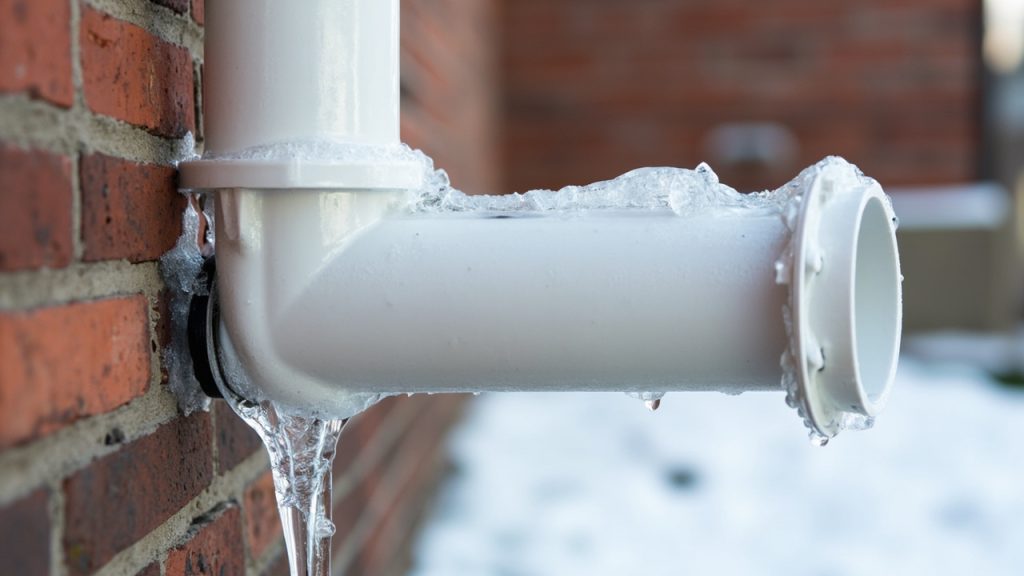
Your sump pump is running. You can hear it humming. But water is still rising in your basement because the discharge line is frozen solid. This is one of the most common winter emergencies we see across Macomb County, and it happens fast once temperatures drop below 20°F for more than a day or two.
This guide gives you immediate steps to stop the flooding, explains why Michigan’s winters target this specific weak point in your drainage system, and shows you the permanent fixes that actually hold up through a Great Lakes winter.
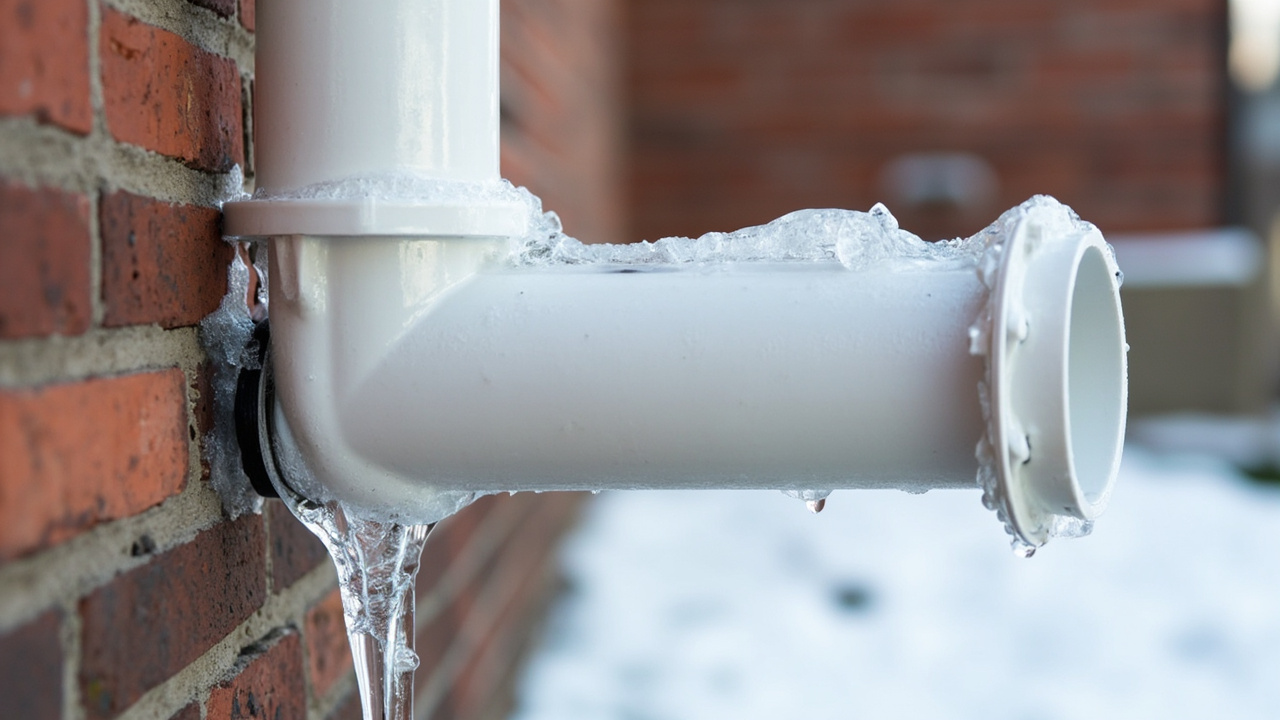
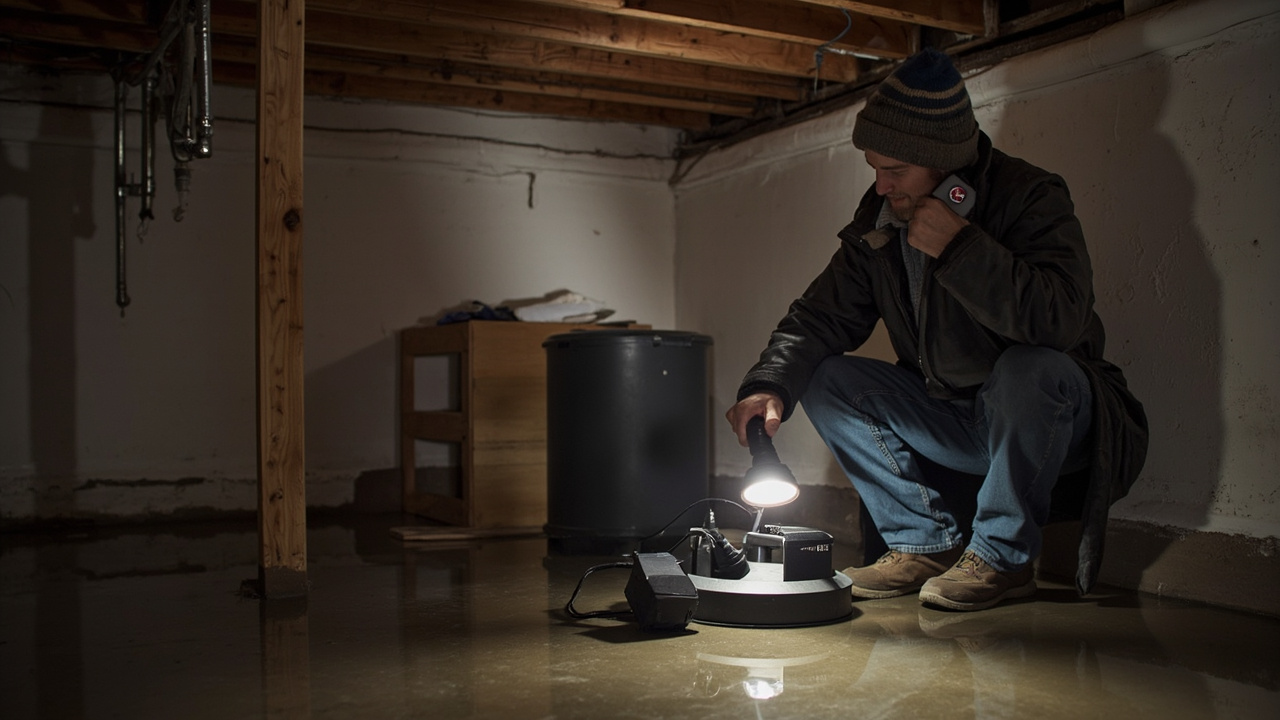
Emergency Action Plan If Your Basement Is Flooding Right Now
Before anything else, protect your property. Follow these steps in order.
- Turn off your sump pump at the circuit breaker. A pump running against a frozen line will burn out the motor within minutes. That turns a pipe problem into a full equipment replacement.
- Move anything off the basement floor. Electronics, boxes, furniture, and stored items need to go up on tables or out of the space entirely.
- Use a wet-dry vac or floor squeegee to push water toward the drain or sump basin. Every inch of standing water you remove now is less structural damage later.
- Open basement windows slightly if outdoor temps are above freezing. Air circulation slows mold growth, which can start within 24 to 48 hours on wet drywall and framing.
- Document everything with photos before you touch anything. Your insurance adjuster will need this. For more on that process, read our guide on how to get your Detroit home insurance to actually pay for water restoration.
- Call a water mitigation professional if water has reached drywall, flooring, or wood framing. Structural drying is not a DIY job.
Once you have stabilized the situation, you can address the frozen line itself.
Why Sump Pump Discharge Lines Freeze in Southeast Michigan
Southeast Michigan sits in a freeze-thaw cycle zone that punishes improperly installed drainage systems. The frost line in Macomb and Oakland counties runs approximately 42 inches deep. Any pipe that exits your foundation above that depth and runs above grade is exposed to freezing air temperatures for three to five months of the year.
The problem is not just cold air. It is a combination of factors working together.
Improper Pipe Pitch
The discharge pipe needs a minimum slope of one quarter inch per foot away from the house. If the pipe was installed flat, or if soil settling has created a low spot, water sits inside the pipe between pump cycles. That sitting water freezes. Ice builds up incrementally with each cycle until the pipe is fully blocked.
Pipe Diameter Too Small
A 1.5-inch discharge pipe is far more vulnerable than a 2-inch pipe. The smaller the interior diameter, the faster a partial ice buildup chokes off flow. Most professional installations in the greater Detroit area use 2-inch pipe for outdoor runs specifically because of this. The extra volume keeps water moving faster and gives ice less surface area to grip.
The Exit Point Location
Pipes that terminate close to the foundation, or that point straight down onto a hard surface like a patio or driveway, create pooling. That pooled water wicks back toward the pipe opening and freezes as a plug. The pipe needs to discharge at least 10 feet from the foundation and onto a sloped gravel bed or drainage swale when possible.
Michigan’s Polar Vortex Events
The Detroit metro area experiences polar vortex intrusions that drive wind chills into the negative 20s and hold air temperatures below zero for 48 to 72 hours at a stretch. During those events, even a properly installed pipe with good pitch can freeze if it lacks additional insulation. Homeowners in areas like Utica, Washington Township, and northern Shelby Township feel these temperature swings harder than communities closer to the warming influence of Lake St. Clair.
How to Safely Thaw a Frozen Discharge Line
You have options depending on how much of the pipe is accessible and how severe the blockage is.
Heat Tape (Self-Regulating)
This is the most controlled method for accessible above-grade pipe sections. Self-regulating heat tape, sold at most hardware stores in the Metro Detroit area, wraps around the pipe and plugs into a standard outlet. It senses temperature and increases or decreases heat output automatically. Apply it along the full exposed run and cover it with pipe insulation foam. Allow two to four hours for a full thaw.
Warm Water Poured Into the Discharge Opening
If you can access the outdoor pipe terminus, pouring warm (not boiling) water directly into the opening can melt a terminal ice plug. Use a funnel and a steady stream. This works best on partial blockages near the pipe exit. Do not use boiling water. The thermal shock can crack PVC pipe, especially at fittings and elbows.
A Space Heater Aimed at the Exposed Pipe Section
For basement runs or short above-grade sections, a ceramic space heater positioned 12 to 18 inches from the pipe can thaw a blockage within one to two hours. Keep it away from any standing water. Never leave it unattended.
What Not to Do
Never use an open flame torch on PVC. It will melt and deform the pipe, and it creates a serious fire risk near your foundation. Never pour salt into the discharge line. It accelerates corrosion and damages the check valve at the pump. Do not run the sump pump repeatedly to try to force through the ice. You will burn out the motor.
Signs Your Sump Pump Is Already Struggling With a Frozen Line
You may not see standing water yet, but the pump is telling you there is a problem. These are the warning signs to catch early.
| Warning Sign | What It Means | Urgency Level |
|---|---|---|
| Pump runs continuously without shutting off | Discharge line is blocked, pump cannot evacuate water | High — motor damage imminent |
| Humming sound but no water movement | Impeller is spinning but pressure is backing up against ice | High — turn off pump immediately |
| Short cycling (pump turns on and off rapidly) | Partial blockage creating back-pressure on the float switch | Medium — thaw the line before it worsens |
| Water visible in sump basin despite pump running | Flow rate is zero or near zero, basin is filling faster than it drains | High — flooding imminent |
| Float stuck in raised position | Back-pressure or ice in basin area is holding the float up | Medium — inspect check valve and discharge line |
A healthy submersible pump should run for 30 to 90 seconds per cycle during normal groundwater conditions. Cycles shorter than 15 seconds or pump running longer than three minutes without shutting off both indicate a problem with the discharge side of the system.
Permanent Solutions That Handle Michigan Winters
Thawing the line gets you through tonight. These are the fixes that prevent this from happening next winter.
Install an IceGuard or Freeze-Relief Valve
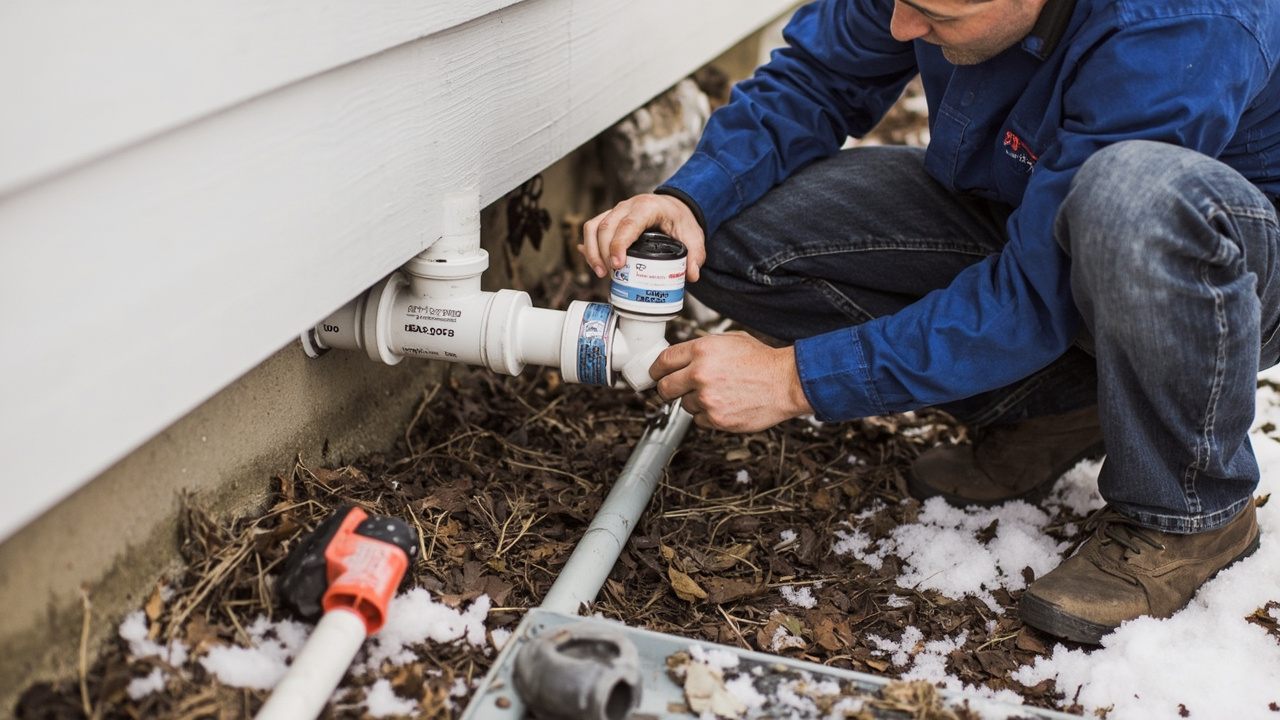
An IceGuard fitting (manufactured by Zoeller Pump Company and available through plumbing supply houses in the Detroit metro area) is a slotted fitting installed in the discharge line just outside the foundation wall. If the line downstream freezes and blocks flow, the IceGuard allows water to exit through the slots directly at the foundation before it backs up into the basin. This does not eliminate the frozen line problem, but it prevents basement flooding while you deal with the pipe. It is the single best upgrade for homes in Shelby Township, Sterling Heights, and Troy that have above-grade discharge runs.
Bury the Discharge Line Below the Frost Line
The permanent solution is a buried run that takes the pipe below 42 inches for its entire length until it reaches a daylight outlet or a pop-up emitter in the yard. This requires excavation and a proper daylight outlet or a connection to a yard drain. It is more involved, but it eliminates freeze risk entirely for the underground portion. The surface emitter is still exposed but handles a much smaller volume of pipe that is easier to manage.
Increase Pipe Diameter and Re-Slope the Run
If your current installation uses 1.5-inch pipe or has a flat or reverse pitch, a re-run with 2-inch pipe at proper slope is worth the investment. Combined with an IceGuard fitting, this addresses the two most common causes of freeze-related failures.
Insulate the Above-Grade Section
Closed-cell foam pipe insulation on the above-grade section, covered with heat tape on a thermostat controller, is the lowest-cost preventive measure for existing installations. This works well for shorter exposed runs, typically under 10 feet. For runs longer than that, buried pipe is the more reliable long-term answer.
| Permanent Fix Option | Best For | Freeze Protection Level | Installation Complexity |
|---|---|---|---|
| IceGuard / Freeze-Relief Valve | All above-grade discharge runs | Prevents flooding (not freezing) | Low — DIY possible |
| Self-regulating heat tape plus insulation | Short exposed runs under 10 feet | High for mild to moderate cold | Low to Medium |
| Buried run below frost line (42 inches) | Long runs or repeat-freeze problem areas | Very High — eliminates underground freeze risk | High — requires excavation |
| 2-inch pipe re-run with proper pitch | Under-sized or poorly pitched original installs | Medium — reduces but does not eliminate risk | Medium |
| Combined buried run plus IceGuard at exit | Homes with chronic freeze history | Highest available | High — but permanent solution |
When a Frozen Discharge Line Becomes a Water Damage Restoration Emergency
A sump pump that cannot discharge does not just inconvenience you. It allows hydrostatic pressure to push groundwater through your foundation floor and walls. Shelby Township sits on clay-heavy glacial soil that holds water exceptionally well. When the water table rises after snowmelt or a mid-winter rain event, the pressure against your foundation increases significantly. Without a working sump pump, that water finds any crack, joint, or penetration it can.
Water that has been sitting on a basement floor for more than a few hours begins wicking into concrete block, drywall, fiberglass insulation, and wood framing. After 24 hours, you are in mold-risk territory. After 48 hours on wood framing, structural drying timelines extend significantly and secondary damage costs multiply.
If water has reached your finished basement, carpet, or any wood framing, the work moves beyond pipe repair. Proper structural drying requires calibrated desiccant or refrigerant dehumidifiers, high-velocity air movers, and thermal imaging to verify that moisture has been fully removed from wall cavities and subfloors. An IICRC-certified technician uses a moisture meter to map the affected area and verify drying standards are met before work is complete.
If wet carpet is involved, the decision about whether to save or remove it depends on how long it has been saturated and what is underneath it. Our guide on deciding whether your wet carpet in Sterling Heights can be saved or needs to go walks through that decision in detail.
For homes with hardwood floors in finished basements or adjacent living areas, time matters enormously. Read more about how to save your hardwood floors after a water leak to understand what the restoration window looks like.
Mold Risk After a Basement Flood
Michigan basements flooded in winter carry a specific mold risk that is easy to underestimate. The cold air slows visible mold growth, so homeowners often assume the basement dried out on its own. It did not. Moisture trapped inside wall cavities, under flooring, and in insulation stays warm enough for mold colonization even when outdoor temps are in the teens.
If you used bleach on affected surfaces, understand that bleach does not penetrate porous materials. It addresses surface appearance only. The mold colony inside drywall or wood framing continues to grow. For a detailed explanation of why this matters, see our article on why bleach won’t fix your Ferndale basement mold.
For guidance on the insurance claim process, including documentation requirements and what adjusters look for after a basement flooding event, our guide on filing a successful water damage insurance claim covers the process in full.
What to Check Before Next Winter Hits
A frozen discharge line is almost always preventable with an inspection done in late October or early November, before the first hard freeze.
Walk the discharge run from where it exits the foundation to where it terminates. Check for any sags or low spots in the pipe. Confirm the pipe slopes consistently away from the house. Clear any debris from the pipe outlet. Make sure the end cap or grate is not blocked. Inspect the IceGuard fitting if you have one and confirm the slots are open and clean.
Inside, test the pump by pouring a bucket of water into the sump basin and watching the float rise and activate the pump. Listen for 30 to 90 seconds of clean, consistent motor sound. Watch the water level drop. Confirm the check valve is seating properly so discharged water does not flow back into the basin when the pump shuts off.
For the EPA’s guidance on basement moisture management, including vapor barriers and drainage system standards, that is a useful reference for understanding how sump systems fit into the broader picture of foundation moisture control.
If you are dealing with active flooding right now, or if water has reached your walls or flooring, contact an IICRC-certified water mitigation team. The longer structural drying is delayed, the more extensive the damage becomes. Our team serves Shelby Township, Utica, Washington Township, Sterling Heights, Troy, and the broader Macomb and Oakland County areas, and we respond to emergency calls around the clock through Michigan winters.
{
“@context”: “https://schema.org”,
“@type”: “BlogPosting”,
“headline”: “Why Your Shelby Township Sump Pump Discharge Pipe Keeps Freezing in the Winter”,
“description”: “Frozen sump pump discharge line in Shelby Township? Get emergency fixes, DIY thawing steps, and permanent prevention tips from Detroit water damage pros.”,
“wordCount”: 2244,
“datePublished”: “2026-08-02T13:33:00.000Z”,
“dateModified”: “2026-08-02T13:33:00.000Z”,
“inLanguage”: “en-US”,
“mainEntityOfPage”: {
“@type”: “WebPage”,
“@id”: “https://ironwoodwaterdamagerestorationdetroit.com”
},
“publisher”: {
“@type”: “LocalBusiness”,
“name”: “Ironwood Water Damage Restoration Detroit”,
“url”: “https://ironwoodwaterdamagerestorationdetroit.com”
},
“author”: {
“@type”: “Organization”,
“name”: “Ironwood Water Damage Restoration Detroit”,
“url”: “https://ironwoodwaterdamagerestorationdetroit.com”
},
“image”: {
“@type”: “ImageObject”,
“url”: “https://ironwoodwaterdamagerestorationdetroit.com/wp-content/uploads/2026/03/why-your-shelby-township-sump-pump-discharge-pipe-1.jpg”
}
}
{
“@context”: “https://schema.org”,
“@type”: “LocalBusiness”,
“name”: “Ironwood Water Damage Restoration Detroit”,
“url”: “https://ironwoodwaterdamagerestorationdetroit.com”,
“address”: {
“@type”: “PostalAddress”,
“addressLocality”: “Detroit”
},
“areaServed”: {
“@type”: “City”,
“name”: “Detroit”
}
}
{
“@context”: “https://schema.org”,
“@type”: “BreadcrumbList”,
“itemListElement”: [
{
“@type”: “ListItem”,
“position”: 1,
“name”: “Home”,
“item”: “https://ironwoodwaterdamagerestorationdetroit.com”
},
{
“@type”: “ListItem”,
“position”: 2,
“name”: “Blog”,
“item”: “https://ironwoodwaterdamagerestorationdetroit.com/blog”
},
{
“@type”: “ListItem”,
“position”: 3,
“name”: “Why Your Shelby Township Sump Pump Discharge Pipe Keeps Freezing in the Winter”
}
]
}
{
“@context”: “https://schema.org”,
“@type”: “Service”,
“serviceType”: “Water Damage Restoration”,
“provider”: {
“@type”: “LocalBusiness”,
“name”: “Ironwood Water Damage Restoration Detroit”,
“url”: “https://ironwoodwaterdamagerestorationdetroit.com”
},
“areaServed”: {
“@type”: “City”,
“name”: “Detroit”
},
“description”: “Frozen sump pump discharge line in Shelby Township? Get emergency fixes, DIY thawing steps, and permanent prevention tips from Detroit water damage pros.”
}