

Your furnace runs all winter. Your whole house humidifier works quietly behind the scenes. And somewhere behind that drywall in your utility room or finished basement, water is pooling right now without you knowing it.
This is one of the most common sources of hidden water damage we find in Warren, Sterling Heights, and across Macomb County. A furnace humidifier leaking is not dramatic. It does not announce itself. It just slowly soaks your subflooring, saturates your drywall, and creates the perfect environment for mold to colonize — often within 24 to 48 hours of the first drop.
If you have noticed a musty smell near your furnace, a water stain on the ceiling below your HVAC unit, or unexplained dampness in your utility closet, your humidifier is a serious suspect.
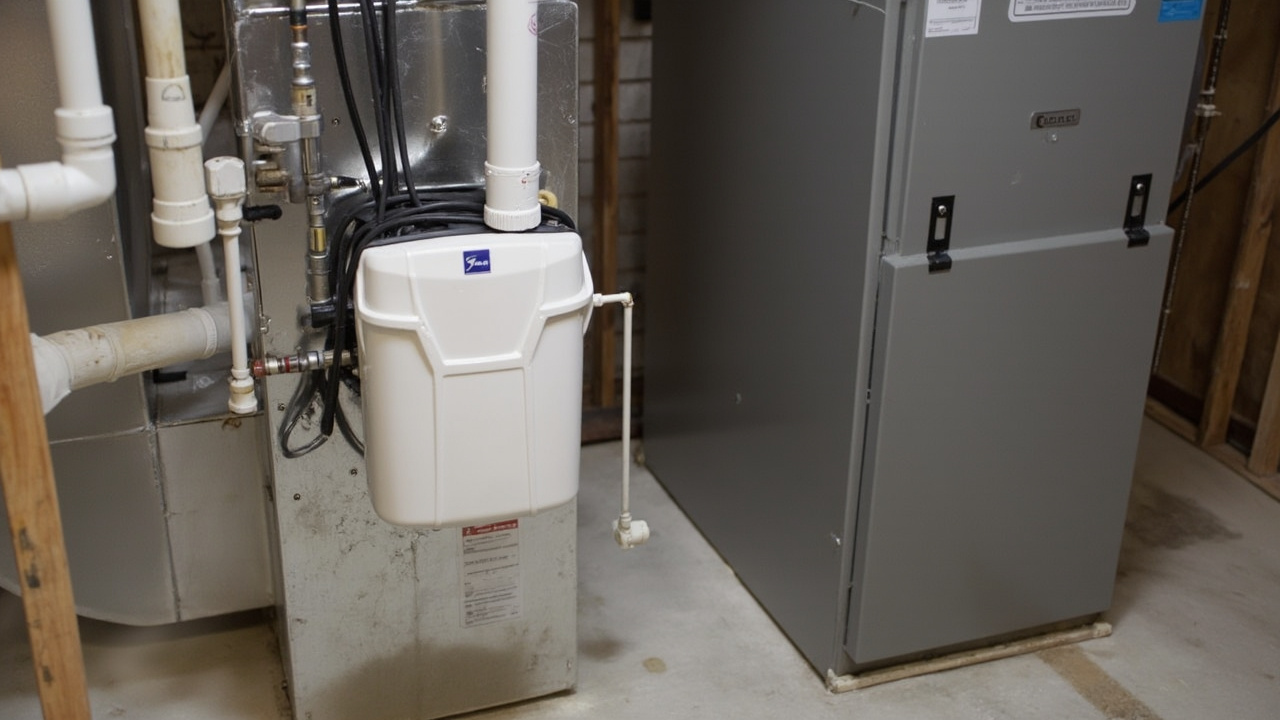
How a Whole House Humidifier Actually Works (And Where It Fails)
Most homes in the Detroit metro use a bypass or fan-powered flow-through humidifier mounted directly to the supply or return plenum of the furnace. A solenoid valve opens during heating cycles, allowing water to flow over an evaporator pad. Excess water drains through a condensate drain line to a floor drain or utility sink.
That system has four or five points where things go wrong. And in Southeast Michigan, where municipal water carries some of the highest calcium and magnesium concentrations in the Midwest, those failure points show up faster than the manufacturer expects.
The Detroit Hard Water Problem
Warren and the surrounding communities pull water from the Great Lakes Water Authority system. That water is safe to drink, but it is loaded with dissolved minerals. Every gallon that passes through your humidifier leaves a small deposit of calcium carbonate behind.
Over a single heating season, those deposits scale up the evaporator pad, clog the condensate drain line, and eventually prevent the solenoid valve from seating properly. When that valve cannot close fully, water runs continuously — even when the furnace is off. That is when a small maintenance issue becomes a water damage emergency.
5 Reasons Your Furnace Humidifier Is Leaking
- Clogged condensate drain line. Mineral scale and biofilm block the drain. Water backs up inside the humidifier housing and overflows onto the plenum, then drips down the furnace cabinet and onto the floor.
- Failed or stuck solenoid valve. The solenoid valve controls water flow into the humidifier. When the coil burns out or mineral scale prevents it from closing, water flows 24 hours a day. This is the most common cause of serious water damage from a humidifier.
- High water pressure. Most humidifiers are rated for 15 to 125 PSI of inlet pressure. Homes in parts of Warren near 8 Mile and Mound Road sometimes see pressure spikes above that threshold, which can blow the saddle valve fitting and send water pouring down the side of the furnace.
- Improperly seated evaporator pad. If the pad is installed wrong after a seasonal changeout, water bypasses the distribution tray and channels directly to the drain pan. When that pan is cracked or missing, the water goes straight to the floor.
- Cracked or disconnected supply tubing. The small plastic or copper line running from the saddle valve to the humidifier gets brittle over time, especially with freeze-thaw cycling in inadequately heated utility spaces. A hairline crack in that line drips constantly.
What to Do Right Now If You Suspect a Leak
Do not wait for your HVAC technician to schedule an appointment next week. If you see standing water or a fresh water stain near your furnace, take these steps immediately.
Step 1. Locate the saddle valve on the cold water supply line feeding the humidifier. Turn it clockwise until it stops. This cuts off the water source entirely.
Step 2. Switch the humidifier control (the humidistat) to the off position. On most Aprilaire and Honeywell units, this is a dial on the side of the humidifier cabinet or on the wall near the thermostat.
Step 3. Power down the furnace at the service switch or the breaker. You are not working on live electrical — you are just stopping the system so you can inspect without a heating cycle triggering more water flow.
Step 4. Mop up or dry any standing water on the floor immediately. Use old towels, a wet/dry vac, or both. The clock starts the moment water contacts your subfloor or drywall. Mold does not need much time to get started.
Step 5. Take photos of everything — the humidifier, the water, the staining on the floor or wall. If you file a homeowner’s insurance claim later, documentation from the first moments matters. For more guidance on navigating that process, read our article on how to get your Detroit home insurance to actually pay for water restoration.

The Hidden Damage You Cannot See From the Outside
A humidifier leak that has been running for even a few days creates damage that goes far beyond what is visible on the surface. This is where most homeowners underestimate the problem.
Water follows gravity and capillary action. It wicks into drywall paper and gypsum core. It seeps under vinyl flooring and into the OSB or plywood subfloor below. In a finished basement — common in Warren’s mid-century ranch-style homes — that water can travel laterally inside wall cavities and show up as a stain 10 feet from the actual leak source.
The EPA’s guidance on mold remediation confirms that mold spores can begin colonizing wet building materials in as little as 24 to 48 hours under the right temperature and humidity conditions. Your utility room — warm, poorly ventilated, and now wet — is exactly those conditions.
By the time you see black or green growth on the drywall, the mold has already established itself deep in the paper facing and likely in the cavity behind the wall. Wiping it down with bleach does not fix that. For a detailed explanation of why surface treatments fail, see our article on why bleach won’t fix your Ferndale basement mold.
Drywall, Subflooring, and Structural Risk
Standard 1/2-inch drywall becomes structurally compromised when its moisture content exceeds 1 percent by weight. You cannot judge this by touch. IICRC-certified restoration technicians use calibrated moisture meters and thermal imaging cameras to map the true extent of saturation — including into the subfloor, the bottom plate of the wall, and the concrete below.
If OSB subfloor stays wet for more than 48 to 72 hours, delamination begins. The board swells, the layers separate, and the floor becomes soft and springy underfoot. At that point, drying alone is not enough. The material needs to be removed and replaced.
| Material Affected | Time to Damage Threshold | Restoration Possibility |
|---|---|---|
| Drywall (paper-faced gypsum) | 24 to 48 hours | Dry if caught early, replace if mold present |
| OSB Subfloor | 48 to 72 hours | Dry if minimal swelling, replace if delaminated |
| Hardwood Flooring | 24 to 36 hours | Salvageable with rapid drying in many cases |
| Carpet and Pad | 24 to 48 hours | Pad almost always replaced, carpet case-by-case |
| Wall Insulation (fiberglass batt) | 24 to 48 hours | Usually replaced, difficult to dry in place |
| Wall Insulation (spray foam) | Not applicable | Resistant to moisture absorption |
DIY Repairs Versus Professional Restoration — Where the Line Is
Replacing a solenoid valve, swapping out an evaporator pad, or clearing a clogged condensate drain is reasonable DIY work if you are comfortable with basic plumbing. Parts for most Aprilaire, GeneralAire, and Honeywell humidifiers are available at HVAC supply houses throughout the Warren and Madison Heights area.
But the HVAC repair and the water damage remediation are two completely separate problems. Fixing the leak stops future damage. It does not address the water already in your walls and floor.
You need professional restoration when any of the following are true.
- The leak has been running for more than 24 hours and you can see staining on drywall or flooring.
- You can smell a musty or earthy odor near the furnace or in adjacent rooms.
- Moisture readings on the drywall surface exceed 16 percent by weight (standard restoration threshold).
- The leak has affected a finished space — a bedroom, a rec room, or a carpeted area adjacent to the utility space.
- You see visible mold growth of any size on any surface.
Professional structural drying uses commercial-grade desiccant dehumidifiers, high-velocity air movers, and psychrometric monitoring to dry building assemblies from the inside out. This is not equipment you rent from a hardware store. The airflow rates and dehumidification capacity are calibrated to the actual moisture load in the materials, tracked against psychrometric charts until the readings return to pre-loss baselines.
If your floors took a hit, read our guide on how to save your hardwood floors after a significant water leak — the same principles apply in Warren and throughout Metro Detroit. And if carpet was involved in adjacent rooms, the decision on whether to save or replace it is not always obvious. Our article on deciding whether your wet carpet in Sterling Heights can be saved or needs to go walks through the factors that determine salvageability.

Humidifier Leak Repair vs. Water Damage Restoration — Understanding the Cost Gap
Homeowners are often surprised by how much more the water damage side costs compared to the HVAC repair. The part that caused the problem is inexpensive. The damage it created is not.
| Repair or Restoration Item | Typical Scope | Cost Driver |
|---|---|---|
| Solenoid valve replacement | HVAC technician, 1 to 2 hours | Parts and labor only |
| Evaporator pad replacement | DIY or tech, under 1 hour | Minimal, seasonal maintenance item |
| Condensate drain clearing | DIY or plumber, 30 to 60 minutes | Low cost, high impact if neglected |
| Structural drying (small area) | 3 to 5 days of equipment, certified tech monitoring | Equipment rental rates, labor, monitoring visits |
| Drywall removal and replacement | Demo plus new board, tape, texture, and paint | Labor-intensive, scope expands if mold is found |
| Subfloor replacement | Full demo of finish floor plus OSB or plywood | Highest cost category, often insurance-eligible |
| Mold remediation | Containment, HEPA removal, treatment, clearance testing | Scope-dependent, requires IICRC-certified crew |
The pattern we see consistently across Oakland, Wayne, and Macomb County claims is this: homeowners who call within 24 hours of noticing a leak spend significantly less on restoration than those who wait a week hoping it dries on its own. Fast action almost always means smaller scope and a simpler insurance claim.
For a detailed guide on working with your insurer through this process, our article on filing a successful water damage insurance claim covers documentation, adjuster communication, and what to expect from the process.
Humidity Settings for Michigan Winters and Long-Term Prevention
Michigan winters create a specific challenge for whole house humidifiers. When outdoor temperatures drop below 10 degrees Fahrenheit — which happens regularly in Warren and the northern suburbs from December through February — indoor relative humidity targets need to drop as well.
Running your humidifier at 45 percent relative humidity when it is 0 degrees outside drives condensation into your exterior walls and attic sheathing. That condensation creates its own moisture damage problem, separate from a humidifier leak.
A good general rule for Southeast Michigan homes is to adjust your humidistat based on outdoor temperature.
- Outdoor temp above 20°F, target 35 to 40 percent indoor RH.
- Outdoor temp between 10°F and 20°F, target 30 to 35 percent indoor RH.
- Outdoor temp below 10°F, target 25 to 30 percent indoor RH.
- Outdoor temp below 0°F, target 20 to 25 percent indoor RH.
Replacing your evaporator pad at the start of each heating season and flushing the condensate drain with a diluted white vinegar solution every 60 days eliminates most of the conditions that cause leaks. If your home has particularly hard water, a whole-house water softener dramatically extends the life of your solenoid valve and pad.
Annual Maintenance Checklist Before Heating Season
Every fall before you fire up the furnace, run through these checks on your humidifier.
- Replace the evaporator pad. Do not try to clean and reuse old ones.
- Inspect the distribution tray for scale buildup and cracks.
- Check the solenoid valve by activating the humidistat and listening for a clean click and consistent water flow.
- Pour water through the condensate drain line and confirm it exits freely at the floor drain.
- Inspect all plastic supply tubing for brittleness or cracks, especially near joints and fittings.
- Test the saddle valve by closing and reopening it to confirm it shuts off cleanly.
- Set the humidistat to the appropriate level for your home’s insulation quality and your local outdoor forecast.
A 15-minute inspection at the start of the season prevents a significant portion of the calls we respond to throughout winter in Warren, Troy, and the communities along I-696.
When to Stop Troubleshooting and Call a Restoration Team
If you have stopped the leak, dried the surface water, and things still smell musty after 48 hours, the moisture is inside the building assembly. At that point, you have passed the boundary of what DIY can address.
IICRC-certified water damage restoration technicians carry the equipment and the training to perform accurate moisture mapping, contain affected areas, execute structural drying protocols, and document everything in a format that satisfies your insurance adjuster.
Waiting to see if it dries on its own is the most expensive decision you can make. Mold remediation after the fact costs far more than structural drying done promptly. Subfloor replacement costs far more than drying a subfloor that was caught in time.
If you are in Warren, Detroit, Roseville, or anywhere across Metro Detroit and you have found a humidifier leak — or any mystery water near your furnace — call a certified restoration team now. The longer you wait, the deeper the damage goes.
{
“@context”: “https://schema.org”,
“@type”: “BlogPosting”,
“headline”: “Why Your Whole House Humidifier in Warren Might Be Ruining Your Drywall”,
“description”: “A furnace humidifier leaking in Warren or Detroit can destroy drywall and grow mold fast. Learn the causes, DIY fixes, and when to call restoration pros.”,
“wordCount”: 2278,
“datePublished”: “2026-04-18T04:07:00.000Z”,
“dateModified”: “2026-04-18T04:07:00.000Z”,
“inLanguage”: “en-US”,
“mainEntityOfPage”: {
“@type”: “WebPage”,
“@id”: “https://ironwoodwaterdamagerestorationdetroit.com”
},
“publisher”: {
“@type”: “LocalBusiness”,
“name”: “Ironwood Water Damage Restoration Detroit”,
“url”: “https://ironwoodwaterdamagerestorationdetroit.com”
},
“author”: {
“@type”: “Organization”,
“name”: “Ironwood Water Damage Restoration Detroit”,
“url”: “https://ironwoodwaterdamagerestorationdetroit.com”
},
“image”: {
“@type”: “ImageObject”,
“url”: “https://ironwoodwaterdamagerestorationdetroit.com/wp-content/uploads/2026/03/why-your-whole-house-humidifier-in-warren-might-be-1.jpg”
}
}
{
“@context”: “https://schema.org”,
“@type”: “LocalBusiness”,
“name”: “Ironwood Water Damage Restoration Detroit”,
“url”: “https://ironwoodwaterdamagerestorationdetroit.com”,
“address”: {
“@type”: “PostalAddress”,
“addressLocality”: “Detroit”
},
“areaServed”: {
“@type”: “City”,
“name”: “Detroit”
}
}
{
“@context”: “https://schema.org”,
“@type”: “BreadcrumbList”,
“itemListElement”: [
{
“@type”: “ListItem”,
“position”: 1,
“name”: “Home”,
“item”: “https://ironwoodwaterdamagerestorationdetroit.com”
},
{
“@type”: “ListItem”,
“position”: 2,
“name”: “Blog”,
“item”: “https://ironwoodwaterdamagerestorationdetroit.com/blog”
},
{
“@type”: “ListItem”,
“position”: 3,
“name”: “Why Your Whole House Humidifier in Warren Might Be Ruining Your Drywall”
}
]
}
{
“@context”: “https://schema.org”,
“@type”: “Service”,
“serviceType”: “Water Damage Restoration”,
“provider”: {
“@type”: “LocalBusiness”,
“name”: “Ironwood Water Damage Restoration Detroit”,
“url”: “https://ironwoodwaterdamagerestorationdetroit.com”
},
“areaServed”: {
“@type”: “City”,
“name”: “Detroit”
},
“description”: “A furnace humidifier leaking in Warren or Detroit can destroy drywall and grow mold fast. Learn the causes, DIY fixes, and when to call restoration pros.”
}