
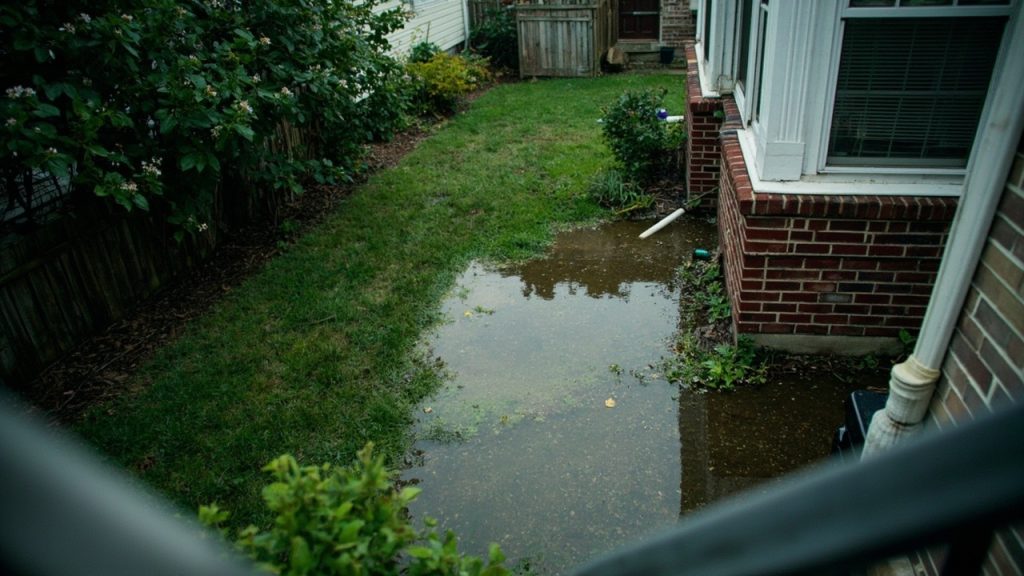
Your basement is wet again. You check the sump pump. You inspect the window wells. Everything looks fine on the inside, but water keeps finding a way in. The problem might be standing 10 feet away from your foundation, hiding in plain sight on your front or back lawn.
Yard grading is one of the most overlooked causes of chronic basement flooding in Redford and across metro Detroit. When the soil around your home slopes toward the foundation instead of away from it, every rain event and every spring thaw sends water straight to your basement wall. It does not matter how good your waterproofing is if the grade is working against you.
What Negative Grading Actually Does to Your Foundation
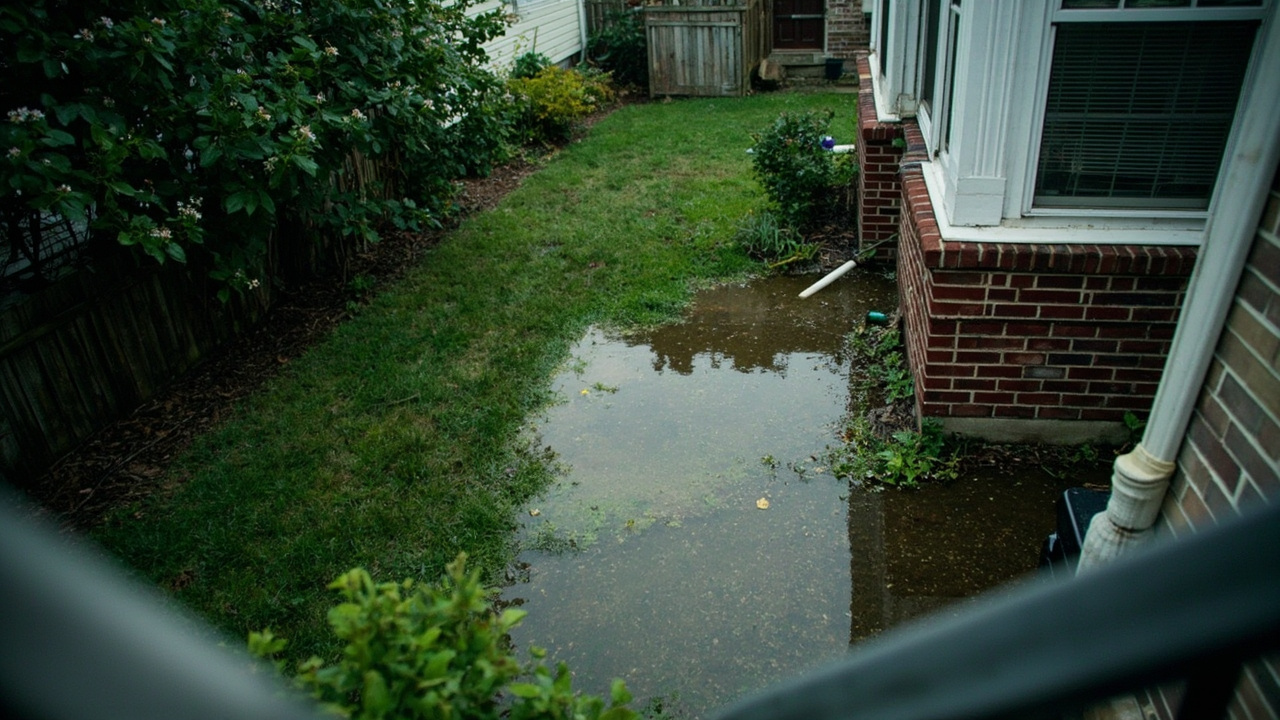
Grading refers to the slope of the soil around your home. Positive grading means the ground falls away from the foundation, directing water toward the yard and street. Negative grading means the opposite. The soil tilts toward your home, and water collects right where you do not want it.
The Federal Emergency Management Agency consistently identifies improper site drainage as a primary contributor to residential flood damage. In Southeast Michigan, this issue is amplified by soil composition and precipitation patterns that make even a minor grade problem a serious one.
When water pools against your foundation, it does not just sit there. It applies hydrostatic pressure against the wall. Hydrostatic pressure is the force water exerts as it saturates the surrounding soil and pushes against any surface containing it. Concrete block foundations, which are extremely common in Redford’s mid-century ranches and bungalows, are especially porous. Water under pressure finds every crack, every mortar joint, and every gap around a pipe penetration.
Over time, that pressure causes walls to bow, crack, and seep. The process is slow enough that most homeowners do not connect the wet basement to the lawn outside until the damage is already significant.
Why Detroit’s Clay Soil Makes Grading Problems Worse
Wayne County sits on a thick layer of glacial clay deposited over thousands of years. This clay soil is largely non-permeable, meaning it does not absorb water quickly. When an inch of rain falls on a clay-heavy lawn in Redford, most of that water runs off or sits on the surface rather than soaking in at a rate that relieves pressure.
Contractors who have worked Southeast Michigan for years often call this the bathtub effect. The clay acts like the walls of a tub. When the tub fills, the water has nowhere to go except the lowest point, which is frequently the area just outside your foundation where backfill soil has settled over the decades.
Here is why backfill settlement matters so much. When a home is built, the soil excavated for the foundation is piled up and then pushed back against the foundation walls once construction is complete. That backfilled soil is loose and disturbed. Over years, it compresses and settles, often forming a subtle bowl shape right next to the house. From the street, the grade can look perfectly flat. But that low ring around your foundation is silently collecting water every time it rains.
Homes built in the 1950s through the 1980s in neighborhoods like Redford Township, Livonia, and Dearborn Heights are especially vulnerable to this settling pattern. The foundations in these areas have had 40 to 70 years to sink, shift, and create drainage problems that did not exist when the house was new.
How Michigan’s Freeze-Thaw Cycles Accelerate the Damage
Detroit’s frost line sits at approximately 42 inches below grade. Every winter, the ground freezes and thaws repeatedly. Each freeze-thaw cycle causes the clay soil to expand and contract. This movement shifts grading over time, even on properties that had perfectly corrected slopes years ago.
Spring thaw is the highest-risk period for Redford homeowners. Snow melt combined with early spring rainfall hits soil that is still partially frozen and cannot absorb moisture. The result is rapid surface runoff, and if your grade is negative, that runoff goes directly to your foundation. Many homeowners who have never had a wet basement before will experience their first significant flooding event during a heavy March or April thaw.
If you have dealt with water damage from a frozen pipe burst in past winters, you already know how fast water can cause serious structural and mold issues. A grading-related flood can produce the same volume of water intrusion with far less drama but equally serious long-term consequences.

Signs Your Yard Grade Is Sending Water to Your Basement
Not every wet basement comes with an obvious source. Here is a checklist of grading-related warning signs that homeowners in Redford and greater Detroit should watch for.
- Spongy or consistently wet grass within 5 to 6 feet of your foundation walls, even days after rain
- Visible water staining or efflorescence (white mineral deposits) on the lower portions of your basement walls
- Puddles that form near the base of your home and take more than 24 hours to drain
- A musty odor in the basement that intensifies after rain events
- Downspout discharge landing directly against the foundation or less than 4 feet away
- Cracks in the foundation wall that appear damp or show rust staining from rebar corrosion
- Window well flooding, particularly on below-grade egress windows
- Water intrusion that appears at the base of the wall where it meets the floor (a classic sign of hydrostatic pressure from poor grading)
The last point is important. Water that enters at the wall-to-floor joint (called the cove joint) is almost always a hydrostatic pressure issue. Interior waterproofing can manage the symptom, but if you do not correct the exterior grade, the pressure never goes away.
The Standard for Correct Yard Slope Around a Foundation
The building industry standard for foundation drainage calls for a minimum drop of 6 inches over the first 10 horizontal feet away from the foundation. That works out to a 5 percent slope. This grade needs to be maintained for at least 10 feet before the lawn levels out.
| Grade Type | Slope Direction | Risk Level | Water Behavior |
|---|---|---|---|
| Positive Grade (5% or greater) | Away from foundation | Low | Directs runoff to yard and drainage systems |
| Flat Grade (0% to 1%) | No meaningful direction | Moderate | Water pools, slow infiltration, increases hydrostatic pressure over time |
| Negative Grade (slopes toward foundation) | Toward foundation | High | Concentrates water at foundation wall, continuous hydrostatic pressure |
| Severely Negative Grade (2%+ inward slope) | Strongly toward foundation | Very High | Rapid water accumulation, foundation saturation, high flood risk |
Corrective Grading Solutions That Actually Work in Detroit
Fixing negative grading does not always require a full landscape overhaul. The right solution depends on how severe the slope problem is and what other drainage features exist around your property.
Soil Regrading with Topsoil or Fill
For many Redford homes, the fix is straightforward. A landscaper or excavation contractor adds clean fill soil or clay-loam mix to build up the grade along the foundation, then slopes it outward. This work typically covers the first 6 to 10 feet of lawn around the perimeter. The new soil is compacted and either seeded or sodded.
One important note: avoid using pure topsoil directly against the foundation. Topsoil retains moisture. Use a compactable fill material for the base and finish with topsoil only at the surface layer.
French Drains and Perimeter Drainage
When the yard layout makes grading difficult (tight lots between homes are common in older Redford neighborhoods), a French drain can intercept water before it reaches the foundation. A French drain is a perforated pipe laid in a gravel-filled trench that captures subsurface water and routes it away from the structure to a daylight outlet, a drywell, or a municipal storm system.
French drain installation in Wayne County requires care around underground utilities, and some installations near the street or city sidewalk may require a permit. Always confirm local requirements before digging.
Swales
A swale is a shallow, gently sloped channel cut into the lawn to redirect surface runoff. In neighborhoods where homes sit close together, a well-designed swale between two houses can move significant amounts of water away from both foundations. Swales work best on lots with enough width to accommodate the gradual grade change without creating a drainage problem for an adjacent neighbor.
Downspout Extensions
Gutters and downspouts that discharge too close to the foundation dump thousands of gallons of water in exactly the wrong place during a heavy rain. Downspout extensions should direct water at least 6 feet from the foundation, and longer is better. Underground downspout drain lines that carry water to a pop-up emitter in the yard are a clean, permanent solution that works well in Redford’s residential lots.
| Solution | Best For | Complexity | Longevity |
|---|---|---|---|
| Soil Regrading | Settled backfill, general negative grade | Low to Moderate | 10 to 20 years with proper maintenance |
| French Drain | High water table, persistently saturated soil | Moderate to High | 20 to 30 years with periodic flushing |
| Yard Swale | Surface runoff between structures | Low | Long-term with vegetation maintenance |
| Downspout Extensions | Concentrated roof drainage near foundation | Very Low | 5 to 10 years for above-ground, 20+ for underground |
| Window Well Covers and Drainage | Below-grade windows collecting water | Low | Indefinite with covers in good condition |

What Happens When the Grading Has Already Caused a Flood
Fixing the grade stops future flooding. It does not fix what already happened. If your basement has taken on water due to a grading issue, the restoration process involves several steps that go beyond mopping up the visible water.
Water Extraction and Structural Drying
Professional water extraction removes standing water using truck-mounted or portable extraction units. But the greater concern is the moisture absorbed into the concrete, block walls, wood framing, and any insulation. Structural drying using industrial-grade desiccant or refrigerant dehumidifiers and high-velocity air movers is what actually returns the structure to dry standard, which is measured using moisture meters against baseline readings.
The IICRC S500 Standard for Professional Water Damage Restoration defines the protocols for structural drying, moisture documentation, and category classification of water damage. Category 1 water (clean source) and Category 3 water (sewage or floodwater) are treated very differently, and the restoration process must reflect those differences.
Water from yard flooding is typically Category 2 or Category 3, depending on how much soil contact it had before entry. This matters because Category 3 water requires removal of contaminated porous materials, including carpet, drywall, and certain types of insulation.
Mold Prevention After Grading-Related Flooding
Mold growth can begin within 24 to 48 hours of water intrusion in a basement environment. Detroit’s humid summers make this window even shorter. If you have had recurring water intrusion due to grading issues over months or years, you may already have mold growth behind finished walls or beneath flooring that is not visible from the surface.
For homeowners in Royal Oak, Grosse Pointe, or Redford dealing with mold after repeated basement flooding, the process of identifying and treating hidden mold requires moisture mapping and sometimes removal of finished materials to inspect the cavity. You can learn more about what that process involves for Detroit-area homes in this guide on safely removing mold from your Royal Oak home.
Assessing Foundation Damage After Chronic Water Exposure
Long-term hydrostatic pressure on concrete block walls causes more than moisture intrusion. Efflorescence is an early indicator. Horizontal cracking in block walls is a more serious structural warning sign that hydrostatic pressure has compromised the wall’s integrity. These cracks typically appear at the mid-point of the wall where bending stress is highest.
If you have horizontal cracks in your basement wall, a structural engineer should evaluate them before you invest in any waterproofing or grading corrections. Grading alone will not fix a wall that has already deflected.
Basement Flooding in Redford vs. Other Metro Detroit Communities
Redford Township sits northwest of Detroit proper, sandwiched between the Rouge River watershed and the drainage basin that feeds into the Lower Rouge. The flat topography of the area means water has very little natural slope to follow. This makes proper grading even more critical here than in communities with natural terrain variation.
Compare that to areas like Grosse Pointe, where older homes often have brick or stone foundations that are highly susceptible to water intrusion, or Dearborn, where high density and older storm infrastructure mean drainage systems are often overwhelmed during heavy events. The professional flooded basement cleanup process in Dearborn follows similar steps to Redford, but the root causes often differ neighborhood to neighborhood.
In Redford specifically, the combination of clay-heavy soil, flat topography, and aging mid-century construction means that grading failures are more common and more consequential than in communities with naturally sloped terrain or newer construction standards.
When Grading Fixes Alone Are Not Enough
Sometimes the exterior grade is fine but water still gets in. When that happens, the investigation needs to go deeper. A perimeter drain tile system that has collapsed or clogged over decades is a common culprit in Redford homes. Interior drain tile systems, sump pump failures, and window well drainage failures are all possibilities worth evaluating.
If you have dealt with a sewage backup that mixed with basement flooding, the cleanup protocols are significantly more involved. The approach to sewage backup cleanup in Detroit requires different containment and remediation steps than standard water damage, and the two issues can easily co-occur during a heavy storm event when the municipal system backs up.
For homeowners in Grosse Pointe dealing with flooding from multiple sources, the flooded basement cleanup process in Grosse Pointe covers what a complete professional response looks like from extraction through final drying and documentation.
The Cost Comparison That Changes How Homeowners Think About Prevention
Regrading the perimeter of a typical Redford ranch home costs a fraction of what a single significant basement flood event costs to remediate. A grading correction is a landscaping and excavation project. A basement flood involves water extraction, structural drying equipment running for days, potential mold remediation, drywall removal and replacement, floor covering removal, and content damage.
Preventative grading does not eliminate all flood risk. Detroit’s storm sewer system gets overwhelmed during extreme precipitation events, and there are limits to what any grading correction can handle. But it removes the single most preventable contributor to chronic basement water intrusion in the metro area.
If your basement has taken on water and you are not sure whether your yard grade is contributing to the problem, a professional inspection can identify the source. A water damage restoration contractor with experience in the Redford and greater Detroit area will look at both the interior and exterior conditions before recommending a course of action.
Do not let the grade of your lawn quietly work against your foundation for another season. A visual inspection after the next heavy rain, combined with a simple string-line grade check along your foundation, can confirm whether the slope is working for you or against you. If you need professional eyes on the problem, contact a restoration and drainage specialist familiar with Wayne County soil conditions and the specific construction types common to your neighborhood.
{
“@context”: “https://schema.org”,
“@type”: “BlogPosting”,
“headline”: “Why the Grading of Your Yard in Redford Could Be Flooding Your Basement”,
“description”: “Is your Redford yard slope sending water toward your foundation? Learn how negative grading causes basement flooding and what Detroit homeowners can do about it.”,
“wordCount”: 2506,
“datePublished”: “2026-03-30T04:46:00.000Z”,
“dateModified”: “2026-03-30T04:46:00.000Z”,
“inLanguage”: “en-US”,
“mainEntityOfPage”: {
“@type”: “WebPage”,
“@id”: “https://ironwoodwaterdamagerestorationdetroit.com”
},
“publisher”: {
“@type”: “LocalBusiness”,
“name”: “Ironwood Water Damage Restoration Detroit”,
“url”: “https://ironwoodwaterdamagerestorationdetroit.com”
},
“author”: {
“@type”: “Organization”,
“name”: “Ironwood Water Damage Restoration Detroit”,
“url”: “https://ironwoodwaterdamagerestorationdetroit.com”
},
“image”: {
“@type”: “ImageObject”,
“url”: “https://ironwoodwaterdamagerestorationdetroit.com/wp-content/uploads/2026/03/why-the-grading-of-your-yard-in-redford-could-be-f-1.jpg”
}
}
{
“@context”: “https://schema.org”,
“@type”: “LocalBusiness”,
“name”: “Ironwood Water Damage Restoration Detroit”,
“url”: “https://ironwoodwaterdamagerestorationdetroit.com”,
“address”: {
“@type”: “PostalAddress”,
“addressLocality”: “Detroit”
},
“areaServed”: {
“@type”: “City”,
“name”: “Detroit”
}
}
{
“@context”: “https://schema.org”,
“@type”: “BreadcrumbList”,
“itemListElement”: [
{
“@type”: “ListItem”,
“position”: 1,
“name”: “Home”,
“item”: “https://ironwoodwaterdamagerestorationdetroit.com”
},
{
“@type”: “ListItem”,
“position”: 2,
“name”: “Blog”,
“item”: “https://ironwoodwaterdamagerestorationdetroit.com/blog”
},
{
“@type”: “ListItem”,
“position”: 3,
“name”: “Why the Grading of Your Yard in Redford Could Be Flooding Your Basement”
}
]
}
{
“@context”: “https://schema.org”,
“@type”: “Service”,
“serviceType”: “Water Damage Restoration”,
“provider”: {
“@type”: “LocalBusiness”,
“name”: “Ironwood Water Damage Restoration Detroit”,
“url”: “https://ironwoodwaterdamagerestorationdetroit.com”
},
“areaServed”: {
“@type”: “City”,
“name”: “Detroit”
},
“description”: “Is your Redford yard slope sending water toward your foundation? Learn how negative grading causes basement flooding and what Detroit homeowners can do about it.”
}