
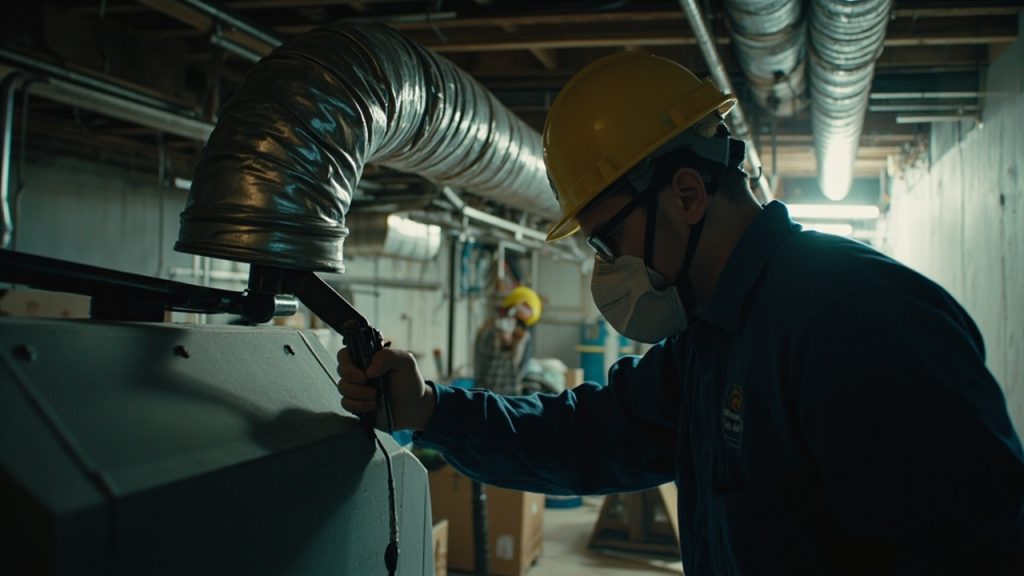
Detroit homeowners dealing with mold often ask the same question: can they run a store-bought air purifier during cleanup and call it done? The short answer is no. The equipment gap between a consumer air purifier and a professional air scrubber is wide, and understanding that gap could protect your family from serious health consequences.
This is especially true in Detroit. The city’s position near the Great Lakes, its aging housing stock in neighborhoods like Corktown, Midtown, and West Village, and its humid summers create ideal conditions for mold growth. Relative humidity in metro Detroit regularly climbs above the 60% threshold where mold colonies establish and spread.
Why Mold Remediation Demands More Than Standard Air Filtration
Standard air purifiers are built for maintenance. They remove everyday particulates, allergens, and odors from a stable indoor environment. Mold remediation is a different category entirely. When you disturb a mold colony during demolition or cleaning, you release millions of airborne fungal spores and Microbial Volatile Organic Compounds (mVOCs) all at once.
A consumer HEPA purifier runs at low airflow speeds designed for quiet operation. It is not engineered to handle the sudden, concentrated surge of contaminants that remediation work generates. It also lacks the negative pressure capability to prevent those spores from migrating into clean areas of your home.
This is why the IICRC S520 Standard for Professional Mold Remediation mandates specific equipment and containment protocols. That standard exists because spore migration during improper cleanup is one of the primary causes of recurring mold problems and cross-contamination.
The Real Science Behind Air Scrubbers and HEPA Filtration
An air scrubber is not just a bigger air purifier. It is an industrial-grade negative air machine designed to do three distinct jobs simultaneously. It filters the air, exhausts contaminated air outside the work zone, and maintains negative pressure within the containment area.
Understanding how it works starts with micron filtration. Mold spores range from 1 to 30 microns in diameter. HEPA filters, which stands for High-Efficiency Particulate Air, capture 99.97% of particles at 0.3 microns. That means they trap virtually every spore size encountered during remediation, plus the fine debris from building materials disturbed during work.
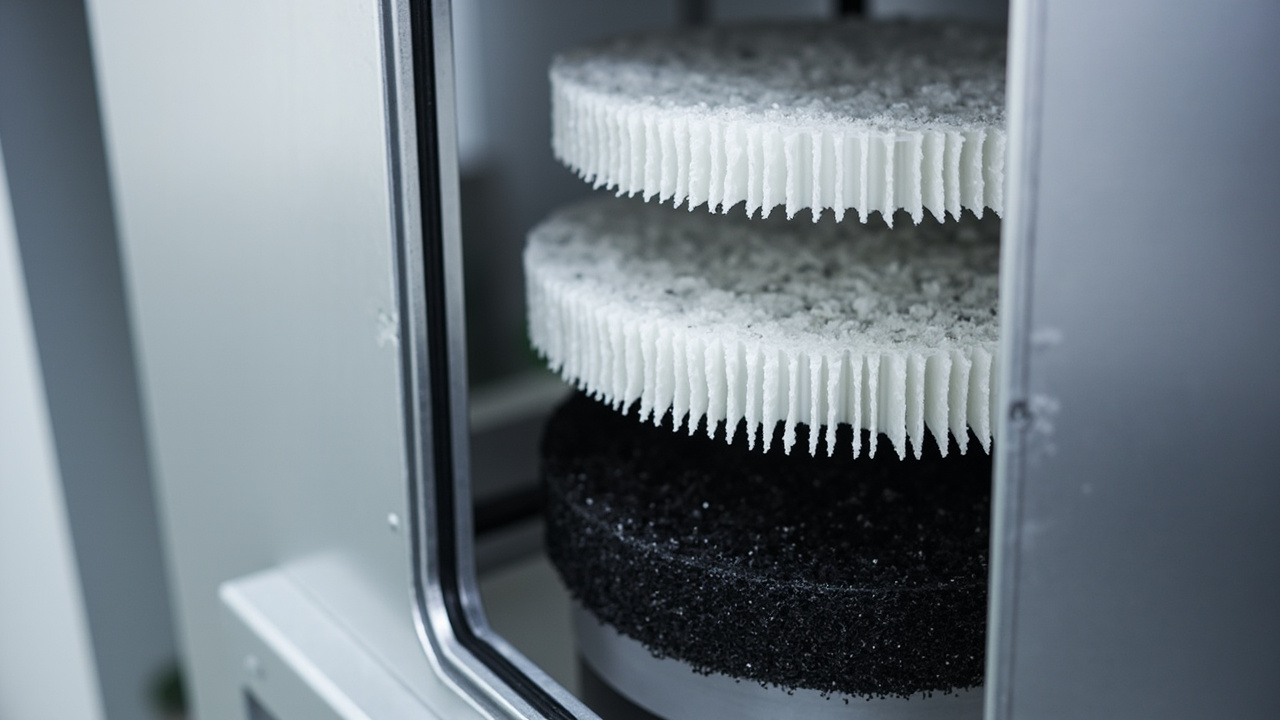
Professional air scrubbers use a three-stage filtration system that consumer purifiers do not replicate.
- Pre-filter stage captures large particles like drywall dust, insulation fibers, and visible debris, protecting the downstream filters from clogging prematurely.
- HEPA filter stage captures mold spores, bacteria, and fine particulates at 99.97% efficiency down to 0.3 microns.
- Activated carbon filter stage adsorbs mVOCs, the gaseous byproducts of active mold growth that cause the musty odor and can irritate respiratory systems.
That carbon stage is critical. Stachybotrys chartarum, commonly called black mold, produces particularly potent mVOCs. A purifier without a robust carbon layer simply cannot address that chemical component.
Negative Air Pressure and Why It Prevents Cross-Contamination
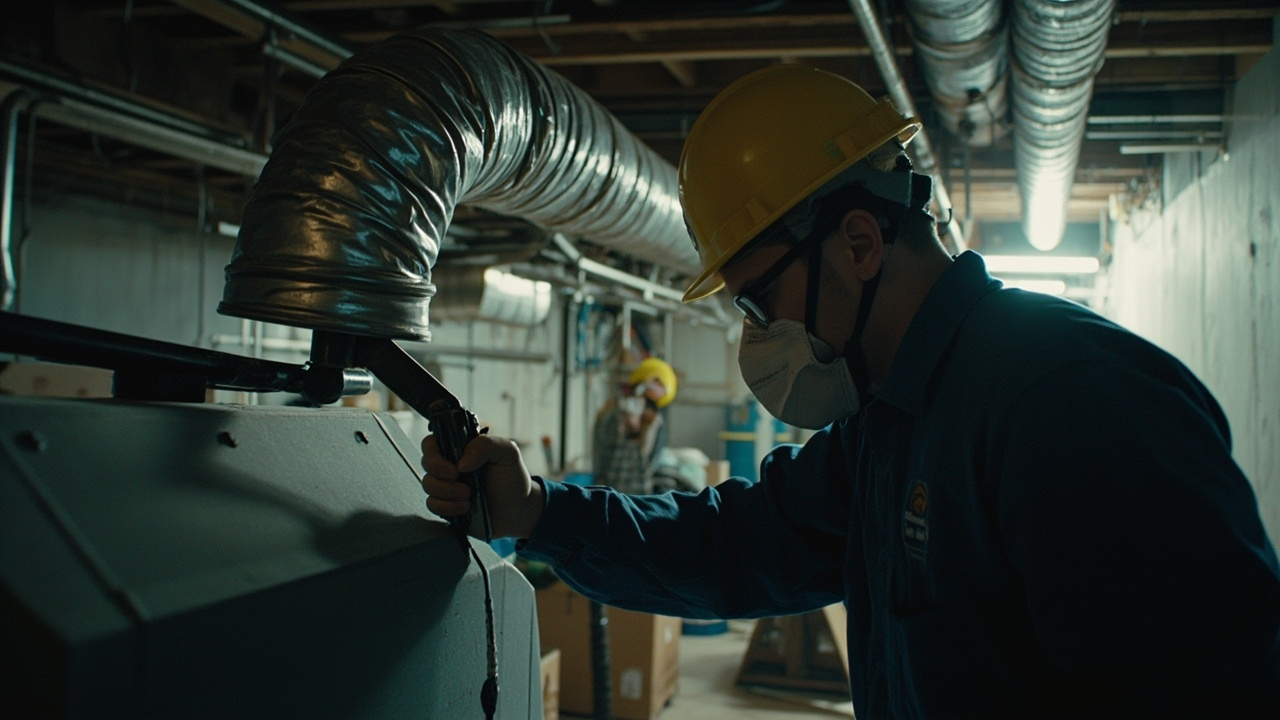
Negative air pressure is the feature that separates professional remediation from DIY attempts. When a technician sets up containment in a basement or bathroom, the air scrubber exhausts air to the outside through ductwork routed out a window or exterior opening. This creates a pressure differential: the contained work zone runs at slightly lower air pressure than surrounding rooms.
Because air flows from high pressure to low pressure, any air leakage through the containment barrier moves inward toward the work zone, not outward into your living space. Spores cannot drift from the contaminated area into your kitchen or bedrooms during active work.
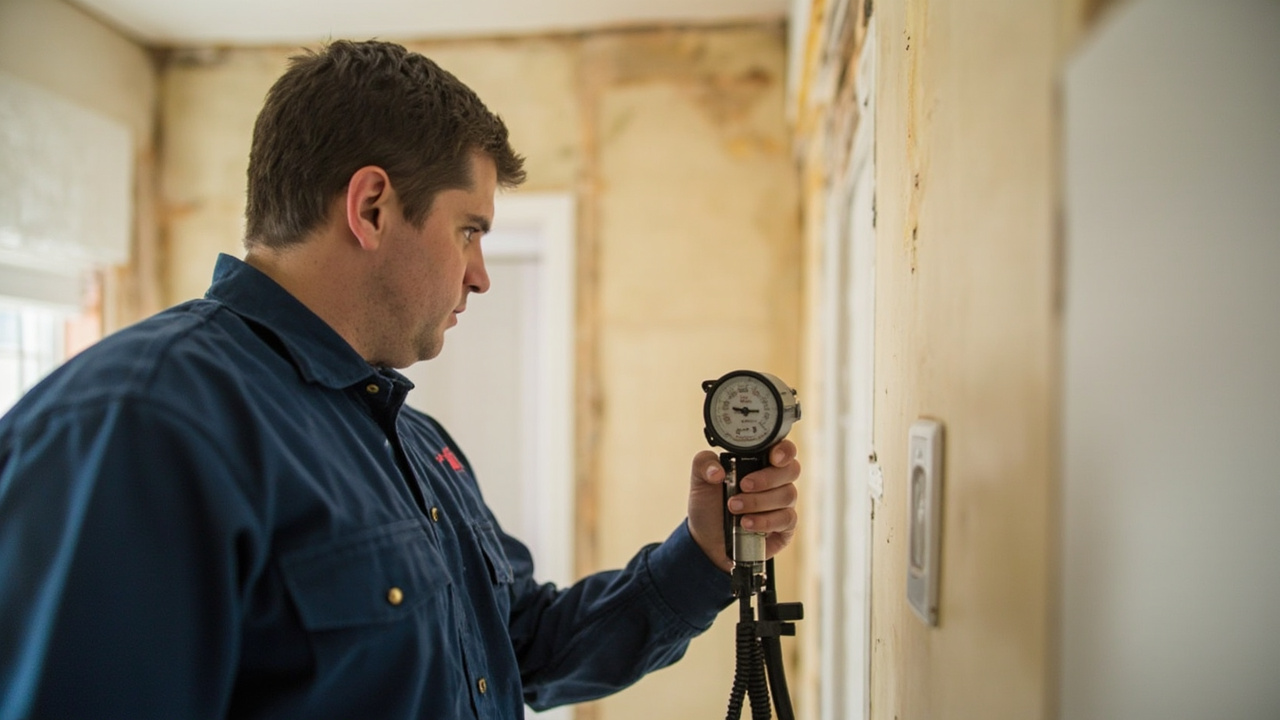
Technicians verify this pressure differential using a manometer, a pressure gauge that reads the difference between the contained zone and adjacent spaces. Without a measurable negative pressure reading, the containment is not performing correctly.
For a Detroit home with an open floor plan, or one of the many connected bungalows common in neighborhoods like Bagley or Grandmont-Rosedale, this containment step is non-negotiable. Those floor plans allow air to move freely between spaces, and an inadequate setup can spread a localized mold problem throughout an entire floor.
Air Scrubbers vs Standard Purifiers Side by Side
The table below breaks down the key technical differences between what professional remediation crews deploy versus what you can buy at a home improvement store.
| Feature | Professional Air Scrubber | Consumer Air Purifier |
|---|---|---|
| Filtration Stages | Pre-filter, HEPA, Carbon (3 stages) | Typically HEPA only or HEPA plus basic carbon |
| HEPA Efficiency | 99.97% at 0.3 microns | Varies, some units use “HEPA-type” filters at lower efficiency |
| Airflow Capacity (CFM) | 500 to 2,000 CFM depending on unit | 50 to 400 CFM typical |
| Negative Air Capability | Yes, with exhaust ducting to exterior | No |
| Air Changes Per Hour (ACH) | 4 to 6 ACH for remediation zone | 1 to 2 ACH at typical room size |
| mVOC Adsorption | Activated carbon stage rated for remediation loads | Light carbon layer rated for household odors only |
| Manometer Monitoring | Technician-monitored pressure differential | Not applicable |
| IICRC S520 Compliance | Yes, when properly deployed | No |
The CADR (Clean Air Delivery Rate) metric is useful here too. CADR measures how much filtered air a unit delivers per minute. Professional air scrubbers used in remediation achieve CADR values that allow for 4 to 6 complete air changes per hour within the contained work zone. That rate is the minimum recommended under the IICRC S520 standard during active mold disturbance. Most consumer purifiers achieve 1 to 2 air changes per hour in a comparably sized room under ideal conditions, which drops further as filters load.
Equipment Brands That Actually Get Used in the Field
When you see a professional remediation crew in Detroit, you will likely see equipment from Dri-Eaz or Phoenix Restoration Equipment. Both brands manufacture air scrubbers that meet commercial remediation standards. Dri-Eaz units like the F284 are common on Detroit job sites because of their reliability and stackable ducting design for tight basement setups.
Phoenix machines, particularly their Guardian series, are built with the HEPA-plus-carbon configuration appropriate for jobs involving Stachybotrys or elevated mVOC readings. These units are not available in hardware stores. They are commercial tools that require trained operators who understand when to replace filters, how to configure ducting, and how to confirm pressure readings with a manometer.
What the Remediation Process Looks Like in a Detroit Home
A properly executed mold remediation project in a Detroit-area home follows a sequence that integrates air scrubbing at every phase. If you have dealt with a flooded basement leading to mold growth, the process connects directly to the initial water event. You can see how the early water response ties into mold risk in our guide on flooded basement cleanup in Grosse Pointe.
The typical sequence on a residential project runs as follows. First, technicians establish containment barriers using 6-mil poly sheeting sealed with spray adhesive, isolating the work zone from the rest of the home. Air scrubbers are set up and ducted to the exterior before any demolition begins. The manometer confirms negative pressure before work starts.
During active demolition, which involves removing contaminated drywall, insulation, or framing, the air scrubber runs continuously. Filters are checked and swapped as needed based on pressure drop readings across the filter bank. After demolition, the contained area is HEPA-vacuumed and wiped with EPA-registered antimicrobial solutions.
Post-remediation clearance testing by an independent industrial hygienist confirms spore counts are within acceptable ranges before containment comes down. The air scrubber continues running through final wipe-down and for a period after containment removal to address any residual particulates.
Detroit homes with connected ductwork present an additional challenge. Forced-air systems can carry spores from a contaminated basement through the entire house if the HVAC system runs during remediation. Professionals seal supply and return registers in the work zone as a standard step. For homes in Dearborn or Detroit proper where mechanical systems often run through unconditioned crawl spaces, this step requires extra attention. Our article on professional cleanup for flooded basements in Dearborn covers related structural considerations in that area.
Detroit Climate Factors That Drive Mold Risk Higher
Detroit’s proximity to Lake St. Clair and Lake Erie means summer humidity regularly exceeds 60%, which is the threshold where mold colonies can establish on most organic building materials. Basements in older Detroit neighborhoods experience ground moisture intrusion even in dry seasons due to the region’s clay-heavy soil, which holds water against foundation walls.
Freeze-thaw cycles during Michigan winters create repeated stress on masonry foundations, opening micro-cracks that allow moisture infiltration throughout the heating season. By the time a homeowner notices visible mold in a Corktown greystoner or a brick colonial in Palmer Woods, the colony has typically been active for weeks or months in areas not visible during routine inspection.
Sewage backup events, which are unfortunately common in Detroit’s older combined sewer systems, introduce Category 3 water contaminated with biological material. That moisture category accelerates mold growth and introduces additional pathogens into building materials. If you have dealt with a sewage event, understanding the contamination levels matters for your remediation scope. Our resource on sewage backup cleanup in Detroit covers the immediate response steps.
Frozen pipe failures during Detroit’s extreme cold snaps introduce large volumes of water quickly into wall cavities and subfloor assemblies. Those materials saturate before anyone realizes the extent of the damage, and mold follows within 24 to 72 hours under warm interior conditions. See our breakdown of what happens after a frozen pipe bursts for the full picture of how these events create mold conditions.
Michigan Standards and Local Compliance for Mold Remediation
Michigan does not currently have a mandatory state licensing program specifically for mold remediators, though that regulatory landscape continues to shift. What does carry weight in Detroit is adherence to the IICRC S520 standard, which is the industry benchmark recognized by insurance carriers, industrial hygienists, and property managers throughout the metro area.
The Detroit Department of Appeals and Specialized Property Maintenance handles code enforcement for residential properties. While their jurisdiction focuses on structural and habitability issues, properties with documented mold conditions can become subjects of blight or habitability complaints. Professional documentation of remediation work, including air monitoring results and post-clearance testing, creates a verifiable record that protects homeowners during property transactions or insurance claims.
For mold-related work in Royal Oak and surrounding Oakland County communities, local building departments may require permits for remediation work that involves structural material removal. Our article on mold removal in Royal Oak addresses those jurisdiction-specific considerations.
Equipment Capability Compared to Room Size
Sizing air scrubbers correctly for the containment zone is a calculation that depends on room volume and required ACH. The table below shows how different containment scenarios map to equipment requirements based on IICRC S520 guidance.
| Containment Zone Size | Room Volume (cubic feet) | Required CFM for 6 ACH | Typical Equipment Configuration |
|---|---|---|---|
| Small bathroom | 400 to 600 cu ft | 40 to 60 CFM | Single 500 CFM unit at partial speed |
| Average bedroom | 800 to 1,200 cu ft | 80 to 120 CFM | Single 500 CFM unit |
| Detroit basement (standard footprint) | 3,000 to 5,000 cu ft | 300 to 500 CFM | Single 1,000 to 2,000 CFM unit |
| Large open basement or crawl space | 5,000 to 8,000 cu ft | 500 to 800 CFM | Two 1,000 CFM units in series |
| Commercial or multi-room remediation | 8,000 cu ft and above | 800 CFM and above | Multiple units with manifolded exhaust ducting |
Undersizing the air scrubber for the containment volume is a common mistake in DIY attempts and with inexperienced crews. Running a unit that achieves only 2 ACH in a large contaminated basement means spores remain airborne far longer between filtration cycles, increasing technician exposure and containment failure risk.
Questions Detroit Homeowners Actually Ask About Air Scrubbing
Can you run a HEPA purifier during remediation to supplement the air scrubber?
You can run additional filtration units in areas outside the containment zone as a precaution, but they do not replace the air scrubber inside the work area. The goal inside containment is negative pressure and high ACH. Consumer units do not contribute to either requirement.
How long does the air scrubber need to run after the physical remediation work is done?
Most protocols call for continued air scrubber operation for a minimum of several hours after completion of physical work before clearance testing. Some industrial hygienists recommend 24 hours of continuous operation post-remediation before sampling for post-clearance verification. This flushes residual airborne particulates from the contained space.
Will a rented air scrubber from a hardware store work?
Some equipment rental centers offer machines marketed as air scrubbers. Verify the filter configuration before renting. If the unit lacks a true HEPA stage and a carbon stage, it is not adequate for mold remediation. Many rental units are dust collectors, not true three-stage remediation air scrubbers. The difference matters, and the IICRC S520 standard is specific about what qualifies.
Does the air scrubber address odor as well as spores?
The activated carbon stage handles mVOCs, which are the source of the musty smell associated with active mold growth. However, carbon filters have finite adsorption capacity. On large jobs or projects involving significant Stachybotrys growth, carbon filters may require mid-job replacement. A technician who tracks filter loading metrics will know when that swap is necessary.
If you are seeing or smelling signs of mold in your Detroit area home, the equipment deployed during cleanup matters as much as the physical removal work. A proper air scrubber setup under IICRC S520 guidelines is not an upgrade, it is the baseline for safe, effective mold remediation. Contact a certified remediation professional before starting any work that disturbs visible mold growth.
{
“@context”: “https://schema.org”,
“@type”: “BlogPosting”,
“headline”: “Air Scrubbers vs Standard Purifiers During a Mold Cleanup (What Detroit Homeowners Need to Know)”,
“description”: “Learn why professional air scrubbers outperform standard purifiers during mold remediation in Detroit homes. IICRC S520 standards explained.”,
“wordCount”: 2234,
“datePublished”: “2026-03-15T10:59:00.000Z”,
“dateModified”: “2026-03-15T10:59:00.000Z”,
“inLanguage”: “en-US”,
“mainEntityOfPage”: {
“@type”: “WebPage”,
“@id”: “https://ironwoodwaterdamagerestorationdetroit.com”
},
“publisher”: {
“@type”: “LocalBusiness”,
“name”: “Ironwood Water Damage Restoration Detroit”,
“url”: “https://ironwoodwaterdamagerestorationdetroit.com”
},
“author”: {
“@type”: “Organization”,
“name”: “Ironwood Water Damage Restoration Detroit”,
“url”: “https://ironwoodwaterdamagerestorationdetroit.com”
},
“image”: {
“@type”: “ImageObject”,
“url”: “https://ironwoodwaterdamagerestorationdetroit.com/wp-content/uploads/2026/03/comparing-air-scrubbers-and-standard-purifiers-dur-1.jpg”
}
}
{
“@context”: “https://schema.org”,
“@type”: “LocalBusiness”,
“name”: “Ironwood Water Damage Restoration Detroit”,
“url”: “https://ironwoodwaterdamagerestorationdetroit.com”,
“address”: {
“@type”: “PostalAddress”,
“addressLocality”: “Detroit”
},
“areaServed”: {
“@type”: “City”,
“name”: “Detroit”
}
}
{
“@context”: “https://schema.org”,
“@type”: “FAQPage”,
“mainEntity”: [
{
“@type”: “Question”,
“name”: “Can you run a HEPA purifier during remediation to supplement the air scrubber?”,
“acceptedAnswer”: {
“@type”: “Answer”,
“text”: “You can run additional filtration units in areas outside the containment zone as a precaution, but they do not replace the air scrubber inside the work area. The goal inside containment is negative pressure and high ACH. Consumer units do not contribute to either requirement.”
}
},
{
“@type”: “Question”,
“name”: “How long does the air scrubber need to run after the physical remediation work is done?”,
“acceptedAnswer”: {
“@type”: “Answer”,
“text”: “Most protocols call for continued air scrubber operation for a minimum of several hours after completion of physical work before clearance testing. Some industrial hygienists recommend 24 hours of continuous operation post-remediation before sampling for post-clearance verification. This flushes residual airborne particulates from the contained space.”
}
},
{
“@type”: “Question”,
“name”: “Will a rented air scrubber from a hardware store work?”,
“acceptedAnswer”: {
“@type”: “Answer”,
“text”: “Some equipment rental centers offer machines marketed as air scrubbers. Verify the filter configuration before renting. If the unit lacks a true HEPA stage and a carbon stage, it is not adequate for mold remediation. Many rental units are dust collectors, not true three-stage remediation air scrubbers. The difference matters, and the IICRC S520 standard is specific about what qualifies.”
}
},
{
“@type”: “Question”,
“name”: “Does the air scrubber address odor as well as spores?”,
“acceptedAnswer”: {
“@type”: “Answer”,
“text”: “The activated carbon stage handles mVOCs, which are the source of the musty smell associated with active mold growth. However, carbon filters have finite adsorption capacity. On large jobs or projects involving significant Stachybotrys growth, carbon filters may require mid-job replacement. A technician who tracks filter loading metrics will know when that swap is necessary.”
}
}
]
}
{
“@context”: “https://schema.org”,
“@type”: “BreadcrumbList”,
“itemListElement”: [
{
“@type”: “ListItem”,
“position”: 1,
“name”: “Home”,
“item”: “https://ironwoodwaterdamagerestorationdetroit.com”
},
{
“@type”: “ListItem”,
“position”: 2,
“name”: “Blog”,
“item”: “https://ironwoodwaterdamagerestorationdetroit.com/blog”
},
{
“@type”: “ListItem”,
“position”: 3,
“name”: “Air Scrubbers vs Standard Purifiers During a Mold Cleanup (What Detroit Homeowners Need to Know)”
}
]
}
{
“@context”: “https://schema.org”,
“@type”: “Service”,
“serviceType”: “Water Damage Restoration”,
“provider”: {
“@type”: “LocalBusiness”,
“name”: “Ironwood Water Damage Restoration Detroit”,
“url”: “https://ironwoodwaterdamagerestorationdetroit.com”
},
“areaServed”: {
“@type”: “City”,
“name”: “Detroit”
},
“description”: “Learn why professional air scrubbers outperform standard purifiers during mold remediation in Detroit homes. IICRC S520 standards explained.”
}