
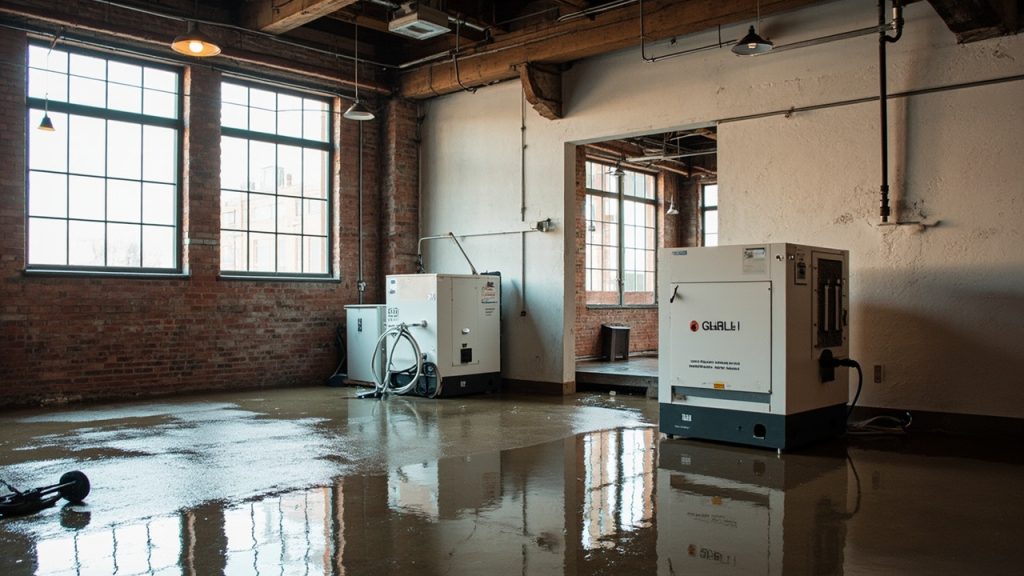
Comparing Refrigerant and Desiccant Dehumidifiers for Commercial Drying in Downtown Detroit
When water damage hits a commercial property in Detroit, the equipment you deploy makes the difference between a 3-day dry-out and a 3-week mold remediation job. Comparing refrigerant and desiccant dehumidifiers for commercial drying in Downtown Detroit is not an academic exercise. Property managers, facility directors, and restoration contractors all face the same question fast: refrigerant or desiccant?
The answer is not always obvious. Detroit’s climate swings hard, from brutal January pipe bursts to humid August basement floods in neighborhoods like Midtown, Corktown, and Eastern Market. Each scenario demands a different dehumidification strategy rooted in the science of psychrometry.
This guide breaks down both technologies using real performance data, IICRC S500 standards, and field experience across Wayne, Oakland, and Macomb counties.
Why Professional Dehumidification Is Not Optional in Commercial Drying
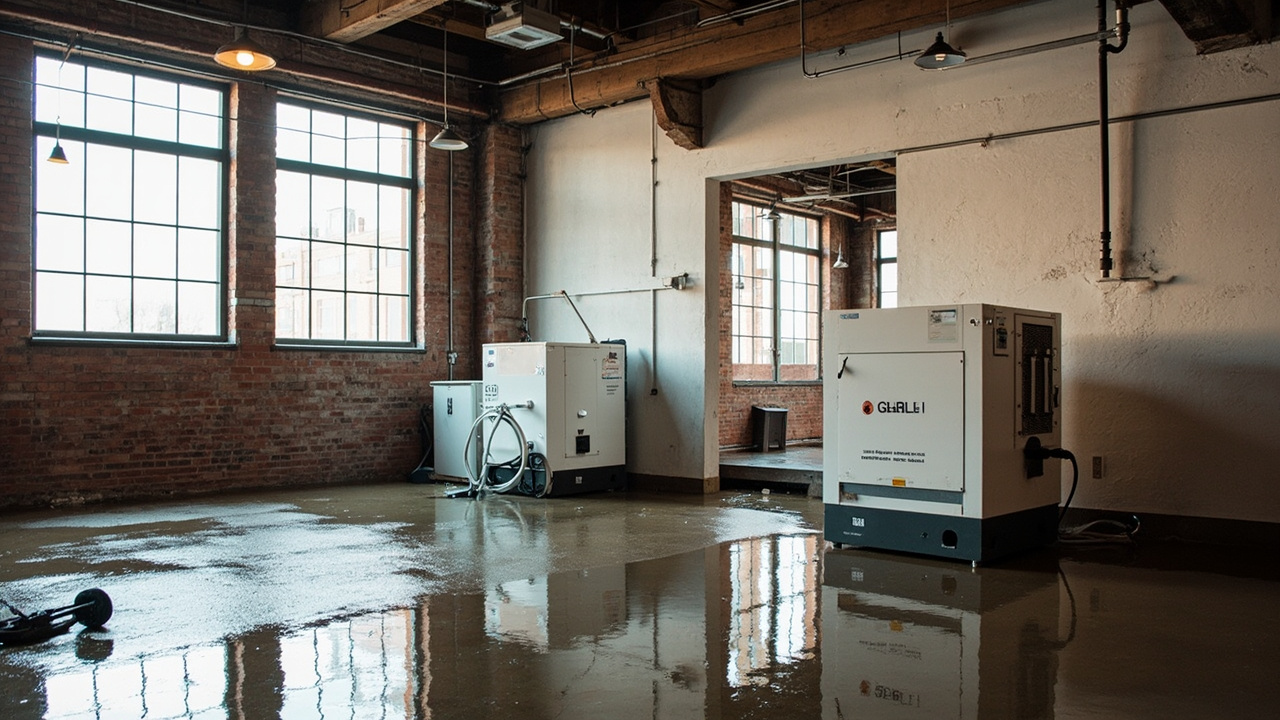
Consumer-grade units from a hardware store pull moisture at 30 to 70 pints per day under ideal lab conditions. Real-world performance in a flooded Detroit warehouse or a soaked Greektown restaurant kitchen drops well below that. They are not built for continuous operation, high water loads, or the structural drying targets set by the IICRC (Institute of Inspection Cleaning and Restoration Certification).
Professional structural drying targets a specific goal: reducing Grains Per Pound (GPP) in the air to a level where building materials release moisture faster than the environment reabsorbs it. That threshold, defined under IICRC S500 guidelines, requires equipment that can maintain consistent vapor pressure differentials across walls, subfloors, and ceiling assemblies.
Commercial units operate at 150 to 800+ pints per day. They run 24 hours straight. They are built for Category 2 and Category 3 water events. That is a fundamentally different tool for a fundamentally different job.
The Two Main Commercial Dehumidifier Technologies
Refrigerant Dehumidifiers and How They Work
Refrigerant dehumidifiers pull humid air across a cold coil. Moisture condenses on the coil and drains away. The dry air is then reheated slightly and returned to the space. The process is efficient when ambient temperatures stay above 60°F and relative humidity (RH) is high.
Conventional refrigerant units excel during the initial phase of a water loss, when RH levels are 80% or higher. They move a lot of water fast at a lower operating cost per pint removed compared to desiccant units in warm conditions.
Low Grain Refrigerant (LGR) dehumidifiers are the upgraded version of this technology. LGR units pre-cool incoming air using a heat exchanger before it reaches the main evaporator coil. This allows them to pull air down to much lower GPP levels than conventional refrigerant units. Most LGR machines can achieve final GPP readings in the 20 to 40 range, which meets the deep drying targets required before a floor rebuild or drywall reinstallation.
LGR units are the industry standard for most commercial water losses in Detroit’s spring and summer months, when ambient temperatures support efficient refrigerant cycle operation.
Desiccant Dehumidifiers and When They Win
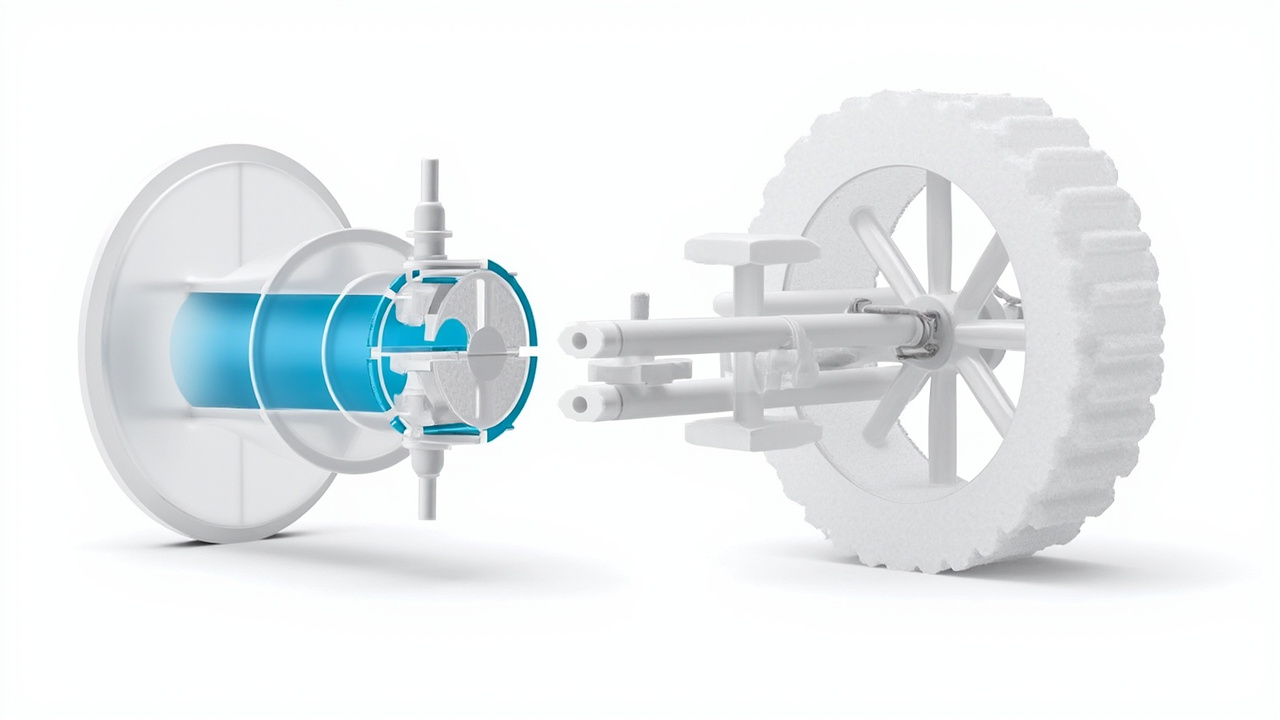
Desiccant units work on a completely different principle. Instead of a cold coil, they use a rotating wheel coated with silica gel or lithium chloride. As humid air passes through the wheel, the desiccant material absorbs moisture chemically. A separate heated reactivation airstream drives the collected moisture out of the wheel and exhausts it outside the building.
The critical advantage is temperature independence. Desiccant units perform at or near full capacity at temperatures below freezing. A refrigerant unit loses significant efficiency below 50°F and can ice up below 40°F. A desiccant unit does not care. If you are drying a parking structure in February after a burst sprinkler line in Detroit’s New Center district, a desiccant machine is the right tool.
Desiccant units also reach lower final GPP readings than even LGR refrigerant units. They can drive GPP into single digits, which matters for specialty applications like drying historic masonry buildings in Corktown or hardwood floor assemblies in a Midtown loft space where tight final dryness standards apply.
LGR vs Desiccant Performance at Detroit Seasonal Temperatures
This table reflects real-world operational data across commercial drying deployments. The performance gaps become significant as temperatures drop below 60°F, which happens roughly 6 months of the year in the Detroit metro area.
| Ambient Temperature | LGR Refrigerant Efficiency | Desiccant Efficiency | Recommended Unit |
|---|---|---|---|
| Above 70°F | Full capacity, optimal | Full capacity but higher energy cost | LGR Refrigerant |
| 60°F to 70°F | Near full capacity | Full capacity | LGR Refrigerant preferred |
| 45°F to 60°F | Reduced 20% to 40% | Full capacity maintained | Desiccant |
| 32°F to 45°F | Severely limited, icing risk | Full capacity maintained | Desiccant |
| Below 32°F | Non-functional | Operational with heating assist | Desiccant only |
The core decision rule for Downtown Detroit jobs: If the ambient temperature in the affected space is above 60°F, start with LGR refrigerant dehumidification. If it is below 60°F, deploy desiccant units. This single threshold eliminates the most common equipment selection mistakes on commercial losses in this market.
AHAM Ratings and Real-World PPD Comparisons
The Association of Home Appliance Manufacturers (AHAM) sets standardized test conditions for dehumidifier ratings. AHAM testing runs at 80°F and 60% RH. This matters because a unit rated at 200 pints per day (PPD) under AHAM conditions may only deliver 120 to 140 PPD in a 55°F basement in March.
When evaluating equipment for a commercial property in Detroit, ask for the manufacturer’s derating curve, not just the AHAM PPD number.
| Equipment Class | AHAM PPD Rating | Real-World PPD at 55°F | Typical CFM Airflow | Best Application |
|---|---|---|---|---|
| Conventional Refrigerant | 100 to 150 PPD | 50 to 70 PPD | 200 to 350 CFM | Initial water removal, warm conditions |
| LGR Refrigerant | 150 to 250 PPD | 90 to 150 PPD | 300 to 500 CFM | Deep drying, spring and summer |
| Commercial Desiccant | 100 to 400 PPD | 95 to 380 PPD | 400 to 800 CFM | Winter drying, specialty materials, low GPP targets |
| Industrial Desiccant | 400 to 1,000+ PPD | 380 to 950 PPD | 800 to 2,500 CFM | Large commercial, cold storage, below-grade structures |
CFM (Cubic Feet per Minute) airflow matters as much as PPD rating. Moving dry air across wet surfaces accelerates evaporation. A high PPD unit with low CFM will not dry a large open floor plate efficiently. Proper equipment placement and air movement calculations are part of any IICRC S500-compliant drying plan.
Detroit-Specific Drying Challenges That Change Your Equipment Decision
Detroit presents a combination of climate and infrastructure variables that directly affect how dehumidification equipment performs on the job.
Winter Frozen Pipe Events
Burst frozen pipes are among the most common commercial water losses in Detroit from December through March. The ambient temperatures in an affected space, especially in unheated parking structures, mechanical rooms, or older brick buildings near the Detroit River waterfront, can be at or below 40°F when crews arrive.
Deploying LGR refrigerant units in these conditions wastes time and money. The coil ices over, the unit goes into defrost cycles, and effective moisture removal drops to near zero. Desiccant units, often paired with temporary heating equipment to support the reactivation process, are the correct choice. If you have dealt with a frozen pipe situation, our resource on fixing the mess after a frozen pipe bursts in your Detroit home covers what the mitigation process actually looks like from start to finish.
Detroit Basement Flooding and Below-Grade Drying
Detroit’s older commercial building stock, particularly the 1920s to 1950s era structures throughout downtown, Midtown, and New Center, feature deep basements with fieldstone or poured concrete foundations. These materials are hygroscopic, meaning they hold and release moisture slowly.
After a flooding event, the concrete and masonry walls continue releasing moisture into the space long after standing water is removed. LGR units handle this well in warmer months. In cooler seasons, desiccant units are needed to maintain the vapor pressure differential required to pull moisture out of those assemblies at a meaningful rate.
For residential contexts across the metro area, the process of professional flooded basement cleanup in Dearborn follows the same psychrometric principles as commercial drying, just at a different scale.
High Summer Humidity Along the Detroit River Corridor
Detroit’s proximity to the Detroit River and Lake St. Clair means summer outdoor relative humidity regularly sits above 75%. When a water loss occurs in July or August in a building near Rivertown or the Renaissance Center area, the outdoor air you bring in for ventilation is already loaded with moisture.
In these conditions, you close the structure, rely on LGR dehumidification, and run air movement equipment strategically. Ventilating with outdoor air in high summer humidity will work against the drying goal entirely. This is a mistake commonly made when building maintenance staff attempt to manage a loss without restoration expertise.
Mold Risk in Detroit’s Older Building Stock
The combination of aged HVAC systems, brick and wood-framed construction, and inconsistent climate control in Detroit’s older commercial buildings creates a tight window between water loss and mold colonization. The EPA’s guidelines on mold and health note that mold growth can begin within 24 to 48 hours of a water event on organic materials. In Detroit buildings with wood framing, plaster walls, and cellulose insulation, that window is the real timeline.
Getting dehumidification equipment on site within the first few hours of a loss is not a sales pitch. It is the only way to keep a water damage job from becoming a mold remediation job. For properties where mold has already taken hold, see our breakdown of how to remove mold safely in the Detroit area.
How to Size Dehumidification Equipment for a Commercial Drying Project
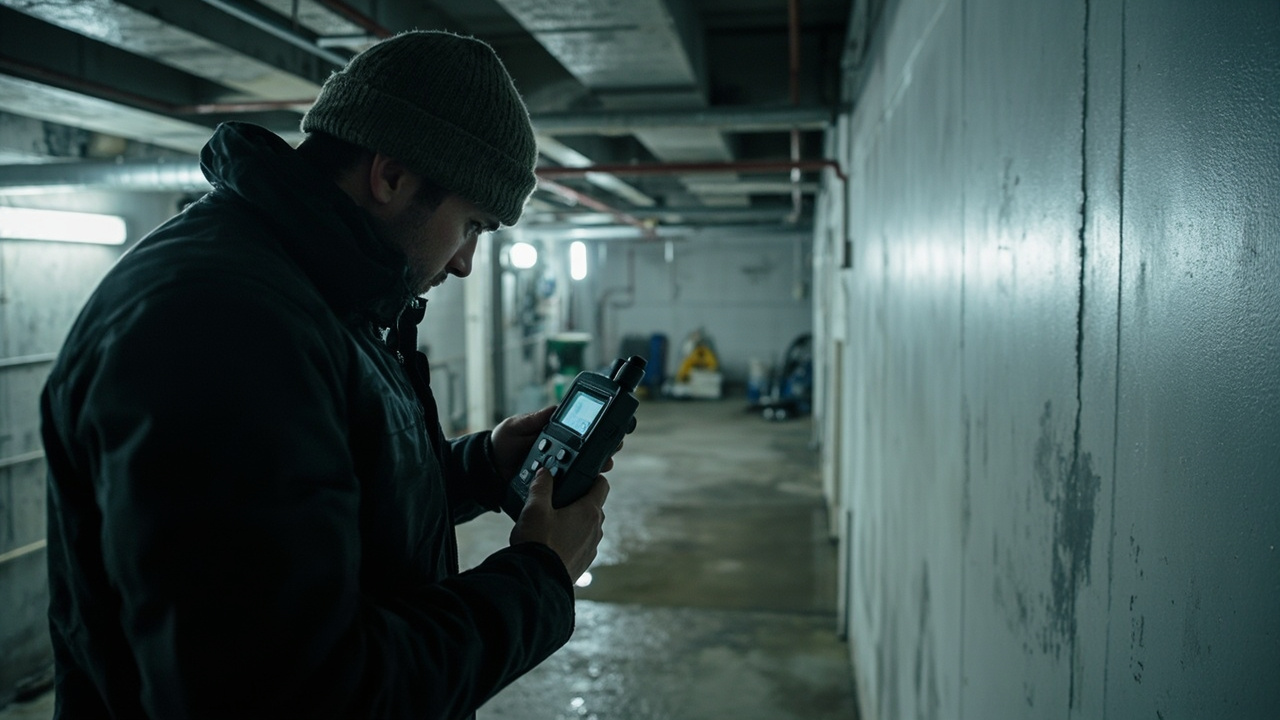
Proper sizing follows a structured calculation process. Using undersized equipment extends drying time, increases mold risk, and raises the total cost of the job. Using oversized equipment on a small loss wastes mobilization cost without proportional benefit.
The basic calculation framework for a IICRC S500-compliant drying plan considers these variables:
- Total square footage of affected area
- Ceiling height and total cubic volume
- Category and class of water damage (Class 1 through Class 4)
- Ambient temperature at time of equipment placement
- Type of materials affected (concrete slab, wood framing, gypsum board, masonry)
- Current GPP readings from psychrometric measurements
- Target GPP required for clearance under the drying standard
As a field reference, a Class 2 loss affecting a 5,000 square foot open floor plate commercial space at 65°F typically requires 3 to 5 LGR units with matching air mover support to achieve drying within a standard 3 to 5 day window. Drop that ambient temperature to 45°F, and you swap to desiccant units and likely extend the timeline.
Choosing the Right Equipment for Your Detroit Commercial Property
The decision framework is straightforward once you know the variables.
If the loss occurred in a heated commercial space above 65°F, with high initial RH, and you are targeting standard structural drying clearance, LGR refrigerant dehumidification is your primary tool. It is cost-efficient per pint removed, widely available from Detroit-area restoration contractors, and proven across thousands of commercial drying jobs in this market.
If the loss involves cold ambient temperatures, large masonry assemblies, specialty flooring materials like engineered hardwood, or a target GPP below 30, add desiccant capacity to the equipment plan. Some larger commercial losses require both technologies running simultaneously, with LGR units handling the bulk moisture load early and desiccants finishing the job to final clearance GPP targets.
For sewage-related water events, which add Category 3 contamination to the equation, equipment selection is secondary to proper containment and material removal. A flooded parking garage in the Rivertown district with a sewage backup requires different protocols entirely. Our overview of sewage backup cleanup in Detroit explains that process in detail.
For Grosse Pointe commercial and mixed-use properties dealing with basement flooding, the timeline for equipment placement is critical given the higher-end finish materials typical in that area. See our resource on flooded basement cleanup in Grosse Pointe for a detailed look at what fast response means for those properties.
What to Ask Your Restoration Contractor Before Equipment Is Placed
Property managers and facility directors in Detroit should ask these questions before a restoration crew places a single unit on a commercial loss:
- What is the current ambient temperature and GPP reading in the affected space?
- Are you using LGR, conventional refrigerant, or desiccant units, and why for this specific loss?
- What is the target GPP for structural drying clearance on this property type?
- How are you tracking drying progress (daily psychrometric logs)?
- What is the estimated drying time based on Class and Category of loss?
Any contractor who cannot answer these questions with specific numbers is not running an IICRC S500-compliant drying program. That matters because insurance carriers and adjusters increasingly require documentation that drying was performed to standard, and because shortcutting the drying phase is the primary cause of post-loss mold claims in Detroit’s commercial building market.
If you manage a commercial property anywhere in the Detroit metro, from the historic warehouse districts near Eastern Market to the office corridors in Southfield or the hospitality properties along the waterfront, the right conversation to have after a water loss starts with the science, not the invoice. Get the equipment selection right from the first hour and everything downstream gets easier and cheaper.
Reach out to our team for a direct equipment assessment and psychrometric drying plan for your property. We carry both LGR and desiccant inventory and deploy based on what the data requires, not what is sitting on the truck.
{
“@context”: “https://schema.org”,
“@type”: “BlogPosting”,
“headline”: “Comparing Refrigerant and Desiccant Dehumidifiers for Commercial Drying in Downtown Detroit”,
“description”: “Comparing refrigerant and desiccant dehumidifiers for commercial drying in Downtown Detroit? This guide covers equipment selection by temperature, season, and loss type.”,
“wordCount”: 2225,
“datePublished”: “2026-03-26T12:51:00.000Z”,
“dateModified”: “2026-03-26T12:51:00.000Z”,
“inLanguage”: “en-US”,
“mainEntityOfPage”: {
“@type”: “WebPage”,
“@id”: “https://ironwoodwaterdamagerestorationdetroit.com”
},
“publisher”: {
“@type”: “LocalBusiness”,
“name”: “Ironwood Water Damage Restoration Detroit”,
“url”: “https://ironwoodwaterdamagerestorationdetroit.com”
},
“author”: {
“@type”: “Organization”,
“name”: “Ironwood Water Damage Restoration Detroit”,
“url”: “https://ironwoodwaterdamagerestorationdetroit.com”
},
“image”: {
“@type”: “ImageObject”,
“url”: “https://ironwoodwaterdamagerestorationdetroit.com/wp-content/uploads/2026/03/comparing-refrigerant-and-desiccant-dehumidifiers-1.jpg”
}
}
{
“@context”: “https://schema.org”,
“@type”: “LocalBusiness”,
“name”: “Ironwood Water Damage Restoration Detroit”,
“url”: “https://ironwoodwaterdamagerestorationdetroit.com”,
“address”: {
“@type”: “PostalAddress”,
“addressLocality”: “Detroit”
},
“areaServed”: {
“@type”: “City”,
“name”: “Detroit”
}
}
{
“@context”: “https://schema.org”,
“@type”: “BreadcrumbList”,
“itemListElement”: [
{
“@type”: “ListItem”,
“position”: 1,
“name”: “Home”,
“item”: “https://ironwoodwaterdamagerestorationdetroit.com”
},
{
“@type”: “ListItem”,
“position”: 2,
“name”: “Blog”,
“item”: “https://ironwoodwaterdamagerestorationdetroit.com/blog”
},
{
“@type”: “ListItem”,
“position”: 3,
“name”: “Comparing Refrigerant and Desiccant Dehumidifiers for Commercial Drying in Downtown Detroit”
}
]
}
{
“@context”: “https://schema.org”,
“@type”: “Service”,
“serviceType”: “Water Damage Restoration”,
“provider”: {
“@type”: “LocalBusiness”,
“name”: “Ironwood Water Damage Restoration Detroit”,
“url”: “https://ironwoodwaterdamagerestorationdetroit.com”
},
“areaServed”: {
“@type”: “City”,
“name”: “Detroit”
},
“description”: “Comparing refrigerant and desiccant dehumidifiers for commercial drying in Downtown Detroit? This guide covers equipment selection by temperature, season, and loss type.”
}