
Your Cabinets Are Wet Right Now. Here Is What to Do First.
A slow drip under the kitchen sink is one of the most deceptive water damage problems a homeowner faces. By the time you notice the puddle, the cabinet floor has been absorbing moisture for days, maybe weeks. If you are dealing with this right now in Grosse Pointe Woods, the next few hours matter more than you think.
Stop the water source first. Turn off the supply valves under the sink. If you cannot find the valves, shut off the main water supply to the house. Then open the cabinet doors wide to start air circulation and pull out everything stored inside.
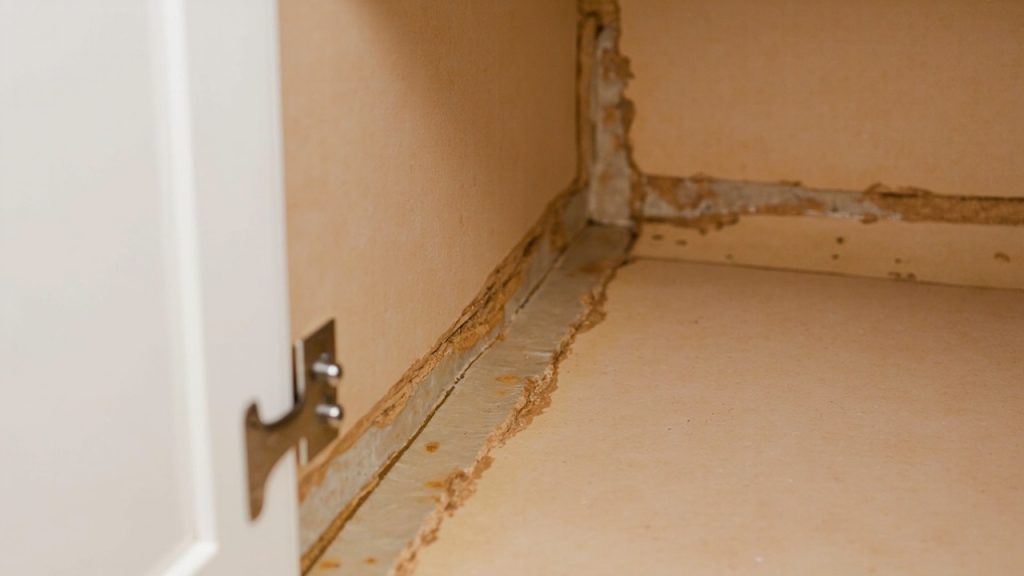
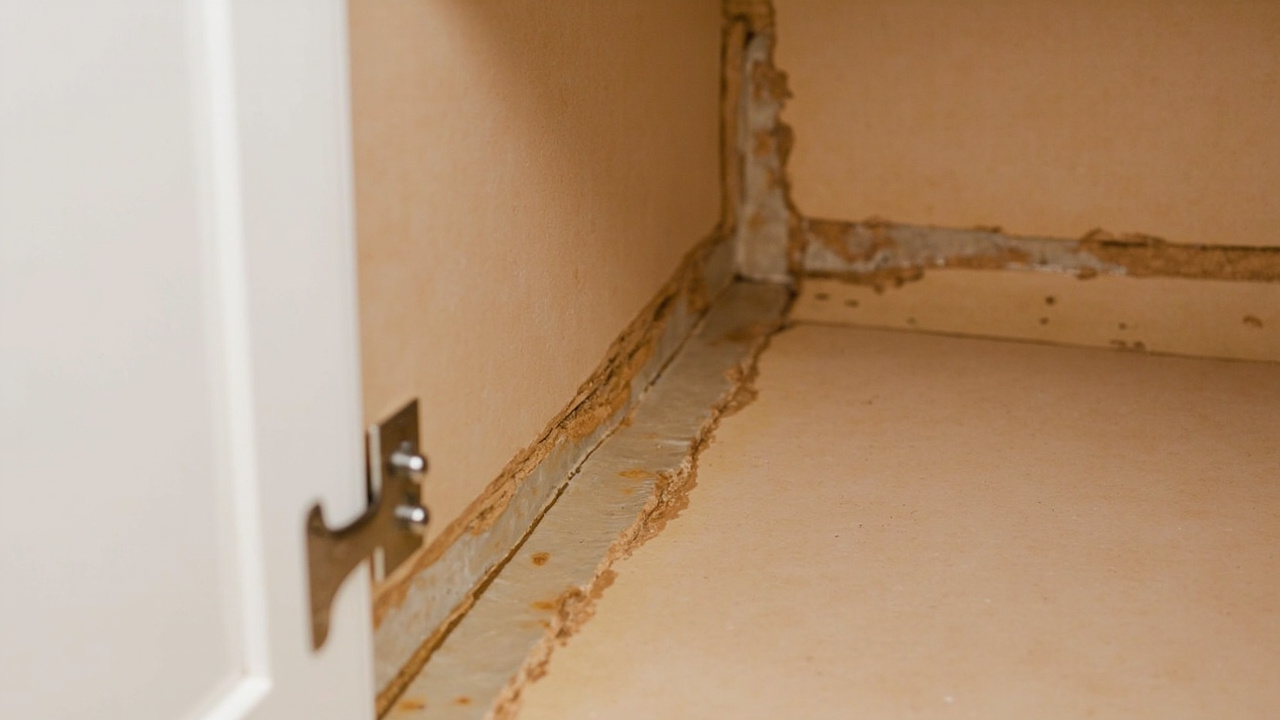
Do not wait to see if it dries on its own. Cabinet substrates like MDF (Medium Density Fiberboard) and plywood begin swelling and delaminating within 24 to 48 hours of sustained moisture exposure. Mold spores can colonize wet wood surfaces in as little as 72 hours, especially during Michigan’s humid summer months.
Why Grosse Pointe Woods Kitchens Face Specific Water Damage Risks
Homes in Grosse Pointe Woods, many of them built between the postwar era and the mid-century period, carry some specific plumbing characteristics that create recurring cabinet damage problems. Supply lines to older kitchen faucets often use braided steel or copper fittings that fatigue over time. The freeze-thaw cycles Southeast Michigan experiences every winter stress pipe joints and compression fittings under sinks in exterior or poorly insulated wall cavities.
Dishwasher drain line failures are another common culprit. Many Grosse Pointe Woods homes have dishwashers tucked directly beside the kitchen sink cabinet, and a loose drain hose clamp can push water into the base cabinet for an entire wash cycle before anyone notices. The same goes for refrigerator water line connections if your fridge sits near the kitchen perimeter.
The Great Lakes climate also means average indoor humidity in Metro Detroit kitchens runs higher than in dryer climates. That baseline humidity level means water-damaged cabinets dry out more slowly and carry a greater mold risk than comparable damage would in, say, a home in a low-humidity region. This is not a minor detail. It changes how aggressively you need to respond.
Assess the Damage Before You Touch Anything Else
What Cabinet Material Do You Have?
The single biggest factor in whether your cabinets can be saved or need replacement is the substrate material. Here is a clear breakdown of how water affects each type differently.
| Cabinet Material | Water Resistance | What Happens When Wet | Typical Outcome After Leak |
|---|---|---|---|
| MDF (Medium Density Fiberboard) | Very Low | Swells rapidly, surface bubbles, loses structural integrity | Replacement usually required if wet more than 24 hours |
| Particleboard | Very Low | Crumbles, warps, delamination of veneer face | Replacement almost always required |
| Plywood | Moderate | Can delaminate between plies if prolonged exposure | Often salvageable with professional drying if caught early |
| Solid Wood (Oak, Maple, Cherry) | Moderate to High | Warping, swelling of joints, finish damage | Frequently salvageable, refinishing may be needed |
| Thermofoil over MDF | Very Low | Thermofoil lifts and peels from substrate | Replacement usually required |
Run your hand along the interior base of the cabinet. If the wood feels soft, spongy, or the surface layer is lifting, you are dealing with significant substrate damage. If the wood still feels firm with minor surface moisture, professional drying equipment may save it.
Check Beyond the Cabinet Box
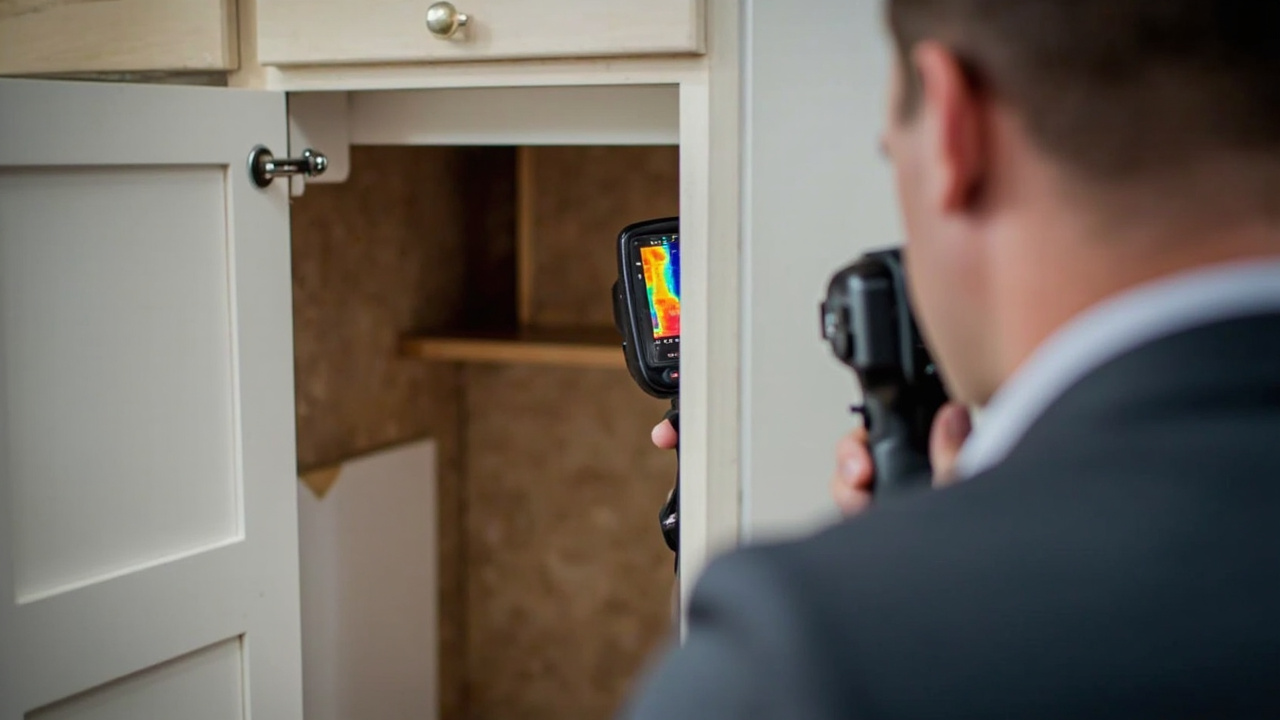
Cabinet damage from a sink leak rarely stays contained to the cabinet itself. Water follows gravity and finds the path of least resistance. A professional restoration technician uses thermal imaging cameras to trace moisture migration behind the toe kick panels, into adjacent cabinets, and down into the subfloor below. Hydrostatic pressure from a sustained leak can push water horizontally several feet from the original source.
Subfloor damage under kitchen cabinets is one of the most expensive secondary consequences of ignoring a cabinet leak. If the subfloor gets wet long enough, you are looking at a much bigger project than cabinet repair. Catching this early with thermal imaging is how a $800 drying job stays an $800 drying job rather than escalating into a full subfloor replacement. You can read more about what to expect when water spreads to structural areas in our guide on professional cleanup for flooded basements in Dearborn.
Repair vs. Replace: Making the Right Call
This is the question every Grosse Pointe Woods homeowner asks. The honest answer depends on four factors. Material type (covered above), duration of exposure, extent of structural compromise, and mold presence.
Here is a practical guide to help you understand the decision framework restoration professionals use on-site.
| Damage Scenario | Recommended Action | Estimated Drying Time (Professional Equipment) |
|---|---|---|
| Surface moisture only, caught within 12 hours, solid wood or plywood | Professional drying, antimicrobial treatment, refinishing | 2 to 4 days |
| Moderate swelling, 24 to 48 hour exposure, plywood base | Professional drying, structural assessment, partial replacement of base panel | 3 to 5 days |
| Significant swelling, MDF or particleboard, exposure over 48 hours | Cabinet removal and replacement, subfloor inspection | N/A (replace, not restore) |
| Any scenario with visible mold growth or musty odor | Mold remediation before any drying or restoration work | Determined after remediation assessment |
| Subfloor involvement confirmed by moisture meter | Cabinet removal, subfloor drying or replacement, full restoration | 5 to 10 days depending on subfloor material |
The Professional Restoration Process Step by Step
When our crew arrives at a Grosse Pointe Woods home for kitchen cabinet water damage, we follow a structured process that aligns with IICRC S500 standards for water damage restoration. This is not a general cleanup. It is a technical drying and restoration process.
Step 1: Moisture Mapping and Thermal Imaging
We use thermal imaging cameras and calibrated moisture meters to map exactly where the water has traveled. This tells us which cabinets are affected, whether the subfloor is compromised, and whether water has wicked up into the wall cavity behind the sink.
Step 2: Controlled Demolition (When Necessary)
If the toe kick needs to come off to access the subfloor, or if a damaged cabinet base panel needs to be removed to allow airflow, we do targeted removal. The goal is to expose what needs to dry without destroying what can be saved.
Step 3: Water Extraction and Structural Drying
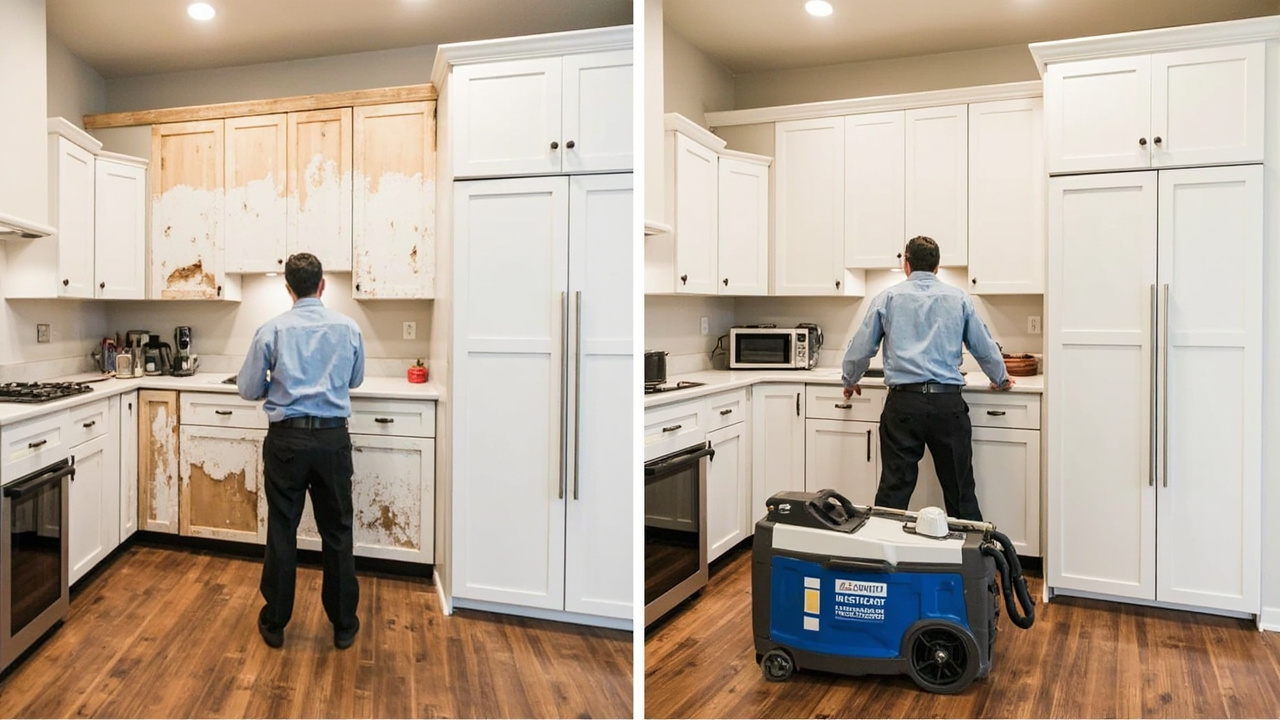
Commercial-grade air movers and low-grain refrigerant (LGR) dehumidifiers run continuously until moisture readings reach dry standard. Drying cabinet substrates takes longer than drying open floor space because the wood is dense and the geometry restricts airflow. We position equipment specifically to drive air through the cabinet structure, not just around it.
Step 4: Antimicrobial Treatment
Once dry, we apply antimicrobial treatment to all affected surfaces. This step is non-negotiable in Michigan kitchens where ambient humidity supports mold growth. Skipping it is how cabinets that look fine end up with a mold problem three months later.
Step 5: Assessment and Refinishing
After drying is complete, we assess what can be refinished versus what needs replacement. Solid wood cabinet frames that dried successfully often need only light sanding and refinishing to look right again. Cabinet face frames and doors may need to be re-hung and adjusted if swelling shifted the alignment.
Mold in kitchens requires its own careful process. If you are dealing with mold on top of water damage, see our detailed breakdown of how to remove mold safely from your home before the restoration process begins.
Common Causes of Cabinet Water Damage in Metro Detroit Homes
Understanding what caused the damage matters for two reasons. It helps you prevent a recurrence, and it matters to your insurance company when you file a claim.
- Slow supply line leaks under the sink, often from aging braided hoses or loose compression fittings. These are the most common cause in Grosse Pointe Woods homes built before the late 1990s.
- Dishwasher drain line failures, including loose clamps, cracked hoses, or improper high-loop installation that allows backflow into the cabinet base.
- Garbage disposal leaks from the flange, the dishwasher inlet, or the drain connection. Disposal leaks tend to be slow and go unnoticed for weeks.
- Burst or frozen pipes in kitchen walls during Michigan winters. This risk is real in any home where the kitchen sits on an exterior wall with inadequate insulation. For a deeper look at freeze damage, read our article on fixing the mess after a frozen pipe bursts in your Detroit home.
- Refrigerator water line failures where the supply line to the ice maker or water dispenser cracks or disconnects at the fitting behind the fridge.
- Drain pipe condensation in humid summer months, where moisture accumulates on the outside of cold drain pipes and drips onto the cabinet base.
Navigating Your Homeowners Insurance Claim
Most standard homeowners policies in Wayne County cover sudden and accidental water damage. A supply line that failed abruptly typically qualifies. A slow leak that was ignored for months often does not, because insurers classify it as a maintenance failure.
Documentation is everything. When we arrive on-site, we photograph all damage before touching anything, record moisture readings in writing, and produce a detailed scope of work that your adjuster can review. We have worked with every major carrier operating in the Metro Detroit market and understand what documentation format adjusters need to process claims without unnecessary delays.
If your damage involved sewage backflow from the drain lines under the sink, that is a different claims category and requires separate sewage backup coverage. Check your policy, and if you need guidance on that specific situation, see our page on sewage backup cleanup in Detroit.
One important note. Do not complete repairs before an adjuster documents the damage. You can mitigate (stop additional damage from occurring), but do not replace or dispose of damaged materials until the claim is documented. We help you stay on the right side of that line.
What Happens If Water Reached the Basement
In some Grosse Pointe Woods homes, kitchen plumbing runs through or near a basement or crawl space. A significant under-sink leak can send water down through the subfloor and into the space below. If you notice dampness, water staining, or a musty smell in your basement after a kitchen leak, that area needs its own assessment. Our team covers the full vertical path of water migration in these situations. You can see how we handle that specific problem in our overview of flooded basement cleanup in Grosse Pointe.
What You Should Not Do After a Cabinet Leak
A few actions that feel logical actually make cabinet water damage worse.
Do not use a household fan alone and assume that counts as drying. Consumer fans move air but do not remove the moisture from it. Without a dehumidifier pulling moisture out of the air, you are just circulating humid air over wet wood. This barely moves the drying process forward and gives mold a better environment to grow.
Do not close the cabinet doors to hide the smell. Closed doors trap humid air inside the cabinet box and accelerate mold growth.
Do not apply paint or finish over swollen or still-damp wood. Trapping moisture under a sealed surface creates ideal conditions for rot and mold even after the surface looks dry.
Do not throw away damaged materials before an insurance adjuster or your restoration crew documents them. Those materials are evidence for your claim.
How Fast Can Your Cabinets Actually Be Saved
Timing is the variable that most determines the outcome. Solid wood or plywood cabinets caught within the first 12 hours of a leak have an excellent chance of full restoration. The same cabinets left wet for 72 hours or more have significantly worse odds, and MDF or particleboard has almost no chance of full structural recovery after that window.
Our team reaches homes throughout Grosse Pointe Woods, Grosse Pointe Farms, St. Clair Shores, and greater Wayne County within 60 minutes of your call for emergency water damage response. The EPA’s guidance on mold and moisture confirms that 48 to 72 hours is the critical window for preventing mold colonization after water intrusion. Do not wait to see if things dry out on their own.
If your cabinets are wet right now, call us at (313) 999-0001. We will tell you within the first 15 minutes of being on-site exactly what can be saved and what needs to go. No guessing, no upselling. Just a straight technical read on your situation so you can make an informed decision.
{
“@context”: “https://schema.org”,
“@type”: “BlogPosting”,
“headline”: “How to Save Your Kitchen Cabinets After a Sink Leak in Grosse Pointe Woods”,
“description”: “Sink leak soaked your kitchen cabinets in Grosse Pointe Woods? Learn what to save, what to replace, and when to call a pro. Detroit restoration experts available now.”,
“wordCount”: 2064,
“datePublished”: “2026-03-31T09:04:00.000Z”,
“dateModified”: “2026-03-31T09:04:00.000Z”,
“inLanguage”: “en-US”,
“mainEntityOfPage”: {
“@type”: “WebPage”,
“@id”: “https://ironwoodwaterdamagerestorationdetroit.com”
},
“publisher”: {
“@type”: “LocalBusiness”,
“name”: “Ironwood Water Damage Restoration Detroit”,
“url”: “https://ironwoodwaterdamagerestorationdetroit.com”
},
“author”: {
“@type”: “Organization”,
“name”: “Ironwood Water Damage Restoration Detroit”,
“url”: “https://ironwoodwaterdamagerestorationdetroit.com”
},
“image”: {
“@type”: “ImageObject”,
“url”: “https://ironwoodwaterdamagerestorationdetroit.com/wp-content/uploads/2026/03/how-to-save-your-kitchen-cabinets-after-a-sink-lea-1.jpg”
}
}
{
“@context”: “https://schema.org”,
“@type”: “LocalBusiness”,
“name”: “Ironwood Water Damage Restoration Detroit”,
“url”: “https://ironwoodwaterdamagerestorationdetroit.com”,
“address”: {
“@type”: “PostalAddress”,
“addressLocality”: “Detroit”
},
“areaServed”: {
“@type”: “City”,
“name”: “Detroit”
}
}
{
“@context”: “https://schema.org”,
“@type”: “FAQPage”,
“mainEntity”: [
{
“@type”: “Question”,
“name”: “What Cabinet Material Do You Have?”,
“acceptedAnswer”: {
“@type”: “Answer”,
“text”: “The single biggest factor in whether your cabinets can be saved or need replacement is the substrate material. Here is a clear breakdown of how water affects each type differently.”
}
}
]
}
{
“@context”: “https://schema.org”,
“@type”: “BreadcrumbList”,
“itemListElement”: [
{
“@type”: “ListItem”,
“position”: 1,
“name”: “Home”,
“item”: “https://ironwoodwaterdamagerestorationdetroit.com”
},
{
“@type”: “ListItem”,
“position”: 2,
“name”: “Blog”,
“item”: “https://ironwoodwaterdamagerestorationdetroit.com/blog”
},
{
“@type”: “ListItem”,
“position”: 3,
“name”: “How to Save Your Kitchen Cabinets After a Sink Leak in Grosse Pointe Woods”
}
]
}
{
“@context”: “https://schema.org”,
“@type”: “Service”,
“serviceType”: “Water Damage Restoration”,
“provider”: {
“@type”: “LocalBusiness”,
“name”: “Ironwood Water Damage Restoration Detroit”,
“url”: “https://ironwoodwaterdamagerestorationdetroit.com”
},
“areaServed”: {
“@type”: “City”,
“name”: “Detroit”
},
“description”: “Sink leak soaked your kitchen cabinets in Grosse Pointe Woods? Learn what to save, what to replace, and when to call a pro. Detroit restoration experts available now.”
}