

Your basement flooded last night. You drove to the nearest home improvement store on Eight Mile, grabbed a 50-pint dehumidifier off the shelf, and plugged it in. The bucket fills up. You feel like you are making progress.
You are not making progress. Not enough of it. And by the time you realize that, mold has already started colonizing the backside of your drywall.
This is the most common and most costly mistake Detroit homeowners make after a water loss event. Understanding the difference between a commercial grade dehumidifier and a residential unit from a big box store is not just an academic exercise. It directly determines whether your home dries properly or develops a secondary mold problem that costs far more to fix than the original flood.
Why Detroit’s Climate Makes Equipment Choice Critical
Southeast Michigan sits at the intersection of two moisture problems. Summer humidity from Lake St. Clair and Lake Erie pushes ambient relative humidity (RH) above 70% for weeks at a time. Winters bring frozen pipes and ice dam events that dump water into attics and wall cavities. Detroit’s older housing stock, particularly the brick bungalows in neighborhoods like Jefferson Chalmers, Grandmont-Rosedale, and East English Village, has dense structural assemblies that trap moisture deep inside wall cavities and subfloors.
The EPA’s guidance on mold prevention recommends keeping indoor relative humidity below 60%, and ideally between 30% and 50%. After a flood event in a July heat wave, you are often starting above 80% RH with wet structural materials adding constant moisture load to the air. A residential dehumidifier is not engineered for those conditions.
The Detroit Water and Sewerage Department infrastructure in older neighborhoods also means combined sewer overflows happen during heavy rain events. When your basement takes on water from a sewer backup, the contamination level changes the drying protocol entirely. See our guide on what to do right now for sewage backup cleanup in Detroit for that specific scenario.
How Residential Big Box Dehumidifiers Are Designed (And Where They Fall Short)
Residential dehumidifiers are designed for maintenance humidity control in a conditioned, finished living space. They work on a standard refrigerant cycle. Humid air passes over a cold coil, moisture condenses on the coil, and water drops into a collection bucket or drains through a hose.
That process works reasonably well when ambient temperatures are above 65°F and relative humidity is in the 50-70% range. It starts to fail in two specific ways that matter enormously in a flood scenario.
Coil Icing at Lower Temperatures
Standard residential units ice up when temperatures drop below 60°F. A typical Detroit basement in January, or even early spring after a pipe burst, can sit at 50-55°F. When the coil ices over, the unit stops extracting moisture entirely. It just runs and moves air over a block of ice. You can read more about what happens when frozen pipes burst and how drying gets complicated in those conditions in our article on fixing the mess after a frozen pipe bursts in your Detroit home.
Pint Per Day Ratings Are Lab Numbers
That 50 PPD (pints per day) rating on the box is measured at 80°F and 60% relative humidity. That is a controlled laboratory condition. In a real flooded basement at 65°F with wet concrete, wet framing, and saturated insulation, the actual extraction rate drops significantly. You might get 20 to 30 PPD in real-world post-flood conditions from a unit rated at 50 PPD.
What Commercial Grade LGR Dehumidifiers Actually Do Differently
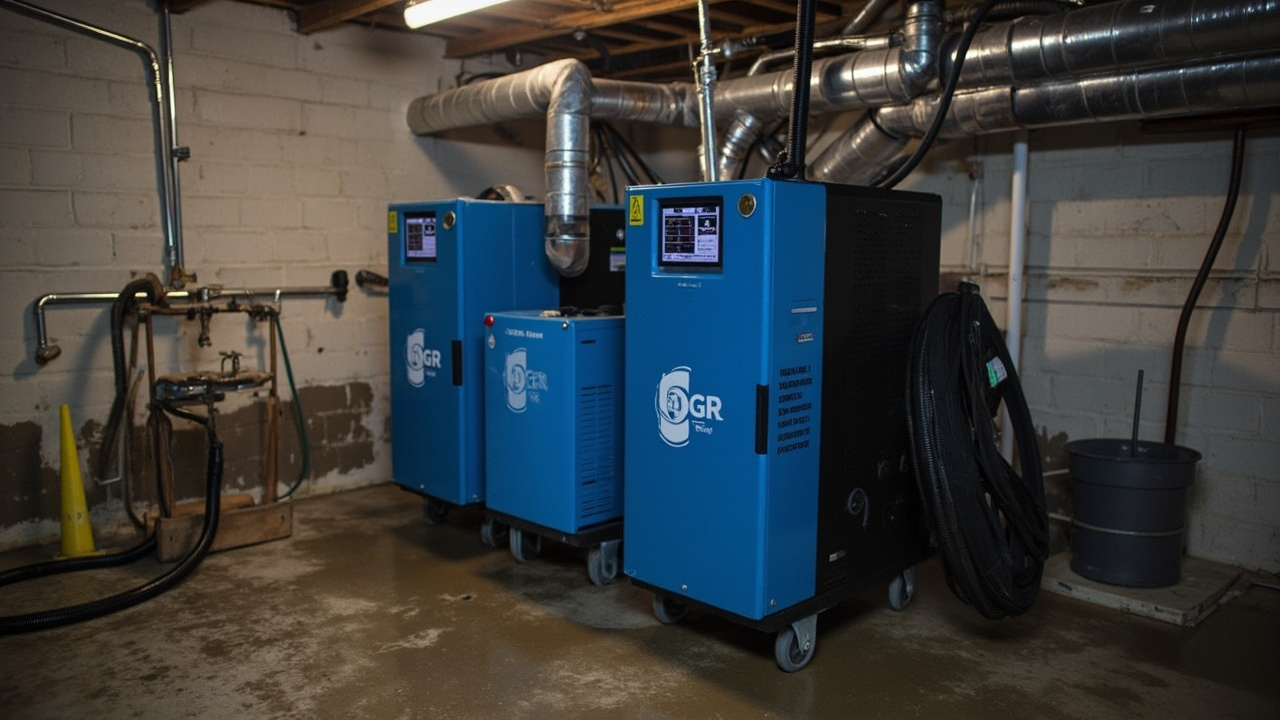
Commercial dehumidifiers used in professional water damage restoration fall into two main categories. Low Grain Refrigerant (LGR) units are the workhorses of structural drying. Desiccant dehumidifiers handle extreme cold and very low grain environments. For most Detroit residential jobs, LGR units are the primary tool.
LGR technology pre-cools incoming air before it hits the evaporator coil. This allows the unit to extract moisture from air that already has a relatively low moisture content, pulling the grain count in the air down much further than a conventional refrigerant unit can. The result is that an LGR dehumidifier keeps pulling moisture out of structural materials, not just free-floating air moisture, which is what actually dries your studs, subfloor, and wall cavities.

Psychrometrics and Why It Matters for Your Subfloor
Psychrometrics is the science of air and water vapor relationships. Restoration technicians use psychrometric calculations to determine how many commercial dehumidifiers a space needs, how to position air movers to create optimal drying airflow, and how to track daily moisture removal to confirm structural materials are drying within acceptable timeframes.
The IICRC (Institute of Inspection Cleaning and Restoration Certification) S500 Standard for Professional Water Damage Restoration sets specific drying goals based on material moisture content readings, not just air humidity levels. A residential dehumidifier gives you no feedback mechanism for any of this. A professional drying system monitored by an IICRC-certified technician targets specific moisture content levels in your subfloor, framing, and wall assemblies with daily documentation.
Side by Side Technical Comparison
| Specification | Residential Big Box Unit | Commercial LGR Unit |
|---|---|---|
| Extraction Rate (real-world flood conditions) | 15 to 30 PPD | 80 to 150+ PPD |
| Rated Airflow (CFM) | 100 to 200 CFM | 300 to 500+ CFM |
| Minimum Operating Temperature | 60 to 65°F (coil icing below this) | 33 to 45°F (LGR technology prevents icing) |
| Target Grain Level | 45 to 55 grains per pound of dry air | Below 30 grains per pound of dry air |
| Structural Material Drying Capability | Surface moisture only | Deep structural assembly drying |
| Drainage | Bucket or gravity drain (slow, requires attention) | Continuous pump, high-volume drain capable |
| Durability / Duty Cycle | Designed for intermittent household use | Designed for continuous 24/7 operation on job sites |
Detroit Flood Scenario Comparison
The difference in performance is not abstract. Here is what it looks like on two real types of Detroit water damage calls.
Scenario One: Flooded Grosse Pointe Basement in July
A homeowner in Grosse Pointe Park gets four inches of water in a finished basement after a sump pump failure during a July storm. Ambient temperature is 72°F, starting RH is 85%. The homeowner rents a 70-pint residential unit and sets it up.
After 48 hours, the air humidity feels better. The bucket empties on schedule. But the moisture meter reading on the bottom of the subfloor is still at 22% wood moisture content, far above the acceptable 12 to 15% range for finished material. The drywall base is still at 40% moisture content. Mold begins within 72 hours of a water event at those moisture levels when temperatures are above 70°F.
A professional drying setup for the same space would deploy two to three commercial LGR dehumidifiers with matched air movers targeting specific airflow patterns across wet materials. Drying logs track moisture content daily. Typical structural drying to standard reaches completion in three to five days with professional equipment. The same space with a residential unit may take two to three weeks to reach similar moisture content levels, well past the mold growth window. Our team handles these scenarios directly, as detailed in our guide to flooded basement cleanup in Grosse Pointe done fast and done right.
Scenario Two: Pipe Burst in a Royal Oak Home in January
A Royal Oak homeowner finds a burst pipe in an exterior wall. Water has saturated a section of flooring, wall cavity, and the adjacent subfloor. Basement temperature is 52°F.
A residential dehumidifier plugged in at 52°F will ice up and stop functioning within hours. It provides essentially zero drying benefit. A commercial LGR unit continues operating efficiently at that temperature, while a desiccant unit would handle it even if temperatures dropped below freezing. Secondary mold damage in this scenario without proper drying equipment is nearly certain, and Royal Oak’s older craftsman and colonial-style homes often have original plaster and lath that absorbs and holds moisture particularly aggressively.
If you are in that situation right now, read our guide on how to remove mold safely from your Royal Oak home to understand what you are dealing with if drying was delayed.

The Real Cost of Using the Wrong Equipment
The comparison that matters most to most homeowners is financial. A big box dehumidifier is cheaper to rent or buy. Professional drying services cost more upfront. But that framing ignores what happens when the wrong equipment leaves structural materials wet long enough for mold to establish.
| Outcome Factor | Residential Unit DIY Drying | Professional Commercial Equipment |
|---|---|---|
| Typical drying time to standard | 10 to 21+ days | 3 to 5 days |
| Risk of secondary mold colonization | High (especially in summer months) | Low when IICRC protocols are followed |
| Subfloor and wall cavity drying | Inconsistent, difficult to verify | Verified with moisture meters per IICRC S500 |
| Documentation for insurance claims | None | Daily drying logs, moisture readings, equipment records |
| Risk of material replacement vs. drying in place | Higher risk of needing drywall and flooring removal | Lower risk when drying begins within 24 to 48 hours |
| Mold remediation likelihood | Significant if drying is delayed past 72 hours | Minimal with rapid deployment and proper psychrometric monitoring |
Mold remediation in a Detroit basement is not a small project. It involves containment, HEPA air filtration, biocide treatment, and often material removal. The cost of that remediation, plus the material replacement you could have avoided, consistently exceeds what proper professional drying would have cost from the start.
For Dearborn homeowners dealing with basement flooding, our breakdown of professional cleanup for flooded basements in Dearborn walks through exactly what to expect from the process.
What Professional Drying Equipment Deployment Actually Looks Like
When an IICRC-certified restoration team responds to a water loss in Detroit, the equipment deployment follows a structured process based on the IICRC S500 Water Damage Restoration Standard. Here is what that looks like in practice.
- Initial moisture mapping with calibrated pin and pinless meters to determine the full scope of wet materials before any equipment goes in
- Calculation of the number of commercial LGR dehumidifiers needed based on the cubic footage of the affected space, the class of water damage, and the starting psychrometric conditions
- Matched deployment of air movers at calculated CFM ratios to create consistent airflow across wet surfaces and drive moisture from materials into the air where dehumidifiers can capture it
- Daily monitoring of temperature, relative humidity, and specific humidity readings to confirm the drying system is performing to psychrometric targets
- Daily moisture content readings of structural materials with documentation showing the drying curve from wet to standard
- Adjustment of equipment placement and settings as materials dry and conditions change
- Final clearance readings confirming materials have returned to acceptable moisture content before equipment is removed
None of that happens with a residential unit from a big box store. There is no monitoring, no documentation, no verification, and no protocol to catch the spots that are not drying fast enough before mold becomes the next problem.
When a Residential Unit Is Actually Appropriate
To be clear, residential dehumidifiers serve a purpose. Running one in your basement during Michigan’s humid summers as a preventive measure is completely appropriate. If you have a minor condensation problem or a small area of high humidity in a finished space with no structural materials at risk, a residential unit handles that job fine.
The line is when you have experienced an active water loss event. Any situation where water has contacted structural materials, subfloor, wall cavities, or building assemblies moves beyond what a residential unit can handle within the timeframe that matters.
Frequently Asked Questions About Dehumidifiers After a Flood
Can I just run multiple residential dehumidifiers instead of one commercial unit?
Running two or three residential units does not replicate a commercial LGR unit. The issue is not just total PPD capacity. It is the grain level each unit can reach, the operating temperature range, the airflow engineering, and the psychrometric monitoring that professional equipment enables. Multiple residential units in a flooded basement may improve air RH readings while leaving structural materials wet because they cannot pull moisture down to the grain levels needed for structural drying.
How loud are commercial dehumidifiers?
Commercial LGR units run at 65 to 72 decibels, comparable to a vacuum cleaner. They are not quiet. If the affected space is a living area, the noise is a factor to consider during the drying period. Restoration companies typically place equipment in the affected zone and minimize the disruption to the rest of the home.
What power requirements do commercial dehumidifiers need?
Most commercial LGR units run on standard 115V to 120V circuits and draw 7 to 12 amps per unit. Air movers typically draw 2 to 4 amps each. A professional team assesses available circuit capacity before deploying equipment and uses separate circuits to distribute the electrical load safely. Do not attempt to run multiple commercial units on a single 15-amp household circuit.
Will my homeowner’s insurance cover professional drying?
In most cases, yes. Standard homeowner’s policies in Michigan cover sudden and accidental water losses, and professional structural drying is a covered mitigation expense. The daily moisture logs and equipment documentation that IICRC-certified technicians provide are exactly what adjusters need to process the claim. DIY drying with a residential unit typically produces no documentation, which can complicate claims if you later need mold remediation or structural repairs.
Get an Accurate Assessment Before You Decide
If you are standing in a wet basement right now trying to figure out whether to drive to the hardware store or call a professional, here is the honest answer. For any water event that has contacted structural materials, subfloor, or wall assemblies, professional commercial drying equipment is not optional if you want to avoid mold and material damage. The equipment difference is real, the physics of structural drying are real, and the 72-hour mold window is real.
Our IICRC-certified team responds to water damage across Detroit and the surrounding metro, from Grosse Pointe to Royal Oak to Dearborn. We perform moisture mapping at no charge so you know exactly what you are dealing with before any commitment. Contact Ironwood Water Damage Restoration to get an assessment of your situation and a clear picture of what proper drying requires for your specific property.
{
“@context”: “https://schema.org”,
“@type”: “BlogPosting”,
“headline”: “Professional Grade Dehumidifiers vs Big Box Store Models (What Detroit Homeowners Need to Know)”,
“description”: “Learn why big box store dehumidifiers fail after Detroit floods and how commercial LGR units actually dry your home’s structure. IICRC-certified perspective.”,
“wordCount”: 2356,
“datePublished”: “2026-04-07T10:41:00.000Z”,
“dateModified”: “2026-04-07T10:41:00.000Z”,
“inLanguage”: “en-US”,
“mainEntityOfPage”: {
“@type”: “WebPage”,
“@id”: “https://ironwoodwaterdamagerestorationdetroit.com”
},
“publisher”: {
“@type”: “LocalBusiness”,
“name”: “Ironwood Water Damage Restoration Detroit”,
“url”: “https://ironwoodwaterdamagerestorationdetroit.com”
},
“author”: {
“@type”: “Organization”,
“name”: “Ironwood Water Damage Restoration Detroit”,
“url”: “https://ironwoodwaterdamagerestorationdetroit.com”
},
“image”: {
“@type”: “ImageObject”,
“url”: “https://ironwoodwaterdamagerestorationdetroit.com/wp-content/uploads/2026/03/comparing-professional-grade-dehumidifiers-and-the-1.jpg”
}
}
{
“@context”: “https://schema.org”,
“@type”: “LocalBusiness”,
“name”: “Ironwood Water Damage Restoration Detroit”,
“url”: “https://ironwoodwaterdamagerestorationdetroit.com”,
“address”: {
“@type”: “PostalAddress”,
“addressLocality”: “Detroit”
},
“areaServed”: {
“@type”: “City”,
“name”: “Detroit”
}
}
{
“@context”: “https://schema.org”,
“@type”: “FAQPage”,
“mainEntity”: [
{
“@type”: “Question”,
“name”: “Can I just run multiple residential dehumidifiers instead of one commercial unit?”,
“acceptedAnswer”: {
“@type”: “Answer”,
“text”: “Running two or three residential units does not replicate a commercial LGR unit. The issue is not just total PPD capacity. It is the grain level each unit can reach, the operating temperature range, the airflow engineering, and the psychrometric monitoring that professional equipment enables. Multiple residential units in a flooded basement may improve air RH readings while leaving structural materials wet because they cannot pull moisture down to the grain levels needed for structural drying.”
}
},
{
“@type”: “Question”,
“name”: “How loud are commercial dehumidifiers?”,
“acceptedAnswer”: {
“@type”: “Answer”,
“text”: “Commercial LGR units run at 65 to 72 decibels, comparable to a vacuum cleaner. They are not quiet. If the affected space is a living area, the noise is a factor to consider during the drying period. Restoration companies typically place equipment in the affected zone and minimize the disruption to the rest of the home.”
}
},
{
“@type”: “Question”,
“name”: “What power requirements do commercial dehumidifiers need?”,
“acceptedAnswer”: {
“@type”: “Answer”,
“text”: “Most commercial LGR units run on standard 115V to 120V circuits and draw 7 to 12 amps per unit. Air movers typically draw 2 to 4 amps each. A professional team assesses available circuit capacity before deploying equipment and uses separate circuits to distribute the electrical load safely. Do not attempt to run multiple commercial units on a single 15-amp household circuit.”
}
},
{
“@type”: “Question”,
“name”: “Will my homeowner’s insurance cover professional drying?”,
“acceptedAnswer”: {
“@type”: “Answer”,
“text”: “In most cases, yes. Standard homeowner’s policies in Michigan cover sudden and accidental water losses, and professional structural drying is a covered mitigation expense. The daily moisture logs and equipment documentation that IICRC-certified technicians provide are exactly what adjusters need to process the claim. DIY drying with a residential unit typically produces no documentation, which can complicate claims if you later need mold remediation or structural repairs.”
}
}
]
}
{
“@context”: “https://schema.org”,
“@type”: “BreadcrumbList”,
“itemListElement”: [
{
“@type”: “ListItem”,
“position”: 1,
“name”: “Home”,
“item”: “https://ironwoodwaterdamagerestorationdetroit.com”
},
{
“@type”: “ListItem”,
“position”: 2,
“name”: “Blog”,
“item”: “https://ironwoodwaterdamagerestorationdetroit.com/blog”
},
{
“@type”: “ListItem”,
“position”: 3,
“name”: “Professional Grade Dehumidifiers vs Big Box Store Models (What Detroit Homeowners Need to Know)”
}
]
}
{
“@context”: “https://schema.org”,
“@type”: “Service”,
“serviceType”: “Water Damage Restoration”,
“provider”: {
“@type”: “LocalBusiness”,
“name”: “Ironwood Water Damage Restoration Detroit”,
“url”: “https://ironwoodwaterdamagerestorationdetroit.com”
},
“areaServed”: {
“@type”: “City”,
“name”: “Detroit”
},
“description”: “Learn why big box store dehumidifiers fail after Detroit floods and how commercial LGR units actually dry your home’s structure. IICRC-certified perspective.”
}