

Fire Sprinkler Water Damage Restoration in Detroit Loft Buildings
A single sprinkler head activation can release between 25 and 50 gallons of water per minute. In a New Center loft or Midtown high-rise, that water does not just soak the floor beneath the head. It moves through ceiling assemblies, saturates drywall, travels down elevator shafts, and soaks multiple units before anyone shuts off the main supply. By the time the building manager locates the shut-off valve, you may be looking at thousands of gallons released into the structure.
If you own a loft in Detroit’s New Center neighborhood, Brush Park, or the Corktown district, your building almost certainly has a wet-pipe or dry-pipe sprinkler system required under Wayne County building codes and Detroit Fire Department regulations. Understanding what happens when those systems discharge unexpectedly is not optional knowledge. It is critical to protecting your investment and your personal property.
Why Sprinkler Water Is Not the Same as a Burst Pipe
Most property owners think water damage is water damage. It is not. The IICRC (Institute of Inspection Cleaning and Restoration Certification) classifies water into three categories based on contamination level, and fire sprinkler water almost always qualifies as Category 3, also called Black Water.
Here is why. Sprinkler pipes sit dormant for years, sometimes decades. Inside those pipes, stagnant water accumulates biofilm, rust, sediment, and microbial colonies. When a head activates, all of that contaminated water discharges at high pressure directly into your living space. It is not clean municipal water from a fresh supply line. It carries biological and chemical hazards that require full protective protocols during cleanup.
The pressure matters too. Residential sprinkler systems typically operate at 7 to 25 PSI, while commercial wet-pipe systems in older Detroit loft conversions can reach 100 PSI or higher at the main riser. That kind of force drives water deep into porous materials, substrate flooring, and wall cavities within minutes.
| Category | Source Examples | Contamination Level | Required PPE for Restoration |
|---|---|---|---|
| Category 1 (Clean Water) | Supply line break, fresh municipal tap | None to minimal | Standard gloves |
| Category 2 (Gray Water) | Washing machine overflow, HVAC condensate | Moderate biological load | Gloves, eye protection |
| Category 3 (Black Water) | Fire sprinkler discharge, sewage, flood water | High biological and chemical contamination | Full PPE, respirators, Tyvek suits |
Treating sprinkler discharge as clean water is one of the most expensive mistakes loft owners make. Inadequate decontamination leads to microbial growth within 24 to 48 hours, and in Detroit’s humid summers, mold colonies establish themselves faster than most people expect.
The Unique Drainage Challenges in Detroit Loft Conversions
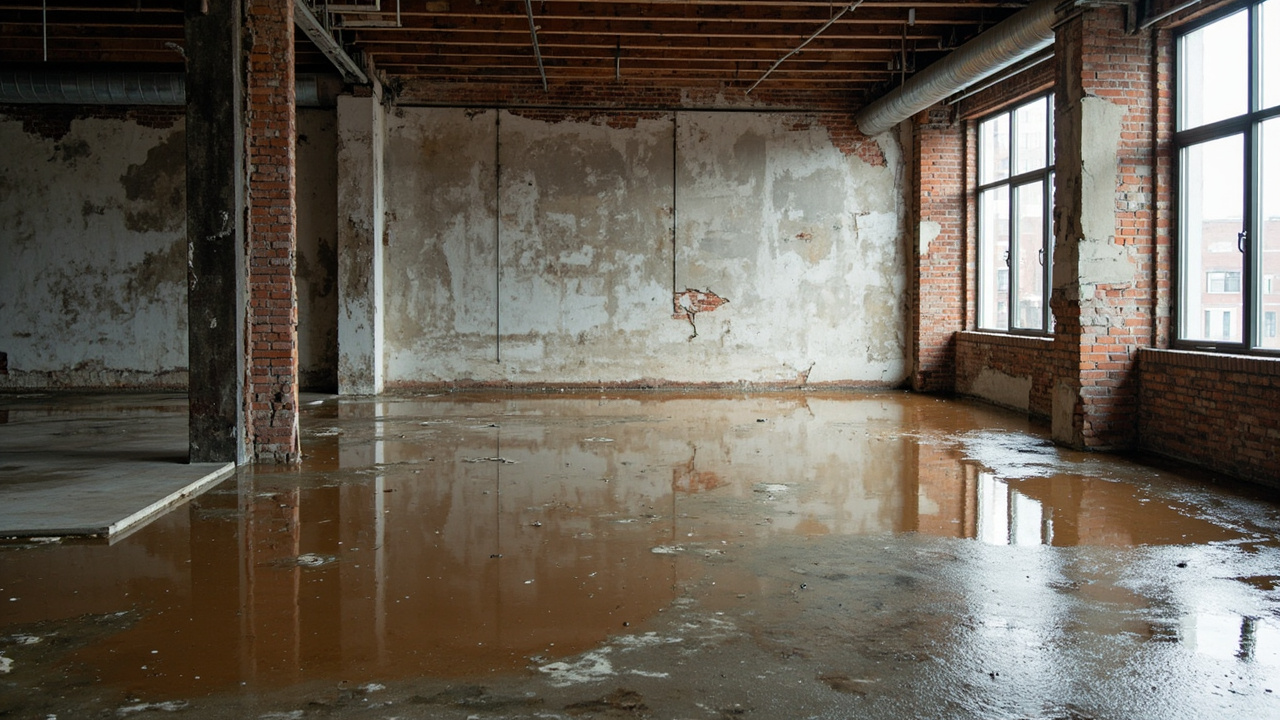
New Center and Midtown loft buildings are often repurposed industrial or commercial structures. The Albert Kahn-era warehouses and factory conversions in this corridor were not designed with residential water intrusion in mind. When a sprinkler activates on the fourth floor of a converted loft building, water follows structural pathways that a standard ranch home simply does not have.
Concrete decking with minimal floor drains means water pools quickly and finds penetrations through conduit runs, plumbing sleeves, and HVAC penetrations. Exposed brick walls absorb moisture deeply. Polished concrete floors appear dry but hold moisture beneath the surface coating. Original timber beams and subfloor systems in older conversions absorb water aggressively and dry slowly.
The Detroit Water and Sewerage Department (DWSD) infrastructure in older New Center blocks also adds a layer of complexity. Buildings connected to aging combined sewer systems can experience backflow pressure events during heavy rain, compounding an already saturated structure. This is worth understanding if your building experienced a sprinkler event during or after a storm.
If you have also dealt with water coming in from below grade, our guide on professional cleanup for flooded basements explains what proper extraction and documentation looks like from the ground up.

What Immediate Response Looks Like After a Sprinkler Discharge
The first 60 minutes after a sprinkler event determine a significant portion of the total restoration cost and timeline. Speed matters. Here is what a qualified restoration crew should do when they arrive at a Detroit loft building after a sprinkler discharge.
- Water source confirmation. Verify the sprinkler supply has been fully shut off at the main riser before entering the affected area. This is coordinated with building management or the Detroit Fire Department if the activation triggered an alarm response.
- Safety assessment. Check for electrical hazards, structural instability in saturated ceiling assemblies, and slip hazards on hard flooring surfaces. Category 3 water means full PPE goes on before any crew member enters.
- Moisture mapping. Thermal imaging cameras scan walls, ceilings, and floors to identify the full migration path of the water. In a multi-story loft, water rarely stays where it appears to. Moisture mapping using calibrated meters establishes the true scope before a single piece of equipment is placed.
- High-volume water extraction. Truck-mounted extractors pull standing water from concrete, hardwood, and carpet substrates. Portable extractors access areas where truck units cannot reach, including elevator lobbies and stairwells.
- Structural drying setup. Industrial-grade dehumidifiers, air movers, and desiccant units are placed based on the moisture map. Drying targets follow IICRC S500 standard protocols, which require documentation of temperature, relative humidity, and moisture content readings at each visit.
- Microbial growth inhibitors applied. Because sprinkler water is Category 3, EPA-registered antimicrobial agents are applied to all affected surfaces before drying equipment runs. This step is non-negotiable.
- Damage documentation for insurance. Photo and video documentation, moisture readings, and a written scope are compiled from day one to support your insurance claim and any HOA or building owner liability documentation.
NFPA 25 Compliance and What It Means for Your Building
Under NFPA 25, all water-based fire protection systems require regular inspection, testing, and maintenance. In Detroit, the Fire Marshal’s office enforces these requirements for commercial and mixed-use loft buildings. Accidental discharge events are often traceable to deferred maintenance, corrosion in aging pipe systems, or mechanical damage to sprinkler heads.
When a discharge results from a maintenance failure on the building’s part, liability documentation becomes critical for the unit owner filing a claim. The restoration company’s moisture mapping data, extraction logs, and drying records serve as the factual backbone of that claim. This is why choosing a crew that produces thorough written documentation matters as much as the physical work they perform.
Wayne County building codes also require specific notification and remediation timelines after water intrusion events in multi-unit buildings. A restoration company familiar with Detroit’s commercial permit environment understands when a building permit for remediation work is required and when the scope falls within existing authority to repair provisions.
Sprinkler System Types Found in Detroit Loft Buildings
| System Type | Common Location | Discharge Volume Risk | Restoration Complexity |
|---|---|---|---|
| Wet Pipe | Midtown loft conversions, newer builds | High (water in pipe at all times) | Moderate to high |
| Dry Pipe | Unheated areas, older New Center warehouses | Very high (delayed activation, larger discharge) | High (rust and sediment in discharge) |
| Pre-Action | Data centers, archive spaces | Low (requires dual trigger) | Low to moderate |
| Deluge | High-hazard commercial areas | Extreme (all heads open simultaneously) | Severe, multi-unit impact |
Dry-pipe systems are particularly common in the older warehouse conversions along the New Center corridor and in portions of Eastern Market. Because compressed air fills the pipes instead of water, there is a delay between head activation and water delivery. That delay allows more air and sediment to mobilize, producing discharge that carries a heavier biological and chemical load than wet-pipe systems. The restoration approach for dry-pipe discharge requires additional decontamination steps.
How Mold Becomes the Second Disaster
In a loft with exposed brick, original timber framing, or original plank flooring, drying timelines are longer than they are in standard drywall-and-carpet residential construction. Brick is highly porous and retains moisture deep in its mass. Timber framing absorbs water unevenly and can sustain moisture levels that support mold growth even after surface readings appear normal.
Mold growth in a sprinkler-damaged Detroit loft typically appears within 48 to 72 hours when the structure is not immediately dried under controlled conditions. In summer months, with outdoor dewpoint levels in Detroit regularly exceeding 65 degrees Fahrenheit, ambient humidity accelerates that timeline significantly.
If mold has already established itself in your space, the remediation process changes substantially. Our resource on how to remove mold safely covers the containment and remediation protocols that apply when growth is confirmed, including what IICRC-certified technicians do differently from general contractors.
The key point is this. Do not let anyone tell you that a shop vac and some box fans are adequate after a sprinkler discharge. The moisture load is too high, the contamination classification is too serious, and the structural materials common in Detroit loft buildings hold water too well for DIY drying to be effective.

Insurance Coordination After a Sprinkler Event
Most loft owner insurance policies in Detroit cover accidental sprinkler discharge under the water damage provision, but the claims process after a sprinkler event involves more parties than a standard pipe burst. You may be dealing with your own HO-6 or condo owner policy, the building owner’s commercial property policy, and potentially a third-party liability claim against the building if the discharge resulted from a maintenance failure.
Restoration documentation is the single most important factor in a smooth claim outcome. Adjusters working Detroit-area commercial losses want to see moisture readings taken at initial assessment, drying logs showing daily progress against target moisture content, photos of all affected materials before and after extraction, and a written scope that ties damage to the specific event.
Do not wait for an adjuster to inspect before beginning emergency mitigation. Most policies require prompt action to prevent further damage. A delay in starting extraction can result in claim denial for secondary damage that occurred after the event. Start mitigation immediately and document everything from the first hour.
Detroit loft owners who have also experienced sewage-related water events can review our breakdown of what to do right now for sewage backup cleanup in Detroit, which covers the same urgent documentation principles that apply to any Category 3 water event.
Frozen Sprinkler Pipes in Detroit Winters
Detroit winters create a specific risk that loft owners in warmer climates never think about. When heating systems fail or exterior wall penetrations allow cold air infiltration, the water inside wet-pipe sprinkler lines can freeze. When those pipes thaw, or when the ice expands and ruptures a fitting, the result is a discharge event with no fire. The water is just as contaminated and the structural damage is just as serious.
Dry-pipe systems in unheated spaces are designed to avoid this problem, but older New Center buildings sometimes have wet-pipe segments running through poorly insulated areas. This is exactly the kind of building-specific risk that a restoration company with genuine Detroit experience understands before walking through the door.
Frozen pipe failures follow a similar destruction pattern to sprinkler discharges. Our article on fixing the mess after a frozen pipe bursts in your Detroit home covers the immediate steps and what professional drying involves when cold-weather failures send water through your structure.
Choosing a Restoration Company for Your Detroit Loft
Not every water damage company in the Detroit metro has handled a multi-story loft sprinkler event. The logistics are different from a residential basement flood. You need a crew with commercial-scale extraction equipment, experience coordinating access with building management, and familiarity with the structural characteristics of the New Center, Brush Park, and Corktown building stock.
Ask any company you consider these questions before committing.
- Are your technicians IICRC-certified under the S500 standard for water damage and S520 for mold if applicable?
- Do you carry equipment capable of handling multi-floor commercial extraction, not just residential portable units?
- Can you produce moisture mapping data with calibrated readings from day one, suitable for insurance adjuster review?
- Do you have experience working within Detroit high-rise and loft building access protocols, including coordination with building management and the Detroit Fire Marshal’s office?
- Can you provide documentation in a format compatible with both residential HO-6 and commercial property insurance claims?
A company that answers yes to all of those questions with specific examples rather than vague assurances is the right call for a loft building event. Sprinkler discharge is not a small job, and the margin for error when Category 3 water is involved is very narrow.
For loft owners who have also experienced water events in below-grade parking or storage areas, our coverage of flooded basement cleanup in Grosse Pointe illustrates the extraction and drying standards that apply when water pools in enclosed lower-level spaces.
What Proper Drying Documentation Looks Like
Every qualified restoration company should provide you with a drying log at the close of each visit. That log should show the date and time of the reading, the specific location of each measurement, the moisture content percentage for each material type, the temperature and relative humidity inside the drying chamber, and the target moisture content for each affected material based on IICRC S500 guidelines.
When drying is complete, the structure should return to normal baseline moisture levels for Detroit’s climate conditions, typically between 6 and 12 percent for wood-based materials and below 0.5 percent for concrete substrates measured with a calibrated pin or pin-less meter. Any company that declares a structure dry without showing you those numbers is leaving you exposed to a future mold or structural claim with no documentation to support your position.
Sprinkler water damage in a Detroit loft is a serious, complex event. The water volume is large, the contamination level is high, and the structural materials in these buildings hold moisture in ways that require experienced, equipment-equipped crews and rigorous documentation. The difference between a clean recovery and a mold remediation project six months from now comes down to how fast you respond and who does the work.
If a sprinkler event has already occurred in your New Center or Midtown loft, contact a certified restoration company immediately. Every hour matters when Category 3 water is present in a structure.
{
“@context”: “https://schema.org”,
“@type”: “BlogPosting”,
“headline”: “What New Center Loft Owners Need to Know About Fire Sprinkler Water Damage”,
“description”: “Fire sprinkler water damage in Detroit lofts moves fast. Learn what makes it unique, what restoration involves, and how to protect your investment.”,
“wordCount”: 2340,
“datePublished”: “2026-04-06T08:13:00.000Z”,
“dateModified”: “2026-04-06T08:13:00.000Z”,
“inLanguage”: “en-US”,
“mainEntityOfPage”: {
“@type”: “WebPage”,
“@id”: “https://ironwoodwaterdamagerestorationdetroit.com”
},
“publisher”: {
“@type”: “LocalBusiness”,
“name”: “Ironwood Water Damage Restoration Detroit”,
“url”: “https://ironwoodwaterdamagerestorationdetroit.com”
},
“author”: {
“@type”: “Organization”,
“name”: “Ironwood Water Damage Restoration Detroit”,
“url”: “https://ironwoodwaterdamagerestorationdetroit.com”
},
“image”: {
“@type”: “ImageObject”,
“url”: “https://ironwoodwaterdamagerestorationdetroit.com/wp-content/uploads/2026/03/what-new-center-loft-owners-need-to-know-about-fir-1.jpg”
}
}
{
“@context”: “https://schema.org”,
“@type”: “LocalBusiness”,
“name”: “Ironwood Water Damage Restoration Detroit”,
“url”: “https://ironwoodwaterdamagerestorationdetroit.com”,
“address”: {
“@type”: “PostalAddress”,
“addressLocality”: “Detroit”
},
“areaServed”: {
“@type”: “City”,
“name”: “Detroit”
}
}
{
“@context”: “https://schema.org”,
“@type”: “BreadcrumbList”,
“itemListElement”: [
{
“@type”: “ListItem”,
“position”: 1,
“name”: “Home”,
“item”: “https://ironwoodwaterdamagerestorationdetroit.com”
},
{
“@type”: “ListItem”,
“position”: 2,
“name”: “Blog”,
“item”: “https://ironwoodwaterdamagerestorationdetroit.com/blog”
},
{
“@type”: “ListItem”,
“position”: 3,
“name”: “What New Center Loft Owners Need to Know About Fire Sprinkler Water Damage”
}
]
}
{
“@context”: “https://schema.org”,
“@type”: “Service”,
“serviceType”: “Water Damage Restoration”,
“provider”: {
“@type”: “LocalBusiness”,
“name”: “Ironwood Water Damage Restoration Detroit”,
“url”: “https://ironwoodwaterdamagerestorationdetroit.com”
},
“areaServed”: {
“@type”: “City”,
“name”: “Detroit”
},
“description”: “Fire sprinkler water damage in Detroit lofts moves fast. Learn what makes it unique, what restoration involves, and how to protect your investment.”
}