
Your wall feels dry. You press your hand against the drywall, and it feels fine. So the water damage is handled, right?
Not even close. This is the most expensive assumption a Detroit homeowner can make after a flood, pipe burst, or basement leak. What your hand feels on the surface of drywall tells you almost nothing about what is happening three inches deeper, inside the wall cavity, behind the vapor barrier, or in the subfloor below your feet.
Professional moisture detection is not about fancy equipment for its own sake. It is about the difference between a home that is genuinely dry and a home that is quietly growing Stachybotrys (black mold) inside your walls while you sleep.
Why the Touch Test Fails Detroit Homeowners
Human hands can detect surface moisture down to roughly 20 percent relative saturation on a smooth, flat surface. That sounds useful until you realize that drywall and plaster begin supporting mold growth at moisture content levels as low as 15 to 17 percent. Your hand cannot feel the difference.
Detroit homes face a specific combination of challenges that make the touch test even less reliable. Southeast Michigan sits in a Great Lakes climate zone with high ambient relative humidity (RH) throughout spring and fall, extreme freeze-thaw cycling from November through March, and a housing stock that skews heavily toward pre-1970 construction with original wood framing, plaster walls, and cast iron plumbing.
In a home in Hamtramck or East English Village, a burst pipe in January does not just wet one wall. The water migrates along floor joists, wicks up into plaster lath, and pools in the subfloor under vinyl or hardwood. Your touch test covers maybe four square inches. The water covers four hundred.
The Truth About Consumer-Grade Pin Meters
You can buy a pin-style moisture meter at any big-box hardware store in Dearborn or Warren for a modest price. These tools are not worthless. They have real uses. But they have serious limitations that most homeowners do not know about before they rely on them to clear a water damage situation.
Here is what consumer pin meters actually measure and where they fall short.
| Feature | Consumer Pin Meter | Professional Instruments |
|---|---|---|
| Measurement depth | Surface only (top 1/4 inch) | Up to 4 inches deep (non-invasive), full depth (invasive probe) |
| Calibration | Factory-set, rarely recalibrated | Field-calibrated daily against known standards |
| Wall cavity readings | Cannot detect moisture inside cavities | Thermal imaging maps cavity moisture without cutting walls |
| Subfloor assessment | Surface reading only, misses delamination below | Anhydrous calcium chloride test and deep probe confirm structural saturation |
| Documentation | None. No record for insurers. | Digital moisture maps, thermal images, timestamped data logs |
| False negative rate | High. Dried surface masks wet framing below. | Very low when full protocol is followed per IICRC S500 Standards |
The depth issue is the critical one. When water saturates a wall in a Detroit home, the surface drywall or plaster often dries within 24 to 48 hours because of surface evaporation. The wood framing, fiberglass insulation, and sheathing behind it can stay wet for 10 to 14 days. A pin meter reads the surface as dry. The structure is still saturated. Mold is already colonizing.
What Professional Technicians Actually Use
A certified restoration technician working under IICRC S500 Standards arrives with a toolkit that addresses the full depth problem, not just the surface.
Infrared Thermography
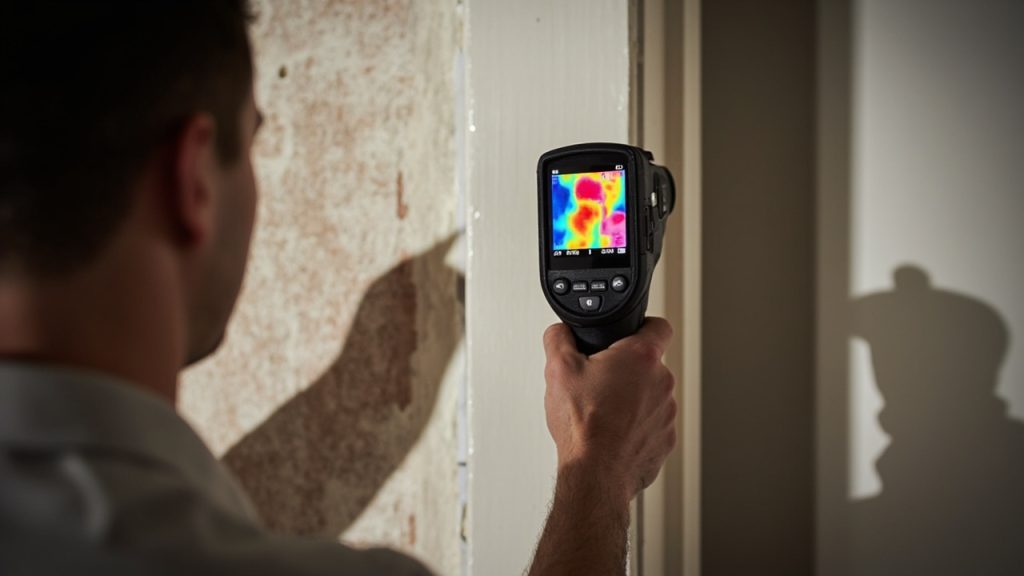
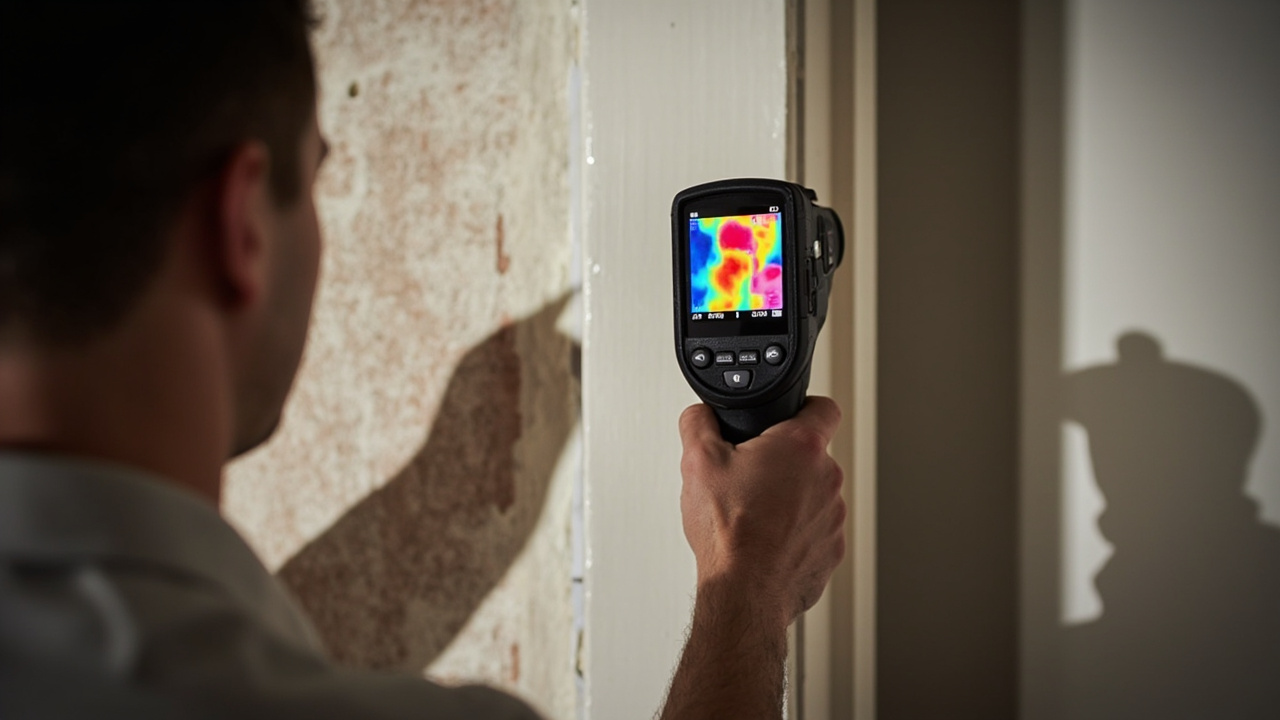
Infrared cameras (commonly FLIR brand) detect temperature differentials across wall surfaces. Wet materials hold and release heat at a different rate than dry materials. A trained technician reads the thermal image to identify moisture pockets behind walls without cutting a single hole. This is non-invasive moisture detection at its most effective.
In a two-story brick colonial in Grosse Pointe, for example, a pipe leak behind a first-floor wall can wick upward into the wall cavity and appear as a cold zone on the second floor. The homeowner sees a wet spot on the first floor and misses the hidden saturation eight feet above. A thermal camera catches both.
Industrial Hygrometers and Psychrometry
Professional hygrometers measure the relative humidity inside wall cavities and in room air with precision to within one percent RH. This matters because psychrometry, the science of air and water vapor relationships, tells technicians whether the drying equipment is actually working or just moving wet air around.
Southeast Michigan’s seasonal humidity complicates this significantly. In April or October, ambient outdoor RH often sits above 70 percent. Running dehumidifiers without proper psychrometric monitoring can actually draw moist outdoor air into a structure and slow down drying. Professional equipment accounts for this. A home sensor from a hardware store does not.
Non-Invasive Capacitance Meters
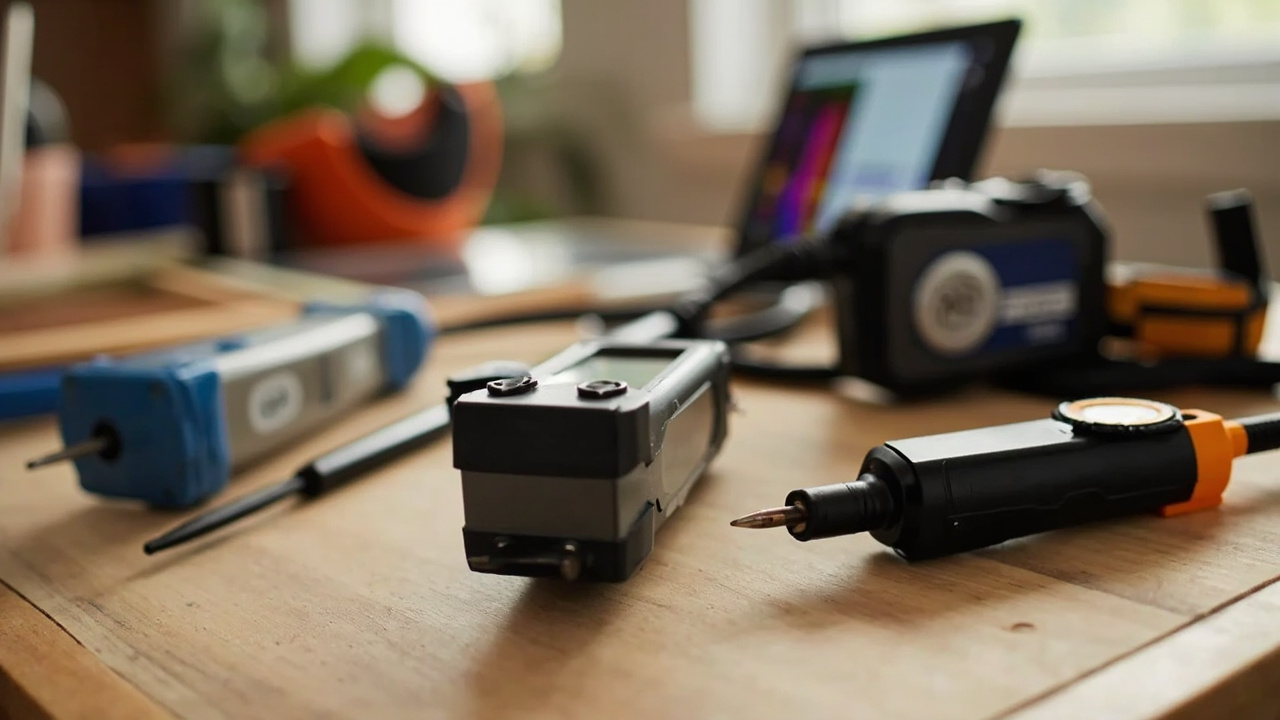
These are the flat-pad meters you see technicians press against walls without pins. They use electrical capacitance to read moisture content down to three or four inches deep without penetrating the surface. They are a standard part of the verification protocol before a technician signs off on a structure as dry.
Invasive Probe Testing for Structural Cavities
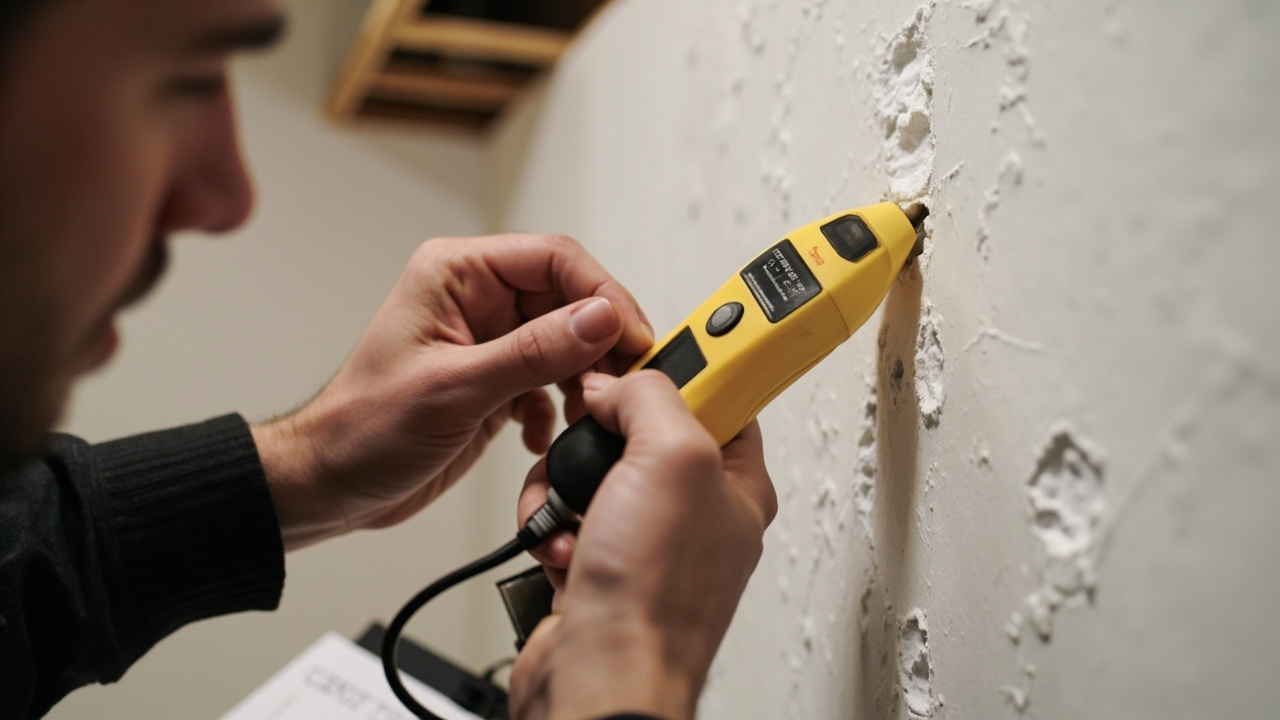
When readings suggest moisture inside a wall cavity, technicians drill a small access hole and insert a probe directly into the framing space. This gives an exact moisture content reading for the wood framing itself. Wood framing is considered dry at 19 percent or below. Above that, fungal growth is a matter of time, not possibility.
The Detroit-Specific Problems That Make This Harder
Water damage in the Detroit metro area presents challenges you do not find in Phoenix or Atlanta. Three factors make professional detection especially important here.
Hydrostatic Pressure in Wayne County Basements
Much of Wayne County sits on clay-heavy soil with a relatively high water table. During spring snowmelt or heavy rain events, hydrostatic pressure pushes water through basement walls and floor slabs at rates that can look like active seepage even days after rain stops. The moisture source is not inside the house. It is the ground itself, slowly pushing through.
A consumer meter on a basement wall might give you a surface reading of dry when the block or poured concrete wall is still absorbing ground moisture from the outside face. Professional moisture mapping tracks the gradient from exterior to interior and tells you whether active mitigation is still needed.
If you have dealt with a flooded basement in this area before, you know this situation well. Our detailed guide on flooded basement cleanup in Grosse Pointe covers why thorough drying verification matters so much in older lakefront properties.
Ice Dams and Hidden Winter Water Intrusion
Ice dams form when heat escapes through a roof, melts snow at the ridge, and that melt water refreezes at the cold eaves. The water backing up behind the ice dam finds its way under shingles and into the wall assembly. By the time it shows up as a water stain on a ceiling or wall, it may have been saturating the attic framing and wall top plates for weeks.
Detroit winters routinely produce the conditions for ice dam formation. A homeowner who spots a stain in February, touches the wall, finds it dry in March (because it dried slowly), and calls it resolved has potentially missed weeks of concealed saturation. Thermal imaging during and after a melt event is the only reliable way to know how far the water traveled.
For homes dealing with burst pipes during those same winter events, the damage pathway is equally hidden. Read more about what full remediation looks like in fixing the mess after a frozen pipe bursts in your Detroit home.
Plaster and Lathe Construction
A significant portion of Detroit’s residential housing stock, particularly in neighborhoods like Woodbridge, Boston-Edison, and Palmer Park, features original plaster over wood lathe construction. Plaster has a much lower permeability rating than modern drywall. It dries slowly and unevenly. A surface reading on a plaster wall can appear dry while the wood lathe behind it remains wet enough to support mold growth for months.
What Happens When You Miss 10 to 15 Percent of the Moisture
This is not a theoretical risk. It is the most common way water damage becomes a catastrophic and expensive problem.
- Mold colonies can establish in wall cavities within 24 to 72 hours at moisture levels above threshold and temperatures above 40 degrees Fahrenheit.
- Subfloor delamination begins when OSB or plywood subfloor panels remain wet. The glue fails, the layers separate, and the floor becomes spongy and structurally compromised. This requires full subfloor replacement, not just drying.
- Structural cavity drying failures lead to wood rot in framing members. In older homes with original Douglas fir framing, this can compromise load-bearing walls.
- Insurance carriers reviewing a claim for secondary damage, meaning mold or rot found months after the original event, frequently deny coverage when they determine that proper drying verification was not performed. They call it negligent follow-through, and they are not wrong.
Michigan homeowners dealing with sewage-related flooding face an even higher risk tier. Category 3 (black) water contamination carries biological hazards that require both moisture elimination and disinfection. The stakes for missed moisture in those situations are higher. Our guide on sewage backup cleanup in Detroit covers what that full process involves.
Comparing the Risk Profiles of DIY vs. Professional Moisture Detection
| Scenario | DIY Detection Outcome | Professional Detection Outcome |
|---|---|---|
| Small surface leak, caught within 2 hours | Low risk. Surface dry and structural damage unlikely if dried fast. | Confirmation that no cavity saturation occurred. Clean documentation. |
| Pipe burst in wall, water ran overnight | High risk. Surface dries first, wall framing stays wet. Mold likely. | Full thermal scan identifies all affected areas. Drying equipment placed correctly. Mold prevented. |
| Basement flood, 2 to 4 inches of water | Very high risk. Subfloor, wall bases, and framing stay wet after surface dries. | Moisture mapping confirms complete drying before sign-off. Insurance documentation provided. |
| Ice dam water intrusion over several weeks | Extremely high risk. Damage is largely invisible until mold or rot is advanced. | Infrared scan traces full moisture pathway from roof penetration to lowest affected point. |
| Sewage backup, Category 3 water | Dangerous. No way to confirm biological contaminant removal without lab testing. | Full remediation protocol, clearance testing, and documentation for insurer and health department. |
When a Consumer Meter Is Actually Fine
Honesty matters here. If you have a very small leak, a single cup of water spilled in a cabinet, or condensation on a window sill that you caught immediately, a consumer pin meter used on the surface material is a reasonable confirmation tool. These are surface events with no structural exposure.
The moment water has been present for more than a few hours, has any possibility of reaching framing or subfloor, or involves more than a few gallons, a consumer meter is no longer adequate. The cost of professional verification is a fraction of the cost of mold remediation. If mold does develop, the remediation process for a home in Royal Oak or Dearborn Heights involves containment, HEPA vacuuming, antimicrobial treatment, and possible structural material removal. That process is detailed in our article on how to remove mold safely from your Royal Oak home.
What Professional Moisture Documentation Means for Your Insurance Claim
Most Michigan homeowners do not know that insurance carriers increasingly require documented moisture readings as part of a valid water damage claim. A verbal report from a homeowner saying the walls feel dry is not documentation. A timestamped digital moisture map produced by a certified technician is.
IICRC-certified technicians produce a moisture baseline report on day one of mitigation and a clearance report when drying is complete. These documents show the insurer that the work was done to the S500 standard, which is the professional benchmark for water damage restoration. Without this documentation, secondary damage claims are difficult to approve and easy to deny.
Homeowners in Dearborn dealing with basement flooding are often surprised by how much the professional documentation process affects their claim outcome. The full picture of what that process looks like is covered in our guide on professional cleanup for flooded basements in Dearborn.
Getting a Professional Moisture Assessment in the Detroit Metro Area
If you have had any water event in your home, including a slow leak you found after the fact, a storm backup, or a pipe failure, the right first step is a professional moisture assessment using thermal imaging and calibrated instrumentation.
Do not wait for a musty smell or visible discoloration. Those are signs that mold is already established, not early warnings. The window for effective prevention is the first 48 to 72 hours after water exposure.
An IICRC-certified technician can give you an accurate moisture map of your affected areas, tell you exactly what is wet and at what depth, and build the documentation your insurer needs. That information is worth far more than a surface reading from a tool that cannot see inside your walls.
If you are dealing with water damage right now in the Detroit metro area, Wayne County, or anywhere in Southeast Michigan, call a certified restoration company before you make any assumptions about what is dry and what is not. Your walls may feel fine. That does not mean they are.
{
“@context”: “https://schema.org”,
“@type”: “BlogPosting”,
“headline”: “Why Professional Moisture Meters Beat the Touch Test When Your Detroit Walls Are Wet”,
“description”: “Detroit homeowners: learn why professional moisture detection tools catch hidden water damage that a DIY touch test or cheap meter will miss every time.”,
“wordCount”: 2201,
“datePublished”: “2026-03-23T08:22:00.000Z”,
“dateModified”: “2026-03-23T08:22:00.000Z”,
“inLanguage”: “en-US”,
“mainEntityOfPage”: {
“@type”: “WebPage”,
“@id”: “https://ironwoodwaterdamagerestorationdetroit.com”
},
“publisher”: {
“@type”: “LocalBusiness”,
“name”: “Ironwood Water Damage Restoration Detroit”,
“url”: “https://ironwoodwaterdamagerestorationdetroit.com”
},
“author”: {
“@type”: “Organization”,
“name”: “Ironwood Water Damage Restoration Detroit”,
“url”: “https://ironwoodwaterdamagerestorationdetroit.com”
},
“image”: {
“@type”: “ImageObject”,
“url”: “https://ironwoodwaterdamagerestorationdetroit.com/wp-content/uploads/2026/03/why-professional-moisture-meters-are-better-than-a-1.jpg”
}
}
{
“@context”: “https://schema.org”,
“@type”: “LocalBusiness”,
“name”: “Ironwood Water Damage Restoration Detroit”,
“url”: “https://ironwoodwaterdamagerestorationdetroit.com”,
“address”: {
“@type”: “PostalAddress”,
“addressLocality”: “Detroit”
},
“areaServed”: {
“@type”: “City”,
“name”: “Detroit”
}
}
{
“@context”: “https://schema.org”,
“@type”: “BreadcrumbList”,
“itemListElement”: [
{
“@type”: “ListItem”,
“position”: 1,
“name”: “Home”,
“item”: “https://ironwoodwaterdamagerestorationdetroit.com”
},
{
“@type”: “ListItem”,
“position”: 2,
“name”: “Blog”,
“item”: “https://ironwoodwaterdamagerestorationdetroit.com/blog”
},
{
“@type”: “ListItem”,
“position”: 3,
“name”: “Why Professional Moisture Meters Beat the Touch Test When Your Detroit Walls Are Wet”
}
]
}
{
“@context”: “https://schema.org”,
“@type”: “Service”,
“serviceType”: “Water Damage Restoration”,
“provider”: {
“@type”: “LocalBusiness”,
“name”: “Ironwood Water Damage Restoration Detroit”,
“url”: “https://ironwoodwaterdamagerestorationdetroit.com”
},
“areaServed”: {
“@type”: “City”,
“name”: “Detroit”
},
“description”: “Detroit homeowners: learn why professional moisture detection tools catch hidden water damage that a DIY touch test or cheap meter will miss every time.”
}