Why the parging on your Dearborn basement walls is flaking off and what it means for leaks
White powdery patches on your basement walls. Chunks of concrete crumbling in your hands. If you’re seeing these signs in your Dearborn home, you’re not just dealing with cosmetic damage. You’re watching your basement’s first line of defense fail against Michigan’s relentless moisture. Michigan Residential Code.
Dearborn’s older brick and block foundation homes built before the 1980s often have a thin mortar coating called parging. When this protective layer starts flaking off, it’s telling you something important: water is finding its way through your foundation walls. The freeze-thaw cycles we experience along the Rouge River corridor accelerate this deterioration, turning small cracks into major water entry points. Water Damage Restoration Livonia.
This isn’t just about appearance. Flaking parging means your basement walls are losing their waterproofing barrier. What starts as a few loose chunks can quickly become active leaks during our spring rains or winter thaws. The question isn’t if water will get in—it’s when. Flooded Basement Cleanup in Grosse Pointe Done Fast and Done Right.
What exactly is parging and why does it fail?
Parging is a thin coat of mortar applied to the exterior of foundation walls. Think of it as the skin on your basement’s bones. It’s designed to seal small imperfections and provide a smooth surface for waterproofing membranes. When parging fails, you’re seeing the first visible sign of moisture intrusion.
Efflorescence vs. Spalling: Know the difference. Efflorescence shows up as white, chalky deposits—mineral salts left behind when water evaporates. It’s ugly but not structurally threatening. Spalling is when actual chunks of concrete break away. That’s structural damage requiring immediate attention.
Common failure patterns in Dearborn homes include:
- Crazing: Fine hairline cracks that spiderweb across the surface
- Scaling: Shallow flaking that removes only the surface layer
- Pitting: Small, deep holes that weaken the wall’s integrity
- Large-scale delamination: Sections peeling away like sunburned skin
Call (313) 572-5559 today to schedule your inspection before the next storm hits.
Why Dearborn basements are particularly vulnerable
Dearborn sits in a unique geological zone where heavy clay soils meet the Rouge River watershed. This combination creates perfect conditions for basement moisture problems. The clay retains water like a sponge, keeping your foundation in constant contact with moisture for weeks after rain. Fixing the Mess After a Frozen Pipe Bursts in Your Detroit Home.
Local soil conditions matter. Wayne County’s clay-heavy soil expands when wet and contracts when dry. This constant movement puts pressure on foundation walls—what engineers call hydrostatic pressure. Over decades, this pressure forces water through the tiniest cracks, causing parging to fail from the inside out.
Climate impact is severe. The Michigan freeze-thaw cycle means water trapped in small cracks expands when it freezes. Each winter cycle widens these cracks slightly. After 20-30 Michigan winters, what started as microscopic flaws become channels for water entry.
Age of construction plays a role. Many Dearborn homes in areas like West Dearborn and the original village were built between 1920-1960. The parging materials and application methods from that era weren’t designed for today’s more intense rainfall patterns.
Table: Common parging failure patterns and their severity
| Failure Pattern |
Visual Appearance |
Water Risk Level |
Repair Urgency |
| Crazing |
Fine hairline cracks |
Low |
6-12 months |
| Efflorescence |
White powdery deposits |
Medium |
3-6 months |
| Scaling |
Shallow flaking patches |
High |
1-3 months |
| Spalling |
Deep chunks missing |
Critical |
Immediate |
The hidden dangers of ignoring flaking parging
Water doesn’t just damage concrete. It creates a cascade of problems that compound over time. What starts as cosmetic flaking becomes a structural and health hazard.
Mold growth begins within 24-48 hours of water contact. Once moisture penetrates behind flaking parging, it creates the perfect dark, damp environment for mold spores to multiply. The EPA reports that indoor mold exposure can trigger respiratory issues, especially in children and elderly residents. EPA mold information.
Structural integrity declines gradually but steadily. Each winter, expanding ice widens foundation cracks. What might have been a $500 repair in year one becomes a $5,000 structural repair by year ten. The Michigan Residential Code Section R404.1 requires foundations to withstand specific soil pressures—compromised parging reduces this capacity.
Property value takes a hit. Home inspectors flag active water damage as a major concern. Buyers often demand price reductions of 5-10% for visible basement moisture issues, or walk away entirely from the purchase.
Energy efficiency plummets. Water-damaged basement walls lose their insulating properties. Your HVAC system works harder, increasing utility bills by 15-25% during extreme weather months.
Table: Cost progression of untreated parging failure
| Timeframe |
Damage Level |
Repair Cost Range |
Additional Issues |
| 0-6 months |
Cosmetic |
$300-$800 |
None |
| 6-24 months |
Active moisture |
$1,500-$3,500 |
Early mold risk |
| 2-5 years |
Structural concerns |
$4,000-$8,000 |
Mold confirmed |
| 5+ years |
Foundation compromise |
$10,000+ |
Structural repairs needed |
Professional solutions for Dearborn basement walls
DIY patching rarely solves the underlying problem. Professional remediation addresses both symptoms and causes. Here’s what effective repair looks like in Dearborn’s specific conditions. Professional Cleanup for Flooded Basements in Dearborn (What to Expect and Why It Matters).
Exterior waterproofing is the gold standard. This involves excavating around your foundation, applying new waterproofing membrane, and installing proper drainage. The Michigan freeze-thaw cycle demands materials rated for extreme temperature swings—standard products fail within 3-5 years here.
Interior drainage systems capture water before it enters living spaces. A properly installed French drain with sump pump can handle Wayne County’s heaviest rainfall events. The system needs to account for our high clay content soil, which drains much slower than sandy soils.
Crack injection seals active leaks from the inside. Polyurethane foam expands to fill cracks completely, even those with active water flow. This method works well for hairline to 1/4-inch cracks common in Dearborn’s older foundations.
Vapor barrier installation prevents moisture from entering basement air. In Dearborn’s humid summers, a 10-mil vapor barrier can reduce basement humidity by 30-40%, making the space more comfortable and preventing mold growth.
Table: Repair method comparison for Dearborn conditions
| Method |
Best For |
Lifespan |
Cost Range |
Disruption Level |
| Exterior waterproofing |
Severe, active leaks |
15-20 years |
$8,000-$15,000 |
High |
| Interior French drain |
Chronic seepage |
10-15 years |
$4,000-$8,000 |
Medium |
| Crack injection |
Specific cracks |
5-10 years |
$500-$1,500 |
Low |
| Vapor barrier |
Humidity control |
10-15 years |
$1,500-$3,000 |
Low |
Why waterproof paint is just a band-aid
Home improvement stores sell waterproof paint that promises to seal your basement walls. Here’s why it fails in Dearborn’s conditions: The paint can’t bridge existing cracks. It peels when trapped moisture tries to escape. It provides zero structural reinforcement.
Real waterproofing requires addressing the source. That means managing water outside your foundation before it reaches your walls. Paint might buy you 6-12 months of appearance improvement, but it won’t stop the underlying deterioration.
The science is straightforward. Water pressure against your foundation—called hydrostatic pressure—can reach 30-40 pounds per square foot during heavy rains. No paint coating can withstand that pressure long-term. Professional systems redirect this water instead of trying to block it.
Cost comparison tells the story. Waterproof paint: $100-200 for materials, 1-2 days labor. Professional exterior waterproofing: $8,000-15,000, 3-5 days. But the paint solution often leads to $20,000+ in damage within 2-3 years when water finds new entry points.
Diagnostic steps before any repair
Before spending money on repairs, you need to understand exactly what’s happening. Professional diagnosis prevents wasting money on the wrong solution.
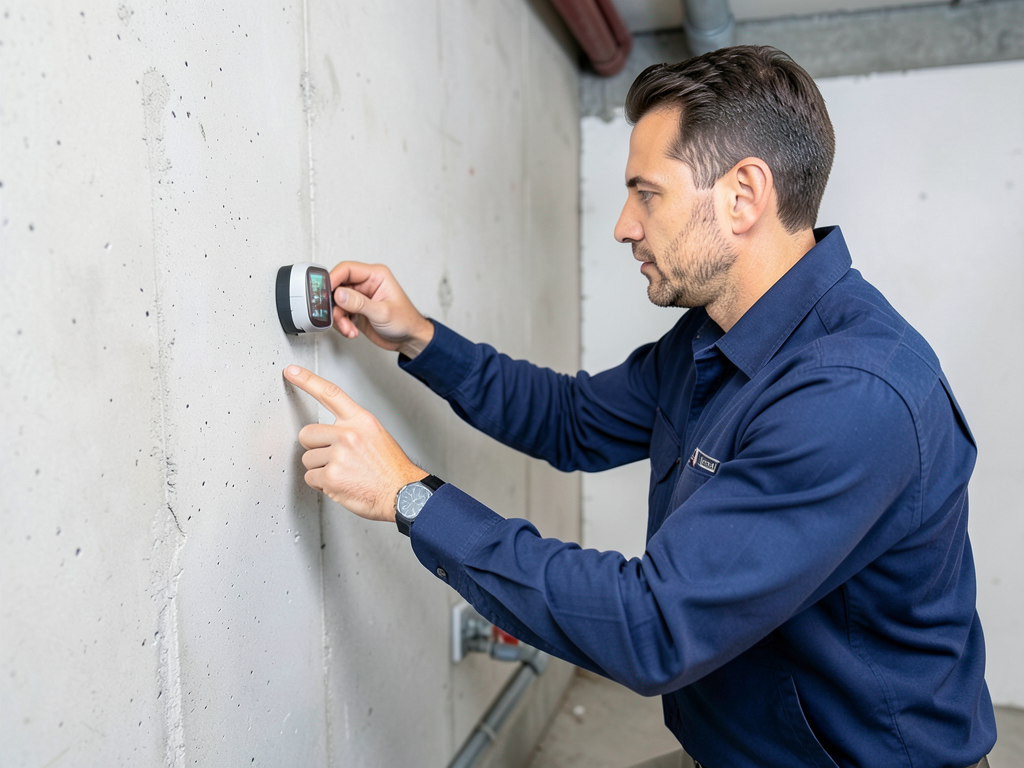
Moisture meter testing reveals water content at different depths. Readings above 18% indicate active moisture problems. In Dearborn’s clay soils, surface readings can be misleading—you need to test several inches into the wall.
Visual inspection should check for these specific signs in Dearborn homes: horizontal cracks (often from soil pressure), stair-step cracks in block foundations (settling issues), and efflorescence patterns (water entry points).
Hygrometer readings measure basement air moisture. Levels above 60% indicate conditions ripe for mold growth. Dearborn’s proximity to the Rouge River and Lake Erie contributes to our higher ambient humidity.
Exterior grading assessment is critical. Soil should slope away from your foundation at 1 inch per foot for at least 6 feet. Many Dearborn homes have settled over decades, creating negative grading that directs water toward foundations.
Div class=”how-to-steps” data-name=”How to assess basement moisture problems”>
- Visual inspection
Check walls for flaking, staining, or mold. Note where damage appears heaviest.
- Moisture testing
Use a moisture meter at multiple wall locations. Document readings above 18%.
- Humidity monitoring
Place a hygrometer in your basement for 24-48 hours. Record peak levels.
- Exterior evaluation
Check grading, downspouts, and drainage patterns around your home.
- Professional assessment
Document findings and get a certified inspector’s opinion.
Prevention strategies for Dearborn homeowners
Once you’ve addressed active problems, prevention becomes your best investment. These strategies work specifically for Dearborn’s climate and soil conditions.
Gutter maintenance prevents 80% of basement water issues. Clean gutters twice yearly—spring and fall. Ensure downspouts extend at least 6 feet from your foundation. In Dearborn’s heavy clay soil, water needs maximum distance to percolate away safely. How to Remove Mold Safely from Your Royal Oak Home.
Grading improvements cost little but prevent major damage. Add clean fill dirt around your foundation to create positive slope. Compact it properly so it doesn’t wash away during our spring rains.
Sump pump maintenance is non-negotiable in Dearborn. Test your pump monthly during wet seasons. Consider a battery backup system—power outages during storms are when you need pumping most. The Detroit area experiences 5-10 significant storm-related outages annually.
Foundation plantings need strategic placement. Keep shrubs at least 2 feet from foundation walls. Roots can create pathways for water, and dense plantings trap moisture against walls.
Seasonal inspections catch problems early. Check your basement walls quarterly, paying special attention after spring thaw and fall rains—when hydrostatic pressure peaks in our region.
When to call a professional immediately
Some basement moisture signs demand immediate professional attention. Don’t wait for the next rain if you notice these warning signs.
Active water flow during dry weather indicates a high-pressure leak that will worsen quickly. This often appears as a steady drip or small stream from foundation walls.
Horizontal cracks wider than 1/8 inch suggest soil pressure exceeding your foundation’s design capacity. This is common in Dearborn’s clay soils after heavy rains.
Musty odors combined with visible mold growth mean moisture has been present long enough for significant biological growth. The CDC recommends professional remediation for areas over 10 square feet.
Foundation movement—sticking doors, sloping floors, or visible wall bowing—indicates structural compromise requiring immediate structural engineering assessment.
Multiple failure signs appearing simultaneously (flaking, staining, mold, cracks) suggest system-wide failure rather than isolated issues.
Table: Emergency vs. non-emergency moisture signs
| Sign |
Emergency? (Yes/No) |
Risk Level |
Recommended Action |
| Active water flow |
Yes |
Critical |
Call immediately |
| Horizontal cracks |
Yes |
High |
Professional assessment within 24-48 hours |
| Minor flaking |
No |
Low |
Schedule inspection within 30 days |
| Mold spots |
Maybe |
Medium |
Assess size; under 10 sq ft may be DIY |
Local building code considerations
Dearborn and Wayne County follow the Michigan Residential Code, which has specific requirements for basement waterproofing and drainage. Understanding these helps ensure your repairs meet local standards.
Foundation drainage requirements (Section R405) mandate perimeter drains for basements with soil moisture conditions likely to cause water problems. Dearborn’s clay soils fall into this category automatically.
Sump pump discharge regulations require water to exit at least 20 feet from the foundation and not create hazards on adjacent properties. Many Dearborn homes violate this during DIY repairs.
Moisture barrier requirements in Section R406.7 specify minimum standards for wall vapor barriers in basements. Post-2015 code updates increased requirements based on Michigan’s humidity patterns.
Permit requirements typically apply to any work affecting structural elements or major waterproofing systems. The City of Dearborn Building Department requires permits for most foundation repairs over $2,000.
Insurance considerations matter too. Standard homeowners policies often exclude groundwater intrusion damage. You may need separate flood insurance or specific endorsements for comprehensive coverage.
Cost factors specific to Dearborn
Several factors make Dearborn basement repairs unique in terms of cost and complexity.
Soil conditions drive excavation costs. Dearborn’s heavy clay requires specialized equipment and techniques. Clay excavation takes 30-50% longer than sandy soil, increasing labor costs.
Historic district regulations may apply if you’re near Dearborn’s original village or historic properties. These can restrict exterior work options and require additional approvals.
Utility proximity matters. Older Dearborn neighborhoods often have tightly spaced utilities underground. This increases survey and excavation costs to avoid damage.
Seasonal timing affects pricing. Foundation work in frozen ground (December-March) typically costs 15-25% more due to slower excavation and specialized equipment needs.
Accessibility challenges in established neighborhoods with mature landscaping can add $1,000-3,000 to exterior waterproofing projects. Removing and replacing landscaping is often necessary.
Frequently Asked Questions
How long does parging typically last in Michigan’s climate?
Quality parging in Michigan lasts 15-25 years under ideal conditions. In Dearborn’s clay soils with freeze-thaw cycles, expect 10-15 years before significant deterioration. Homes near the Rouge River corridor often see faster failure due to higher moisture exposure.
Can I repair flaking parging myself?
Minor cosmetic repair is possible for DIYers, but it won’t address underlying water problems. DIY patching typically fails within 1-2 years because it doesn’t manage the moisture causing the original damage. For anything beyond surface treatment, professional assessment is recommended.
Will my homeowner’s insurance cover parging repair?
Standard policies cover sudden, accidental damage but not gradual deterioration. Flaking parging from age or water intrusion is considered maintenance, not a covered peril. However, if damage results from a covered event like a burst pipe, related repairs might be covered.
How can I tell if moisture is coming through the wall vs. condensation?
Water entry through walls often leaves mineral deposits (efflorescence) and appears as staining that grows after rain. Condensation is uniform, appears on cooler surfaces, and worsens during humid weather. A moisture meter can definitively distinguish between the two patterns.
What’s the typical timeline for professional basement waterproofing?
Simple crack injection takes 1-2 days. Interior French drain installation requires 3-5 days. Complete exterior waterproofing with excavation takes 5-10 days, weather permitting. Most Dearborn projects face weather delays 1-2 days due to our variable spring and fall conditions.
Take action before small problems become major expenses
Flaking parging isn’t just an eyesore—it’s your basement’s warning signal. In Dearborn’s challenging soil and climate conditions, what starts as minor deterioration becomes major water damage within 12-24 months. The longer you wait, the more expensive and extensive the repairs become.
Professional assessment costs nothing but time and could save you thousands in prevented damage. Our team understands Dearborn’s specific challenges—from the clay soils of west Dearborn to the historic foundations near the original village. We don’t just patch symptoms; we solve underlying moisture problems.
Don’t let another Michigan winter cycle worsen your foundation problems. The freeze-thaw pattern that makes our summers beautiful destroys basement walls one season at a time.
Ready to protect your home? Call (313) 572-5559 today for a free Dearborn basement inspection. We’ll identify the exact cause of your parging failure and provide a permanent solution backed by our satisfaction guarantee. Your basement walls are trying to tell you something—make sure you’re listening.
Or pick up the phone and call (313) 572-5559 before the next storm hits. Every day you wait is another day water works its way deeper into your foundation.